Short Answer
The Night Battle of December 23, 1814, was a surprise American attack on British forces that had just landed at the Villeré Plantation, about nine miles below New Orleans, during the War of 1812. Under Major General Andrew Jackson, American troops struck at dusk in a chaotic, close-range engagement that, while tactically inconclusive, blunted the British advance and gave Jackson time to construct the defensive line that would become famous at the Battle of New Orleans on January 8, 1815.
Historical Context
By late 1814, Britain, having defeated Napoleon, turned full attention to the war with the United States. The British strategic plan for the Gulf Coast aimed at capturing New Orleans, a vital port controlling the Mississippi River and a repository for millions of dollars in cotton. Vice Admiral Sir Alexander Cochrane proposed the invasion, and after assembling a fleet in Jamaica, the British arrived off Lake Borgne in early December. On December 14, a British boat attack destroyed the American flotilla defending the lake, removing the naval obstacle to an approach from the east. Guided by Royal Navy Captain R. Spencer and Lieutenant John Peddie, who had disguised themselves as fishermen, the British discovered a route through Bayou Bienvenue to within a few miles of the Mississippi. The lack of shallow-draft boats forced the British to move in stages via Pea Island, and by December 23 the first brigade under Major General John Keane had reached the plantation of Major General Jacques Villeré. The British captured the plantation house and took several militia prisoners, establishing a foothold only a few hours’ march from New Orleans. Jackson, who had arrived in the city on December 1, was unaware of the landing until news came early in the afternoon; the threat was immediate and unopposed, with no significant American force between the British camp and the city.
What Happened
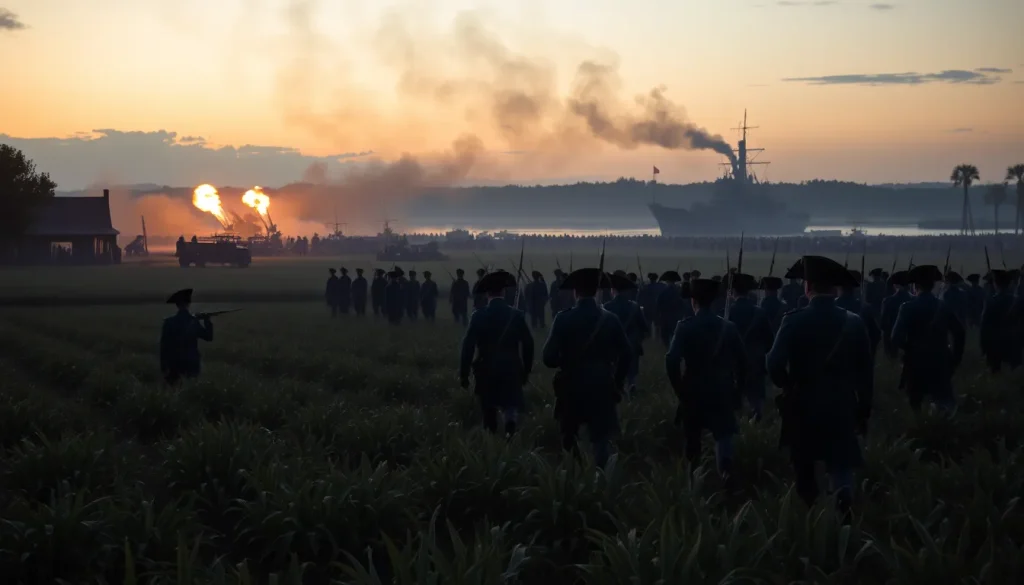
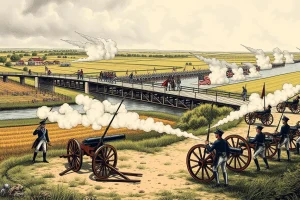
Upon learning of the British presence, Jackson made a rapid decision: attack that evening rather than await a besieging force. He dispatched orders to all available troops, including Tennessee militia under Generals William Carroll and John Coffee, Louisiana militia, regular infantry, and a naval detachment under Commodore Daniel Patterson. By late afternoon, American forces assembled in New Orleans and began moving down the river road. The plan was to launch a coordinated assault with the schooner USS Carolina, anchored in the Mississippi, opening a bombardment as the signal for the infantry to advance. Around 7:30 p.m. the Carolina opened fire on the British camp, and American troops advanced in three columns. The attack achieved complete surprise; the British were caught unprepared, many still bivouacked or preparing encampments. The fighting quickly became confused in the darkness and smoke, with musketry, artillery, and hand-to-hand combat. The 7th and 44th U.S. Infantry regiments, along with Carroll’s and Coffee’s Tennesseans, pushed into the British lines, while the Louisiana militia moved through the fields. However, the lack of light and the chaos of night combat led to instances of friendly fire, and American units became entangled. The British, though initially staggered, organized a defense and counterattacked with bayonets. After approximately three hours of fighting, Jackson, unsure of the enemy’s strength and wary of risking his force, ordered a withdrawal. By around 11 p.m., American troops fell back to the Rodriguez Canal, a pre-dug ditch on the Chalmette Plantation. The night battle had cost the Americans an estimated 24 killed and 115 wounded, while the British reported 46 killed and 145 wounded, though exact figures vary among sources.
Why It Matters
The Night Battle of December 23, 1814, was the first major land engagement of the Gulf Coast campaign. Its immediate effect was to halt the British advance just short of New Orleans, giving Jackson a critical day and a half to fortify the line at the Rodriguez Canal, later known as Line Jackson. Without this intervention, the British might have pressed directly into the city, which was unprepared for defense. The battle also demonstrated Jackson’s aggressive leadership and raised American morale. In the longer term, the defense built at Chalmette proved unbreakable on January 8, 1815, when a British frontal assault was repelled with heavy losses, leading to the withdrawal of British forces and the ratification of the Treaty of Ghent. Historians generally agree that Jackson’s decision to attack at night was strategically essential; it converted a vulnerable situation into a fighting chance. Some have debated whether the British might have captured New Orleans before Jackson could prepare, arguing that Keane’s caution—partly influenced by prisoners’ exaggerated claims of American strength—was a critical factor. The night battle thus stands as a pivotal moment in the wider Battle of New Orleans campaign.
Prelude
In the weeks before the battle, the British had assembled a formidable expeditionary force, including veterans of the Peninsular War. After the American gunboat loss at Lake Borgne, the British faced the logistical challenge of moving troops from the fleet to the mainland. They used open boats to ferry men and supplies from Pea Island to the mouth of Bayou Bienvenue, a journey of several days that exhausted many troops. The landing at the Villeré Plantation was unopposed, and the British captured a small American militia detachment. Jackson’s first intelligence came from Colonel Pierre Denis de La Ronde, who suspected the landing, and from the escaped René Philippe Gabriel Villeré, who evaded capture and reached the city. Jackson also dispatched scouts, and the news was confirmed just after 1 p.m. on December 23.
Forces and Commanders
American forces under Major General Andrew Jackson included about 2,200 men: the 7th and 44th U.S. Infantry regiments, the Tennessee militia under Generals William Carroll and John Coffee, the Orleans Battalion of Uniform Militia under Major J. B. Plauché, the Louisiana Militia under Governor William C. C. Claiborne, and a detachment of U.S. Marines and sailors. The schooner USS Carolina provided naval gunfire support. The British force, commanded by Major General John Keane, consisted of roughly 1,600–2,000 men from the 4th, 21st, 44th, 85th, and 93rd Regiments, plus rocket troops and sappers, organized as the Light Brigade under Colonel William Thornton and an ad hoc brigade. Admiral Cochrane was present, but Keane held field command until the arrival of Sir Edward Pakenham on December 25.
Battlefield and Map Context
The fight took place on and around the Villeré Plantation, a sugar plantation located on the east bank of the Mississippi River, about nine miles downriver from New Orleans. The area featured open fields bordered by swamp and the river, with the plantation house serving as a focal point. A contemporary map by Arsène Lacarrière Latour, Jackson’s chief engineer, depicts the positions and the attack at 7 p.m. (Library of Congress). The map shows the British encampment near the river and American columns advancing from the north and east.
Battle Chronology
- Morning–midday: British land at Villeré plantation and capture the militia outpost.
- 1:30 p.m.: Jackson at headquarters receives confirmation of the British advance.
- Early afternoon: Orders are sent to all American units to assemble and march.
- ~4 p.m.: American troops gather and begin moving from New Orleans.
- 7:30 p.m.: USS Carolina opens fire as a signal, and American infantry launch the assault.
- 7:30–11 p.m.: Fierce night fighting; both sides suffer casualties in confused combat.
- ~11 p.m.: Jackson orders withdrawal to the Rodriguez Canal.
Casualties and Losses
Casualty figures for the night battle are often cited from American regimental returns. The most commonly cited numbers are American losses of 24 killed and 115 wounded, and British losses of 46 killed and 145 wounded. However, these figures are not universally agreed upon; British returns may have been higher because of the confusion and the effectiveness of the American artillery. Some sources list British casualties as high as 200–300. The disparity underscores the difficulty of accurate accounting in a night engagement.
Result
Militarily, the battle was a tactical draw—neither side achieved its immediate objectives. The Americans did not dislodge the British, and the British did not pursue. However, strategically, the results favored the Americans. Jackson’s attack delayed the British advance by at least a day, forced the British to halt and consolidate, and allowed Jackson to withdraw his army to a prepared defensive line. The night battle thus bought crucial time that proved decisive in the subsequent campaign.
Strategic Consequences
The night battle enabled Jackson to strengthen the Rodriguez Canal line, extending it from the river to a cypress swamp. When the British made a formal reconnaissance on December 28 and a full assault on January 8, 1815, they faced a fortified position that withstood their attacks. The defeat on January 8 led to the British withdrawal from Louisiana and contributed to the end of the war. In a broader context, the night battle set the tone for Jackson’s aggressive defense and boosted American national pride, with the January 8 victory celebrated for decades. Historians such as Robert Remini argue that had Jackson not attacked on December 23, the British might have taken New Orleans almost unopposed, potentially altering the war’s outcome.
Primary Accounts
Key contemporary records include the map prepared by Arsène Lacarrière Latour, who witnessed the battle and later published a history of the campaign. Latour’s map, held by the Library of Congress, depicts the troop positions and the attack. Andrew Jackson’s official report to the Secretary of War, dated December 27, 1814, provides an American command perspective, praising his troops and requesting reinforcements. British accounts include the letters and dispatches of Major General John Keane and Admiral Cochrane, though they are less accessible. The NPS Handbook for Jean Lafitte contains a detailed narrative based on primary documents. A notable participant account comes from Major Plauché, whose battalion fought in the night engagement. These sources generally agree on the sequence of events but differ in casualty estimates and the degree of success.
Battlefield Today
The site of the Night Battle of December 23, 1814, is now part of the Chalmette Battlefield, a unit of the Jean Lafitte National Historical Park and Preserve, administered by the National Park Service. The Villeré plantation house no longer stands, but a historical marker describes the event. The Chalmette Battlefield preserves the later defensive line and offers interpretive programs, including a self-guided tour that covers the December 23 skirmish. The battlefield is located in Chalmette, Louisiana, about six miles southeast of New Orleans.
Primary Sources
The most valuable primary source is the battlefield map created by Arsène Lacarrière Latour in 1814, available through the Library of Congress (catalog number 2012588020). This map provides a contemporary visual representation of the attack. Latour also wrote a detailed account in his Historical Memoir of the War in West Florida and Louisiana in 1814–15 (1816), which includes a narrative of the night battle. Andrew Jackson’s official report, sent from his headquarters on December 27, 1814, describes the engagement and the fortification of the line; it is available in The Papers of Andrew Jackson. The British perspective can be found in the dispatches of Major General Keane, published in the parliamentary papers, though these are less detailed. The NPS handbook by the National Park Service synthesizes these sources with archival research.
Further Reading
- Latour, Arsène Lacarrière. Historical Memoir of the War in West Florida and Louisiana in 1814–15. 1816.
- Remini, Robert V. Andrew Jackson: The Course of American Empire, 1767–1821. Johns Hopkins University Press, 1977.
- Owsley, Frank Lawrence. Struggle for the Gulf Borderlands: The Creek War and the Battle of New Orleans, 1812–1815. University of Florida Press, 1981.
- National Park Service. Jean Lafitte: Historical Handbook, No. 29.
- American Battlefield Trust. “Battle of New Orleans: The Last Battle of the War of 1812.” Accessed 2025.
References
- American Battlefield Trust, “Battle of New Orleans: The Last Battle of the War of 1812,” https://www.battlefields.org/learn/articles/battle-new-orleans-last-battle-war-1812.
- Arsène Lacarrière Latour, “Plan of the attack made by Major Gen. Jackson on a division of the British army commanded by Major Gen J. Keane on the 23rd December 1814 at 7 o’clock at night,” Library of Congress, https://www.loc.gov/item/2012588020/.
- National Park Service, “NPS Historical Handbook: Jean Lafitte,” https://npshistory.com/handbooks/historical/29/hh29h.htm.
- “Battle of New Orleans,” Wikipedia, https://en.wikipedia.org/wiki/Battle_of_New_Orleans.
- Dallas Bogan, “Volunteer State Soldiers Played Large Role in War of 1812’s Battle for New Orleans,” LaFollette Press, reprinted at https://www.tngenweb.org/campbell/hist-bogan/NewOrleans.html.
FAQ
Why did Andrew Jackson attack at night on December 23, 1814?
Jackson learned that a British force had landed almost unopposed just nine miles from New Orleans. He decided to attack immediately to surprise the exhausted British, buy time, and prevent them from advancing before the city could be fortified.
Who commanded the British forces in the Night Battle?
Major General John Keane commanded the British brigade on the day of the battle. Admiral Cochrane was present, but Keane had field command until Sir Edward Pakenham arrived on December 25.
What was the strategic significance of the Night Battle?
The engagement delayed the British advance, allowing Jackson to build the Rodriguez Canal defensive line, which held against the British attack on January 8, 1815, and led to the eventual British withdrawal from Louisiana.


Leave a Reply