
Short Answer
The Battle of Villéré’s Plantation (also known as the Night Battle of December 23, or the Battle of Villiere Canal) was a sharp engagement fought on December 23–24, 1814, on the east bank of the Mississippi River approximately nine miles below New Orleans, Louisiana. It occurred when Maj. Gen. Andrew Jackson attacked a British army that had just occupied the plantation of Jacques Philippe Villeré after advancing from Bayou Bienvenue. The battle, part of the larger Battle of New Orleans campaign, succeeded in checking the British advance and bought crucial time for the American fortification of the city.
Historical Context
By late 1814, the War of 1812 had reached a critical phase. After the British burning of Washington in August and the failed American invasion of Canada, Britain sought to seize New Orleans to control the Mississippi River and potentially reclaim the Louisiana Purchase. Vice Admiral Sir Alexander Cochrane, commanding British naval forces in the Gulf, advocated a campaign against the city, believing it would weaken American resolve. On December 14, 1814, British ships and sailors won the Battle of Lake Borgne, capturing the American gunboat flotilla and securing access to the shallow lakes east of New Orleans. With the lakes cleared, British troops under Maj. Gen. John Keane began landing at Pea Island, then moved to the mouth of Bayou Bienvenue, a waterway that led through the swamps to within a few miles of the Mississippi River.
What Happened
On December 22, 1814, British advance units captured the small American post at the mouth of Bayou Bienvenue, and by the morning of December 23 they had reached the Villeré plantation. They rushed the plantation house, capturing a militia detachment of about thirty men under Maj. Gabriel Villeré, the son of Jacques Philippe Villeré. Major Villeré, however, escaped by leaping from a window and made his way through the swamp to warn Jackson. Meanwhile, Jackson received additional reports of the British presence. Deciding to strike immediately, Jackson assembled a force of about 2,100 men, including regulars, militia, free men of color, and Baratarian pirates led by Jean Lafitte. As night fell, the American schooner USS Carolina, under Commodore Daniel Patterson, moved into position and opened fire on the British camp. At approximately 7:30 PM, the Carolina fired, signaling the start of the American attack. Jackson’s troops advanced in the darkness, but confusion and a lack of visibility led to friendly-fire incidents. The battle continued for several hours, with both sides taking casualties, before Jackson, concerned about a possible British counterattack, ordered a withdrawal under cover of darkness. The British, though shaken, remained in place but did not advance the next day; instead, they fortified their position and made the Villeré plantation their headquarters for the next month.
Why It Matters
The Battle of Villéré’s Plantation was a critical turning point in the New Orleans campaign. Although tactically inconclusive, it prevented the British from making an immediate, unopposed march on New Orleans. Jackson’s aggressive night attack bought precious time for his engineers, led by Maj. Latour, to construct a formidable defensive line along the Rodriguez Canal, about four miles closer to the city. The British delay also allowed reinforcements to reach Jackson. The engagement demonstrated Jackson’s willingness to take the initiative and had a profound effect on the morale of the American defenders and the civilian population. In historical memory, the battle is often overshadowed by the final Battle of New Orleans on January 8, 1815, but it is recognized as the moment the British advance was first halted.
Prelude
Following the British victory at Lake Borgne, Vice Admiral Cochrane and Maj. Gen. Keane faced the challenge of moving troops to the Mississippi River. Captain Spencer and Lieutenant Peddie of the Quartermaster Department had reconnoitered Bayou Bienvenue during December 22, finding it unguarded. The British landing force was divided into two brigades: the Light Brigade commanded by Col. William Thornton (85th and 95th Regiments, rocket troops, sappers, and miners) and the Second Brigade under Col. Arthur Brooke (21st, 44th, and 93rd Regiments). On the night of December 22, they crossed Lake Borgne in shallow-draft boats, enduring harsh weather and exposure. By the morning of December 23, the leading elements reached the Villeré plantation, where they captured the militia post and established a foothold on the dry ground near the river.
Forces and Commanders
American Forces: Brevet Maj. Gen. Andrew Jackson commanded the American forces. His army consisted of about 2,100 men, including the 7th U.S. Infantry, Tennessee and Kentucky militia, Louisiana militia, the Orleans Battalion of Uniform Militia Companies led by Maj. Jean Baptiste Plauché, free men of color from Santo Domingo led by Maj. Daquin, and a contingent of Baratarian pirates under Jean Lafitte. The USS Carolina, a 14-gun schooner, was commanded by Commodore Daniel Patterson and assisted in the attack.
British Forces: The British troops initially ashore were approximately 1,600 men under Maj. Gen. John Keane, with Col. William Thornton leading the advance elements. This force included elite light infantry and the 85th Regiment, as well as rocket artillery. Rear elements remained at Pea Island or on ships.
Battlefield and Map Context
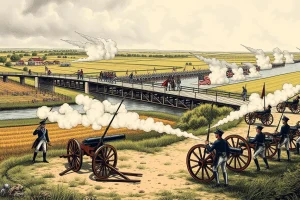
The battlefield centered on the Villeré plantation, located on the east bank of the Mississippi River in what is now St. Bernard Parish, Louisiana. The plantation house stood about nine miles southeast of New Orleans’ French Quarter. The terrain was open fields bordered by cypress swamps and the river, with the river road running along the levee. The Rodriguez Canal, which would later anchor the American defensive line, lay about four miles upriver. The site is now within the Chalmette National Historical Park, a few miles from the main battle monument.
Battle Chronology
On December 23, by 10:00 a.m., the British advance party had moved from Bayou Bienvenue and captured the Villeré house. Major Villeré escaped and reached Jackson’s headquarters on Royal Street around 1:00 p.m. Jackson immediately ordered a concentration of all available troops. By sunset, about 2,100 Americans had assembled on the grounds of the La Ronde plantation, concealed by an avenue of trees. The USS Carolina took position in the river to cover the attack. At 7:30 p.m., the Carolina opened fire, throwing the British camp into confusion. After about half an hour of bombardment, Jackson launched a frontal attack, supported by a simultaneous strike on the British flanks. The battle raged in darkness, with units losing cohesion; some Americans fired on one another. By approximately 10:30 p.m., Jackson ordered a withdrawal to avoid a possible British counterattack. The British, uncertain of American strength, did not pursue and instead began entrenching.
Casualties and Losses
Reported casualties vary by source. The American force suffered approximately 24 killed, 115 wounded, and 74 missing or captured. British casualties were estimated at 46 killed, 167 wounded, and 64 missing or captured. These figures are drawn from the detailed returns compiled after the battle and are broadly accepted by historians. The fighting also caused several friendly-fire deaths in the American ranks due to darkness and confusion.
Result
The battle is generally considered an American tactical success despite the withdrawal, as it achieved Jackson’s goal of checking the British advance, inflicting disproportionate losses, and shocking the British command. Strategically, the American attack forced Keane to wait for reinforcements and gave the Americans time to construct the defensive works that would prove decisive on January 8, 1815. The engagement is often described as a draw in immediate tactical terms but a significant operational victory for the United States.
Strategic Consequences
The immediate consequence was a halt to the British offensive. Keane, believing himself outnumbered (based on inflated prisoner reports), chose to await his full force, which included reinforcements under Major General Sir Edward Pakenham. This delay allowed Jackson’s men to dig the Rodriguez Line, fortify it with artillery, and bring in additional militia and regulars. The battle also established a psychological advantage, as the British became more cautious and the Americans gained confidence. Over the following weeks, the British conducted reconnaissances and skirmishes, but the January 8 battle would prove their only major assault. Thus, the Battle of Villéré’s Plantation set the stage for the decisive defeat of the British invasion.
Primary Accounts
Several first-hand accounts exist. Maj. Gabriel Villeré’s escape and report to Jackson is described in a letter from Jackson to Secretary of War James Monroe, dated December 24, 1814. American engineer A. L. Latour, who was present, published an official history of the campaign in 1816, including details of the night battle. British officers also left accounts: Lt. Gleig, an ensign in the 85th Regiment, wrote about the confusion of the night attack. The Carolina’s log and Patterson’s report provide naval perspectives. These sources are detailed but must be read critically, as they contain partisan views and errors.
Battlefield Today
The site of the Villeré plantation is now within the Chalmette National Historical Park, administered by the National Park Service. The park preserves a portion of the January 8 battlefield, including the Rodriguez Canal and the Chalmette Monument. The Villeré plantation house itself no longer stands, but a historical marker dedicated in 2018 commemorates the plantation’s role in the War of 1812. The marker is located at 2305 Highway 46, Meraux, Louisiana. The park offers interpretive programs and is a National Historic Landmark.
Primary Sources
The most valuable primary sources include:
- Letter from Andrew Jackson to James Monroe, December 24, 1814 – Jackson’s official report of the battle, describing his decision to attack and claiming a successful check on the enemy.
- Memoirs of Lt. George Gleig of the 85th Regiment – Gleig’s account gives a British enlisted man’s perspective on the confusion and hardships of the night.
- Report of Commodore Daniel Patterson – Details the USS Carolina’s fire support and its role in the battle.
- Historical Memoir of the War in West Florida and Louisiana, 1814-1815 by A.L. Latour (1816) – A detailed American account from the engineer who surveyed the battlefield.
Further Reading
- Latour, Arsène Lacarrière. Historical Memoir of the War in West Florida and Louisiana, 1814-1815. New Orleans, 1816.
- Pitch, Anthony S. The Burning of Washington: The British Invasion of 1814. Naval Institute Press, 2000.
- Remini, Robert V. The Battle of New Orleans. Penguin, 2001.
- Smith, Gene A. The British Navy in the War of 1812. University of Florida Press, 2010.
- National Park Service. Chalmette Battlefield Handbook. Government Printing Office, 1975.
References
- “Battle of New Orleans.” Wikipedia, The Free Encyclopedia, accessed 2026, https://en.wikipedia.org/wiki/Battle_of_Viller%C3%A9%27s_Plantation.
- “NPS Historical Handbook: Jean Lafitte – Chalmette.” National Park Service, accessed 2026, https://www.npshistory.com/handbooks/historical/29/hh29h.htm.
- “Plantation of Jacques Philippe Villere Historical Marker.” Historical Marker Database, accessed 2026, https://www.hmdb.org/m.asp?m=149145.
- “Villeré Plantation Receives Historical Marker.” The St. Bernard News, April 11, 2018, https://thestbernardnews.com/2018/04/11/villere-plantation-receives-historical-marker/.
- “Battle of Villiere Canal.” My War of 1812, accessed 2026, https://www.mywarof1812.com/battles/141223.html.
FAQ
What happened at the Battle of Villéré’s Plantation?
On the night of December 23, 1814, American forces under Andrew Jackson launched a surprise attack on a British force that had occupied the Villeré plantation. The attack, supported by the USS Carolina, caused hundreds of casualties and forced the British to halt their advance, giving Americans time to fortify New Orleans.
Why is the Battle of Villéré’s Plantation important?
The battle delayed the British advance by several weeks, allowing Andrew Jackson’s army to construct the defensive line along the Rodriguez Canal that proved decisive at the Battle of New Orleans on January 8, 1815.
Where was the Battle of Villéré’s Plantation fought?
The battle occurred at the Villeré plantation, located about nine miles downriver from New Orleans, in what is now St. Bernard Parish, Louisiana. The site is part of the Chalmette National Historical Park.


Leave a Reply