
Short Answer
The Bombardment of Fort McHenry (13–14 September 1814) was the naval phase of the British assault on Baltimore, Maryland, during the War of 1812. After landing troops at North Point, a British fleet under Vice-Admiral Alexander Cochrane subjected the star-shaped fort to a prolonged shelling from bomb vessels and a rocket ship. The fort’s defenders, commanded by Major George Armistead, withstood the attack, forcing the British to abandon their campaign against the city and inspiring Francis Scott Key’s poem that would become the United States national anthem.
Historical Context
Following the defeat of Napoleon in April 1814, Britain redirected veterans and naval forces to the Americas, escalating the war against the United States. A British army under Major General Robert Ross and a fleet under Vice-Admiral Cochrane captured Washington, D.C., on August 24, 1814, burning the capital. Baltimore, a vital commercial port and privateer haven, was the next target. The city’s defenses included an entrenched line on Hampstead Hill, but the critical point was Fort McHenry, guarding the entrance to the inner harbor. If the fort fell, British ships could sail into the harbor and support a land assault.
What Happened
On September 12, British troops landed at North Point and began advancing toward Baltimore. While skirmishing with American militia, General Ross was fatally shot; command passed to Colonel Arthur Brooke. The British land force then halted within sight of the American defensive line, awaiting naval support. That support required neutralizing Fort McHenry.
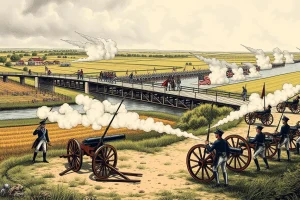
At dawn on September 13, Cochrane positioned his bomb vessels—HMS Terror, Volcano, Meteor, Devastation, and Aetna—and the rocket ship HMS Erebus about two miles from the fort. Beginning around 6:30 a.m., they launched an intense bombardment of high-angle mortar shells and Congreve rockets. The fort’s guns initially returned fire, but its cannons lacked the range to reach the British ships. The British maintained a relentless barrage for about twenty-five hours, firing an estimated 1,500 to 1,800 shells and rockets. The fort suffered modest structural damage, and American casualties were light—four killed and twenty-four wounded. A shell that struck the powder magazine’s roof failed to explode, preventing a catastrophe. During the night, a British attempt to send boats past the fort was repelled by American fire from Fort Covington and other positions.
At dawn on September 14, Armistead ordered the large garrison flag, which had been made by Mary Pickersgill and measured 30 by 42 feet, to be raised. The sight of the flag over the fort signaled that the defense had held. With the fort unsubdued and the land attack impractical without naval support, Brooke and Cochrane decided to withdraw. The British fleet departed, ending the Chesapeake campaign.
Why It Matters
The bombardment’s immediate military significance was that Baltimore remained in American hands, denying Britain a strategic prize and a blow to American morale. The failure at Baltimore, following the burning of Washington, helped shift the war’s momentum and contributed to the negotiations that led to the Treaty of Ghent in December 1814.
More importantly, the event became a powerful American symbol. Francis Scott Key, a lawyer who had been aboard a British truce ship during the bombardment, witnessed the fort’s flag still flying in the dawn’s early light. He wrote a poem, “Defence of Fort M’Henry,” later set to the tune “To Anacreon in Heaven” and renamed “The Star-Spangled Banner.” In 1931, it became the official national anthem of the United States. The resilience of the fort and the flag became central to American national identity.
Historians have also noted that the bombardment demonstrated the limitations of naval firepower against well-constructed fortifications, a lesson that remained relevant throughout the nineteenth century.
Prelude
Before the bombardment, the Baltimore defenses had been prepared over the preceding year. Fort McHenry, built in the late 1790s at Whetstone Point, controlled the approach to the inner harbor. In August 1814, Major Armistead requested a large American flag “to be seen by the enemy at a distance.” The British landing at North Point on September 12 began the land assault, and the naval bombardment was intended to open the harbor for the fleet. The Americans, expecting the attack, had strengthened the fort, deployed gun barges across the channel, sunk hulks to obstruct navigation, and added batteries on the Ferry Branch.
Forces and Commanders
United States: Fort McHenry’s garrison numbered about 1,000 men, including regular army artillery, Maryland militia, and U.S. Navy and flotilla personnel. Commanding officer was Major George Armistead of the U.S. Corps of Artillery. Auxiliary defenses included Fort Covington, Fort Lookout, and Battery Babcock to the west, and a battery at the Lazaretto to the east.
United Kingdom: The naval squadron under Vice-Admiral Alexander Cochrane comprised five bomb vessels (ships carrying 10-inch and 13-inch mortars), the rocket ship HMS Erebus, frigates, and smaller warships. The land force, initially under Major General Robert Ross and then Colonel Arthur Brooke, numbered roughly 5,000 men.
Battlefield and Map Context
Fort McHenry is located on Whetstone Point, a peninsula that separates the Patapsco River’s Ferry Branch (to the west) from the Northwest Branch (to the east), which leads directly to Baltimore’s inner harbor. The fort’s five bastions and water batteries commanded the channel. The British bomb vessels anchored in the Patapsco River to the south, approximately two miles from the fort, where they could lob shells over the walls while staying beyond the range of the fort’s guns. The shallow water prevented heavy frigates from closing, but the bomb vessels and rocket ship were sufficient for the bombardment.
Battle Chronology
- September 12: British troops land at North Point; Battle of North Point; General Ross mortally wounded; Colonel Brooke takes command.
- September 13, early morning: British fleet moves up the Patapsco; bomb vessels and rocket ship take position.
- 6:30 a.m.: HMS Terror fires the first shell; bombardment begins.
- 7:00 a.m.: Fort McHenry’s guns open fire but soon cease as British ships are out of range.
- Daylight: British bomb vessels fire continuously; fort returns fire intermittently.
- 2:00 p.m.: A bomb explodes over the fort, killing two men and wounding several; other shells strike the powder magazine but fail to ignite.
- Night: Cochrane stages a diversionary attack on forts west of McHenry; American shore batteries repel a boat attempt.
- September 14, dawn: The large garrison flag is raised; the British see the fort still holds. They cease fire and prepare to withdraw.
Casualties and Losses
American casualties at Fort McHenry were relatively light: four killed and twenty-four wounded, according to contemporary returns. British naval casualties are reported as negligible; at least one man was wounded, but the fleet suffered no ships lost and no reported deaths. The disparity reflects the inaccuracy of the high-angle mortar fire against earth and masonry defenses.
Result
The bombardment failed to reduce Fort McHenry or open the harbor to British ships. The British withdrew their naval and land forces, ending the attack on Baltimore. The outcome was a strategic victory for the United States, preserving a major port and boosting American morale.
Strategic Consequences
The failure at Baltimore marked the end of British offensive operations in the Chesapeake. It also influenced the peace negotiations at Ghent, where the British were already inclined to conclude the war due to the expense and the military deadlock in North America. The defense of Fort McHenry became a rallying point for American nationalism and provided a heroic counterpoint to the humiliation of Washington’s burning.
Primary Accounts
The most famous account is Francis Scott Key’s poem “Defence of Fort M’Henry,” composed from his observation during the bombardment. Key was aboard a British truce ship, having been briefly detained after securing the release of Dr. William Beanes. His poem, widely printed, described the flag “still there” after the attack. Other contemporary sources include Major George Armistead’s official report to the Secretary of War, the diary of British naval surgeon James Copland, and letters from participants. These accounts vary in detail but agree on the length and intensity of the bombardment and the fort’s successful defense.
Battlefield Today
Fort McHenry is now a national monument and historic shrine, administered by the National Park Service. The original star fort has been restored and includes the American flag that flies over the site. Visitors can see the barracks, powder magazine, and the location where the garrison flag was raised. The park also contains a visitor center with exhibits on the battle and the Star-Spangled Banner.
Primary Sources
- Major George Armistead’s report (September 24, 1814): Official American account of the bombardment, detailing the fort’s condition and casualties. It is held in the National Archives.
- Francis Scott Key’s poem (September 1814): Manuscript copy in the Library of Congress; the poem was published as a broadside and in newspapers.
- HMS Erebus logbook (National Archives, UK): Provides daily entries on the ship’s movements and firing during the bombardment.
- Letters of Vice-Admiral Alexander Cochrane (British Library): Cochrane’s correspondence describes the decision to withdraw.
- American Battlefield Trust and National Park Service interpretive materials summarize and contextualize these primary documents.
Further Reading
- Hickey, Donald R. The War of 1812: A Forgotten Conflict. University of Illinois Press, 1989.
- Lambert, Andrew. The Challenge: Britain Against America in the Naval War of 1812. Faber & Faber, 2012.
- Latimer, Jon. 1812: War with America. Harvard University Press, 2007.
- National Park Service, Fort McHenry National Monument and Historic Shrine, official website.
- American Battlefield Trust, “Fort McHenry Battle Facts and Summary.”
References
- “The Bombardment of Fort McHenry.” National Park Service, accessed 2023. https://www.nps.gov/fomc/learn/historyculture/the-bombardment-of-fort-mchenry.htm
- “Bombardment of Fort McHenry Part 1.” National Park Service. https://nps.gov/fomc/learn/historyculture/bombardment-of-fort-mchenry-pt-1.htm
- “Bombardment of Fort McHenry Part 2.” National Park Service. https://nps.gov/fomc/learn/historyculture/bombardment-of-fort-mchenry-pt-2.htm
- “Bombardment of Fort McHenry – War of 1812.” The War of 1812. https://thewarof1812.org/battles/bombardment-of-fort-mchenry/
- “Fort McHenry Battle Facts and Summary.” American Battlefield Trust. https://www.battlefields.org/learn/war-1812/battles/fort-mchenry
- Hickey, Donald R. The War of 1812: A Forgotten Conflict. University of Illinois Press, 1989.
- Lambert, Andrew. The Challenge: Britain Against America in the Naval War of 1812. Faber & Faber, 2012.
- Latimer, Jon. 1812: War with America. Harvard University Press, 2007.
FAQ
How long did British ships bombard Fort McHenry?
The bombardment lasted approximately 25 hours, from dawn on September 13 to dawn on September 14, 1814.
Who commanded the American forces at Fort McHenry?
Major George Armistead of the U.S. Corps of Artillery commanded the garrison of about 1,000 men.
What was the significance of the fort's large flag?
The large garrison flag, sewn by Mary Pickersgill, signaled that the fort had survived the night and inspired Francis Scott Key's poem.


Leave a Reply