Short Answer
The Battle of Bladensburg, fought on August 24, 1814, in Maryland, was a decisive British victory that cleared the way for the capture and burning of Washington, D.C., during the War of 1812. Despite holding a numerical advantage and a defensive position on high ground, American forces under Brigadier General William H. Winder were routed by a smaller, disciplined British army led by Major General Robert Ross. The defeat, famously ridiculed as “the Bladensburg Races,” became a symbol of American military unpreparedness and remains a subject of historical debate over its causes.
Historical Context
By 1814, the War of 1812 had reached a stalemate. The United States had failed to conquer Canada, and British naval dominance had enabled a destructive blockade of the American coast. With the defeat of Napoleon in April 1814, Britain was able to transfer veteran troops from the Peninsular War to North America. These hardened soldiers, many of whom had fought under Wellington, were far more experienced than the American regulars and militia that had previously contested the Canadian front. In the Chesapeake Bay region, British forces under Rear Admiral George Cockburn had conducted raiding operations throughout 1813 and 1814, disrupting American shipping and instilling fear along the coast. The British high command, seeking to weaken American morale and force a favorable peace, planned a campaign that included a strike on the American capital. The result was a British expeditionary force that landed at Benedict, Maryland, in August 1814, with the immediate objective of advancing on Washington.
What Happened
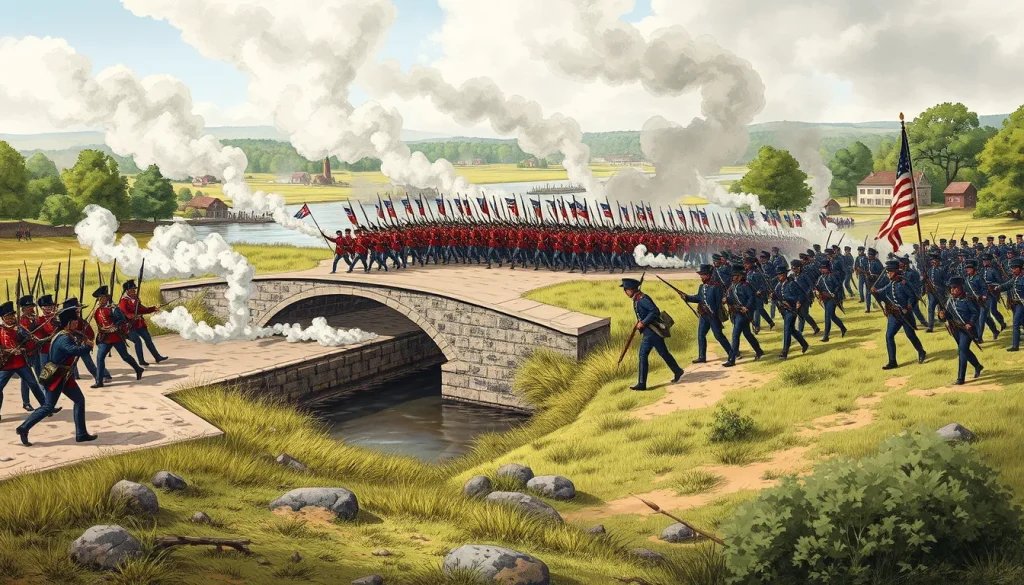
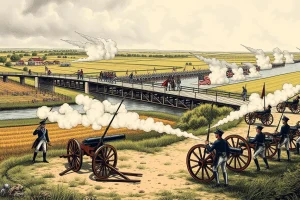
On August 24, 1814, Major General Robert Ross led approximately 4,500 British troops, many of them Peninsular War veterans, toward Washington. The American commander, Brigadier General William Winder, had been in command of the defense of the capital for only about a week. His hastily assembled force of roughly 6,500 men consisted mostly of militia from Maryland, Virginia, and the District of Columbia, with small contingents of U.S. regulars, Marines, and sailors from Commodore Joshua Barney’s Chesapeake Flotilla. Winder placed his troops in three successive defensive lines on the eastern bank of the Eastern Branch of the Potomac (now the Anacostia River) near the town of Bladensburg. The first line covered the bridge over the river, the second was positioned about five hundred yards behind it, and the third, which included Barney’s sailors and Marines, was farther back.
British troops arrived at Bladensburg around noon. Ross quickly assessed the American positions and ordered an attack. British light infantry crossed the bridge under heavy fire but were initially repulsed. A second attempt succeeded after the British forded the river north of the bridge, turning the American left flank. The first American line, composed largely of militia, broke under the combined pressure of Congreve rocket fire and a disciplined British advance. The rockets, though inaccurate, created a terrifying spectacle that unnerved untested troops. The second line also collapsed, and soon the American retreat turned into a rout. Only the third line, anchored by Barney’s flotillamen and Marines, offered determined resistance. They repelled two British advances and inflicted significant casualties before being outflanked and forced to retreat when their ammunition ran low. Barney was wounded and captured. The American withdrawal became chaotic, with soldiers fleeing in all directions. President James Madison and other cabinet members, who had observed the battle from a nearby field, escaped to safety. That evening, British troops entered Washington and destroyed public buildings, including the Capitol and the White House.
Why It Matters
The defeat at Bladensburg was not merely a military setback; it was a national humiliation. It allowed a foreign army to occupy the capital for the first and only time in American history, leading to the burning of iconic symbols of the republic. The speed of the American retreat earned the battle the derisive nickname “the Bladensburg Races,” and a famous poem of the era mocked the flight of President Madison and his cabinet. The loss shook American confidence and exposed the inherent weaknesses of relying on untrained militia for national defense. It also influenced post-war debates about military readiness and the need for a professional standing army. For the British, the victory achieved a psychological objective, demonstrating that the United States could not protect its own seat of government. The Chesapeake campaign, however, did not end the war; it shifted to Baltimore, where British hopes were dashed at Fort McHenry. Historians have interpreted Bladensburg as a cautionary tale of command failure, political interference, and the perils of an unprepared citizen-soldiery.
Definition
The question of why American forces lost at Bladensburg is a historical problem that examines the specific causes of the American defeat. It requires separating the immediate tactical failures from broader structural deficiencies in the American military system. The defeat was the result of a complex interplay of command decisions, troop quality, and the skill of the opposing force.
Background
In the summer of 1814, the British launched a diversionary campaign in the Chesapeake Bay to draw American forces away from the Canadian border and to strike at American morale. The British expedition, under Major General Robert Ross, landed at Benedict, Maryland, on August 19 and advanced rapidly toward Washington. The American government, caught between defending Baltimore and Washington, chose to make a stand at Bladensburg, where the main road from the coast crossed the Anacostia River. The defense was improvised under the command of Brigadier General William Winder, a political appointee with no prior field command experience. His forces were hurriedly assembled and lacked the training and cohesion of regular troops.
How It Worked
The American defense at Bladensburg was flawed in several ways. Winder’s inexperience led to indecisive positioning and a lack of coordination among the three lines. Secretary of State James Monroe, who arrived at the battlefield without authority, personally repositioned some troops, creating gaps that British forces exploited. The lines were placed too far apart to support one another, and the militia, many of whom had never been under fire, were vulnerable to the psychological impact of British rocket fire. The British, by contrast, were battle-tested professionals who had faced Napoleon’s army. They executed a coordinated turning movement by fording the river above the bridge, unhinging the American left flank. Once the first two lines broke, the retreat became a rout, with most militia discarding their weapons and fleeing. Only the naval contingent under Barney, who had experienced combat in the Chesapeake, held his ground briefly. The collapse was thus a direct result of poor leadership, inadequate training, and the disparity in combat experience.
Competing Viewpoints
Historians have offered differing explanations for the American defeat. Some emphasize the poor tactical deployment and the political interference of President Madison and his cabinet, who countermanded Winder’s orders. Others highlight the inherent weakness of the militia system, arguing that no amount of positioning could make untrained citizen-soldiers stand against professionals. A third school of thought points to the quality of the British army, particularly the Peninsular War veterans, who were among the best infantry in the world. There is also debate about the role of Congreve rockets: while not accurate, their noise and smoke created panic that broke the first line. Contemporary accounts and later historians generally agree that the defeat was avoidable, but they disagree on whether the primary blame rests with individual commanders or with the larger American military structure. Some, like Donald Hickey, emphasize institutional failings, while others, such as Walter Lord, focus on the chaos of the battlefield and the specific errors of the day.
Role in the War of 1812
The Battle of Bladensburg was part of the British Chesapeake campaign, designed to divert American resources and demoralize the population. Although the capture of Washington was a symbolic victory, it did not end the war. The British next attacked Baltimore, where they were repulsed at Fort McHenry, inspiring the composition of “The Star-Spangled Banner.” The defeat at Bladensburg forced the American government to rethink its reliance on militia and contributed to the post-war movement to expand the regular army. For the British, the battle demonstrated the vulnerability of the American capital but also marked the high-water mark of their coastal raids. The campaign contributed to the eventual peace negotiations, as both sides recognized the futility of continued conflict.
Consequences and Historical Interpretation
The immediate consequence of the defeat was the burning of Washington, which stunned the nation and led to criticism of President Madison’s administration. In the longer term, the “Bladensburg Races” became a byword for cowardice and incompetence, influencing American military reforms. Historians have used the battle to discuss the limits of citizen-soldiers against professional armies and the dangers of political interference in military operations. The memory of Bladensburg also fueled post-war nationalist narratives, with some celebrating the resilience of Barney’s sailors as a redeeming moment. Modern scholars view the battle as a case study in leadership failure and the importance of adequate training and clear command structures.
Primary Sources
Contemporary accounts of the battle include the official report of Brigadier General William Winder to Secretary of War John Armstrong, written the day after the battle, in which he acknowledged the “shameful” retreat but attempted to justify his decisions. Commodore Joshua Barney’s report, composed while recovering from his wound, provides a vivid description of the stand made by his flotillamen. British commander Robert Ross’s dispatch to his superiors praises the conduct of his troops and notes the rapid American flight. A British naval officer’s diary, published in later years, contains the observation that the Americans “fled in every direction” and were too quick to be captured. The American press, particularly newspapers such as the National Intelligencer, initially attempted to downplay the defeat, but by October 1814 a poem ridiculing the retreat as the “Bladensburg Races” had become popular. These sources, while valuable, are colored by the authors’ perspectives—Winder sought to defend his reputation, Ross emphasized British professionalism, and American newspapers dealt with popular outrage.
Further Reading
- Hickey, Donald R. The War of 1812: A Forgotten Conflict. University of Illinois Press, 1989.
- Latimer, Jon. 1812: War with America. Harvard University Press, 2007.
- Lord, Walter. The Dawn’s Early Light. W. W. Norton, 1972.
- Pitch, Anthony S. The Burning of Washington: The British Invasion of 1814. Naval Institute Press, 1998.
- National Park Service. “Battle of Bladensburg.” Star-Spangled Banner National Historic Trail. https://www.nps.gov/stsp/learn/historyculture/battle-of-bladensburg.htm
- American Battlefield Trust. “Bladensburg Battle Facts and Summary.” https://www.battlefields.org/learn/war-1812/battles/bladensburg
References
- National Park Service. “Battle of Bladensburg.” Star-Spangled Banner National Historic Trail. Accessed 2025. https://www.nps.gov/stsp/learn/historyculture/battle-of-bladensburg.htm
- National Park Service. “Summer 1814: American troops flee in humiliation, leaving Washington exposed.” Accessed 2025. https://www.nps.gov/articles/bladensburg-races.htm
- American Battlefield Trust. “Bladensburg Battle Facts and Summary.” Accessed 2025. https://www.battlefields.org/learn/war-1812/battles/bladensburg
- Whitlow, Zachary. “Bladensburg: Before the British Could Torch the Capital of the United States.” American Battlefield Trust, Fall 2017. https://www.battlefields.org/learn/articles/bladensburg-british-could-torch-capital-united-states
- Hickey, Donald R. The War of 1812: A Forgotten Conflict. University of Illinois Press, 1989.
- Latimer, Jon. 1812: War with America. Harvard University Press, 2007.
FAQ
How did the British get to Bladensburg?
The British landed at Benedict, Maryland, on August 19, 1814, and marched overland toward Washington, covering about 50 miles in five days. Their objective was the American capital.
Why did the American militia flee so quickly?
Most of the militia were untrained and had never experienced combat. The psychological impact of Congreve rockets, the sight of disciplined British veterans, and poor leadership caused panic once the first line was threatened.
Did any American units fight well at Bladensburg?
Yes, Commodore Joshua Barney’s flotillamen and U.S. Marines held their ground in the third line and inflicted significant casualties. They fought until outflanked and overwhelmed after the surrounding militia had fled.


Leave a Reply