
Short Answer
The burning of York, the capital of Upper Canada, on April 27, 1813, was a pivotal event of the War of 1812. An American force of about 1,700 regulars, transported by Commodore Isaac Chauncey’s Lake Ontario squadron and led on shore by Brigadier General Zebulon Pike, captured the town after a short but intense engagement. In the aftermath, American soldiers burned the parliament buildings, government houses, and other public structures, while looting both public and private property. This article examines the multiple reasons behind the destruction, from strategic orders to the emotional aftermath of a devastating explosion, and places the event in the broader context of the war’s cycle of retaliation.
Historical Context
The War of 1812 was fought between the United States and Great Britain, with British North America (Canada) as a key theatre. Control of the Great Lakes, especially Lake Ontario, was critical because it served as the main supply line for British forces in Upper Canada. At the start of the war, the British Provincial Marine had gained the upper hand on the lakes, allowing Major General Isaac Brock to shift troops quickly and win early victories. However, by late 1812, the Americans had built a powerful squadron at Sackets Harbor, New York, under Commodore Isaac Chauncey, and planned ambitious offensive operations for 1813.
Secretary of War John Armstrong initially proposed capturing Kingston, the main British naval base, but Generals Dearborn and Chauncey decided that York was a more vulnerable target. York was the capital and had a naval yard where the corvette Sir Isaac Brock was under construction. The town was defended by only about 750 British regulars, militia, and Ojibwe warriors under Major General Roger Hale Sheaffe, who also served as Lieutenant Governor. The Americans believed that a strike at the capital would cripple British morale, destroy naval assets, and provide a badly needed victory after a dispiriting 1812 campaign.
What Happened
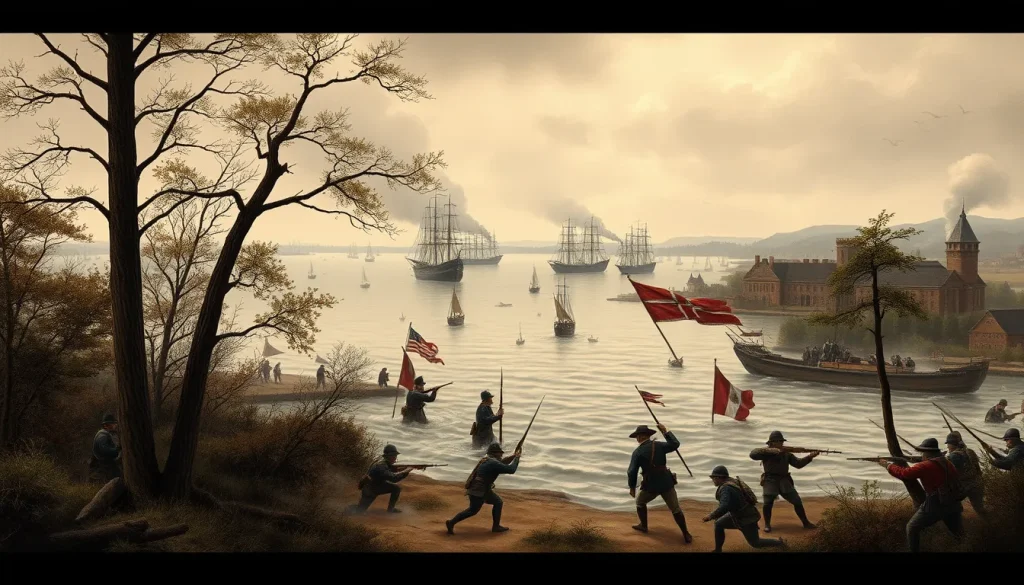
At dawn on April 27, 1813, the American flotilla approached the western beaches of York. Under covering fire from Chauncey’s ships, the troops landed and pushed back a small force of British regulars and Indigenous warriors. Sheaffe’s forces fought a series of delaying actions, but the American numerical superiority and naval gunfire forced them to retreat toward the fort. Recognizing the situation was hopeless, Sheaffe ordered his regulars to withdraw to Kingston, leaving the militia and civilians to negotiate a surrender.
As the Americans advanced on the fort’s main magazine, a massive explosion tore through the position, killing or wounding over 200 troops, including Brigadier General Pike, who was struck by flying debris. The blast, which many Americans believed was a deliberate British act of sabotage, incensed the soldiers. Over the next several days, they burned the unoccupied Parliament buildings, Government House, and other public structures, and looted several homes and businesses. The destruction included the printing press owned by the government. The Americans also captured and removed military stores, though they failed to secure the largest prizes before the retreat.
Why It Matters
The capture and burning of York was a significant American victory, boosting morale after a series of failures. For the British, it was an embarrassment that exposed the vulnerability of their Upper Canadian defenses. But the destruction at York had far-reaching consequences: it became a central justification for British reprisals, culminating in the burning of Washington, D.C., in August 1814. The raid also shaped Canadian memory and contributed to a sense of victimization and identity. Historians debate whether the burning was justified military necessity or an act of vandalism, and whether it was premeditated or a spontaneous expression of revenge.
Definition
In the context of the War of 1812, “burning York” refers to the deliberate destruction of public buildings and government property by American forces after the capture of the town on April 27, 1813. This included the legislative assembly buildings, Government House, and associated structures, as well as the destruction of military stores and the partially built Sir Isaac Brock. The act was carried out over several days during the American occupation.
Background
The decision to attack York stemmed from the American high command’s strategic assessment in early 1813. Secretary of War John Armstrong and Generals Dearborn and Pike saw an opportunity to strike at the British supply lines and naval capabilities on Lake Ontario. York was not the main base—Kingston was—but it was weaker and symbolically important as the seat of colonial government. Moreover, intelligence suggested that a ship being built at York threatened American control of the lake. The plan was to land a large force, seize the town, destroy the warship and naval stores, and then withdraw. The burning of public buildings was intended to deprive the British of administrative capacity and to demonstrate the cost of the war.
How It Worked
The implementation of the burning was not the result of a single order but evolved as the situation on the ground changed. After the landing, Sheaffe’s retreat left York’s civilians and the remaining militia to surrender. The Americans entered the fort and began securing the area. When the magazine exploded, killing Pike and many others, the soldiers’ fury turned against the town. While some officers, including Colonel Henry Dearborn (who remained aboard ship), sought to maintain discipline, many enlisted men and junior officers took initiative in setting fires. They targeted the parliament buildings, which were quickly consumed. The town was also looted, with private homes, a church, and the library being entered. The Americans claimed they were only destroying public property that could support the British war effort, but contemporary accounts note widespread vandalism.
Competing Viewpoints
Historians and contemporaries have offered diverse interpretations of the burning. American authorities, including Secretary Armstrong and General Dearborn, insisted that the destruction was limited to public buildings and was necessary to prevent the British from using them. They also cited an alleged scalp found in the parliament buildings as evidence of British collusion with Indigenous warriors, which they claimed justified retribution. British and Canadian accounts, however, portrayed the act as wanton vandalism and a violation of the laws of war, accusing the Americans of looting private property and burning even a printing press. A key point of controversy is whether the magazine explosion that killed Pike was a deliberate action by the British or an accident. Many Americans believed it was a trap, while British reports described it as an unfortunate result of the retreat. Modern historians are divided, though many note that the explosion likely resulted from British efforts to destroy stores before surrender, rather than a targeted act against American troops.
Role in the War of 1812
The burning of York played a crucial role in shaping the course of the war. It was the first successful combined army–navy operation for the Americans, demonstrating the effectiveness of their Lake Ontario squadron. However, it did not lead to a permanent occupation; the Americans withdrew after a week. More significantly, the destruction became a rallying point for the British and Canadians. British commanders later cited York, along with the burning of Newark (Niagara-on-the-Lake) in December 1813, as justifications for severe retaliation. When Major General Robert Ross and Rear Admiral George Cockburn entered Washington in August 1814, they deliberately burned the public buildings, including the Capitol and the Executive Mansion, as a direct reprisal for York. This act, in turn, hardened American opinion against Britain and influenced the peace negotiations. Within the broader war, the York raid contributed to the cycle of escalation that characterized the conflict on the Canadian–American frontier.
Consequences and Historical Interpretation
The burning of York had immediate military consequences: the destruction of the Sir Isaac Brock and naval stores crippled British efforts on Lake Erie, contributing to the American victory at the Battle of Lake Erie in September 1813. Politically, the victory gave a morale boost to the American public and the Democratic-Republican administration, though the long-term strategic impact was limited because York was secondary to Kingston. In Canada, the attack is remembered as a key event in the development of a distinct Canadian identity, fostering a sense of resistance and unity against American invasion. Historians generally agree that the burning was a significant, if not decisive, factor in the British decision to burn Washington, though some argue that the British were already contemplating punitive raids. Modern scholarship, such as Robert Malcomson’s Capital in Flames, carefully sifts the evidence to separate fact from propaganda, concluding that while the American destruction of public buildings was deliberate, the extent of private looting was exaggerated. The debate over whether the burning was a legitimate military act or a war crime continues, reflecting broader questions about the conduct of warfare in the early nineteenth century.
Primary Sources
Contemporary primary sources include American military reports, such as Commodore Chauncey’s official dispatches and Major General Dearborn’s correspondence, which describe the landing and the explosion. British accounts include Major General Sheaffe’s report to Governor General Prevost, which details the decision to retreat and the state of the fort. Civilian evidence comes from the diary of John Strachan, an Anglican minister in York, who recorded the looting and burning and later became a prominent critic of the American actions. The American claim about a scalp in the parliament buildings is documented in a letter from Dearborn to Secretary Armstrong, but its authenticity is uncertain. These sources are biased by the participants’ perspectives, and historians must weigh them carefully.
Further Reading
- Robert Malcomson, Capital in Flames: The American Attack on York, 1813 (Robin Brass Studio, 2008).
- Donald R. Hickey, The War of 1812: A Forgotten Conflict (University of Illinois Press, 1989).
- Jon Latimer, 1812: War with America (Harvard University Press, 2007).
- J. Mackay Hitsman, The Incredible War of 1812 (University of Toronto Press, 1965).
- Pierre Berton, Flames Across the Border: The Canadian-American Tragedy, 1813–1814 (McClelland & Stewart, 1981).
References
- Renée Lafferty, “The Battle of York,” The Canadian Encyclopedia, last edited June 11, 2026, https://prod-front.thecanadianencyclopedia.ca/en/article/the-sacking-of-york.
- “Raid on York – War of 1812,” The War of 1812 Website, https://thewarof1812.org/battles/raid-on-york/.
- Chris Raible, “Capital in Flames: The American Attack on York, 1813” (review of Robert Malcomson), Ontario History, 2008, https://doi.org/10.7202/1065702ar.
- David and Jeanne T. Heidler, “The Ravages of War: Targeting Civilians in the Anglo-American Conflict,” National Park Service, https://nps.gov/articles/ravages-of-war.htm.
- “Battle of York,” Wikipedia, https://en.wikipedia.org/wiki/Battle_of_York.
FAQ
Why did the Americans burn York?
The Americans burned York to destroy military supplies, a warship under construction, and public buildings that could support the British war effort. The burning was also fueled by anger over the magazine explosion that killed General Pike, and it was justified by the Americans as retaliation for alleged British atrocities.
Was the explosion that killed Zebulon Pike deliberate?
Historians are divided. Some argue that the British deliberately set fire to the magazine to prevent its capture, while others contend it was an accident during the retreat. The explosion killed over 200 Americans and incited the subsequent destruction.
How did the burning of York lead to the burning of Washington?
British forces explicitly cited the American destruction at York and Newark as justification for burning Washington's public buildings in August 1814. They saw it as a retaliatory act to teach the Americans that they could not destroy government property without consequence.



Leave a Reply