
Short Answer
The Second Siege of Fort Meigs (July 21–28, 1813) was a British and Indigenous attempt to capture the American fortification at the Maumee River Rapids in present-day Perrysburg, Ohio, during the War of 1812. After the failure of the first siege in May, British Brigadier General Henry Procter and the Shawnee leader Tecumseh returned with a larger but less heavily armed force, hoping to lure the garrison out by a simulated battle. The American commander, Brigadier General Green Clay, refused to sally, and the siege ended with a British withdrawal that further strained the alliance between Procter and Tecumseh.
Historical Context
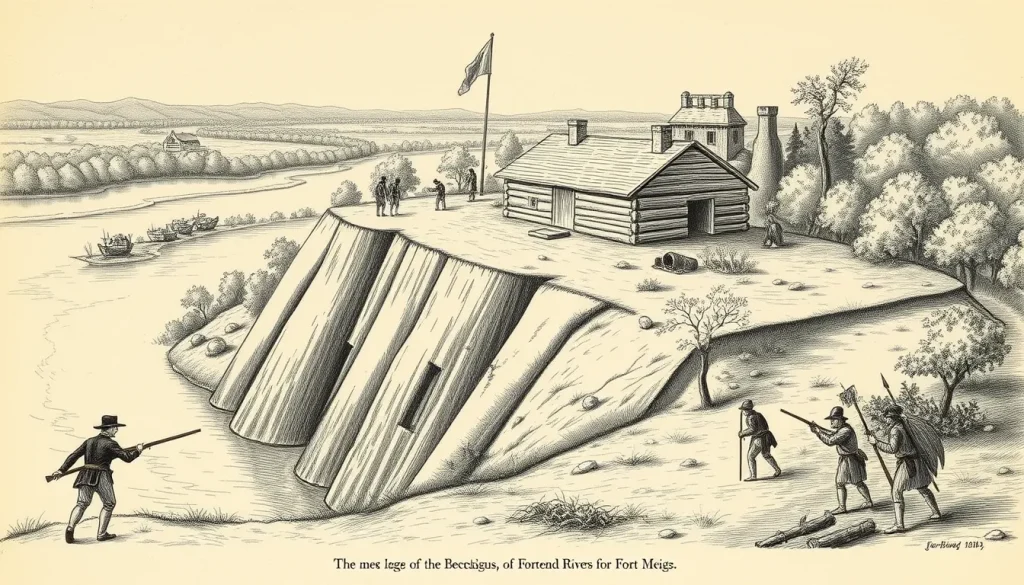
In the Northwest theater of the War of 1812, the United States had suffered a series of reverses in 1812–1813: the surrender of Detroit in August 1812, the abandonment of Fort Dearborn, and the defeat at Frenchtown in January 1813. Major General William Henry Harrison built Fort Meigs in early 1813 as a staging point for a planned American drive to recapture Detroit and invade Upper Canada. The fort, completed in April 1813, was one of the largest American earth-and-log fortifications of the war, enclosing nearly ten acres and positioned on a bluff above the Maumee River.
The first siege, from April 28 to May 9, 1813, saw Procter and Tecumseh besiege the post with British regulars, Canadian militia, and as many as 1,200 Indigenous warriors. American reinforcements under Green Clay fought through, but a disastrous sortie on May 5 cost hundreds of Kentucky militia casualties. Nevertheless, the fort held, and the attackers withdrew. The British remained determined to reduce Fort Meigs, which threatened their supply lines and communications in the northwest.
What Happened
On July 21, 1813, Procter returned with approximately 400 regulars and Canadian militia and some 2,600 Indigenous warriors, a larger force than in the first siege but lacking heavy artillery. The plan, reportedly conceived by Tecumseh, was to trick the garrison into leaving the fort by staging a mock battle that simulated an American relief column being attacked by the enemy. When the garrison sallied out to assist, they would be ambushed by the main body of Indigenous warriors concealed in the surrounding woods.
On July 26, the ruse was executed: warriors fired muskets, raised war cries, and created a din of conflict in the nearby forest. However, Green Clay, mindful of the May 5 sortie disaster and having received warnings of possible deception, kept his men inside the fort. The garrison observed the simulated battle but did not respond. With no way to breach the fort’s defenses and with the Indigenous warriors unwilling to storm prepared earthworks, the siege became pointless. On July 28, Procter withdrew, moving his force to attack Fort Stephenson at Lower Sandusky, where they suffered a severe defeat.
Why It Matters
The second siege of Fort Meigs is often overshadowed by the more dramatic first siege and the subsequent American victory at Fort Stephenson. Yet it had significant consequences. The failed ruse demonstrated the limits of British–Indigenous cooperation and deepened Tecumseh’s distrust of Procter, who was seen as cautious and ineffective. The episode exacerbated the rift between the two leaders, leading to open recrimination during the retreat to Amherstburg and culminating in the Battle of the Thames, where Tecumseh was killed and Procter fled. For the Americans, the successful defense of Fort Meigs boosted morale and secured a vital supply base for the eventual campaign into Canada.
Historians have often dismissed the second siege as a half-hearted investment, but recent scholarship, such as Larry L. Nelson’s article “A Mysterious and Ambiguous Display of Tactics,” emphasizes that the British waged a subtle tactical campaign, and the American response reflected cautious and mature leadership during a period of great uncertainty.
Prelude
After the first siege, Fort Meigs remained a bastion of American strength in the northwest, controlling the rapids of the Maumee River. In June and early July 1813, American forces under Harrison prepared for an advance, but he was called away to other duties, leaving temporary command to Green Clay. Procter, under pressure from Tecumseh and the Indigenous allies, decided on another attempt to capture or neutralize the fort.
Forces and Commanders
The American side, commanded by Brigadier General Green Clay, consisted of a garrison of approximately 2,000 men, mainly Kentucky and Ohio militia, plus regular artillery companies. The British and Indigenous forces, commanded by Brigadier General Henry Procter, included about 400 British regulars and Canadian militia, along with between 2,000 and 2,600 Indigenous warriors under Tecumseh and other leaders. The British lacked the heavy artillery needed for a formal siege and relied on the ruse to draw the Americans out.
Battlefield and Map Context
Fort Meigs sat on a bluff on the south bank of the Maumee River, about 3 miles from its mouth at Lake Erie. The fort’s earth-and-log walls formed a roughly pentagonal enclosure with seven blockhouses, five artillery batteries, and extensive traverses. The surrounding terrain was a mixture of cleared fields, woods, and the rapids of the Maumee, which made movement difficult. The British camped on the north side of the river, near the ruins of the old Fort Miamis, and placed warriors in the woods around the fort to screen their movements.
Battle Chronology
July 21: Procter’s force arrived on the north bank of the Maumee and began establishing positions, while American scouts reported the approach. July 22–25: The British conducted demonstrations and skirmishes to probe the garrison, but no formal assault was attempted. The fort’s defenders were reinforced and remained alert. July 26: The mock battle was staged in the woods south of the fort. Musket fire, war cries, and the sounds of combat were heard for several hours, but Green Clay, suspecting a trick, refused to order a sortie. July 27: With the ruse having failed, Procter began planning a withdrawal, as many Indigenous warriors lost patience and dispersed. July 28: The British and remaining Indigenous forces withdrew, moving east toward the Sandusky River and Fort Stephenson.
Casualties and Losses
Casualties during the second siege were minimal on both sides. The Americans suffered no combat losses inside the fort, and the British and Indigenous forces lost only a few warriors to skirmishing or accident. The primary “loss” was the strategic damage done to the British–Indigenous alliance by the failed operation.
Result
The Second Siege of Fort Meigs was a clear American defensive victory. The British and their Indigenous allies failed to capture the fort or to inflict meaningful losses on its garrison. The American refusal to be drawn out prevented the ambush and preserved the fort intact.
Strategic Consequences
The failure of the second siege accelerated the deterioration of the relationship between Procter and Tecumseh. Tecumseh, already frustrated by Procter’s caution, compared him to “a fat animal, that carries its tail upon its back, but when affrighted, drops it between its legs and runs off.” The British then attacked Fort Stephenson, where a staunch American defense under Major George Croghan repulsed them with heavy losses. This defeat, combined with the loss of Lake Erie at the Battle of Put-in-Bay in September, forced the British to retreat from the Detroit frontier, leading directly to the Battle of the Thames in October 1813, where Tecumseh was killed.
Primary Accounts
Contemporary American accounts include letters and journal entries from officers at Fort Meigs, such as First Lieutenant Joseph H. Larwill of the 2nd Artillery, who recorded the daily events of the siege. The orderly book and diary of Captain Daniel Cushing provide valuable details on garrison life. On the British side, Procter’s official report to Upper Canada’s governor, Sir George Prevost, described the operation as a reconnaissance, though his Indigenous allies expressed frustration. These accounts are preserved in collections such as the Ohio History Connection and the National Archives of Canada.
Battlefield Today
Fort Meigs is now a reconstructed historic site managed by the Ohio History Connection. It is located on West River Road in Perrysburg, Ohio. The fort has been rebuilt on its original plan, and visitors can tour the blockhouses, artillery positions, and traverse structures. The site includes a museum and interpretive programs that cover both the first and second sieges, as well as the broader War of 1812 in the Northwest.
Primary Sources
Key primary sources for the Second Siege of Fort Meigs include:
- Official reports: Procter’s after-action report to Sir George Prevost, and Green Clay’s dispatches to William Henry Harrison, outline the operational plans and outcomes.
- Personal journals: The diary of Captain Daniel Cushing (2nd U.S. Artillery) from October 1812 to July 1813, and Lieutenant Joseph H. Larwill’s journal, provide day-to-day observations.
- Indigenous perspectives: While direct documentation from Indigenous participants is scarce, Tecumseh’s reported speech criticizing Procter was recorded by British officers and later by American chroniclers.
These documents are held at archives such as the Ohio History Connection, the Library of Congress, and Library and Archives Canada. Researchers should note the inherent biases: American accounts emphasize the failure of the ruse, while British reports minimize the operation’s significance.
Further Reading
For further study of the Second Siege of Fort Meigs and its context, consult the following works:
- Larry L. Nelson, “A Mysterious and Ambiguous Display of Tactics”: The Second Siege of Fort Meigs, July 21–28, 1813, Ohio History, Vol. 120 (2013).
- Donald R. Hickey, The War of 1812: A Forgotten Conflict (University of Illinois Press, 2012).
- Alec R. Gilpin, The War of 1812 in the Old Northwest (Michigan State University Press, 2002).
- John Sugden, Tecumseh: A Life (Henry Holt, 1998).
- Robert B. McAfee, History of the Late War in the Western Country (1816; reprint).
References
- Larry L. Nelson, “A Mysterious and Ambiguous Display of Tactics”: The Second Siege of Fort Meigs, July 21–28, 1813, Ohio History, 2013. DOI: 10.1353/ohh.2013.0008.
- “Second Siege of Fort Meigs – War of 1812,” The War of 1812 Project, https://thewarof1812.org/battles/second-siege-of-fort-meigs/ (accessed [date]).
- Dan Wilkens, “The Old Northwest Notebook: The ‘Second Siege’ of Fort Meigs,” blog post, July 30, 2013, http://dpwilkens.blogspot.com/2013/07/the-second-siege-of-fort-meigs.html.
- “Fort Meigs and the War of 1812 – Military History of the Upper Great Lakes,” Michigan Technological University, https://ss.sites.mtu.edu/mhugl/2017/10/21/fort-meigs-and-the-war-of-1812/.
- “A History of Fort Meigs,” Fort Meigs official website, https://fortmeigs.org/a-history-of-fort-meigs/.
FAQ
Why did the British attempt a second siege of Fort Meigs?
After the first siege failed, the British sought to eliminate Fort Meigs as a threat to their supply lines and to support an expected advance against Detroit. Lacking heavy artillery, Procter and Tecumseh devised a ruse to lure the garrison into an ambush.
What was the ruse used in the second siege?
On July 26, 1813, Indigenous warriors staged a simulated battle in the woods near the fort, with musket fire and war cries, to impersonate an American relief column under attack. The goal was to make the garrison sally out, where they would be ambushed.
What were the consequences of the second siege?
The failure led to further deterioration of the British-Indigenous alliance, deepening Tecumseh's distrust of Procter. It also allowed the Americans to hold the fort and contributed to the eventual British defeat at the Battle of the Thames in October 1813.



Leave a Reply