
Short Answer
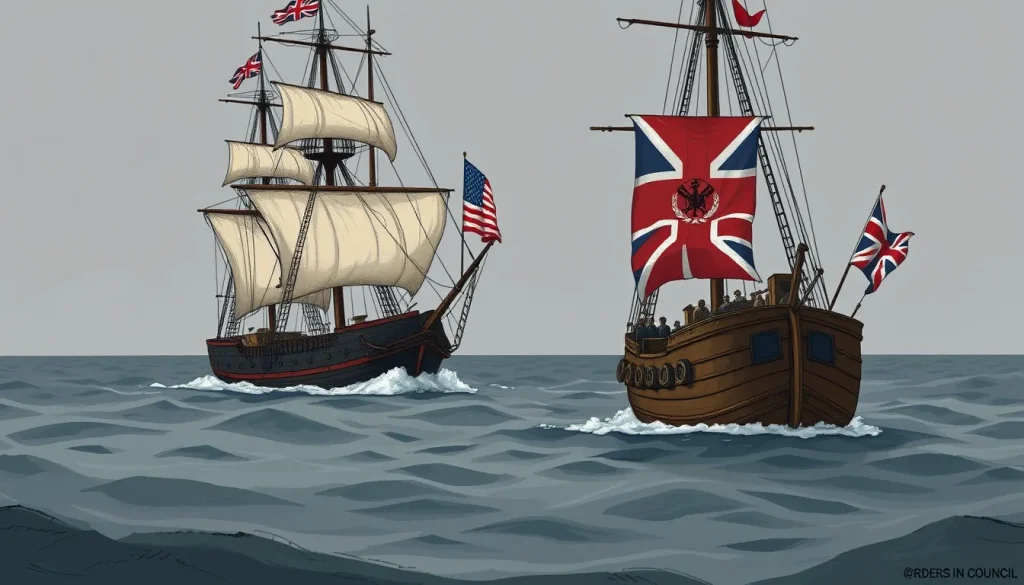
The British Orders in Council were a series of emergency royal decrees issued between 1806 and 1812 that imposed severe restrictions on neutral shipping to France and its allies. For the United States, which sought to profit from neutral commerce during the Napoleonic Wars, these orders directly challenged American maritime rights and contributed to the escalating tensions that culminated in the War of 1812. The orders, combined with French counter-decrees, created a commercial stranglehold that forced the United States to choose between submission and war.
Historical Context
From 1803, Britain and France were locked in a global conflict that each side tried to win through economic warfare. France under Napoleon sought to isolate Britain commercially through the Continental System, while Britain used its naval supremacy to blockade French-controlled ports. The United States, as a neutral nation, became the principal carrier of goods between Europe and the Americas, with American exports rising from roughly $20 million in 1790 to $138.6 million by 1807. Both belligerents attempted to curtail this trade to weaken the other. Britain enforced the Rule of 1756, which held that neutrals could not engage in commerce during wartime that was prohibited during peace, and the Essex decision of 1805 ended the practice of “broken voyages” that had allowed American ships to circumvent that rule. France responded with the Berlin Decree of 1806, declaring a paper blockade of the British Isles. These measures set the stage for a coordinated assault on neutral trade.
What Happened
In response to Napoleon’s Berlin Decree, Britain issued a series of Orders in Council. The first, on 16 May 1806 (the “Fox Blockade”), declared a blockade of the European coast from the Elbe to Brest. On 7 January 1807, an order prohibited neutral ships from carrying coastal trade between ports of France and its allies. The most comprehensive order came on 11 November 1807, which stated that any neutral ship trading with ports from which British ships were excluded (i.e., the entire French-controlled coast) must first call at a British port, pay duties, and obtain a licence. These orders effectively forced neutral trade to pass through Britain or be subject to seizure. American secretary of state James Madison protested the January 1807 order in a letter to British minister David Erskine, calling it “too extreme” and harmful to trade and international relations. The United States responded with the Embargo Act of December 1807, which prohibited all American exports in an attempt to pressure both belligerents. The embargo failed, and in 1809 it was replaced by the Non-Intercourse Act, which reopened trade with both France and Britain but prohibited it with each individually if they did not respect neutral rights. Over the next years, both powers continued to seize American ships, and Britain issued thousands of licences to neutral merchants to trade with the Continent, but the Orders in Council remained the central grievance.
Why It Matters
The Orders in Council directly damaged American commerce and provoked a national crisis. Seizures of American ships and cargoes by both Britain and France amounted to hundreds each year. American merchants and shipowners suffered heavy losses, and the resulting economic pressure fueled calls for war against Britain. The orders also became a point of political controversy in the United States, with War Hawks citing them as an intolerable violation of American rights. The immediate consequence was the American declaration of war on Britain on 18 June 1812, just two days after Britain suspended the Orders in Council in response to domestic economic distress and American pressure. Though the repeal did not reach Washington until after the declaration, it showed that the orders were a primary cause. In the longer term, the dispute over neutral rights and impressment (which was also tied to the maritime conflict) shaped American foreign policy and the nation’s sense of sovereignty.
Definition
The Orders in Council were executive orders issued by the British government under royal prerogative during the Napoleonic Wars. They were used to regulate foreign trade and impose blockades without parliamentary approval. The orders of 1807 and later years established a licensing system that required neutral ships to trade with the European continent only through British ports, effectively integrating neutral commerce into the British war effort.
Background
British maritime policy had long sought to restrict neutral trade during wartime. The Rule of 1756, the navigation acts, and the Essex decision all limited how neutrals could trade with French colonies. The outbreak of war in 1803 intensified these restrictions. After the Berlin Decree of 1806, Britain saw the Orders in Council as a necessary retaliatory measure. The orders were also influenced by legal and strategic minds such as James Stephen, who saw them as a way to undermine French commerce and also to curb American trade that might support French colonies.
How It Worked
The Orders in Council of 7 January and 11 November 1807 operated as follows: the earlier order prohibited neutral ships from engaging in the coastal trade of France and its dependencies. The later order broadened the restriction to all trade with ports from which British ships were excluded, mandating that neutral ships first call at a British port, unload, pay duties, and obtain a licence before proceeding to the continent. Ships failing to comply were subject to seizure and condemnation as prizes. Britain also issued thousands of licences that allowed limited exceptions, creating a complex system of regulated trade. American ships, to continue trading with Europe, were forced to touch at British ports, which many considered an affront to American neutrality.
Competing Viewpoints
The United States argued that the Orders in Council violated long-established neutral rights, including the principle that “free ships make free goods,” and that the blockades were illegal because they were not effective—they were “paper” blockades that could not be physically enforced along the entire coast. American officials like Madison contended that the orders were an unjustifiable interference with lawful neutral commerce. Britain, by contrast, maintained that the orders were a legitimate response to Napoleon’s Continental System, which itself violated the law of nations by blockading Britain only on paper. British officials argued that if neutral powers suffered from these measures, they should seek redress from France, which had initiated the economic warfare. This fundamental disagreement over legal and moral principles made compromise difficult.
Role in the War of 1812
The Orders in Council were a primary cause of the War of 1812. They were repeatedly cited in American declarations and speeches as a principal grievance. The orders disrupted American trade, ruined merchants, and appeared to challenge American independence. The American decision to declare war in June 1812 came after diplomatic efforts to have the orders repealed failed, and just as Britain, facing domestic economic crisis and political pressure, repealed them on 23 June 1812—the day after the American declaration. The news of the repeal arrived too late to prevent the war, but it highlighted that the orders had been a major irritant.
Consequences and Historical Interpretation
The repeal of the Orders in Council did not end the war, as impressment and other issues remained. Historians have debated the relative importance of the orders versus impressment and Western expansion as causes of the war. Some argue that the orders were the most significant economic grievance, while others emphasise the role of Indian relations and national honour. The orders also had enduring consequences: they strengthened American resolve to defend neutral rights and contributed to the development of American nationalism. In British historiography, the orders are often seen as an unfortunate but understandable wartime measure that damaged Anglo-American relations.
Primary Sources
Key primary sources include the Orders in Council themselves, which are preserved in the United Kingdom’s Privy Council records. The American diplomatic correspondence, such as James Madison’s letter to David Erskine (29 March 1807), provides a detailed American official protest. The published correspondence and analyses, such as John Lowell’s “Supplement to the Late Analysis of the Public Correspondence” (1809), offer contemporary perspectives. These sources show how the orders were perceived and debated. However, they are partisan: American sources condemn the orders, while British authorities defend them. No neutral account fully captures the complexity, but together they reveal the fundamental clash over neutral rights.
Further Reading
- Hickey, Donald R. The War of 1812: A Forgotten Conflict. University of Illinois Press, 1989.
- Jennings, Walter W. The American Embargo, 1807–1809. University of Iowa Press, 1921. Available via archive.org.
- Lowell, John. Supplement to the Late Analysis of the Public Correspondence between our Cabinet and those of France and G. Britain. 1809.
- Mahan, Alfred T. The Influence of Sea Power upon the French Revolution and Empire. Boston: Little, Brown, 1892.
References
- James Madison to David Erskine, 29 March 1807, The Gilder Lehrman Collection, American History 1493-1945 (Adam Matthew).
- John Lowell, Supplement to the Late Analysis, 1809, Brock University Digital Repository, hdl.handle.net/10464/2654.
- “Great Britain: Orders in Council and Licenses, 1800–1810,” The Waterloo Association, napoleon-series.org.
- Walter W. Jennings, The American Embargo, 1807–1809, Internet Archive, archive.org.
FAQ
What exactly were the British Orders in Council?
They were emergency royal decrees that restricted neutral shipping to France and its allies, requiring ships to visit British ports and obtain licences.
How did the Orders in Council affect American trade?
They led to the seizure of many American merchant ships and cargoes, disrupting commerce and causing economic hardship.
Did the repeal of the Orders help avoid war in 1812?
Repeal came on 23 June 1812, one day after the US declaration of war. The news arrived too late to prevent the outbreak of conflict.

Leave a Reply