
Short Answer
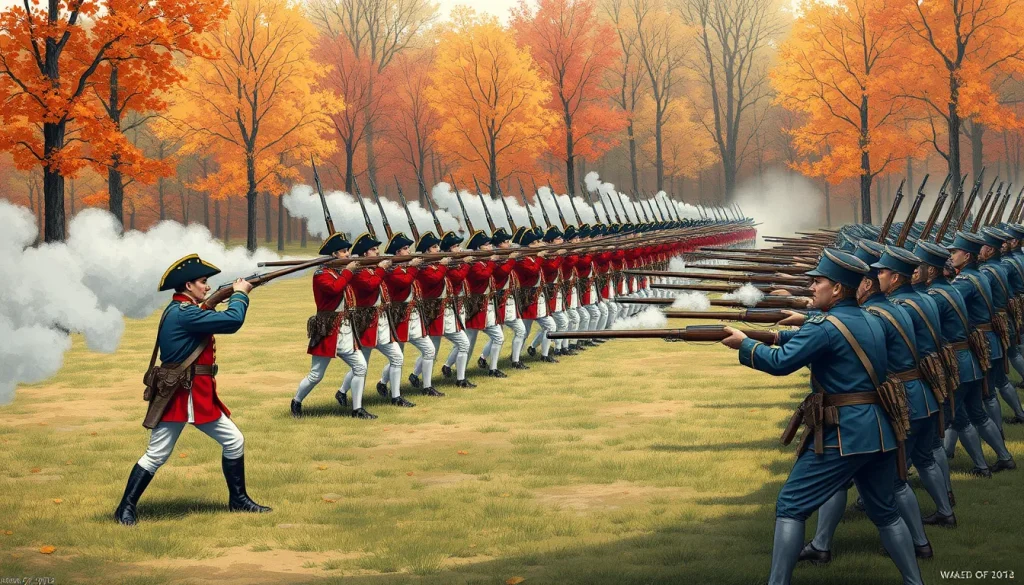
The War of 1812 was fundamentally an infantry struggle. From the Niagara frontier to the Gulf Coast, foot soldiers armed with smoothbore muskets and bayonets decided most land engagements. Both the British and American armies employed the same inherited European tactical systems, but their effectiveness varied widely based on training, leadership, and the challenging North American environment. This article examines how infantry fought, what weapons and formations they used, and how their performance shaped the war.
Historical Context
In 1812, the British Army was a hardened professional force, seasoned by years of combat in the Napoleonic Wars. The United States Army, by contrast, was small, understaffed, and inexperienced. Despite these differences, both armies shared a common tactical heritage rooted in eighteenth-century drill manuals. Infantry were organized into regiments and battalions of roughly 500 to 800 men, armed primarily with the flintlock musket—a smoothbore, muzzle-loaded firearm that fired a one-ounce lead ball. A trained soldier could load and discharge his musket two to three times per minute, but accuracy was poor beyond 50 yards and effectiveness dropped sharply after 150 yards. To achieve decisive firepower, troops fought in tightly packed lines, delivering massed volleys at close range, then relying on the bayonet to drive the enemy from the field. Light infantry—often carrying rifles with grooved barrels—provided skirmish fire, screening the main body and harassing the enemy. In the United States, the regular army was supplemented by state militias; over 450,000 Americans served in militia units during the war, though many refused to fight outside their home states.
What Happened
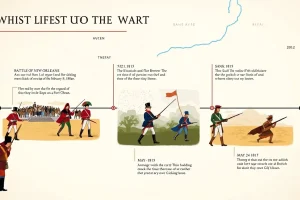
Infantry combat in the War of 1812 followed this European pattern, with adaptations for North America’s forests and farms. The first major clash, the Battle of Queenston Heights (October 13, 1812), saw American regulars advance against British regulars and Canadian militia. Most of the New York militia refused to leave their state, and the attacking force was compelled to surrender. At Crysler’s Farm (November 11, 1813), a British and Canadian force of about 800 men repelled an American army twice its size, using disciplined volley fire and a decisive bayonet charge. The turning point for the American infantry came in 1814, when Brigadier General Winfield Scott drilled his brigade using French tactical manuals. At the Battle of Chippawa (July 5, 1814), American regulars stood toe-to-toe with British regulars, exchanging volleys and driving the enemy from the field—a feat that surprised both sides. Other significant infantry actions included the battles of Lundy’s Lane, Fort Erie, and Plattsburgh, where American regulars and militia combined with artillery to stop British invasions. Throughout the war, light infantry played a crucial role. For example, at the Battle of Châteauguay (October 26, 1813), Canadian light infantry and militia ambushed an American column, causing it to retreat. On the American side, rifle-armed units like the 1st Rifle Regiment operated as skirmishers, though they were too few to replace line infantry in pitched battles.
Why It Matters
Infantry performance directly influenced the war’s outcome. Early American defeats were caused by poorly trained regulars, unreliable militia, and feuding senior officers. By 1814, however, the U.S. regulars had become a professional force capable of matching British veterans. This improvement allowed the Americans to hold critical points on the Niagara frontier and contributed to British decisions to seek peace. The war also exposed the limitations of militia in offensive operations, leading to postwar reforms that expanded the regular army and standardized training. Historically, the infantry combat of 1812 has been remembered through a mix of myth and reality. The notion that Americans fought as individual marksmen, using rifles and trees, persists in popular culture, but modern historians, such as Carl Benn, emphasize that both armies relied on the same linear tactics and volley fire. The war’s small-unit actions and evolving professionalism had a lasting impact on both the United States and Canadian military development.
Definition
Infantry in the War of 1812 consisted of soldiers who fought on foot, organized into regular regiments, militia units, and volunteer corps. Their primary weapons were the smoothbore musket—used in massed formations—and the rifle, preferred by light infantry for its longer range and accuracy.
Background
The tactical system of both armies came from late-eighteenth-century European doctrine, especially as codified in official manuals such as the U.S. “Regulations for the Field Exercise, Manoeuvres, and Conduct of the Infantry” of 1812. The British had refined these systems during the Napoleonic Wars, while the United States had maintained only a small regular establishment since the Revolution, relying heavily on state militias. The outbreak of war in June 1812 found both armies unprepared for large-scale land operations, and infantry forces were hastily expanded with volunteers and incorporated militia.
How It Worked
Infantry fought in two or three ranks, normally forming a line that maximized the number of muskets pointing at the enemy. The command of “make ready—take aim—fire” unleashed a volley that could inflict heavy casualties at close range. A well-drilled battalion could fire several volleys per minute, creating a continuous hail of lead. When an enemy began to waver, the order “charge bayonet” sent the line forward, often breaking the opposing formation. Light infantry, deployed as skirmishers ahead of the main force, used aimed fire and, if available, rifles to harass the enemy and protect the main body’s advance or retreat.
Competing Viewpoints
A persistent myth holds that American soldiers of the War of 1812 were natural frontier marksmen who fought individually, using cover and rifles, while their British opponents remained in rigid, vulnerable lines. Historical evidence contradicts this. Carl Benn notes that both armies used similar line and light infantry tactics, and that rifles were only issued to small numbers of light companies. The American militia sometimes fought from cover, but regulars adopted linear formations. Other historians, like Gregg Adams, emphasize the evolution of American regulars from early defeats to professional competence, but still within the framework of European drill. The myth of the frontier sharpshooter likely arose from romanticized accounts of the war and American national identity.
Role in the War of 1812
Infantry engagements were decisive in key campaigns. The battles of Queenston Heights, Châteauguay, Crysler’s Farm, Chippawa, and Lundy’s Lane all hinged on infantry performance. American militia frequently refused to cross national borders or serve far from home, as at Queenston, while Canadian volunteer and embodied militia regiments fought effectively to defend their homeland. Indigenous warriors, allied with both the British and Americans, often operated as light infantry, using skirmish and ambush tactics, but they rarely formed the main battle line. The war’s most significant infantry achievement was the American regulars’ transformation under Scott, culminating in their stalwart performance at Chippawa, which convinced British commanders that American soldiers could no longer be underestimated.
Consequences and Historical Interpretation
The conflict highlighted the necessity of a trained standing army. After the war, the United States expanded its regular forces, established a standardized drill system, and improved officer education. For British North America, infantry service by Canadian militia and fencible regiments fostered a distinct military identity. Historians interpret the infantry tactics of 1812 as a transitional period: traditional linear warfare remained dominant, but skirmishing and rifle usage foreshadowed later guerrilla and long-range tactics. The war’s memory has been shaped by both national narratives—American frontier myth and British/Canadian valour—but scholarly analysis shows a conflict in which all sides fought in essentially the same manner, with the decisive factors being discipline, training, and leadership.
Primary Sources
- “Regulations for the Field Exercise, Manoeuvres, and Conduct of the Infantry of the United States” (1812): Official manual issued by the War Department, detailing drill and formations used by American regulars and militia.
- Official military reports from commanders such as Winfield Scott and Gordon Drummond describe battles and tactical assessments. Many are preserved in the U.S. and British national archives.
- Diaries and letters of soldiers (e.g., the journals of British and American officers) provide personal perspectives on combat. The Library of Congress and Library and Archives Canada hold collections.
Further Reading
- Adams, Gregg. US Soldier vs British Soldier: War of 1812. Osprey Publishing, 2021.
- Benn, Carl. “The War of 1812: Land Forces.” Osprey Publishing blog, March 15, 2024. https://www.ospreypublishing.com/ca/osprey-blog/2024/the-war-of-1812-land-forces/.
- Graves, Donald E. Field of Glory: The Battle of Crysler’s Farm. Toronto: Dundurn Press, 1999.
- Hitsman, J. Mackay. The Incredible War of 1812. Toronto: University of Toronto Press, 1965.
References
- Benn, Carl. “The War of 1812: Land Forces.” Osprey Publishing, March 15, 2024. Accessed 2024. https://www.ospreypublishing.com/ca/osprey-blog/2024/the-war-of-1812-land-forces/.
- Adams, Gregg. US Soldier vs British Soldier: War of 1812. Osprey Publishing, 2021. ISBN 9781472841674.
- “Regulations for the Field Exercise, Manoeuvres, and Conduct of the Infantry of the United States.” Philadelphia: Fry and Kammerer, 1812. War Department. Accessed at http://www.kelloggscompany1812.org/Docs/Smyth_s_Manual_with_plates.pdf.
- Ogden, Schuyler. “Si vis Pacem, para bellum: The U.S. Army and the War of 1812.” Master’s thesis, Liberty University, 2024.
FAQ
What was the main infantry weapon in the War of 1812?
The smoothbore flintlock musket was the standard weapon for both sides. It had a rate of fire of two to three rounds per minute and was most effective at ranges under 150 yards.
Did American soldiers use rifles and frontier tactics?
Some militia and light infantry units carried rifles, but the majority of regulars used muskets and fought in linear formations. Both armies employed light infantry for skirmishing; the popular image of rifle-armed frontiersmen is largely exaggerated.
Why did American regulars improve later in the war?
Improved training and leadership, particularly under Brigadier General Winfield Scott, who drilled his brigade in French tactical manuals in 1814. This led to professional performance at Chippawa and other battles.
Leave a Reply