
Short Answer
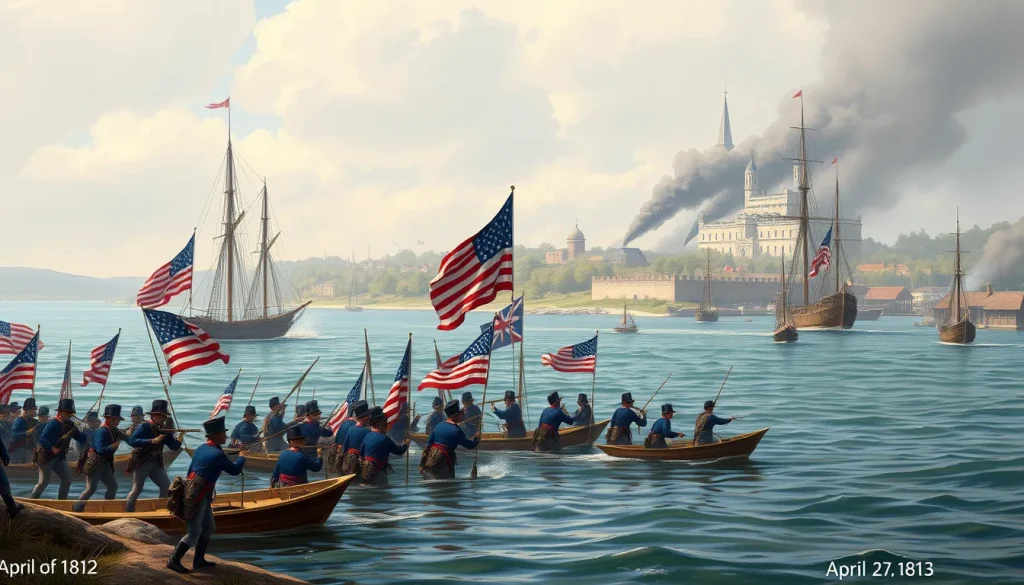
York, the capital of Upper Canada (present-day Toronto, Ontario), was the site of a major American attack on 27 April 1813 during the War of 1812. The battle and subsequent occupation led to the destruction of government buildings and military supplies, and later became a key justification for the British burning of Washington in 1814. The attack highlighted the strategic importance of Lake Ontario and the vulnerability of the provincial capital.
Historical Context
York, founded in 1793 as the capital of Upper Canada, sat on the north shore of Lake Ontario. The lake served as a vital supply line and military frontier between British North America and the United States. At the war’s outset, the British Provincial Marine controlled the lake, allowing Major General Isaac Brock to shift forces to defeat American invasions in 1812. Commodore Isaac Chauncey built an American squadron at Sackets Harbor, New York, to challenge this control. By 1813, both sides were constructing warships; the British laid down the Sir Isaac Brock at York, making the town a target. American Secretary of War John Armstrong had planned a strike on Kingston, the naval base, but faulty intelligence led Generals Henry Dearborn and Isaac Chauncey to choose York instead, believing Kingston too strong. York was defended by only about 300 regulars, 300 militia, and 40-50 Ojibwe warriors under Major General Roger Hale Sheaffe.
What Happened
On 27 April 1813, an American flotilla of 14 ships carrying about 1,700 regulars under Brigadier General Zebulon Pike approached York. The landing occurred west of the town, opposed by British regulars, militia, and Ojibwe warriors. Naval gunfire supported the troops. The defenders fell back, and Sheaffe decided to evacuate his regulars to Kingston, leaving the militia to surrender. As American forces advanced, the fort’s magazine exploded, killing or wounding over 200 Americans including Pike. The blast, likely caused by retreating British forces, was devastating. The Americans then occupied York for six days, looting homes and businesses, and burning the parliament buildings, Government House, and the printing press. The Sir Isaac Brock, under construction, was destroyed. American forces withdrew after seizing military stores. Casualties: American 55 killed, 265 wounded; British 82 killed, 112 wounded, 274 captured.
The explosion is disputed: British accounts often call it accidental, while Americans claimed deliberate sabotage. The destruction of public buildings and looting would later be cited by the British as justification for the burning of Washington.
Why It Matters
The American victory at York was a morale boost after a failed campaign, but it had limited strategic effect as York was not a vital military objective compared to Kingston. Still, the loss of naval stores and the ship hindered British efforts on Lake Erie. Sheaffe was relieved of command. The destruction at York directly influenced British actions in August 1814, when forces under Major General Robert Ross burned public buildings in Washington, citing York as retaliation. The raid also highlighted the vulnerability of the Canadian capital and the importance of naval supremacy on Lake Ontario. Historians continue to debate whether the explosion was intentional and the degree of American depredations.
Historical Map Context
York was located on the north shore of Lake Ontario at the present site of downtown Toronto. The town’s harbour was enclosed by a peninsula to the south. The fort, now Fort York, sat near the lakeshore at the western approach. The town itself stretched east toward the Don River. A blockhouse and batteries protected the harbour. Maps from 1813 show a small settlement with government buildings and a few hundred structures.
Modern Location
Today, the site of York is central Toronto, Ontario. Fort York National Historic Site preserves the fort and is a prominent heritage site. The parliament buildings burned in 1813 were located near the present intersection of Front and Sherbourne Streets; a memorial marks the approximate location.
Events at the Site
The battle of 27 April 1813 was the central event. The landing at what is now Coronation Park, the fighting westward, and the magazine explosion occurred near the fort. After the battle, the Americans occupied the town, burning the parliament buildings and other public structures. A subsequent raid in July 1813 by Chauncey’s forces burned additional buildings and supply depots. The fort was rebuilt and used into the nineteenth century.
Associated People
American leaders: Brigadier General Zebulon Pike (killed), Commodore Isaac Chauncey, Major General Henry Dearborn. British command: Major General Roger Hale Sheaffe, Lieutenant Governor, and his subordinates James Givins, Aeneas Shaw, and John Robinson. Indigenous allies included Ojibwe and Mississauga warriors.
Surviving Monuments and Site
Fort York National Historic Site includes reconstructed earthworks, the original stone magazine (which survived the explosion), and military buildings. A monument to Zebulon Pike stands nearby. A small plaque at the site of the parliament buildings commemorates the burning. The Toronto Public Library’s original collection, lost in the fire, is noted in historical accounts.
Primary Sources
Key contemporary sources include Commodore Chauncey’s official report to the Secretary of the Navy (April 1813), detailing the operation; Major General Sheaffe’s report to Governor Prevost; and letters from American soldiers describing the conditions. British and Canadian accounts often emphasize the accidental nature of the explosion, while American accounts accused the British of treachery. The diary of the American Surgeon’s Mate, as well as later memoirs, provide additional perspectives. These documents are housed in archives such as the Library and Archives Canada and the U.S. National Archives.
Further Reading
- Berton, Pierre. The Invasion of Canada, 1812-1813. Toronto: McClelland and Stewart, 1980.
- Hickey, Donald R. The War of 1812: A Forgotten Conflict. Urbana: University of Illinois Press, 1989.
- Lambert, Andrew. The Challenge: Britain Against America in the Naval War of 1812. London: Faber and Faber, 2012.
- Benn, Carl. Historic Fort York, 1793-1993. Toronto: Dundurn, 1993.
- Turner, Wesley. British Generals in the War of 1812. Montreal: McGill-Queen’s University Press, 1999.
References
- Lafferty, Renée. “The Battle of York.” The Canadian Encyclopedia, June 11, 2026. https://prod-front.thecanadianencyclopedia.ca/en/article/the-sacking-of-york
- “Capture of York.” Canada’s History, March 1, 2013. https://www.canadashistory.ca/explore/military-war/capture-of-york
- “Raid on York.” War of 1812, thewarof1812.org. https://thewarof1812.org/battles/raid-on-york/
- “The Capture of York.” Early Canada Historical Narratives. http://uppercanadahistory.ca/1812/18124.html
- “Battle of York.” Wikipedia. https://en.wikipedia.org/wiki/Battle_of_York
FAQ
Why did the Americans attack York?
York was the capital and had a shipyard where the Sir Isaac Brock was under construction. The Americans hoped to capture naval stores and weaken British control of Lake Ontario.
What was the significance of the magazine explosion?
The explosion killed Brigadier General Zebulon Pike and many American soldiers. It led to accusations of British treachery and later influenced the American destruction of public buildings.
How did the battle affect the British?
British forces retreated, with heavy losses and the loss of naval supplies. Sheaffe was relieved of command, and the burning of York was later cited as justification for the British burning of Washington in 1814.



Leave a Reply