Short Answer
The Battle of Queenston Heights, fought on 13 October 1812, was the first major engagement of the War of 1812 on the Niagara frontier. Winfield Scott, a twenty-six-year-old lieutenant colonel in the United States Army, played a pivotal role in the American attack, taking command of the forces on the heights after the initial leaders were wounded and ultimately surrendering the American position to British forces under Major General Roger Hale Sheaffe. Scott’s conduct during the battle became a defining moment in his early career, influencing his later rise to prominence in the U.S. Army.
Historical Context
The War of 1812 erupted between the United States and Great Britain in June 1812 over maritime grievances, trade restrictions, and British support for Indigenous resistance to American expansion. American strategy included a series of invasions of Upper Canada (now Ontario), with the Niagara frontier as one of the primary invasion routes. Major General Isaac Brock, the British commander in Upper Canada, had achieved a stunning victory in August 1812 by capturing Detroit, which raised British morale and encouraged American efforts to retaliate. Major General Stephen Van Rensselaer, a New York militia officer, commanded the American forces on the Niagara, but his army was composed largely of poorly trained militia and a relatively small number of regular infantry. A temporary armistice between the two sides ended in early September, allowing both armies to regroup and plan offensive operations.
What Happened
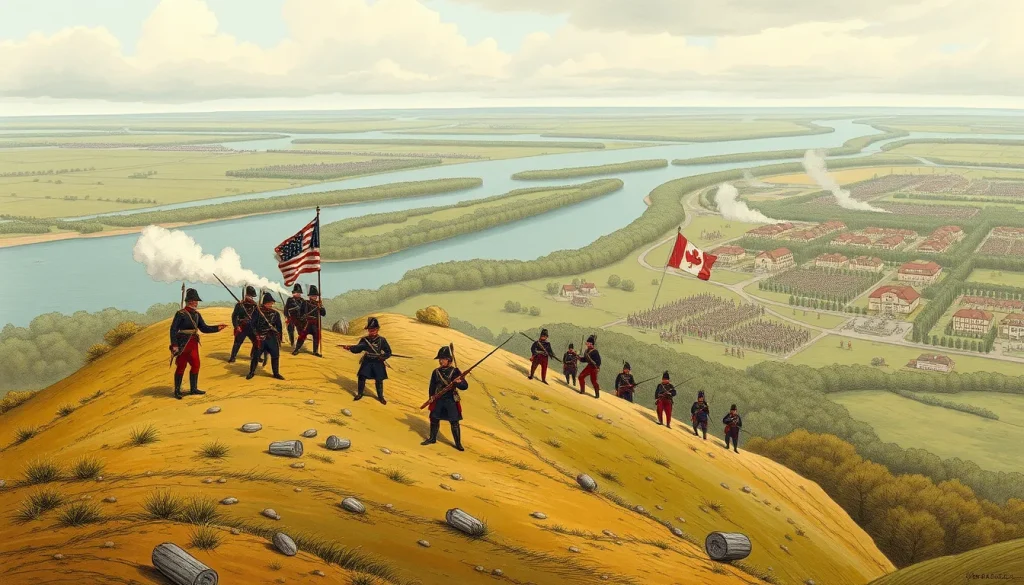
On the night of 12–13 October 1812, Van Rensselaer launched an invasion across the Niagara River from Lewiston, New York, to the village of Queenston, Upper Canada. The initial crossing was disorganized, and several boats were lost. Lieutenant Colonel Solomon Van Rensselaer, the commander’s cousin and aide, was severely wounded during the landing. Winfield Scott, who had volunteered for the expedition, took charge of the American forces on the east bank and led a second wave across the river. After securing the landing, Scott and his men discovered a path to the top of the Niagara Escarpment, where they captured a British redan (gun emplacement) that had been firing on the crossing. From this position, Scott commanded about 350 regulars and 250 militia. However, the American militia on the New York side refused to cross the river, citing that they were not obligated to serve outside the United States. As a result, Scott’s force was isolated on the heights. Meanwhile, British reinforcements under Major General Sheaffe arrived from Fort George and, with the assistance of Indigenous warriors led by John Norton, executed a flanking maneuver to the west. Sheaffe’s attack caught the Americans by surprise; after a brief but sharp engagement, Scott was forced to surrender his remaining force to avoid a massacre. The battle resulted in a decisive British victory.
Why It Matters
The Battle of Queenston Heights had immediate and long-term significance. For the British, it was a crucial defensive victory despite the death of the popular Major General Isaac Brock, who was killed during an earlier counterattack. The battle frustrated the American attempt to establish a foothold in Upper Canada before winter. For Winfield Scott, the battle marked his first major combat command. Although he was captured, his leadership was praised by contemporaries and later historians. Scott was exchanged in early 1813 and promoted to colonel, then brigadier general in 1814. The battle also exposed the weaknesses of American militia and the coordination problems between regulars and militia, which influenced later American military reforms. In British and Canadian memory, the battle is commemorated as a key moment in the defense of Canada, and Brock became a national hero.
Prelude
After the armistice ended, Van Rensselaer faced intense pressure from the American government and public to launch an offensive. His army, numbering over 6,000 men, included regulars under Brigadier General Alexander Smyth and militia under Brigadier General William Wadsworth. Smyth, however, was insubordinate and refused to cooperate fully with Van Rensselaer, preferring an attack near Buffalo. Van Rensselaer chose to cross at Queenston, a location where the Niagara River flows fast and the heights dominate the landing. The Americans had fewer than a dozen boats, sufficient to carry about 600 men at a time. Scott, as a lieutenant colonel in the 2nd Artillery, was attached to Smyth’s brigade but had been sent to Lewiston with a detachment to support the operation.
Forces and Commanders
The American force consisted of approximately 900 regulars and 2,650 militia. Van Rensselaer commanded the overall operation, with Solomon Van Rensselaer as his aide and Scott as a key subordinate. The British garrison at Queenston numbered about 200 men, but reinforcements were available at Fort George and other posts. British forces were led by Major General Isaac Brock and later Major General Roger Hale Sheaffe, with about 1,366 total troops including British regulars, Canadian militia, and Indigenous allies from the Haudenosaunee (Six Nations) and Delaware peoples. Indigenous leadership included John Norton and John Brant, who played a critical role in delaying the Americans.
Battlefield and Map Context
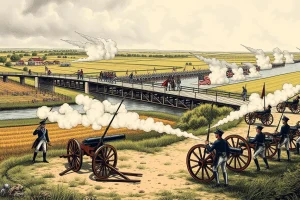
The battlefield is located at Queenston, Ontario, on the Niagara River, where the Niagara Escarpment rises dramatically to a height of about 350 feet. The town of Queenston sat at the base of the escarpment, while the heights provided a commanding position over the river and the crossing point at Lewiston. The Americans landed at the base of the escarpment and climbed a steep path to the redan near the summit. The British used the redan to fire on American boats crossing the river. The surrounding terrain included woodlands that provided cover for Indigenous forces supporting the British.
Battle Chronology
The American crossing began before dawn on 13 October. After a false start on 10–11 October, the main landing occurred around 4 a.m. The first wave, including Solomon Van Rensselaer, crossed under heavy fire. By dawn, American forces had secured the landing and began climbing the escarpment. At approximately 7 a.m., they captured the redan. Brock arrived from Fort George with a small force and led a counterattack, but was killed around 8 a.m. His aide, John Macdonell, led a second attack and was also killed. Scott then took command on the heights, consolidating the position. Throughout the morning, American militia on the New York side refused to cross. Sheaffe, arriving from Fort George, gathered reinforcements and, around 3 p.m., launched a surprise flank attack from the west. The American position was quickly overrun, and Scott surrendered his force of about 300 men after a fifteen-minute engagement.
Casualties and Losses
British and allied casualties were 21 killed, 85 wounded, and 22 captured. American casualties are estimated at 60–100 killed, 80 wounded, and 955 captured (including 90 wounded). The majority of the prisoners were militia. Scott himself was taken prisoner but was later exchanged.
Result
The battle was a decisive British victory. The American invasion of Upper Canada via the Niagara frontier was repulsed, and the initiative in that sector remained with the British. The loss of Brock was a heavy blow, but Sheaffe’s successful command restored order and secured the position.
Strategic Consequences
The British victory at Queenston Heights ended the American threat on the Niagara for the remainder of 1812. It allowed the British to maintain control of the Niagara River, preventing any American foothold in Upper Canada before winter. For the Americans, the defeat exposed the weaknesses of the militia system and the lack of cooperation between regular and militia forces. It also led to Van Rensselaer’s resignation and Smyth’s subsequent failed attempt to invade near Buffalo. The battle contributed to the American realization that the war would not be quickly won.
Primary Accounts
Several contemporary accounts exist. Winfield Scott later wrote about his experiences, though his memoirs were published much later. American officer Solomon Van Rensselaer’s journal provides details of the landing and his wounding. British accounts include letters and reports from Sheaffe and others. Indigenous participation is noted in the accounts, but few direct Indigenous perspectives survived. One notable primary source is a letter from Lieutenant Colonel John Macdonell describing Brock’s death. These accounts must be read critically, as they reflect the biases and limited perspectives of their authors.
Battlefield Today
The battlefield is preserved in Queenston Heights Park, Ontario, which features Brock’s Monument, a tall memorial to Isaac Brock erected in the mid-19th century. The site includes interpretive plaques and trails. The redan and the slopes of the escarpment remain visible. The park is administered by the Niagara Parks Commission and is open to the public.
Primary Sources
Relevant primary sources include: (1) Winfield Scott’s own account in his memoir, Memoirs of Lieutenant-General Winfield Scott (1864), which describes his role at Queenston Heights; (2) the official report by Major General Roger Hale Sheaffe to Sir George Prevost, dated 14 October 1812, detailing the battle and British actions; (3) Stephen Van Rensselaer’s official report to the Secretary of War, October 14, 1812, which discusses the crossing and the militia refusal; (4) a letter from Lieutenant Colonel John Macdonell to his brother, written before his death, that describes Brock’s death. These sources are biased by the authors’ positions and must be cross-referenced with other accounts.
Further Reading
- Benn, Carl. The War of 1812. Oxford: Osprey Publishing, 2002.
- Hitsman, J. Mackay. The Incredible War of 1812: A Military History. Toronto: University of Toronto Press, 1965.
- Malcomson, Robert. Burying General Brock: A History of Brock’s Monument. Hamilton, ON: Department of Canadian Heritage, 1996.
- Scott, Winfield. Memoirs of Lieutenant-General Winfield Scott, LL.D. New York: Sheldon & Company, 1864.
- Stagg, J.C.A. The War of 1812: Conflict for a Continent. Cambridge: Cambridge University Press, 2012.
References
- The Canadian Encyclopedia, “Battle of Queenston Heights”, https://thecanadianencyclopedia.ca/en/article/battle-of-queenston-heights.
- History of War, “Battle of Queenston Heights, 13 October 1812”, https://www.historyofwar.org/articles/battles_queenston_heights.html.
- Lossing, Benson J. Pictorial Field-Book of the War of 1812, 1869. Available at https://freepages.rootsweb.com/~wcarr1/history/Lossing2/Chap19.html.
- American Battlefield Trust, “Winfield Scott in the War of 1812”, https://www.battlefields.org/learn/articles/winfield-scott-war-1812.
- Wikipedia, “Battle of Queenston Heights”, https://en.wikipedia.org/wiki/Battle_of_Queenston_Heights.
FAQ
What was Winfield Scott's rank and role at Queenston Heights?
Scott was a lieutenant colonel in the 2nd U.S. Artillery. He volunteered to lead reinforcements across the Niagara River and later took command of the American force on the heights after other officers were wounded.
Why did Scott surrender at Queenston Heights?
Scott's force was isolated on the heights because New York militia refused to cross the river. British reinforcements under General Sheaffe attacked from the west, and Scott surrendered to prevent a massacre.
How did the Battle of Queenston Heights affect Scott's career?
Despite being captured, Scott's leadership was praised. He was exchanged, promoted to colonel, and later to brigadier general in 1814, becoming one of the most prominent American commanders of the war.


Leave a Reply