
Short Answer
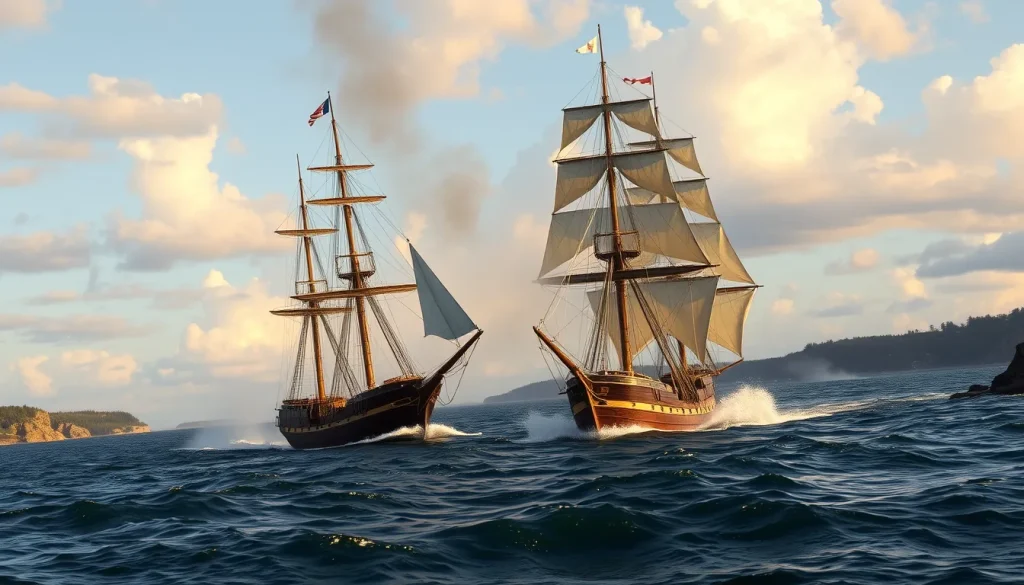
The engagement between the United States Navy brig USS Enterprise and the Royal Navy gun-brig HMS Boxer took place off the coast of Maine on September 5, 1813, during the War of 1812. In a forty-five-minute battle, the two ships exchanged broadsides, and although both commanding officers were mortally wounded, the Enterprise forced the Boxer to surrender. The action is historically significant for its demonstration of American gunnery, the gallantry of the commanders, and the unusual joint funeral that buried the two captains side by side, a gesture of mutual respect that transcended the conflict.
Historical Context
The War of 1812, fought between the United States and Great Britain, was sparked by maritime grievances, including impressment, trade restrictions, and British support for Indigenous resistance to American expansion. By 1813, the war had settled into a struggle that saw the small U.S. Navy, despite being outnumbered, win several single-ship duels that bolstered American morale. The Atlantic coast faced both the Royal Navy’s blockade and the constant threat of British cruisers and privateers disrupting American trade. On the northeastern seaboard, the British sought to intercept American and neutral shipping, while the U.S. Navy deployed its vessels to protect commerce and engage enemy raiders.
USS Enterprise, a veteran of the Quasi-War and the Barbary Wars, had been rebuilt as a brig and was under the command of Lieutenant William Burrows. Her mission in early September 1813 was to cruise from Cape Ann to the Bay of Fundy to counter smuggling and British privateers. HMS Boxer, a British gun-brig launched in July 1812, had been sent from Halifax to patrol the New England coast and had recently escorted a merchantman from New Brunswick to the Kennebec River. The two ships were roughly comparable in size and armament, making the upcoming encounter a test of crew discipline and gunnery.
What Happened
On the morning of September 5, 1813, USS Enterprise, with a crew of 102 men and fourteen guns, sighted HMS Boxer, which carried sixty-six men and twelve guns, off Pemaquid Point, Maine. For nearly six hours the two brigs maneuvered for advantage, the Boxer having nailed an ensign to the mast in a signal of defiance. At approximately 3:00 p.m., the vessels closed to within half pistol shot and opened fire. Commander Samuel Blyth of the Boxer was killed early in the exchange by a cannonball, while Lieutenant Burrows was struck in the thigh by a musket ball moments later, yet he refused to be taken below and continued to direct the fight. The Enterprise’s superior gunnery inflicted severe damage on the Boxer, cutting away her rigging and causing heavy casualties. Within thirty minutes, the Boxer, with her main topmast shot away and water in the hold, struck her colors. The ship surrendered, and the surviving British crew was taken prisoner. Both ships returned to Portland Harbor, where the bodies of the two commanders were prepared for burial. On September 9, the two captains were interred side by side in Portland’s Eastern Cemetery, in a funeral that drew American and British officers alike, honoring men who had fought with great courage and professional respect.
Why It Matters
The strategic consequences of the Enterprise’s victory were minimal—the Royal Navy’s blockade remained unbroken, and the loss of one small brig did not alter the balance of naval power. However, the engagement had significant symbolic value in the United States, which had suffered defeats and reversals in the Canadian theater. The capture of the Boxer, achieved with superior seamanship and gunnery, reinforced the image of the American navy as a capable and determined force. Moreover, the joint burial of Lieutenant Burrows and Commander Blyth became a powerful symbol of the shared naval ethos of honor and professionalism. The event was commemorated in Henry Wadsworth Longfellow’s poem “My Lost Youth,” which recalled the sea fight and the dead captains. Historians have noted that while the battle had negligible military impact, its memory contributed to American national pride and exemplified the mutual respect that could exist between adversaries in the early nineteenth century.
Prelude
In early September 1813, USS Enterprise, under Lieutenant Burrows, had been ordered to cruise the eastern coast of New England to intercept privateers and smugglers. After anchoring at Portland on September 3, she set out on her patrol. Meanwhile, HMS Boxer, commanded by Commander Samuel Blyth, had recently sailed from New Brunswick and was also patrolling the same waters. The Boxer had previously been involved in escorting a merchantman to the Kennebec River and was on the lookout for the American brig. On the morning of September 5, the two ships sighted each other off Pemaquid Point, and the Boxer, with her colors nailed to the mast, offered battle. The initial movements were cautious, as each commander sought the weather gauge and a favorable position.
Forces and Commanders
USS Enterprise was an American brig of approximately 85 feet in length, carrying fourteen 18-pounder carronades and two 9-pounder long guns, with a crew of 102 officers, sailors, and marines. She had been built as a schooner in 1799 and rebuilt as a brig in 1811–1812. Her commander, Lieutenant William Burrows, was an experienced naval officer who had served in the Barbary Wars and was known for his aggressive tactics.
HMS Boxer was a British gun-brig of similar size, mounting twelve 18-pounder carronades and two 6-pounder long guns, with a complement of 66 men. Her commander, Commander Samuel Blyth, had previously won distinction in the Royal Navy, receiving a sword for his conduct under Sir James Yeo in the capture of Cayenne. The Boxer was a new vessel, launched in July 1812, and had been sent to the American coast to intercept enemy commerce.
Battlefield and Map Context
The engagement took place off the coast of Maine, in an area near Pemaquid Point and Monhegan Island, about eight miles southeast of Seguin Island. The exact position has been debated among historians; some accounts place it “near Portland” while others emphasize its proximity to Pemaquid. Contemporary reports indicate that the battle began about eight miles southeast of Seguin and ended some four or five miles east of Pemaquid Point, approximately seven miles west-northwest of Monhegan. The area is characterized by rocky coastline, islands, and open water, which influenced the maneuvering of the two brigs. The ships were visible from shore, and several observers gathered to watch the battle.
Battle Chronology
• Morning (approximately 9:00 a.m.): Enterprise and Boxer sight each other off Pemaquid Point. Both vessels begin maneuvering for favorable position.
• Midday to early afternoon: The two ships engage in a lengthy pursuit and evasive actions, each trying to gain the weather gauge. The Boxer has her ensign nailed to the mast, signaling a fight to the bitter end.
• 3:00 p.m.: The ships close to within half pistol shot. Enterprise opens fire, with her first broadside killing Commander Blyth and inflicting damage. Lieutenant Burrows is wounded shortly thereafter but remains at his post.
• 3:30 p.m.: After about thirty minutes of intense fire, the Boxer’s rigging is severely damaged, her main topmast shot away, and she has three feet of water in her hold. The British ship strikes her colors, and the crew calls for quarter.
• Later afternoon: An American prize crew boards the Boxer. Lieutenant Burrows, informed of the surrender, is satisfied. He declines the sword of the dead British captain and orders it returned to Blyth’s family. Burrows dies the following morning.
• September 6-9: Enterprise and the prize Boxer sail to Portland Harbor. On September 9, the bodies of both commanders are buried side by side in Eastern Cemetery with full military honors.
Casualties and Losses
USS Enterprise suffered three men killed and fourteen wounded. This included Lieutenant Burrows, who died of his wound the next day. HMS Boxer had seven killed and thirteen wounded from her crew of sixty-six, a casualty rate exceeding thirty percent. The Boxer herself was heavily damaged, with her hull holed in multiple places, rigging cut away, and main topmast lost. After the action, she was taken as a prize, later sold at auction for $9,775.
Result
The action resulted in an American victory. The Enterprise forced the Boxer to surrender and captured the British vessel. The prize was subsequently sold, and the Boxer served as a merchantman for a period. The victory was celebrated in American newspapers as another example of the navy’s prowess.
Strategic Consequences
The capture of HMS Boxer had limited strategic impact. It disrupted one British patrol but did not challenge the overall dominance of the Royal Navy on the Atlantic coast. The blockade continued, and American commerce remained vulnerable. However, the victory provided a morale boost, especially in New England, and reinforced the professional reputation of the American officer corps. The funeral and the story of the two dead captains also had a cultural afterlife, shaping perceptions of the war as a conflict in which honor and respect could coexist with lethal combat.
Primary Accounts
Several primary sources illuminate the battle. The official reports by Lieutenant Edward McCall, who assumed command of the Enterprise after Burrows was wounded, and accounts from British survivors were published in contemporary newspapers such as Niles’ Weekly Register (September 18, 1813). The American report details the gunnery and the death of both commanders. British accounts, including those from Lieutenant David McGrery, describe the severe damage to the Boxer and the decision to surrender. The story of the nailed colors and the exchange of swords is recorded in several memoirs and later histories. Henry Wadsworth Longfellow, who was a boy in Portland at the time, wrote the poem “My Lost Youth” (1858), which commemorated the battle and its aftermath. While not an eyewitness account, his poem became an important cultural source. The gravestones and burial records in Portland’s Eastern Cemetery provide physical evidence of the event.
Battlefield Today
The site of the battle lies off the coast of Maine, near Pemaquid Point and Monhegan Island. There is no fixed monument at sea, but the area is part of the Maine coastal waters, visible from land. In Portland, the graves of Lieutenant William Burrows and Commander Samuel Blyth are preserved in the Eastern Cemetery, where they rest side by side. The burial plot is a popular historical site, and a monument or marker may indicate the significance. The battlefield itself is commemorated through historical markers along the coast, and the event is remembered in local historical societies. The United States Navy has also carried on the name of the Enterprise in subsequent warships, preserving the legacy of this early victory.
Primary Sources
The most relevant primary sources include:
- Official reports: Lieutenants Edward McCall and David McGrery submitted reports after the action. These were published in Niles’ Weekly Register on September 18, 1813, and in the National Intelligencer.
- Contemporary newspaper accounts: Many American and British newspapers printed detailed narratives of the battle, including casualty lists and descriptions of the commanders’ deaths.
- Letters and memoirs: The memoir of William Barnes, an American crew member, provides tactical details on the position and maneuvering. The journal of the Boxer’s surgeon or surviving officers may also exist, though some records were lost.
- Longfellow’s poem: “My Lost Youth” (1858) drew on the battle and the burial, reflecting popular memory.
- Court-martial records: Both the American and British navies conducted courts-martial into the conduct of some crew members, which provide official testimony about the engagement.
These sources vary in bias, with official reports often emphasizing the skill and bravery of their own side, while newspaper accounts sometimes exaggerated or condensed events. The exact details of the battle, including precise positions and timing, come from these contemporary narratives and later historical reconstruction.
Further Reading
- Hickey, Donald R. The War of 1812: A Forgotten Conflict. University of Illinois Press, 1989.
- Lambert, Andrew. The Challenge: Britain Against America in the Naval War of 1812. Faber & Faber, 2012.
- Latimer, Jon. 1812: War with America. Harvard University Press, 2007.
- Roosevelt, Theodore. The Naval War of 1812. G. P. Putnam’s Sons, 1882.
- Smith, Joshua M. Battle for the Bay: The Naval War of 1812 on the Maine Coast. Down East Books, 2011.
References
- Thayer, Henry O. “Engagement of Enterprise and Boxer September 5, 1813.” The Centenary of the War of 1812-15, Portland, ME, 1914. Available at DigitalCommons, University of Maine: https://digitalcommons.library.umaine.edu/mainehistory/277.
- “USS Enterprise vs HMS Boxer.” The War of 1812, thewarof1812.org. https://thewarof1812.org/battles/uss-enterprise-vs-hms-boxer/.
- “The U.S. Brig Enterprise Captures the British Brig Boxer.” Encyclopedia Virginia: https://encyclopediavirginia.org/9004-33ff9f2e7c1af89/.
- “The Capture of the H.M.S. Boxer: In 1813, Maine Witnessed a U.S. Naval Victory.” New England Historical Society: https://newenglandhistoricalsociety.com/capture-h-m-s-boxer-1813-maine-witnessed-u-s-naval-victory/.
- “Capture of HMS Boxer.” Wikipedia: https://en.wikipedia.org/wiki/Capture_of_HMS_Boxer.
FAQ
Why were both captains killed in the battle?
Both commanders stood exposed on deck to direct their crews. Commander Blyth was killed by a cannonball early in the engagement, and Lieutenant Burrows was struck by a musket ball while helping to run out a carronade. Burrows refused to be carried below and died the next day.
Where are the captains buried?
They are buried side by side in Eastern Cemetery in Portland, Maine, with a joint funeral that drew honors from both American and British officers.
What was the strategic significance of the battle?
Strategically, the capture of HMS Boxer was minor; it did not break the blockade or change the naval war. Its importance was symbolic and morale-boosting for the United States, and it became a famous example of naval gallantry.


Leave a Reply