

Short Answer
The Lundy’s Lane Battlefield, located in present-day Niagara Falls, Ontario, is historically significant as the site of the Battle of Lundy’s Lane, fought on July 25, 1814, during the War of 1812. This battle, often described as the bloodiest of the conflict, saw British, Canadian, and Indigenous forces under Lieutenant-General Gordon Drummond confront the American army commanded by Major-General Jacob Brown, ultimately halting the American offensive into Upper Canada. Today, the battlefield is commemorated within Drummond Hill Cemetery and is a National Historic Site of Canada.
Historical Context
By July 1814, the War of 1812 on the Niagara frontier had seen a shift in momentum. American forces had crossed the Niagara River from Fort Erie into Upper Canada earlier that month and achieved a significant victory at the Battle of Chippawa on July 5. This success emboldened the American command, which sought to push northward toward the British positions in the Niagara Peninsula. The British were under pressure from the American invasion, and Lieutenant-General Gordon Drummond, the newly appointed lieutenant governor of Upper Canada, was tasked with stopping the advance. The area around Lundy’s Lane, a gently rising road just west of the Niagara River, offered a defensible position due to its high ground, and British forces moved to hold it. The strategic importance of the Niagara frontier was critical for both sides: control of this region would determine the security of Upper Canada and the credibility of the American invasion effort.
What Happened
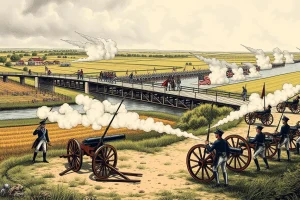
On the afternoon of July 25, 1814, after the American victory at Chippawa, Major-General Jacob Brown’s army advanced north toward Lundy’s Lane. The British, commanded by Lieutenant-General Gordon Drummond, had taken up a defensive position on the hill, with a force estimated at about 2,800 men, including Canadian fencibles and militia. The Americans, numbering roughly the same, arrived in the late afternoon and attacked the British line. The battle lasted about six hours, with the action centering around the British artillery that was positioned on the hill, which is now the site of Drummond Hill Cemetery. Both sides launched repeated attacks and counterattacks, with the fighting continuing well after dark. The scene was characterized by severe close-quarters combat, and casualties were heavy on both side. By midnight, the American forces had failed to dislodge the British from their position and withdrew from the field, retiring toward Fort Erie. The British held the ground at the end of the battle, but both armies had suffered greatly, with each side losing over 800 men killed, wounded, or captured. The American offensive on the Niagara frontier effectively came to an end, and the battle marked the last major attempt by the United States to invade Upper Canada during the war.
Why It Matters
The Battle of Lundy’s Lane is remembered as the bloodiest engagement of the War of 1812, with total casualties estimated at over 1,700. Its immediate effect was to halt the American invasion of Upper Canada, preserving British control over the Niagara Peninsula and securing a critical strategic victory. The battle also demonstrated the resilience and effectiveness of British regulars, Canadian militia, and Indigenous allies. For the United States, the withdrawal meant that the ambitious campaign of 1814 had failed, and subsequent operations were limited to the defense of Fort Erie before the Americans evacuated the Canadian side in November. Historians have debated the outcome of the battle, with some framing it as a tactical draw because both sides suffered heavy losses and neither achieved a clear operational goal. However, strategically, the American failure to break through at Lundy’s Lane effectively ended their offensive in Upper Canada, a point stressed by the Historic Sites and Monuments Board of Canada. The site’s placement in Drummond Hill Cemetery, which also holds the graves of many soldiers and of Laura Secord, an iconic Canadian figure, has made the battlefield a place of remembrance and heritage tourism.
Historical Map Context
The battle took place on a rise of cleared farmland along Lundy’s Lane, a road that ran roughly parallel to the Niagara River and connected the riverfront to the interior. The location was situated just northwest of Niagara Falls, within sight of the falls and near the village of Drummondville (now part of Niagara Falls). The American army advanced north from Chippawa along the Portage Road, while the British approached from positions near the Niagara River. Contemporary maps show the hill as a prominent elevation surrounded by orchard and forest, with the road forming a natural defensive line. The battlefield is now confined to a four-block-square area enveloped by the modern city, but the historical geography is preserved in the layout of Drummond Hill Cemetery and the surrounding streets.
Modern Location
Today, the Lundy’s Lane Battlefield is located at 6110 Lundy’s Lane in Niagara Falls, Ontario, with access via Buchner Place off Drummond Road. The site is a National Historic Site of Canada, designated in 1937, and is administered by Parks Canada, with the City of Niagara Falls maintaining the cemetery. The battlefield is embedded within the Drummond Hill Cemetery, a four-acre expanse that also serves as a burial ground for residents and notable historical figures. Visitors can access a self-guided walking tour that begins at the Niagara Falls History Museum on Ferry Street, a distance of approximately 1.7 kilometers from the battlefield, and follows the American advance and British defense.
Events at the Site
The primary event at the site is the Battle of Lundy’s Lane, fought on July 25, 1814. The battle was centered on the hill where the British established their line and where the fighting around the British guns was fiercest. The cemetery and its surrounding grounds were the focal point of the engagement, and many soldiers on both sides were buried in the cemetery in the aftermath. Over time, the site became a place of commemoration, with the first major monument erected in 1895. The battlefield also served as a location for later remembrance activities, including the addition of commemorative plaques in 1935 and a commemorative wall in 2004, marking the 190th anniversary of the battle.
Associated People
Key military figures associated with the site are Lieutenant-General Sir Gordon Drummond, who led the British and Canadian forces, and Major-General Jacob Brown, who commanded the American army. Drummond was later knighted and served as Administrator of Lower Canada. Brown continued his military career and was regarded as one of the abler American generals of the war. The cemetery also holds the graves of soldiers from both sides, along with notable civilians. Among the most famous individuals buried at Drummond Hill is Laura Secord, whose wartime exploits during the Battle of Beaver Dams in 1813 have made her a celebrated figure in Canadian history. Her monument is a prominent feature of the cemetery. Other figures include Burr Plato, an early Black Canadian resident, and Ruth Redmond, who fought to protect the battlefield from development.
Surviving Monuments and Site
The most prominent monument at the Lundy’s Lane Battlefield is the Soldiers Monument, a large cairn erected in 1895 by the Lundy’s Lane Historical Society. It marks the final resting place of 22 British soldiers whose remains were placed in a vault beneath it. In 1938, three bronze plaques were affixed to the monument, listing the names of British regulars and Canadian militia who were killed in action. Nearby, a commemorative wall built in 2004 features four limestone panels depicting scenes from the battle. The cemetery itself contains numerous grave markers for American and Canadian soldiers, and the site includes a plaque placed by the Historic Sites and Monuments Board of Canada. A well-known copper beech tree, believed to predate the battle, stands within the cemetery and is a living witness to the event. The battlefield is marked by historic signage, and the City of Niagara Falls has a self-guided walking trail to interpret the battlefield and its associated Drummondville village.
Primary Sources
Contemporary primary sources for the Battle of Lundy’s Lane include the official battle reports written by Major-General Jacob Brown and Lieutenant-General Gordon Drummond, which are held in the National Archives of the United States and the United Kingdom, respectively. These documents provide detailed accounts of the troop movements, casualty numbers, and commanders’ perspectives, though they each naturally reflect the viewpoints and interests of their authors. A key Canadian secondary source is the plaque text from the Historic Sites and Monuments Board of Canada, which summarizes the battle’s importance. Additionally, the cemetery’s burial records and the 1895 monument inscriptions offer a direct link to those who participated or died. No complete transcript of a participant’s diary or letter is widely known, but researchers can consult published collections of War of 1812 documents, such as those in the Public Archives of Canada.
Further Reading
- Parks Canada. “Battle of Lundy’s Lane National Historic Site of Canada.” https://www.pc.gc.ca/apps/DFHD/page_nhs_eng.aspx?id=428
- Graves, Donald E. Field of Glory: The Battle of Crysler’s Farm, 1813 (for comparative context) or specifically: The Battle of Lundy’s Lane, 1814 (self-published, 2002).
- American Battlefield Trust. “Lundy’s Lane.” https://www.battlefields.org/visit/battlefields/lundys-lane
- Niagara Falls Museums. “Lundy’s Lane Battlefield.” https://nfexchange.ca/museum/visit-the-niagara-falls-museums/lundy-s-lane-battlefield
References
- Parks Canada. “Battle of Lundy’s Lane National Historic Site of Canada.” Accessed 2023. https://www.pc.gc.ca/apps/DFHD/page_nhs_eng.aspx?id=428
- Niagara Falls Museums. “Lundy’s Lane Battlefield.” Accessed 2023. https://nfexchange.ca/museum/visit-the-niagara-falls-museums/lundy-s-lane-battlefield
- American Battlefield Trust. “Lundy’s Lane.” Accessed 2023. https://www.battlefields.org/visit/battlefields/lundys-lane
- City of Niagara Falls. “Drummond Hill Cemetery.” Accessed 2023. https://niagarafalls.ca/recreation-culture-and-community/cemeteries/cemetery-locations-and-histories/drummond-hill-cemetery/
FAQ
Why is the Lundy's Lane Battlefield considered the bloodiest battle of the War of 1812?
The Battle of Lundy's Lane produced over 1,700 combined casualties, including more than 800 killed, wounded, or captured on each side. The close-quarter fighting that extended through the night resulted in a high death toll, making it the bloodiest single-day engagement of the war.
What was the outcome of the Battle of Lundy's Lane?
Despite heavy losses on both sides, the American army was unable to dislodge the British from their defensive position on Lundy's Lane and withdrew after midnight. The British remained in control of the battlefield, and the American offensive in Upper Canada effectively ended.
Who is buried at Drummond Hill Cemetery on the Lundy's Lane Battlefield?
The cemetery is the final resting place of many soldiers from both sides who died in the battle. It also contains the grave of Laura Secord, a celebrated Canadian figure of the War of 1812, as well as notable citizens such as Burr Plato and the daredevil Karel Soucek.
Is the Lundy's Lane Battlefield accessible to visitors?
Yes, the battlefield is located within Drummond Hill Cemetery in Niagara Falls, Ontario. Visitors can take a self-guided walking tour that starts at the Niagara Falls History Museum, and there are historical markers and monuments, including the Soldiers Monument and a commemorative wall.




Leave a Reply