
Short Answer
Philip Bowes Vere Broke (1776–1841) was a Royal Navy officer who commanded the frigate HMS Shannon during the War of 1812. He is best known for the capture of USS Chesapeake on 1 June 1813, a single-ship action that restored British naval prestige after a series of American frigate victories. Broke’s innovative approach to gunnery training made the Shannon one of the most effective warships of the era and shaped later naval practice.
Historical Context
By 1813, the War of 1812 had seen the United States Navy achieve surprising successes against the Royal Navy in frigate duels. USS Constitution defeated HMS Guerriere in August 1812 and HMS Java in December, USS United States captured HMS Macedonian in October 1812, and USS Hornet sank HMS Peacock in February 1813. These defeats shocked a British public accustomed to naval supremacy and led to official inquiries. American frigates such as Constitution were heavier and more heavily armed than most British frigates, carrying 24-pounder long guns compared with the 18-pounders typical of British ships. The psychological impact of these losses outweighed their strategic importance, but they created an urgent need for a British victory to restore confidence. HMS Shannon, stationed at Halifax after 1811, was part of the British squadron enforcing the blockade of the American coast. Captain Philip Broke had spent nearly seven years training his crew to an exceptional standard, focusing on accurate and rapid gunnery. He refused to weaken his crew by assigning prize crews to captured American merchant ships, preferring to destroy prizes to keep his ship at full fighting strength.
What Happened
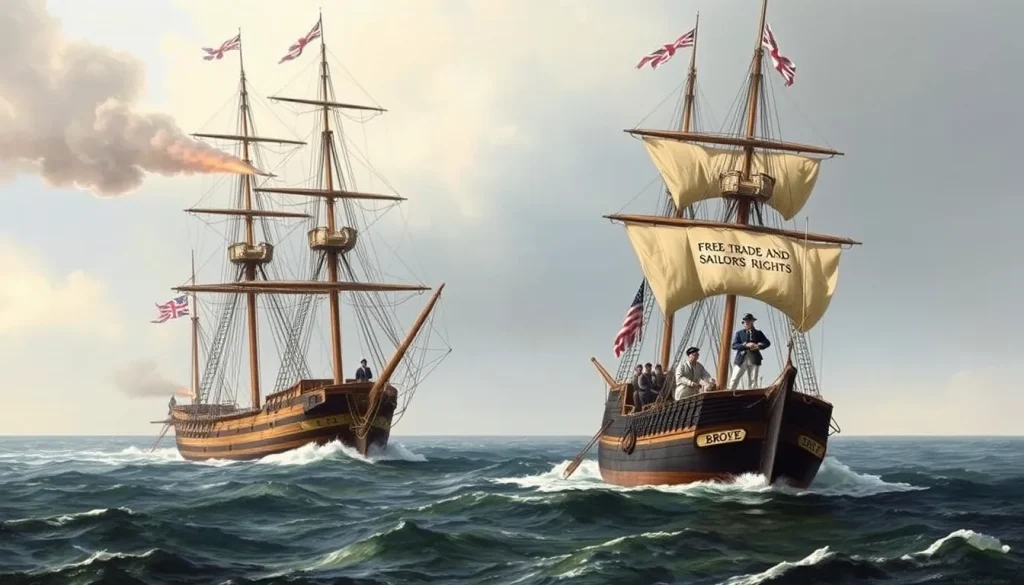
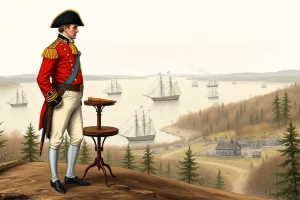
In April 1813, HMS Shannon, with Broke in command, blockaded the port of Boston, watching the American frigate USS Chesapeake, which was being refitted under Captain James Lawrence, the hero of the Hornet–Peacock action. Broke sought a single-ship engagement and wrote a formal challenge to Lawrence, proposing they meet without interference. The letter was sent but did not reach Lawrence before he sailed. On the morning of 1 June 1813, Chesapeake put to sea from Boston harbor, flying a banner reading “Free Trade and Sailors’ Rights.” Bostonians gathered along the harbour heights to watch the expected American victory.
The two frigates met about twenty miles east of Boston. Both were rated as 38-gun ships, though Shannon carried a mix of 18-pounder long guns and 32-pounder carronades. Broke had drilled his crew so that they could fire three aimed broadsides in under four minutes, with an emphasis on targeting the enemy’s quarterdeck and officers. As Chesapeake approached, the Shannon held her fire until the range was close. The first exchange devastated Chesapeake’s rigging and command structure. In about eleven minutes, Shannon’s fire disabled Chesapeake’s wheel and killed or wounded many of her officers, including Captain Lawrence. Seeing the American ship crippled, Broke ordered his men to board. During the boarding, Broke was struck on the head by a cutlass, receiving a severe wound. The British seized control of Chesapeake and secured her as a prize. Casualties were heavy: Shannon lost 23 killed and 56 wounded, including Broke; Chesapeake lost about 60 killed and 85 wounded. The British towed the captured frigate to Halifax, where the victory was celebrated.
Why It Matters
The capture of USS Chesapeake was the most celebrated single-ship action of the War of 1812 and had an immediate psychological impact. It ended the string of American frigate victories, restored the confidence of the Royal Navy, and enhanced British morale on the North Atlantic station. Strategically, it reinforced the British blockade and helped maintain British naval superiority for the remainder of the war, though it did not alter the broader course of the conflict. For historians, the battle is significant as a demonstration of the effectiveness of systematic gunnery training. Broke’s methods—using gun sights, target practice, and drills—were ahead of standard practice and influenced later naval training. The engagement also became a symbol of national pride on both sides: for Americans, it recalled the loss of a famous ship and the death of a gallant captain; for the British and Canadians, it marked a moment of triumph in a war often seen as a series of defeats. Later historians have interpreted the battle as a turning point that helped secure British command of the Atlantic during the war.
Early Life
Philip Bowes Vere Broke was born on 9 September 1776 at Broke Hall, Suffolk, England, into an old naval family. He attended the Royal Naval Academy in Portsmouth from about age twelve and went to sea in June 1792 as a midshipman aboard the sloop Bulldog. He later served in the Mediterranean, seeing action at the occupation of Toulon and the siege of Bastia. In February 1797, as third lieutenant of HMS Southampton, he participated in the Battle of Cape St. Vincent. He was promoted to commander in 1799 and to captain in 1801. After his father’s death, he married Sarah Louisa Middleton in 1802.
Role Before the War
Broke took command of HMS Shannon on 31 August 1806. During the Napoleonic Wars, he served in the North Sea and off the coast of France, including a bombardment of Boulogne with Congreve rockets. He also protected British fisheries near Spitsbergen in 1807 and participated in the reduction of Madeira later that year. In 1808, Shannon cruised in the Bay of Biscay and was present in the aftermath of the capture of the French frigate Thétis by HMS Amethyst; Broke generously offered to waive the Shannon’s claim to the prize money. From 1809 to 1811, he continued routine service in the Channel and Bay of Biscay.
Role During the War
Shannon was ordered to Halifax in August 1811, arriving in September, before the outbreak of war. When war was declared in June 1812, Broke commanded a squadron charged with maintaining the blockade of the American coast. In July 1812, he led a pursuit of USS Constitution but failed to bring her to action. Throughout this period, he insisted on keeping Shannon at the highest state of readiness, sacrificing captures he felt would weaken his crew. He trained his men daily in gunnery, using sights he designed and drilled them in firing at marks. His methods were so effective that other ships’ crews were repeatedly exchanged with Shannon’s to spread the gunnery techniques.
Major Actions
The defining moment of Broke’s career was the engagement with USS Chesapeake on 1 June 1813. Broke’s gunnery discipline proved decisive. His crew’s accurate fire disabled the American ship’s command and rigging, and the subsequent boarding captured Chesapeake. Broke personally led the boarding party and was severely wounded. The victory was a complete success: a British frigate had defeated an American frigate of similar nominal rating in a fair fight. The battle also showcased Broke’s strategic patience—he had deliberately avoided distractions and waited for a favorable opportunity.
Contemporary Accounts
Broke’s own official report to the Admiralty, written after the battle, detailed the engagement and his ship’s condition. The report was published in British newspapers and celebrated. American sources, including letters and newspapers, recorded the loss of Chesapeake and the death of Captain Lawrence. Broke’s challenge letter to Lawrence was later published, and several eyewitness accounts circulated on both sides. These documents provide a rich contemporary record, though they are shaped by national pride and the conventions of naval reporting. The Mariner’s Mirror article on Broke’s carronades uses his correspondence to illuminate his technical decisions.
Later Life
Broke was made a baronet and received many honors, including a sword from the City of London. His severe head injury meant he could not serve at sea again. He was promoted to rear admiral in 1830, by which time his health had further deteriorated after a fall from a horse. He retired to his Suffolk home but remained active in correspondence and was consulted by the Admiralty on gunnery matters. He died on 3 January 1841 in London while seeking medical treatment. He was buried in the family church.
Historical Legacy
Broke is remembered as a pioneer of naval gunnery. His training innovations were influential and were later adopted more widely in the Royal Navy. The victory over Chesapeake made him a national hero in Britain and a respected figure in naval history. Modern historians view the battle as a pivotal moment that restored British confidence and demonstrated the value of disciplined training. The name of HMS Shannon endured; a later Liffey-class frigate of 1855 bore the name and served in the Indian Mutiny, but the original Shannon’s fame rests on its 1813 triumph.
Primary Sources
Key primary sources include Broke’s official dispatch to the Admiralty, dated 6 June 1813, which provides the British account of the action and casualty figures. His challenge letter to Captain Lawrence, dated 30 May 1813, survives in copies and is a remarkable document of naval formality. American accounts include Captain Lawrence’s last orders and letters from crew members, published in newspapers. The memoir ‘Memoirs of Admiral Sir Philip Broke’ was compiled by his family and includes many original documents. These sources are held in the National Archives (UK), the Canadian Archives, and the Suffolk Record Office.
Further Reading
- Ridler, Jason. “HMS Shannon.” The Canadian Encyclopedia, 2011.
- Lambert, Andrew. The War of 1812: Britain’s Naval War. Routledge, 2014.
- Bibbings, Martin. “An Awkward Engine: Captain Philip Broke’s Troublesome Relationship with the Carronade.” The Mariner’s Mirror, 2016.
- “Broke, Sir Philip Bowes Vere (1776–1841).” Dictionary of National Biography, 1885–1900.
- “HMS Shannon vs USS Chesapeake – War of 1812.” thewarof1812.org.
References
- Ridler, Jason. “HMS Shannon.” The Canadian Encyclopedia. https://thecanadianencyclopedia.ca/en/article/hms-shannon
- “HMS Shannon vs USS Chesapeake – War of 1812.” thewarof1812.org. https://thewarof1812.org/battles/hms-shannon-vs-uss-chesapeake/
- “People–UK–Broke, Sir Philip Bowes Vere, Rear Admiral, RN.” Department of the Navy – Naval Historical Center. http://ibiblio.org/hyperwar/OnlineLibrary/photos/prs-for/uk/ukprs-b/pbv-brok.htm
- “Broke, Sir Philip Bowes Vere (1776–1841).” Dictionary of National Biography, 1885–1900. https://en.wikisource.org/wiki/Dictionary_of_National_Biography,_1885-1900/Broke,_Philip_Bowes_Vere
- Bibbings, Martin. “An Awkward Engine: Captain Philip Broke’s Troublesome Relationship with the Carronade.” The Mariner’s Mirror 102, no. 3 (2016): 280–292. doi:10.1080/00253359.2016.1202486
FAQ
What was the outcome of the Shannon–Chesapeake engagement on 1 June 1813?
HMS Shannon captured USS Chesapeake after a brief but bloody fight off Boston. The British boarded the disabled American ship and towed her to Halifax. British casualties were 23 killed and 56 wounded; American losses were about 60 killed and 85 wounded, with the ship captured.
How did Philip Broke train his crew on HMS Shannon?
Broke instituted daily gunnery drills, using gun sights he had fitted and practice at targets. He emphasized firing at an enemy's quarterdeck and officers to disable command. His crew could fire three aimed broadsides in under four minutes, a rate and accuracy unmatched by most Royal Navy ships.
Why was the capture of USS Chesapeake historically significant?
The victory restored British naval confidence after earlier American frigate victories, demonstrated the effectiveness of systematic gunnery training, and reinforced British control of the Atlantic during the War of 1812. It also had a lasting symbolic impact in both countries.
Leave a Reply