
Short Answer
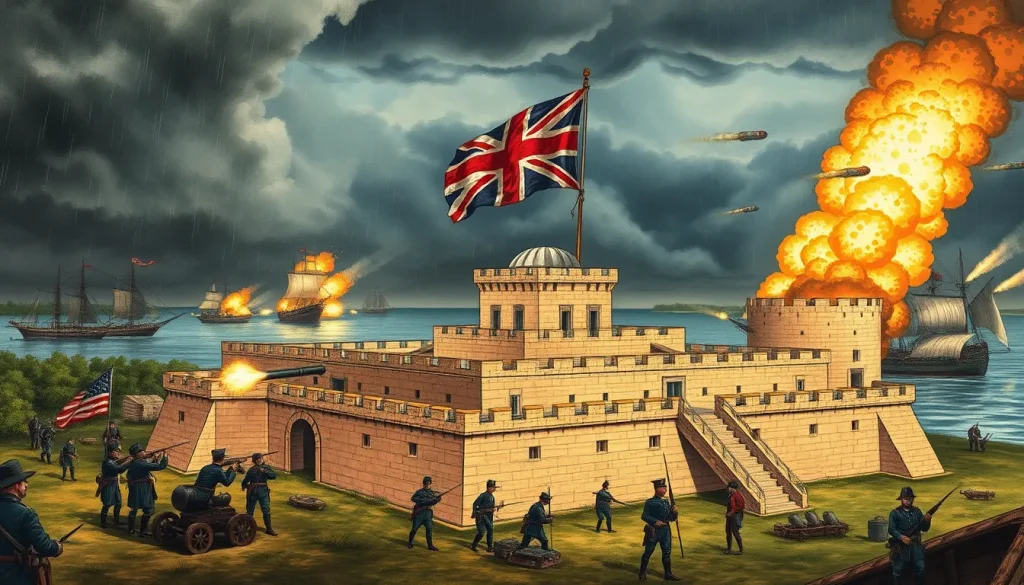
The British bombardment of Fort McHenry on September 13–14, 1814, was a pivotal engagement in the Chesapeake campaign of the War of 1812. The fort, guarding Baltimore harbor, withstood over twenty-five hours of naval artillery fire from a British squadron, causing the British to abandon their combined land and sea assault on the city. This defense became a symbolic American victory and directly inspired Francis Scott Key to write the poem that would become the United States national anthem.
Historical Context
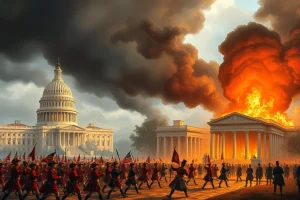
By 1814, the War of 1812 had reached a critical stage. The defeat of Napoleon in Europe allowed Britain to transfer veteran troops and naval forces to North America, escalating the conflict along the United States east coast. Vice Admiral Alexander Cochrane and Major General Robert Ross led a campaign that culminated in the burning of Washington, D.C., on August 24, 1814. After this success, the British turned toward Baltimore, a larger and more strategically vital port. Baltimore’s extensive harbor and privateering activity made it a primary target. Expecting an attack, the city’s residents and military leaders had spent months fortifying the harbor and surrounding heights, with Fort McHenry as the centerpiece.
What Happened
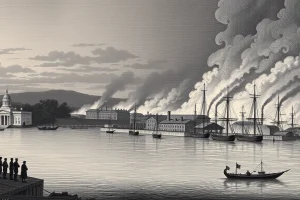
On the morning of September 12, 1814, British troops landed at North Point on the Patapsco River and advanced toward Baltimore. After a skirmish in which General Ross was killed, command passed to Colonel Arthur Brooke. Meanwhile, a British naval squadron under Cochrane moved up the Patapsco. On September 13, the British bomb ships and a rocket vessel began a fierce bombardment of Fort McHenry, while American defenders, commanded by Major George Armistead, returned fire. Despite heavy shelling and a few close calls—including a bomb that struck the powder magazine without causing a catastrophic explosion—the fort held. After over 25 hours, the British ceased fire and withdrew, realizing they could not force a passage or reduce the fort. The land assault was called off, and the British sailed away on September 15.
Why It Matters
The survival of Fort McHenry had immediate and lasting consequences. The British withdrawal from Baltimore preserved a key American port and boosted morale, especially after the burning of Washington. Strategically, it forced the British to abandon their Chesapeake campaign and contributed to the peace negotiations that led to the Treaty of Ghent later that year. The bombardment also produced Francis Scott Key’s “The Star-Spangled Banner,” which became a national symbol of resilience. Historians view the defense as an American victory, though they debate its strategic weight compared to other engagements in the war.
Prelude
Before the bombardment, both sides prepared for a decisive confrontation around Baltimore. The Americans fortified Hampstead Hill east of the city with about 10,000 troops and 100 guns. Fort McHenry, located on a peninsula at the harbor entrance, was reinforced with 1,000 soldiers and additional gun batteries. The harbor approaches were obstructed with sunken ships and a boom chain. The British planned a coordinated land and sea attack: Brooke’s army would advance from the east while the navy would reduce Fort McHenry and sail into the harbor to support the infantry. The initial land engagement at North Point on September 12 delayed the British but cost them their commander, Robert Ross.
Forces and Commanders
American: Major George Armistead commanded the Fort McHenry garrison, which numbered close to 1,200 men after reinforcements from U.S. Army regiments, Maryland militia, artillery companies, and the Chesapeake Flotilla. They manned the fort’s 18- and 24-pounder cannons, plus an outer water battery with additional 18-, 24-, and 36-pounder guns. Supporting forts and batteries on the opposite shore, including the Lazaretto and Fort Covington, contributed to the harbor defense.
British: Vice Admiral Alexander Cochrane commanded the naval force, anchored in the Patapsco River. The bombardment squadron consisted of five bomb ships—HMS Terror, Volcano, Meteor, Devastation, and Aetna—and the rocket ship HMS Erebus, supported by frigates and smaller warships. Colonel Arthur Brooke commanded the army ashore after Ross’s death. The naval force was unable to bring its heavy frigates close to the fort due to shallow water, so the bomb and rocket ships conducted the bombardment from a distance of about two miles.
Battlefield and Map Context
Fort McHenry, a star-shaped masonry fort built in 1800, sat on a peninsula at the entrance to Baltimore’s inner harbor, about two miles south of the city. The Patapsco River’s Northeast Branch passed to the east, and the Ferry Branch to the west. The fort’s location controlled the approach to the city, but it lacked bombproof shelters, leaving defenders exposed. East of the fort, the Lazaretto battery and gun barges guarded the channel, while sunken ships and a boom chain created a physical barrier. To the west, Fort Covington and Battery Babcock protected the indirect route. The British bomb ships anchored just out of range of the fort’s heavy guns but close enough to lob their high-trajectory shells over the walls.
Battle Chronology
September 13: At 6:00 a.m., the weather was cloudy and foggy. The British ships began taking positions. At 6:30 a.m., HMS Terror fired the first bomb shell at the fort. Other bomb ships and the Erebus joined, subjecting the fort to a heavy and continuous barrage. Major Armistead ordered the fort’s guns to return fire. Although the British ships were initially in range, they soon withdrew to a safe distance, keeping up the bombardment. By mid-morning, the British had fired over 1,500 shells, rockets, and round shot. Around 2:00 p.m., a bomb exploded over a bastion, killing Lieutenant Levi Clagett and wounding several others. Another bomb struck the powder magazine but failed to penetrate, only damaging the roof. Armistead then ordered the powder barrels to be distributed along the walls to avoid a catastrophic explosion. In the afternoon, Cochrane signaled the bomb ships to move closer, believing the fort was suppressed. As they closed, Armistead ordered a furious cannonade from all guns. The Volcano and Devastation were hit multiple times; the Devastation began taking on water. Cochrane then ordered the ships to move back out of range.
Night: The bombardment continued through the night, though at a reduced rate. Cochrane planned a diversionary attack on the western forts to support Brooke’s expected land assault, but the message did not reach Brooke in time. The British launched a small barge attack on the Ferry Branch, which was repelled by gunfire from Fort Covington and Battery Babcock.
September 14: The British ceased fire early in the morning. At about 9:00 a.m., Armistead ordered the small storm flag lowered and the large 30-by-42-foot garrison flag raised, a signal that the fort had not surrendered. Key, watching from a truce ship, saw the flag and later composed his poem. The British fleet remained in the river until September 15, then sailed away, completing the withdrawal.
Casualties and Losses
American casualties at Fort McHenry were relatively light: 4 killed and 24 wounded. The British naval force suffered only 1 wounded, according to the American Battlefield Trust, but the bomb ships were damaged. Land fighting at North Point had already cost the British a general and numerous casualties. The bombardment itself did not cause heavy losses because the Americans were well protected outside the fort’s walls, and the British aimed mostly at the fort itself rather than the surrounding batteries.
Result
The British bombardment failed to take Fort McHenry or force its surrender. The fort remained operational, and the harbor defenses were impenetrable to the British navy. Colonel Brooke, seeing that a land assault would face overwhelming odds without naval support, ordered the withdrawal of British troops. The British gave up their attack on Baltimore, and their fleet departed on September 15. The result was a clear American victory.
Strategic Consequences
Baltimore was saved, and the British Chesapeake campaign ended. The British expeditionary force sailed south to attack New Orleans, where it would meet another defeat in January 1815. The victory at Fort McHenry boosted American morale and provided a powerful national symbol. It also contributed to the British decision to negotiate peace, as they realized that further operations on the American coast would be costly. The Star-Spangled Banner became an enduring emblem of national identity, and the defense of Fort McHenry is considered a turning point in the war.
Primary Accounts
Francis Scott Key’s own account, written on board the truce ship, is the most famous firsthand description. Key, with John Skinner and Dr. William Beanes, watched the bombardment and later wrote the lyrics to “The Star-Spangled Banner.” A young British sailor later described the “hissing rockets and fiery shells” as a memorable spectacle. Major Armistead’s official report to Secretary of War John Armstrong provides the American perspective. A contemporary issue of Niles’ Weekly Register recorded the intense exchange, noting that houses in Baltimore shook “to their foundations.”
Battlefield Today
Fort McHenry is now a National Monument and Historic Shrine, managed by the National Park Service. Visitors can tour the restored star fort, view the surviving powder magazine and ramparts, and see replicas of the garrison flag. The site includes a visitor center and exhibits on the bombardment and the history of the flag. It is located at 2400 East Fort Avenue in Baltimore, Maryland, and remains a popular site for commemorating the War of 1812.
Primary Sources
The most relevant primary sources include Major George Armistead’s official report to the Secretary of War (September 24, 1814), which details the bombardment and the fort’s defense. Francis Scott Key’s draft of “The Defence of Fort McHenry” (later “The Star-Spangled Banner”), written in September 1814, provides a poetic but personal account. The truce ship’s log and accounts by John S. Skinner add context. Contemporary newspaper accounts, such as those in Niles’ Weekly Register and The Baltimore American, offer immediate coverage. All these sources must be used with awareness of their patriotic tone and limited perspective; they primarily represent the American view.
Further Reading
- National Park Service. “Bombardment of Fort McHenry Part 1 and 2.” NPS.
- American Battlefield Trust. “Fort McHenry Battle Facts.” Battlefields.org.
- Hickey, Donald R. The War of 1812: A Forgotten Conflict. University of Illinois Press, 1989.
- Sheads, Scott S. The Sea and the Stars: The U.S. Navy and the Fort McHenry Battle (or related works).
References
- National Park Service. “Bombardment of Fort McHenry Part 1.” https://www.nps.gov/fomc/learn/historyculture/bombardment-of-fort-mchenry-pt-1.htm
- National Park Service. “Bombardment of Fort McHenry Part 2.” https://nps.gov/fomc/learn/historyculture/bombardment-of-fort-mchenry-pt-2.htm
- American Battlefield Trust. “Fort McHenry Battle Facts.” https://www.battlefields.org/learn/war-1812/battles/fort-mchenry
- American Battlefield Trust. “O Say Can You See: The Bombardment of Fort McHenry.” https://www.battlefields.org/learn/articles/o-say-can-you-see-bombardment-fort-mchenry
FAQ
Why couldn't the British fleet sail past Fort McHenry?
The British needed to reduce the fort to pass, but shallow water kept their heavy ships far from the fort. The bomb and rocket ships could only lob shells, and the defenses (sunken ships, boom chain, gunboats) prevented any amphibious breakthrough.
Did the bombardment actually damage the fort?
Yes, but not critically. A bomb hit the powder magazine roof, and several buildings were damaged, but the fort's walls held and casualties were light.
What role did Francis Scott Key play?
Key was on a truce ship to negotiate prisoner release. He witnessed the bombardment and the raising of the large flag on the morning of September 14, inspiring him to write the poem that became the Star-Spangled Banner.
Leave a Reply