
Short Answer
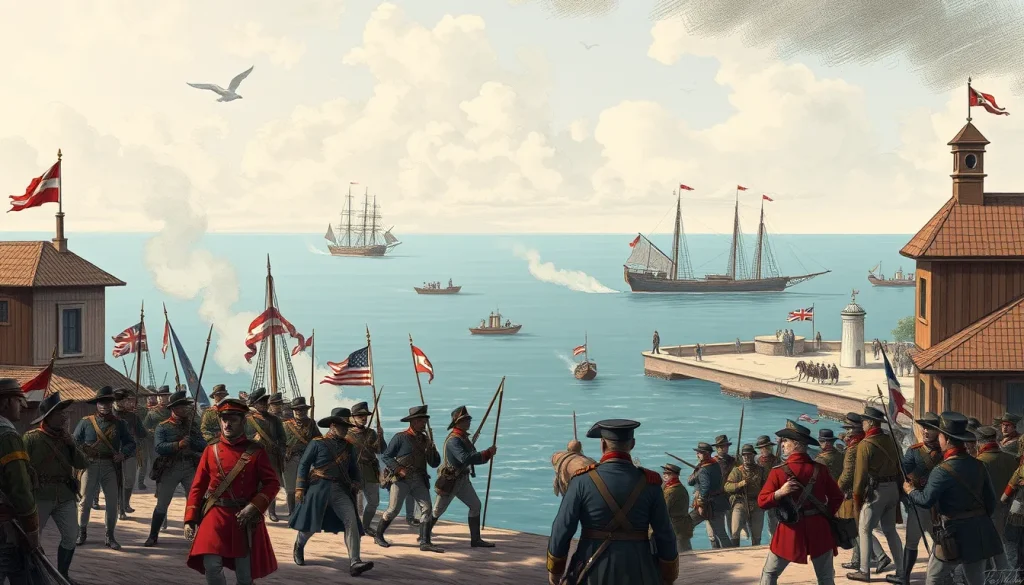
The British Capture of Pensacola refers to the occupation of the Spanish town of Pensacola in West Florida by British forces in August 1814, transforming it into a staging ground for operations against the United States during the War of 1812. This occupation was brief, as American forces under Major General Andrew Jackson captured the town on November 7, 1814, compelling the British and their Indigenous and refugee allies to withdraw. The episode proved significant in the Gulf Coast theater, shaping the strategic context and influencing the subsequent American defense of New Orleans.
Historical Context
In 1814, the War of 1812 had reached a decisive phase in the Gulf Coast region. Great Britain, seeking to open a new front against the United States, planned a major expedition to seize New Orleans and control the Mississippi River. The British commander, Vice Admiral Sir Alexander Cochrane, envisioned a coordinated assault involving regular troops, naval forces, and auxiliary units raised from enslaved African Americans and Southern Indigenous peoples, particularly the Creek and Seminole nations. Spain, still nominally neutral but weakened by the Napoleonic Wars, held nominal sovereignty over West Florida, including Pensacola. The Spanish governor, Mateo González Manrique, allowed the British to occupy the town in August 1814, effectively granting them a forward base without outright ceding it. This decision was influenced by Spain’s recent alliance with Britain against France and the increasing threat from American expansionism. For the United States, the presence of a British base at Pensacola posed a direct danger to the American-held territories along the Gulf and threatened to disrupt communication with the southern frontier. Andrew Jackson’s earlier campaign against the Red Stick Creek at the Battle of Horseshoe Bend had broken Indigenous resistance in the region, but it also left many Creek warriors and fugitive slaves seeking refuge with the British, who promised freedom and support.
What Happened
In August 1814, a British force under Major Edward Nicolls of the Royal Marines and Captain William Percy of the Royal Navy arrived at Pensacola. With Spanish permission, they established a garrison, fortified the town, and began recruiting from the local Creek and Seminole population and from runaway slaves. The British also issued a proclamation offering freedom and land to enslaved Americans who joined their cause, a move that alarmed Southern planters and American officials. By October, the British had gathered a mixed force of roughly 200 Royal Marines and several hundred Indigenous warriors, though the total remained modest compared to American forces in the region. Meanwhile, Andrew Jackson, fresh from his victories over the Creek, assembled an army of approximately 4,000 troops—mostly Tennessee and Kentucky militia, U.S. regulars, and allied Indigenous warriors—and marched toward Pensacola. On November 6, Jackson arrived outside the town and sent a demand for surrender to Governor Manrique, warning that Spanish neutrality had been violated by their cooperation with the British. The governor refused, and on November 7, Jackson’s infantry launched a direct assault through the town. The British and Spanish forces offered only token resistance; the Spanish governor quickly sought terms, and his forces capitulated. The British contingent, however, withdrew to Fort San Carlos, and after spiking the guns and destroying the powder magazine, they evacuated to their ships and departed. American casualties were minimal—reported as 18 killed and wounded—while British and Spanish losses were similarly light, perhaps 15 killed or wounded, though some sources suggest even lower figures.
Why It Matters
The capture of Pensacola eliminated the British forward base on the Gulf Coast, depriving them of a critical staging point for support of the expedition against New Orleans. It also disrupted British efforts to organize a sizable force of Indigenous warriors and refugee slaves, who were scattered by the withdrawal. For the United States, the seizure—though done without explicit authorization from Washington—was a strategic success that allowed Jackson to consolidate his forces and shift his attention to the defense of New Orleans, where he would win a decisive victory in January 1815. The episode had significant diplomatic repercussions, as Spain protested the violation of her neutral territory, and the Madison administration faced embarrassment both at home and abroad. Yet Jackson’s forceful action reinforced his popular image as a decisive military leader and contributed to his later political career. Historians interpret the episode as evidence of the chaotic and contested nature of the southeastern borderland, where imperial boundaries and allegiances were fluid, and where American, British, Spanish, and Indigenous interests collided. The event also underscored the crucial role of slavery and race in the war, as the British promise of freedom to enslaved people threatened the American social order.
Prelude
The British decision to occupy Pensacola in August 1814 came as part of a broader strategy to project naval power into the Gulf of Mexico and to support a land invasion of the United States. Pensacola’s excellent harbor and existing fortifications made it an ideal base, even though it lay on neutral Spanish soil. Governor Manrique’s acquiescence was driven by a combination of wartime expediency and pressure from British naval commanders, who threatened to treat the town as an enemy if cooperation was refused. For the Americans, the British presence represented an immediate danger, especially after the British had earlier seized Fort Bowyer at Mobile Point in September, closing Mobile Bay to American shipping. Jackson, whose orders allowed him to pursue action against the British, decided to act without awaiting specific instructions from Washington, a move that reflected his aggressive interpretation of his command and his conviction that Spain had forfeited its neutrality by aiding the British.
Forces and Commanders
The American force was commanded by Major General Andrew Jackson, numbering approximately 4,000 men, including Tennessee and Kentucky militia, U.S. regulars, and contingents of Choctaw and Cherokee allies. Jackson’s force was battle-hardened from the Creek campaign and was well equipped for mobility. The British contingent was led by Major Edward Nicolls, a Royal Marine officer, and Captain William Percy, RN. Their force consisted of about 200 Royal Marines and naval personnel, supported by several hundred Creek and Seminole warriors who had fled American vengeance. The Spanish garrison, commanded by Governor Mateo González Manrique, was small and poorly armed, and it played only a marginal role in the defense. The British and Spanish presence at Pensacola was thus a combined force, though command relations were tense and coordination limited.
Battlefield and Map Context
Pensacola was located on a bay on the northern Gulf of Mexico coast, in the Spanish colony of West Florida. The town consisted of a harbor protected by Santa Rosa Island, a fort (Fort San Miguel, the former British Fort George) on a hill overlooking the settlement, and an associated battery. The terrain was sandy, with pine flatwoods and swamps surrounding the town. Jackson approached overland from the east, and his assault route followed the main road into the town. The British had established defensive positions at the fort and a battery covering the harbor entrance, but they did not prepare extensive field fortifications outside the town, believing that the Spanish authority would deter an American attack. Map context is essential for understanding the strategic significance: Pensacola controlled the only good deep‐water harbor between New Orleans and the Atlantic coast of Florida, making it a critical naval base.
Battle Chronology
– August 1814: British forces under Nicolls and Percy arrive at Pensacola and begin establishing a base with Spanish permission.
– September–October 1814: British efforts to recruit Indigenous warriors and runaway slaves intensify; they also raid American settlements along the Gulf.
– November 6, 1814: Jackson’s army arrives near Pensacola; he sends a message to Governor Manrique demanding surrender.
– November 7, 1814: Jackson launches an infantry assault through the town; the Spanish governor capitulates, and British forces withdraw to Fort San Carlos.
– November 8–9, 1814: British destroy the fort and evacuate by ship, ending the occupation.
Casualties and Losses
Exact casualties are uncertain. The American Battlefield Trust reports 18 American and 15 British killed or wounded, but other sources, such as an overview at thewarof1812.org, state that casualties were “minimal” and that the town was captured without significant resistance. The discrepancy likely arises from the lack of a formal battle; the British and Spanish forces did not put up a determined defense. Spanish losses are rarely enumerated. Given the rapid collapse of the defense, overall casualties were certainly low, likely in the dozens at most.
Result
The American capture of Pensacola on November 7, 1814, was a decisive tactical victory for Andrew Jackson. The British were forced to abandon a vital base, and the Spanish governor formally surrendered the town to American authority. The immediate result was the denial of Pensacola to the British, who retreated to their ships and sailed away, eventually regrouping at other locations. For the Americans, the success boosted morale and provided a secure jumping‐off point for further operations, while also removing a source of support for Indigenous and refugee slave forces that had harassed American frontiers.
Strategic Consequences
The fall of Pensacola disrupted British plans to launch a coordinated campaign against New Orleans from multiple directions. Without the base at Pensacola, the British expeditionary force had to rely on a longer supply line and lost the support of the Indigenous warriors and refugee slaves that had been assembled there. This contributed to the British failure at the Battle of New Orleans in January 1815. For the United States, the capture of Pensacola allowed Jackson to consolidate his forces and build fortifications along the Mississippi, which proved crucial in the defense of New Orleans. The episode also had lasting diplomatic consequences: Spain’s cooperation with Britain and the subsequent American invasion of its territory worsened already tense relations between Washington and Madrid, and contributed to the eventual transfer of Florida to the United States in 1819.
Primary Accounts
Contemporary accounts include official correspondence from Jackson to Secretary of War John Armstrong, describing his operations and the capture of Pensacola. British reports, including those from Nicolls and Percy, are held in the British National Archives and recount the occupation and withdrawal. Local Spanish records, particularly from the office of Governor Manrique, document the British presence and the surrender. These sources, however, often reflect the biases and interests of their authors—Jackson emphasized the necessity of his action, while British officers sought to justify their retreat. A useful scholarly compilation is Nathaniel Millett’s study in the Florida Historical Quarterly, which synthesizes primary evidence from multiple sides.
Battlefield Today
The site of the 1814 encounter is now part of the modern city of Pensacola, Florida. The historic forts that guarded the town, including Fort San Miguel (formerly Fort George) and the remnants of fortifications, are now within or near the Pensacola Naval Air Station and public parks. Interpretive markers along the Pensacola Heritage Trail and at the T.T. Wentworth Jr. Florida State Museum provide information about the War of 1812 events. The original fortifications have largely been altered or eroded, but the location is recognized as a historic site. Visitors can view commemorative plaques and exhibits that explain the British occupation and Jackson’s capture.
Primary Sources
Key primary sources include Andrew Jackson’s letters and reports, particularly his dispatch of November 14, 1814, to the Secretary of War. These are housed in the Library of Congress and the National Archives in Washington, D.C. British official correspondence, such as Vice Admiral Cochrane’s instructions and Captain Percy’s narrative, are in the National Archives at Kew, UK. The Spanish side is documented in the records of the Spanish governor of West Florida, which are preserved in the Archivo General de Indias in Seville, Spain. These sources provide direct testimony but reflect the conflicting viewpoints of warring parties; none is completely impartial.
Further Reading
- Hickey, Donald R. The War of 1812: A Forgotten Conflict. University of Illinois Press, 2012.
- Lambert, Andrew. The Challenge: Britain Against America in the Naval War of 1812. Faber and Faber, 2012.
- Latimer, Jon. 1812: War with America. Harvard University Press, 2007.
- Millett, Nathaniel. “Britain’s 1814 Occupation of Pensacola and America’s Response: An Episode of the War of 1812 in the Southeastern Borderlands.” Florida Historical Quarterly 84, no. 2 (2005).
- Owsley, Frank. Struggle for the Gulf Borderlands: The Creek War and the Battle of New Orleans. University of Florida Press, 1981.
References
- American Battlefield Trust, “Pensacola (1814) Battle Facts and Summary,” accessed February 2025, https://www.battlefields.org/learn/war-1812/battles/pensacola.
- Millett, Nathaniel, “Britain’s 1814 Occupation of Pensacola and America’s Response,” Florida Historical Quarterly 84, no. 2 (2005), https://stars.library.ucf.edu/cgi/viewcontent.cgi?article=4419&context=fhq.
- “British Operations at Pensacola – War of 1812,” thewarof1812.org, accessed February 2025, https://thewarof1812.org/battles/british-operations-at-pensacola/.
FAQ
Why did the British occupy Pensacola?
The British occupied Pensacola in August 1814 as a strategic base to support an attack on New Orleans, to recruit Indigenous warriors and runaway slaves, and to threaten American borders, relying on Spain's weak neutrality and the governor's cooperation.
How did Andrew Jackson capture Pensacola?
Jackson marched about 4,000 troops to Pensacola on November 6, 1814, demanded Spanish surrender, and after refusal launched an assault on November 7. The Spanish governor capitulated after token resistance, while British forces withdrew to their ships and evacuated.
What was the strategic importance of Pensacola?
Pensacola's deep-water harbor and fortifications made it a vital naval base and assembly point for British forces in the Gulf. Its capture denied the British a staging ground and allowed the Americans to secure the Gulf Coast and prepare for the defense of New Orleans.



Leave a Reply