
Short Answer
The demilitarization of the Great Lakes refers to the process by which the United States and Great Britain agreed, in the years following the War of 1812, to sharply reduce and limit their naval forces on the Great Lakes and Lake Champlain. This process culminated in the Rush-Bagot Agreement of 1817, an exchange of diplomatic notes that restricted each side to a few small armed vessels and prohibited the construction of new warships on these waters. The agreement is historically significant as one of the first successful arms control arrangements in modern history and a foundation of the peaceful U.S.-Canadian border.
Historical Context
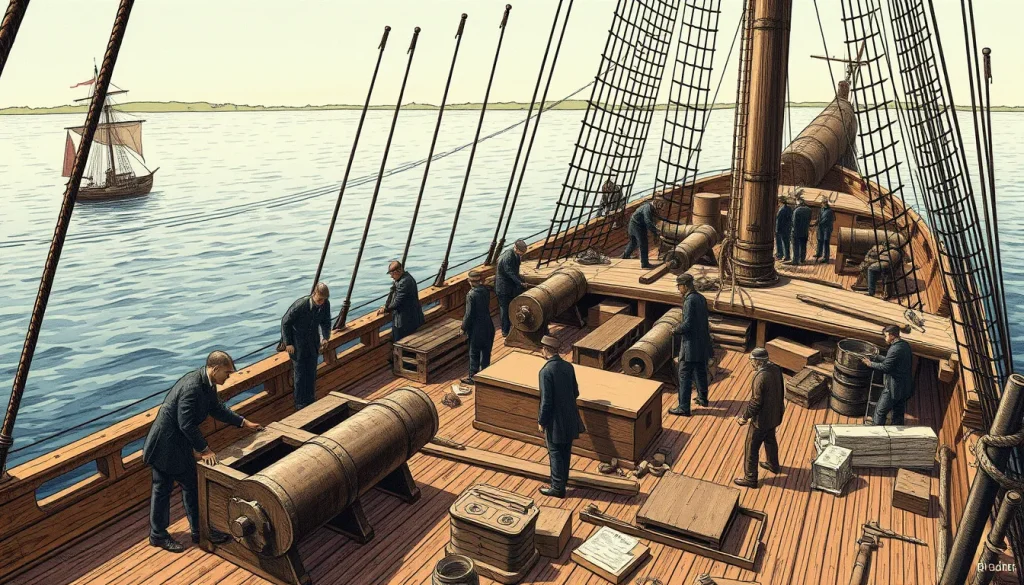
The War of 1812 featured intense naval combat on the Great Lakes, where both American and British forces built substantial fleets of warships to control strategic waterways and supply lines. Battles such as the Battle of Lake Erie (1813) and the Battle of Lake Champlain (1814) demonstrated the critical importance of naval superiority in the region. After the Treaty of Ghent ended the war in December 1814, both nations faced the expensive prospect of maintaining these fleets in peacetime. The United States, with its larger population and industrial capacity, held a long-term advantage in any naval competition, while Britain, concerned about the cost of defending its Canadian provinces, sought to avoid an arms race. Moreover, the wartime destruction and the potential for future conflict made disarmament an attractive option to both governments.
What Happened
In February 1815, the U.S. Congress authorized President James Madison to sell or lay up most American warships on the Great Lakes, effectively halting active naval construction. Britain, meanwhile, initially reinforced its naval presence, leading to fears of a renewed arms race. In response, U.S. Secretary of State James Monroe instructed John Quincy Adams, the American minister in London, to propose a mutual limitation of naval forces on the lakes. After initial British reluctance, negotiations moved to Washington, where British Minister Charles Bagot and Acting Secretary of State Richard Rush exchanged notes on April 28 and 29, 1817. The agreement limited each side to one vessel not exceeding 100 tons burden with a single 18-pounder cannon on Lake Ontario, two similar vessels on the Upper Lakes, and one on Lake Champlain. All other armed vessels were to be dismantled, and no new warships were to be built or armed on these lakes. The notes provided for termination with six months’ notice. The agreement was submitted to the U.S. Senate in April 1818 and formally ratified on April 16, 1818.
Why It Matters
The Rush-Bagot Agreement prevented a potentially ruinous naval arms race on the Great Lakes and helped solidify the peace between the United States and British North America. It established a pattern of mutual restraint that contributed to the long era of peaceful relations along the border. The agreement also encouraged economic development by freeing the lakes for trade and commerce without the menace of military confrontation. Although later revised and reinterpreted, the Rush-Bagot Agreement remains a symbol of the enduring friendship between the United States and Canada and is cited as a model of successful arms control.
Definition
The demilitarization of the Great Lakes is the reduction and limitation of naval military forces on Lake Ontario, the Upper Lakes (Huron, Michigan, Superior, and Erie), and Lake Champlain through diplomatic agreement. It involved dismantling existing warships, prohibiting new construction, and restricting each nation to a minimal number of small vessels for patrol and revenue enforcement.
Background
The War of 1812 brought unprecedented naval construction to the Great Lakes. Both the United States and Britain built large warships at ports such as Sackets Harbor, New York, and Kingston, Ontario. Control of the lakes was essential for troop movements and supply. After the war, the cost of maintaining these fleets weighed heavily on both treasuries. The United States, with its greater industrial potential, could outbuild Britain in the long run, but Britain’s global naval supremacy made American coastal defenses a priority. This strategic calculus led to the initial American proposal for disarmament.
How It Worked
The Rush-Bagot Agreement operated through an exchange of diplomatic notes, not a formal treaty, which allowed for flexibility. It specified numerical limits, maximum tonnage (100 tons), and armament (one 18-pounder cannon) for the allowed vessels. It required the dismantling of all other armed vessels and prohibited the building or arming of new warships on the lakes. It also directed that the permitted vessels be restricted to services that would not interfere with the other party’s vessels. The agreement could be annulled with six months’ notice, providing a mechanism for either side to withdraw if circumstances changed.
Competing Viewpoints
Historians have debated the effectiveness of the Rush-Bagot Agreement. Some, like Stanley L. Falk in his 1961 article “Disarmament on the Great Lakes: Myth or Reality?”, argued that the agreement did not truly demilitarize the lakes because it left fortifications and garrisons untouched, and naval forces were not significantly reduced until much later. Others contend that the agreement was a crucial confidence-building measure that, despite its limitations, prevented an arms race and set a precedent for future disarmament. The debate centers on whether the agreement’s primary impact was symbolic or substantive.
Role in the War of 1812
The demilitarization of the Great Lakes was a direct response to the naval arms race that characterized the war. The heavy investment in warships and the battles fought on the lakes highlighted the destructiveness of military competition in the region. The agreement sought to prevent a recurrence by limiting peacetime naval strength, thereby reducing the likelihood of accidental conflict and the capacity for rapid military escalation. It was, in effect, a lesson drawn from the war’s experience.
Consequences and Historical Interpretation
The Rush-Bagot Agreement led to the scrapping or laying up of most warships on the lakes. The remaining vessels were used for customs and patrol duties. Over time, the agreement became a foundation of U.S.-Canadian cooperation and was incorporated into the broader disarmament framework of the Treaty of Washington (1871). In the 20th century, modifications permitted naval training vessels and modern law enforcement with prior notification. Historians generally view the demilitarization as a successful, albeit imperfect, arms control measure that helped ensure a peaceful boundary, though some argue that its significance lies more in its symbolic value than in its immediate military impact.
Primary Sources
The essential primary sources are the original exchange of notes between Charles Bagot and Richard Rush, dated April 28 and 29, 1817. These documents outline the agreement’s terms and are available in Treaties and Other International Acts of the United States of America, edited by Hunter Miller (1931). Also relevant are the earlier instructions from Secretary of State James Monroe to John Quincy Adams, and Adams’s diplomatic correspondence from London, which reveal the motivations behind the American proposal. The Avalon Project at Yale University provides online access to the full text of the notes.
Further Reading
- Falk, Stanley L. “Disarmament on the Great Lakes: Myth or Reality?” U.S. Naval Institute Proceedings, December 1961.
- Corey, A.B. The Rush-Bagot Agreement. (Scholarly study of the agreement’s origins and impact.)
- Allen, Robert S. “The Rush-Bagot Agreement and the Demilitarization of the Great Lakes.” (Available in edited collections on U.S.-Canadian relations.)
- Avalon Project – Exchange of Notes Relative to Naval Forces on the American Lakes: https://avalon.law.yale.edu/19th_century/conv1817.asp
References
- Avalon Project, “Exchange of Notes Relative to Naval Forces on the American Lakes,” Yale Law School, https://avalon.law.yale.edu/19th_century/conv1817.asp.
- Tasikas, Vasilios. “Rush-Bagot: An Old Treaty Gets Dusted Off.” U.S. Naval Institute Proceedings, March 2006.
- Falk, Stanley L. “Disarmament on the Great Lakes: Myth or Reality?” U.S. Naval Institute Proceedings, December 1961.
- Miller, Hunter, ed. Treaties and Other International Acts of the United States of America. Vol. 2, 1776–1818. Washington: Government Printing Office, 1931.
- Wikipedia, “Rush–Bagot Treaty,” https://en.wikipedia.org/wiki/Rush%E2%80%93Bagot_Treaty.
FAQ
What was the Rush-Bagot Agreement?
It was a diplomatic exchange of notes in 1817 between the United States and Great Britain that limited naval armaments on the Great Lakes and Lake Champlain to a few small vessels.
Did the demilitarization completely remove military presence from the lakes?
No, it limited naval forces to four small patrol vessels per side and prohibited new warships, but it did not address forts or land garrisons.
Is the Rush-Bagot Agreement still in effect?
Yes, it remains in force, though it has been modified through diplomatic notes to allow modern training and law enforcement vessels on the lakes.





Leave a Reply