
Short Answer
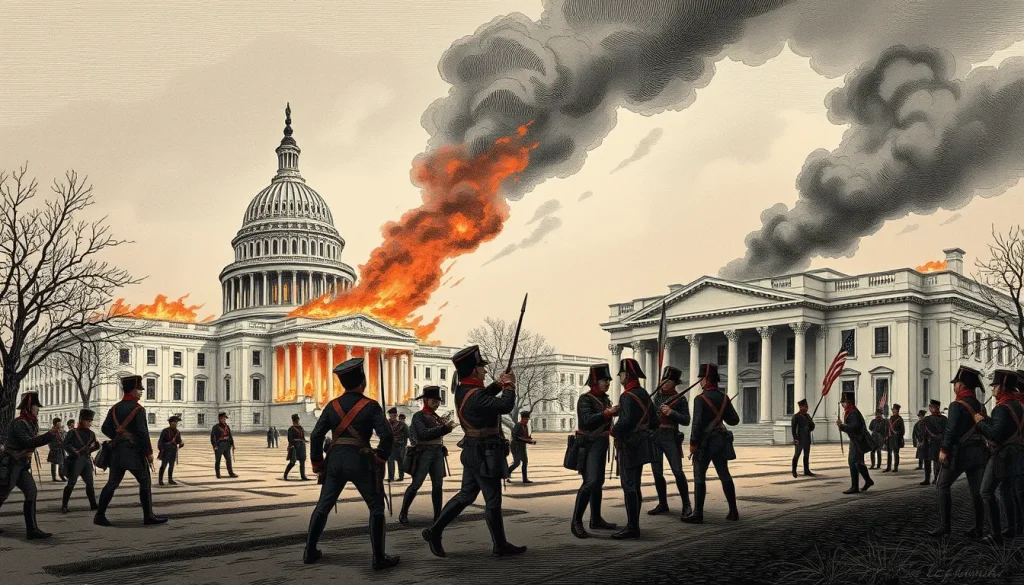
The burning of Washington, D.C., by British forces on August 24–25, 1814, was a defining moment in the War of 1812. British troops under Major General Robert Ross and Rear Admiral George Cockburn set fire to the principal public buildings of the American capital, including the U.S. Capitol, the President’s House, the Treasury, and the War and State Department, in retaliation for American destruction of public buildings in Upper Canada. It remains the only time a foreign power captured and burned the capital of the United States.
Historical Context
After the defeat of Napoleon in Europe in 1814, Britain was able to commit more resources to the war in North America. A British expeditionary force under Major General Robert Ross and Rear Admiral George Cockburn entered the Chesapeake Bay in August 1814, aiming to raid coastal cities and draw American forces away from Canada. The British selected Washington, D.C., because of its poor defenses and political importance. On August 24, the Americans were routed at the Battle of Bladensburg, leaving the capital open to capture.
What Happened
After Bladensburg, American officials and many residents fled the city. President James Madison and his wife Dolley Madison fled, though Dolley oversaw the rescue of a Gilbert Stuart portrait of George Washington. As American troops withdrew, they set fire to the Navy Yard and a frigate under construction to prevent capture. That evening, British forces entered Washington and systematically burned the public buildings. According to Ross’s report, they burned “the capitol, including the Senate-house and House of Representation, the Arsenal, the Dock-yard, Treasury, War-office, President’s Palace, Ropewalk, and the great bridge across the Potomac.” The British intended to destroy only public property, sparing private homes and churches. However, George Cockburn allowed the burning of the office of the National Intelligencer newspaper in retaliation for its anti-British articles. The Patent Office was spared after superintendent William Thornton argued its contents were private property. A tragic accident occurred when gunpowder stored in a well at Greenleaf’s Point exploded, killing about thirty British soldiers. On August 25, a violent thunderstorm, possibly a tornado, extinguished many fires, and the British withdrew that evening.
Why It Matters
The burning of Washington was a psychological blow to the young republic, exposing its vulnerability. It led to widespread calls for relocation of the capital and embarrassed the Madison administration. Domestically, it fueled both anti-war sentiment (leading to the Hartford Convention) and a surge of patriotic resolve, epitomized by the successful defense of Baltimore shortly thereafter. The event also became a source of American national memory, illustrating the costs of war. Historians have debated the extent of destruction, the discipline of British troops, and the justification for the act, which was explicitly retaliation for American burnings in Canada.
Definition: The Burned Buildings
The British targeted government and military structures. The U.S. Capitol, then still incomplete, housed the Senate, House of Representatives, Library of Congress, and Supreme Court; it was extensively damaged. The President’s House (later the White House) was gutted, and its interior destroyed. The Treasury Department, which stood near the President’s House, was burned. The State and War Departments shared a building on Seventeenth Street and were burned. The Washington Navy Yard and several warships, including a frigate under construction, were set ablaze by the Americans and later by the British. The arsenal at Greenleaf’s Point was ignited, though not successfully until the accidental explosion. The three ropewalks, although private property, were burned to deny the navy cordage. The great bridge across the Potomac was also destroyed.
Background: Why the British Burned Washington
The British explicitly stated that the burning was retaliation for American destruction of public buildings in Upper Canada. In April 1813, American forces burned the parliament buildings at York (Toronto), and in December 1813, American troops set fire to Newark (Niagara-on-the-Lake), leaving many civilians homeless. British commander Robert Ross justified the burning as a necessary measure to “complete the destruction of the public buildings with the least possible delay.” The decision to strike at Washington was also a strategic demonstration of power, designed to humiliate the Madison administration and divert American forces away from Canada.
How It Worked: The Execution of the Burning
The British entered Washington after the Battle of Bladensburg. Ross and Cockburn directed their troops to set fire to designated public buildings, using combustible materials and gunpowder to accelerate the flames. They followed a deliberate policy of sparing private property, with only a few exceptions. The Capitol was burned in multiple sections, with furniture and books used as fuel. The President’s House was similarly consumed. A number of American witnesses noted the discipline of the British troops, though some looting occurred. The accidental explosion at Greenleaf’s Point caused the only significant British casualties.
Competing Viewpoints: British and American Perspectives
British officers and soldiers saw the burning as a legitimate act of retaliation for American destruction in Canada. They also believed it was a military necessity to weaken American morale and infrastructure. American leaders and citizens, however, condemned it as an act of barbarism and an attack on civilization, particularly given that it targeted the national capital. Some later American writers downplayed the scale of destruction, while others emphasized the British restraint toward private homes. The British viewpoint was also shaped by a sense that the United States had started the war with an invasion of Canada, and that retaliation was warranted.
Role in the War of 1812
The burning of Washington was part of the larger Chesapeake campaign of 1814. It demonstrated Britain’s ability to strike at the American heartland and forced the United States to consider its defensive weaknesses. Although the British withdrew quickly, the psychological impact was profound. It also set the stage for the subsequent attack on Baltimore, where British forces were repulsed at Fort McHenry. The events galvanized American resistance and partly contributed to the eventual peace negotiations in Ghent.
Consequences and Historical Interpretation
The immediate consequence was the near-total destruction of the American government’s physical infrastructure. Reconstruction took years, with the White House and Capitol being rebuilt. The event also contributed to the political fallout for the Madison administration. In the longer term, the burning became a symbol of national resilience and adversity overcome. Historical interpretation has evolved: earlier American accounts portrayed it as an act of wanton destruction, while recent scholarship emphasizes the British restraint toward private property and the explicit retaliation for American actions in Canada.
Primary Sources
Contemporary accounts include Major General Robert Ross’s official dispatch to Earl Bathurst, dated August 30, 1814, which lists the buildings destroyed and justifies the act as retaliation for American burnings in Canada. This document is reprinted by the National Park Service. Dolley Madison’s letters, particularly her note to her sister describing the rescue of the Washington portrait, provide an American firsthand perspective. The French minister’s eyewitness description of the burning, recorded in a letter, is also a valuable source. These documents carry the biases of their authors—military officials seeking to justify their actions, and American civilians expressing shock and loss—and should be read with that context in mind.
Further Reading
- Hickey, Donald R. The War of 1812: A Forgotten Conflict. University of Illinois Press, 1989.
- Lord, Walter. The Dawn’s Early Light. W.W. Norton, 1972.
- National Park Service. “Burning the Capital”. https://www.nps.gov/articles/burning-the-capital.htm
- White House Historical Association. “The Navy Yard, Treasury Department & Other Buildings”. https://www.whitehousehistory.org/the-navy-yard-treasury-department-other-buildings
References
- National Park Service. “Complete the destruction of the public buildings with the least possible delay.” Accessed 2023. https://www.nps.gov/articles/burning-the-capital.htm
- American Battlefield Trust. “The Capture and Burning of Washington, D.C.” Accessed 2023. https://www.battlefields.org/learn/articles/burning-washington-dc
- The War of 1812. “The Burning of Washington.” Accessed 2023. https://thewarof1812.org/battles/the-burning-of-washington/
- Architect of the Capitol. “A Most Magnificent Ruin: The Burning of the Capitol during the War of 1812.” Accessed 2023. https://www.aoc.gov/comment/731
- White House Historical Association. “The Navy Yard, Treasury Department & Other Buildings.” Accessed 2023. https://www.whitehousehistory.org/the-navy-yard-treasury-department-other-buildings
FAQ
Did the British burn private homes in Washington?
Generally no. British policy under Ross and Cockburn was to destroy only public buildings. Private homes and churches were spared. Exceptions included the office of the National Intelligencer newspaper and the ropewalks, which were military-related, though the latter were private property.
Why did the British burn Washington, D.C.?
The British cited retaliation for American destruction of public buildings in Upper Canada, particularly at York in 1813 and Newark in December 1813. They also aimed to demonstrate British power and demoralize the American government.
Which buildings were burned by the British in 1814?
The U.S. Capitol (including the Library of Congress), the President's House (White House), the Treasury, the State and War Department building, the Washington Navy Yard and warships, the arsenal at Greenleaf's Point, and the great bridge across the Potomac. The Patent Office was spared.



Leave a Reply