
Short Answer
The ‘once an Englishman’ doctrine was the British legal and political argument that a person born a British subject owed permanent allegiance to the Crown and could not shed that obligation by emigrating or becoming a naturalized citizen of another country. In the late eighteenth and early nineteenth centuries, especially during the Napoleonic Wars, the Royal Navy used this doctrine to justify stopping merchant and naval vessels, searching crews, and removing alleged British subjects, including men who claimed American citizenship. The dispute became a central Anglo-American grievance in the years before the War of 1812 and shaped American arguments about sailors’ rights, neutral commerce, and national sovereignty. The phrase refers here to that justification, not to a single statute or formal treaty.
Historical Context
Great Britain and Revolutionary and Napoleonic France were at war almost continuously from 1793 to 1815. The conflict demanded an enormous Royal Navy. Between 1793 and 1812, Parliament expanded the fleet from about 135 to 584 ships and increased personnel from roughly 36,000 to 114,000 seamen. The merchant marine already employed about 118,000 men in 1792, and it often offered better pay, shorter voyages, and less brutal discipline than the navy. Royal Navy wages were sometimes withheld for months to discourage desertion, while merchant crews shared in the profits of successful voyages. The result was a persistent manpower shortage that British authorities met partly through impressment, a longstanding if contested practice of forcing men into naval service.
Impressment had deep roots in English and British maritime custom. The Crown and Admiralty claimed a prerogative to seize seamen in times of emergency. By the eighteenth century, press gangs operated in British ports under the impress service, and naval officers also stopped merchant ships at sea to remove men. The practice grew more aggressive during the French wars because Britain needed sailors for blockade duty, convoy escort, and fleet operations. British officials insisted that they were not seizing foreigners as such; they were reclaiming British subjects and deserters who owed service to the Crown.
The American merchant fleet expanded rapidly in the same period, carrying goods across the Atlantic and into the Caribbean. Many British-born sailors served on American ships, attracted by higher wages and better conditions. The United States also had a relatively open naturalization policy. An immigrant could become an American citizen after a period of residence, and many sailors obtained seamen’s protection certificates to document their status. Britain, however, did not accept that naturalization dissolved the allegiance of a British-born subject. This disagreement turned ordinary merchant voyages into contested encounters over sovereignty and identity.
The legal and diplomatic setting made compromise difficult. The United States depended on neutral trade, especially after the outbreak of European war, and insisted that its flag protected all lawful members of a crew. Britain insisted on the right to search for its own subjects and deserters. The 1807 Chesapeake-Leopard affair, in which HMS Leopard fired on USS Chesapeake after the American frigate refused to allow a search, brought the issue to a crisis. Although the British government later disavowed the attack and made limited reparations, it did not abandon the underlying claim that British subjects could be recovered from foreign vessels.
What Happened
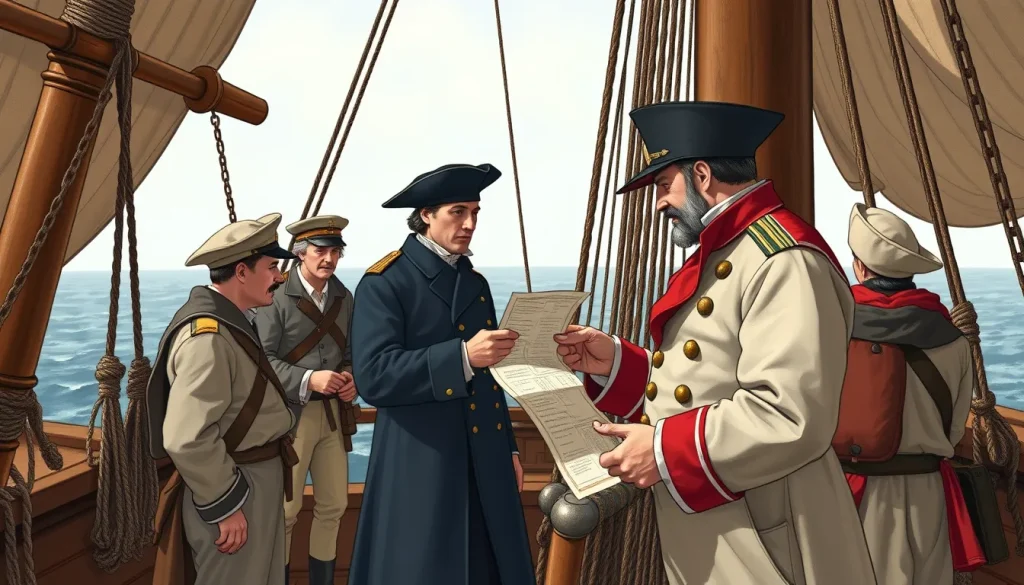
The ‘once an Englishman’ doctrine, often expressed as ‘once a subject, always a subject,’ rested on the principle of indefeasible or perpetual allegiance. British legal writers and admiralty officials argued that allegiance was a personal and permanent bond. A man born within the king’s dominions owed loyalty to the Crown from birth. Emigration, long residence abroad, or naturalization in another country could not cancel that duty. In this view, the United States could offer citizenship to immigrants, but it could not release them from their prior allegiance to Britain. British officials therefore claimed a right to board ships, mustered crews, examine documents and accents, and remove men identified as British subjects or deserters.
In practice, enforcement was rough and uncertain. Royal Navy captains and press gangs did not have reliable records for every sailor. They often relied on local knowledge, physical inspection, linguistic clues, and the testimony of officers. A sailor who possessed an American seamen’s protection certificate might still be detained if British officers doubted its authenticity or argued that it could not protect a British-born man. Native-born Americans could be mistaken for British subjects, especially if they lacked papers or spoke with accents unfamiliar to boarding officers. The burden of proof usually fell on the detained sailor and, later, on the American government seeking his release. American agents in London and consular officials handled many claims, but the process was slow and incomplete.
The doctrine was never merely an abstract legal theory. It affected thousands of seamen and became a recurring subject of Anglo-American diplomacy. American secretaries of state, ministers in London, and congressional committees protested that impressment violated American sovereignty and the rights of naturalized citizens. British ministers replied that they were exercising a necessary and lawful right to recover their own seamen. The dispute persisted through the Orders in Council, the Non-Intercourse Act, and the broader maritime crisis. When President James Madison sent his war message to Congress on June 1, 1812, impressment stood among the leading grievances, alongside trade restrictions and British support for Indigenous resistance on the American frontier. Congress declared war on June 18, 1812.
During the war, impressment continued to shape American rhetoric even as the British concentrated on the larger struggle against France. The Treaty of Ghent, signed on December 24, 1814, ended the war without mentioning impressment. The omission reflected both the difficulty of the issue and the changed strategic situation. With Napoleon defeated in 1814 and 1815, the Royal Navy no longer needed men at the same frantic rate, and impressment of American sailors effectively ceased. The doctrine itself was not formally repudiated in the treaty, leaving the legal disagreement unresolved.
Why It Matters
The ‘once an Englishman’ doctrine mattered because it converted a manpower practice into a question of national sovereignty and individual rights. For the United States, the doctrine meant that American citizenship was not fully respected on the high seas. If Britain could reclaim any sailor born in the British Isles, then American naturalization laws and seamen’s protection certificates offered uncertain protection. For Britain, the doctrine was a matter of national survival. The Royal Navy was the first line of defense against France, and British officials believed that desertion to American merchant ships weakened the fleet and undermined naval discipline.
The dispute also contributed to the outbreak of the War of 1812, though historians disagree about how much weight to give it. Earlier scholarship often treated impressment as a primary cause. Later historians have emphasized western expansionism, Indian policy, agricultural depression, and congressional politics. Some argue that impressment was more important as a symbol of British arrogance and American humiliation than as a direct military provocation. Others maintain that the issue of sailors’ rights was central to how Americans understood the conflict. The British, by contrast, generally regarded the War of 1812 as a minor theater in the global war against France and did not see impressment as a major concession worth making.
The doctrine had a long afterlife. Britain gradually moved away from perpetual allegiance in the nineteenth century, and the Naturalisation Act of 1870 allowed British subjects to renounce their allegiance when they became citizens of another state. By then, the specific maritime dispute was long over, but the principle had been tested and rejected. In American memory, impressment became part of the narrative of the War of 1812 as a second war for independence, a story that emphasized sailors’ rights and resistance to British coercion. Historians today are more cautious, noting that the war had multiple causes and that the United States itself sometimes impressed British sailors. The doctrine remains a clear example of how competing legal ideas about citizenship, allegiance, and sovereignty can drive international conflict.
Definition
The ‘once an Englishman’ doctrine was the British claim that British-born subjects could not expatriate themselves. It held that allegiance to the Crown was indelible and that naturalization in the United States did not alter the status of a British subject. The doctrine is also called indefeasible allegiance or perpetual allegiance. Under this reasoning, the Royal Navy had the right to search foreign ships for British subjects and deserters, even if those men claimed American citizenship.
Background
The doctrine drew on older English ideas about personal allegiance to the sovereign. In the eighteenth century, legal authorities such as William Blackstone described natural allegiance as a bond that could not be altered by change of time or place. British admiralty courts and naval officials applied this general principle to the problem of desertion during the French wars. Because Britain relied on the Royal Navy for survival, the claim to recover seamen was presented as a necessary exercise of sovereign right rather than an act of piracy.
How It Worked
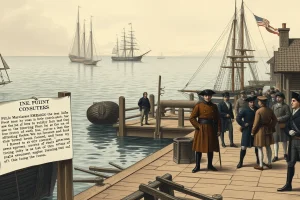
Impressment operated through both shore-based press gangs and shipboard searches. In British ports, the impress service recruited men by force or threat, often targeting sailors and maritime workers. At sea, Royal Navy officers stopped merchant vessels, including American ships, and ordered crews to muster on deck. Boarding parties inspected seamen’s protection certificates, asked questions about birthplace and residence, and sometimes seized men on the spot. Detained sailors could be taken into the Royal Navy, while American officials sought their release through diplomatic channels.
- Search and muster: British officers stopped vessels and required crews to assemble for inspection.
- Identification: Officers relied on documents, testimony, accent, and local knowledge to distinguish British subjects from Americans.
- Detention: Men identified as British subjects or deserters could be removed and forced into naval service.
- Appeal: American agents and consuls filed claims for the release of protected seamen, but success was uneven.
The system was administratively weak. Many sailors lacked reliable proof of citizenship, and British officers had incentives to err on the side of seizing men. The doctrine therefore created a wide gap between British legal theory and the lived experience of American and British sailors.
Competing Viewpoints
British officials argued that the doctrine was lawful, necessary, and consistent with the practice of other maritime powers. They maintained that Britain was not impressing Americans but recovering its own subjects. They also pointed to the threat of French invasion and the need to keep the fleet manned. Some British observers noted that the United States itself had impressed British sailors, suggesting that American protests were selective. From this perspective, impressment was an ugly but legitimate tool of national defense.
American officials and sailors rejected the doctrine as an infringement of sovereignty and individual rights. They argued that naturalization was a voluntary act that transferred allegiance, and that American citizenship should protect naturalized sailors at sea. They also objected to the practical abuse of the system: native-born Americans were sometimes seized, and the burden of proving citizenship was placed on the victim. For Americans, the doctrine represented a refusal to recognize the United States as a sovereign equal.
Historians take varied positions. Some emphasize the legal coherence of the British claim within the context of eighteenth-century ideas about allegiance. Others stress that the doctrine was increasingly out of step with American and later international practice. Many argue that the dispute was less about the number of impressed Americans than about the principle of who had the right to define citizenship. The debate over numbers continues, but most scholars agree that impressment was one of several interconnected causes of the War of 1812.
Role in the War of 1812
Impressment and the ‘once an Englishman’ doctrine gave American war advocates a powerful grievance. President Madison’s war message of June 1, 1812, listed impressment among the injuries inflicted by Britain. Congressional War Hawks from western and southern states often emphasized maritime rights alongside territorial and Indian issues. The doctrine made compromise especially difficult because Britain would not concede that naturalized Americans had ceased to be British subjects, and the United States would not accept a treaty that left its citizens liable to seizure.
During the war, British naval policy remained focused on the European conflict. The Treaty of Ghent did not resolve impressment, and the issue faded mainly because the end of the Napoleonic Wars reduced the Royal Navy’s demand for men. In that sense, the War of 1812 did not produce a clear legal victory on the doctrine. It did, however, mark a turning point in Anglo-American relations and contributed to a growing American insistence that citizenship and neutral rights should be respected at sea.
Consequences and Historical Interpretation
The immediate consequence was the end of large-scale impressment of American sailors after 1815. The longer-term consequence was the gradual rejection of perpetual allegiance in British and international law. The doctrine was not decisively defeated by the Treaty of Ghent, but it became untenable as naturalization and expatriation became more widely accepted. For the United States, the episode reinforced arguments about sailors’ rights and the protection of citizens abroad.
Historians continue to debate the relative importance of impressment in causing the war. Some see it as the central maritime grievance; others see it as one issue among many, including trade restrictions, Indian conflicts, and expansionist ambitions. The ‘once an Englishman’ doctrine remains significant because it shows how legal definitions of citizenship can become matters of war. It also illustrates the gap between official justifications and the experiences of sailors caught between empires.
Primary Sources
- British Admiralty orders and captains’ correspondence, 1793-1815. These records show how British officials understood and implemented impressment. They include instructions to naval officers, reports of boardings, and letters about detained seamen. Their limitation is that they present the British government’s perspective and often omit the voices of impressed sailors.
- American State Papers: Foreign Relations. This published collection contains diplomatic correspondence between American ministers and British officials about impressment, naturalization, and seamen’s protection. It is essential for the American side of the dispute but is selective and reflects official priorities.
- Seamen’s protection certificates and port records. These documents, issued by American officials, recorded a sailor’s claimed citizenship and physical description. They are valuable for individual cases but could be forged, lost, or rejected by British officers.
- President James Madison’s war message, June 1, 1812. Madison listed impressment among the grievances that justified war. It is a key political document, but it was written to persuade Congress and the public rather than to provide a neutral legal analysis.
- British legal treatises, including William Blackstone’s Commentaries on the Laws of England. Such works articulated ideas of natural and perpetual allegiance that British officials later invoked. They are prescriptive and reflect elite legal thought rather than the messier realities of enforcement.
Further Reading
- Bradford Perkins, Prologue to War: England and the United States, 1805-1812.
- Donald R. Hickey, The War of 1812: A Forgotten Conflict.
- Paul A. Gilje, Free Trade and Sailors’ Rights in the War of 1812.
- James Fulton Zimmerman, Impressment of American Seamen.
- J.C.A. Stagg, Mr. Madison’s War: Politics, Diplomacy, and Warfare in the Early American Republic, 1783-1830.
- Connor Rennie, ‘American Citizens, British Subjects and Rights in the Impressment Controversy,’ University of Canterbury, 2013.
References
- John P. Deeben, ‘The War of 1812: Stoking the Fires,’ Prologue (Summer 2012), National Archives, https://www.archives.gov/publications/prologue/2012/summer/1812-impressment.html.
- Connor Rennie, ‘American Citizens, British Subjects and Rights in the Impressment Controversy,’ BA Honours dissertation, University of Canterbury, 2013, https://ir.canterbury.ac.nz/server/api/core/bitstreams/d6ae9887-bd96-49cb-8784-13450144ab68/content.
- Bradford Perkins, Prologue to War: England and the United States, 1805-1812 (Berkeley: University of California Press, 1961).
- James Fulton Zimmerman, Impressment of American Seamen (Port Washington, NY: Kennikat Press, 1925).
- Donald R. Hickey, The War of 1812: A Forgotten Conflict (Urbana: University of Illinois Press, 1989).
- Paul A. Gilje, Free Trade and Sailors’ Rights in the War of 1812 (Cambridge: Cambridge University Press, 2013).
- J.C.A. Stagg, Mr. Madison’s War: Politics, Diplomacy, and Warfare in the Early American Republic, 1783-1830 (Princeton: Princeton University Press, 1983).
- William Blackstone, Commentaries on the Laws of England, Vol. 1 (Oxford: Clarendon Press, 1765).
FAQ
What did the 'once an Englishman' doctrine actually claim?
It claimed that a person born a British subject owed permanent allegiance to the Crown. Emigration or naturalization in the United States did not, in the British view, cancel that allegiance. The Royal Navy therefore asserted a right to search foreign ships and reclaim British-born sailors or deserters.
Did Britain impress American-born sailors?
Britain officially claimed it targeted only British subjects and deserters, not native-born Americans. In practice, however, identification was imperfect, and some American-born sailors were seized. The dispute often focused on naturalized Americans, whom Britain regarded as still British.
How did the doctrine affect the War of 1812?
Impressment was a major American grievance in the years before the war and appeared in President Madison's June 1812 war message. Britain refused to abandon the doctrine, and the Treaty of Ghent did not address it. The issue faded mainly after the Napoleonic Wars reduced the Royal Navy's demand for sailors.

Leave a Reply