
Short Answer
The Indigenous allies at the Battle of Châteauguay were First Nations warriors—identified in Government of Canada accounts as Mohawk, Algonquin, Huron-Wendat, and Abenaki—who fought with British, Canadian, and militia forces under Lieutenant Colonel Charles-Michel de Salaberry on October 26, 1813. The battle took place along the Châteauguay River in Lower Canada, now part of Quebec, during the War of 1812. Parks Canada’s chronology records a party of 22 Indigenous warriors under Captain Lamothe, though the wider Indigenous-British alliance in the region was larger. Their participation helped defeat an American advance on Montreal and illustrates the military and diplomatic agency of Indigenous nations during the war.
Historical Context
By 1813, the United States had failed to conquer Canada in a single campaign, but American strategy shifted toward severing the supply line between Montreal and Upper Canada. Control of the St. Lawrence River was essential to British and Canadian defence. The American plan called for two converging columns: Major General Wade Hampton would advance south of the St. Lawrence through the Châteauguay Valley toward Montreal, while Major General James Wilkinson would move down the St. Lawrence from Sackets Harbor. If either force reached Montreal, the British position in Upper Canada could be isolated.
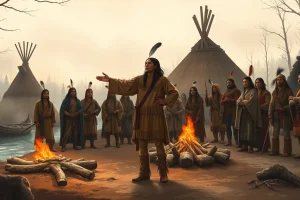
Indigenous nations in the Great Lakes and St. Lawrence Valley had their own reasons for allying with Britain. American settlement was expanding into Indigenous homelands, and many nations saw the British as a counterweight to that pressure. Long-standing diplomatic and trade relationships, reinforced by the British Indian Department, also tied communities such as the Mohawk of Kahnawake, Algonquin, Abenaki, and Huron-Wendat to the Crown. These alliances were not automatic or uniform: Indigenous communities made strategic choices, and some individuals and nations remained neutral or fought with the Americans. At Châteauguay, the Indigenous contingent was part of a broader British effort to use local knowledge, light infantry tactics, and psychological warfare against an invading army.
What Happened
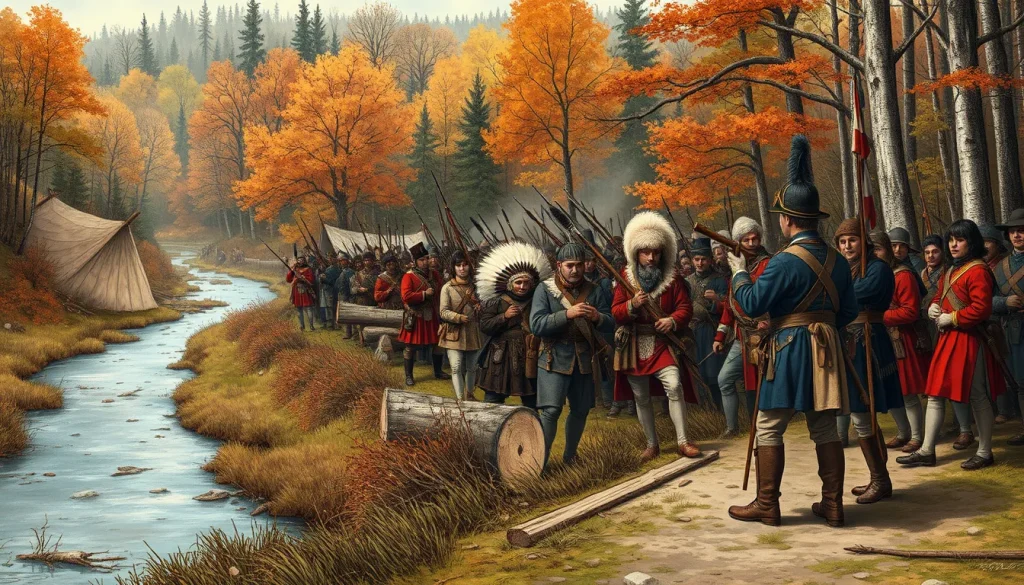
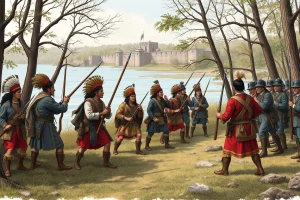
In late September 1813, Lieutenant Colonel Charles-Michel de Salaberry, commanding the British and Canadian defences along the Châteauguay, struck Hampton’s advancing column at Chateaugay Four Corners in New York. Salaberry then withdrew into Lower Canada, blocking cart roads with felled timber to slow the Americans. He chose a defensive position near Allan’s Corners, where the road ran between thick woods and a swamp, and ordered an abatis and several lines of trenches. Hampton crossed the border on October 21–23 with roughly 3,000 men and camped downriver from the Spears farm, near the site of the present-day Ormstown Fair.
On October 25, Hampton sent Colonel Robert Purdy with about 1,000 men into the woods on the south bank of the Châteauguay to outflank the Canadian position. Purdy’s march was slow and difficult. On the morning of October 26, Salaberry deployed about 300 men behind the abatis, including a party of 22 Indigenous warriors under Captain Lamothe, with a reserve of roughly 1,500 farther back. The American attack developed on both banks. On the south bank, Purdy’s advance guard engaged Captain Brugière’s militia company, while on the north bank Brigadier General George Izard’s brigade pushed toward the abatis.
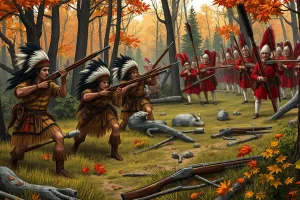
The fighting was confused and intense. At one point, Canadian Fencibles fell back behind the abatis, leading the Americans to believe they were winning. Salaberry responded by ordering bugles to sound in several directions and his men to shout, creating the impression that a much larger force was present. Indigenous war cries added to the deception. On the south bank, Captain Daly and Captain Brugière led a bayonet charge; both were badly wounded, and the militiamen withdrew. Purdy’s men pursued, burst out of the woods, and found themselves exposed to fire from the north bank. Salaberry’s enfilading volley broke their formation. Hampton, his flanking column repulsed and his main attack stalled, retreated to the United States.
Why It Matters
The immediate result was a British and Canadian victory that stopped the American advance on Montreal from the south. Together with the American defeat at Crysler’s Farm in November 1813, it ended the 1813 campaign against Montreal. The battle protected the St. Lawrence supply route and prevented the isolation of Upper Canada. British commanders credited their Indigenous allies with contributing to the defence, and the engagement became part of a wider pattern in which Indigenous warriors fought in nearly every major theatre of the war.
The longer consequences were more ambiguous. The victory helped preserve British North America, but it did not secure Indigenous land rights or political autonomy after the war. In the peace settlement, Britain largely set aside Indigenous interests, and settler expansion continued. For many Indigenous nations, participation in the War of 1812 became a basis for later treaty claims, military memory, and assertions of sovereignty, even as their contributions were often marginalized in Canadian and American national narratives. Historians continue to debate how much the small Indigenous contingent at Châteauguay affected the tactical outcome. Some emphasize the psychological impact of war cries and the deception orchestrated by Salaberry; others stress the role of Canadian regulars and militia. Most agree that Indigenous participation was symbolically and diplomatically significant, and that it must be understood within Indigenous agendas rather than only as service to Britain.
Prelude
Hampton’s advance was part of a coordinated American effort to take Montreal. After an inconclusive movement near the border, he crossed into Lower Canada in late October 1813. Salaberry, who had been watching the frontier, used delaying tactics and chose ground that negated American numerical superiority. Indigenous allies were recruited through the Indian Department and local alliances. Their exact recruitment channels are not fully documented, but Government of Canada accounts place Mohawk, Algonquin, Huron-Wendat, and Abenaki warriors at the battle, while Parks Canada records a party of 22 Indigenous warriors under Captain Lamothe.
Forces and Commanders
The British and Canadian force was commanded by Lieutenant Colonel Charles-Michel de Salaberry. It included the Canadian Voltigeurs, the Canadian Fencibles, sedentary militia from Beauharnois and neighbouring areas, and a small Indigenous contingent under Captain Lamothe. Salaberry reported only about 300 men engaged at the abatis, with a reserve of about 1,500. The American force was commanded by Major General Wade Hampton, with Colonel Robert Purdy leading the flanking column and Brigadier General George Izard commanding a brigade in the main attack. Hampton had roughly 3,000 to 4,000 men available, giving the Americans a substantial numerical advantage that the terrain and Canadian defences partly offset.
Battlefield and Map Context
The battlefield lay along the Châteauguay River, which flows north toward the St. Lawrence near Montreal. The American approach followed the road from Chateaugay Four Corners in New York toward the Canadian border. Salaberry positioned his main line on the north bank near Allan’s Corners, where the road passed through woods and swamp. The south bank offered a potential flanking route but was difficult and heavily wooded. Modern commemorations identify the Battle of the Châteauguay National Historic Site in the Châteauguay Valley near Ormstown, Quebec. The site preserves the river landscape and interprets the battle’s tactical geography.
Battle Chronology
October 25: Hampton sends Purdy with about 1,000 men to flank the Canadian position along the south bank.
10:00 a.m., October 26: Salaberry’s lead party clashes with Hampton’s advance.
10:30 a.m.: Salaberry moves about 300 men, including the 22 Indigenous warriors, behind the abatis.
11:00 a.m.: Purdy’s advance guard attacks Brugière’s company on the south bank; Canadian militiamen under Daly and de Tonnancour counterattack.
12:00 p.m.: Izard’s brigade pushes toward the abatis; heavy firing begins.
2:00 p.m.: Salaberry orders bugles and shouts to create the impression of a larger force; Indigenous war cries contribute to the deception.
2:30 p.m.: Daly and Brugière lead a bayonet charge and are wounded. Purdy’s men emerge from the woods and are caught by fire from the north bank.
3:00 p.m.: The American attack collapses; Hampton withdraws.
Casualties and Losses
Surviving summaries give British and Canadian losses at about 5 killed and 16 wounded. American losses are usually estimated at roughly 23 killed and 30 wounded, with some accounts adding prisoners. These figures vary among sources and should be treated as approximate. Indigenous casualties at Châteauguay, if any, are not separately recorded in the surviving British and Canadian summaries. The absence of a separate count reflects the fragmentary nature of the documentary record rather than proof that no Indigenous warriors were killed or wounded.
Result
The Battle of Châteauguay was a British and Canadian victory. Hampton’s column withdrew to the United States, and the southern prong of the American campaign against Montreal failed. The engagement did not end the war, but it denied the United States a strategic objective and contributed to the broader collapse of the 1813 northern campaign.
Strategic Consequences
The battle helped secure Montreal and the St. Lawrence corridor. It also reinforced British reliance on Indigenous alliances and demonstrated that local defence forces, including militia and Indigenous warriors, could play a meaningful role against a larger invading army. In the longer term, however, the war did not produce a secure Indigenous political order. Britain’s postwar diplomacy largely ignored Indigenous sovereignty, and American and Canadian settlement continued to press on Indigenous lands. For Indigenous nations, the memory of 1812 became a complex legacy: a record of military contribution and alliance, but also of promises unmet and histories often written by others.
Primary Accounts
The principal contemporary written accounts are official military dispatches and reports. Salaberry’s reports to his superiors describe the defensive arrangements and the ruse with bugles and shouts. Hampton’s correspondence explains the American withdrawal and the difficulties of the terrain. Supporting reports by subordinate officers, Indian Department records, and militia returns provide additional details. These sources are overwhelmingly authored by British, Canadian, and American officials; no known first-person written narrative by an Indigenous participant at Châteauguay survives in the conventional archive. Indigenous oral traditions and community histories offer important but different forms of evidence.
Battlefield Today
The Battle of the Châteauguay National Historic Site, managed by Parks Canada, commemorates the engagement near Ormstown, Quebec. The site includes trails, interpretation panels, and monumentation that explain the battle’s tactical setting and its place in the War of 1812. Modern interpretation increasingly acknowledges the participation of Indigenous allies, though the balance between celebrating French-Canadian militia, Canadian regulars, and Indigenous contributions remains a subject of historical discussion.
Primary Sources
Relevant primary sources include Salaberry’s official dispatches, Hampton’s reports to the U.S. Secretary of War, subordinate officers’ letters, and Indian Department correspondence. These documents are held in archives such as Library and Archives Canada and the U.S. National Archives, and some are reproduced in published documentary collections and on Parks Canada and Government of Canada heritage pages. They must be read critically: they were written for military and political purposes, they often omit Indigenous voices, and their casualty and strength figures are sometimes inconsistent.
Further Reading
- Government of Canada, Indigenous contributions to the War of 1812.
- Parks Canada, Battle of the Châteauguay National Historic Site.
- The Canadian Encyclopedia, Battle of Châteauguay.
- Carl Benn, The Iroquois in the War of 1812 (University of Toronto Press, 1998).
- Donald R. Hickey, The War of 1812: A Forgotten Conflict (University of Illinois Press, 1989).
- Alan Taylor, The Civil War of 1812: American Citizens, British Subjects, Irish Rebels, and Indian Allies (Knopf, 2010).
References
- Government of Canada, “Indigenous contributions to the War of 1812,” https://www.rcaanc-cirnac.gc.ca/eng/1338906261900/1607905474266.
- Parks Canada, “A chronology of the events surrounding the battle – Battle of the Châteauguay National Historic Site,” https://www.parks.canada.ca/lhn-nhs/qc/chateauguay/culture/histoire-history/evenements-events/natcul1c.
- The Canadian Encyclopedia, “Battle of Châteauguay,” https://www.thecanadianencyclopedia.ca/en/article/battle-of-chateauguay.
- Carl Benn, The Iroquois in the War of 1812 (Toronto: University of Toronto Press, 1998).
- Donald R. Hickey, The War of 1812: A Forgotten Conflict (Urbana: University of Illinois Press, 1989).
- Alan Taylor, The Civil War of 1812: American Citizens, British Subjects, Irish Rebels, and Indian Allies (New York: Knopf, 2010).
FAQ
Which Indigenous nations fought at the Battle of Châteauguay?
Government of Canada accounts identify Mohawk, Algonquin, Huron-Wendat, and Abenaki warriors at Châteauguay. Parks Canada records a party of 22 Indigenous warriors under Captain Lamothe, and other Indigenous people from the region may have been present.
How many Indigenous allies fought at Châteauguay?
The most specific figure in Parks Canada’s chronology is 22 Indigenous warriors under Captain Lamothe. This almost certainly does not represent all Indigenous participation in the wider campaign, and the documentary record is incomplete.
Why did Indigenous nations ally with Britain at Châteauguay?
Many Indigenous nations sought to resist American expansion into their lands and to maintain long-standing trade and diplomatic relationships with Britain. Their choices were strategic and varied; not all Indigenous communities or individuals supported the British.
Was Châteauguay a major victory?
It was a tactically significant victory because it stopped Hampton’s advance on Montreal and, with Crysler’s Farm, helped end the 1813 American campaign against Montreal. It did not end the war or secure Indigenous land rights afterward.
Leave a Reply