
Short Answer
The Battle of Beaver Dams was fought on 24 June 1813 near present-day Thorold, Ontario, during the War of 1812. A predominantly Indigenous force of Kahnawake (Caughnawaga) Mohawk and other warriors, cooperating with a small British detachment under Lieutenant James FitzGibbon, ambushed and compelled the surrender of a larger United States column commanded by Lieutenant-Colonel Charles G. Boerstler. The engagement helped check the American advance on the Niagara Peninsula and became a leading example of Indigenous military effectiveness in the war, as well as a subject of enduring debate over credit and memory.
Historical Context
The Niagara campaign of 1813 followed the United States declaration of war on Britain in June 1812. In May 1813, U.S. forces captured Fort George at the mouth of the Niagara River, forcing British regulars and Canadian militia under Brigadier General John Vincent to withdraw toward Burlington Heights. The Americans pursued, but a British counterattack at Stoney Creek on 6 June checked their advance. Meanwhile, the U.S. naval flotilla supporting the army was withdrawn to meet a threat to its base, and a British flotilla threatened American communications. The Americans fell back to Fort George. The British established an advanced outpost at DeCou’s stone house near Beaver Dams, from which Indigenous warriors and militia harassed U.S. patrols and outposts. U.S. Brigadier General John Parker Boyd decided to attack the outpost to restore morale and end the raids.
The Indigenous peoples of the Great Lakes and St. Lawrence valleys were not a single bloc. The Haudenosaunee (Iroquois Confederacy) divided during the war, with some nations and communities aligning with Britain and others with the United States. The Kahnawake Mohawk, also called Caughnawaga, had long-standing ties to French and then British authorities near Montreal. For many Indigenous nations, alliance choices reflected local security, trade, kinship, land, and sovereignty rather than simple loyalty to Britain or the United States. The British Indian Department employed officers such as Captain Dominique Ducharme to coordinate Indigenous warriors and interpreters. The wooded terrain along the Niagara Escarpment, cut by trails and creeks, favored scouting, ambush, and knowledge of the land.
What Happened
On the night of 23 June 1813, Boerstler’s column left Fort George and occupied Queenston, quartering in houses and other buildings. Laura Secord, the wife of a wounded Canadian militia captain, James Secord, learned from American officers billeted in her home that an attack was planned. According to later accounts, she set out before dawn, often dated to 22 June, and walked roughly 17 to 20 miles through woods and along Twelve Mile Creek. She encountered an Indigenous camp, whose warriors guided her to FitzGibbon at DeCou’s house. Her warning confirmed information already reported by Indigenous scouts who had observed the American column near St. David’s. The exact timing of Secord’s journey and the precise intelligence she supplied remain uncertain, but her warning became one part of a wider Indigenous and British warning network.
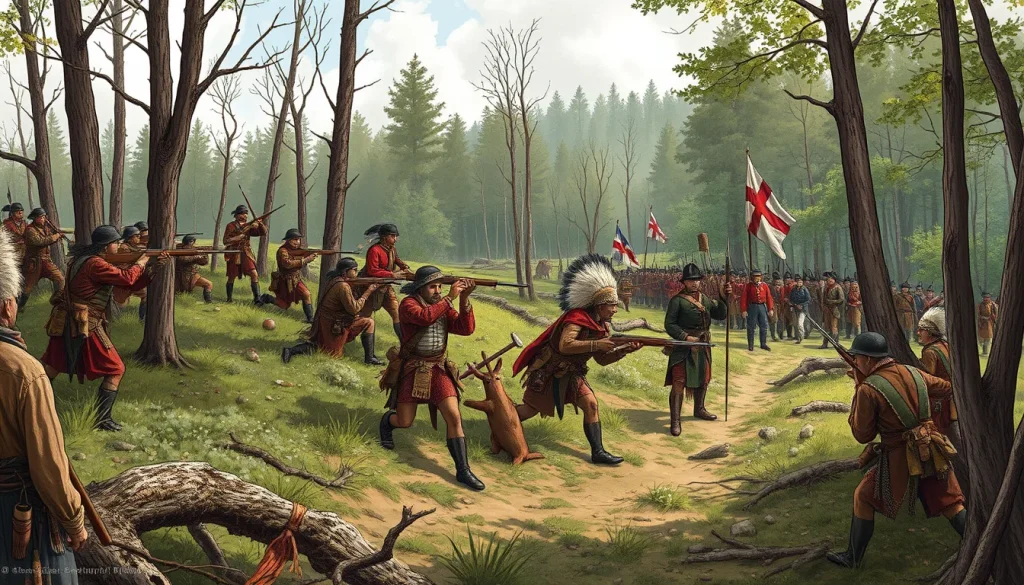
Early on 24 June, the American force advanced from Queenston through St. David’s and along a trail at the base of the Niagara Escarpment before climbing the mountain. Indigenous scouts reported the movement to Ducharme, who sent word to FitzGibbon. About 300 Kahnawake warriors under Ducharme, with Lieutenants Isaac LeClair and J.B. de Lorimier, and about 100 Mohawks under Captain William Johnson Kerr, took positions in a thickly wooded area about 1.5 miles east of Beaver Dams. FitzGibbon and about 46 to 50 men of the 49th Regiment of Foot remained in reserve.
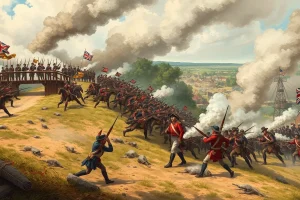
When the Americans entered the ambush zone, the warriors opened fire on their flanks and rear. Boerstler was wounded and placed in a wagon. The fighting lasted about three hours. Some U.S. accounts claim the Americans drove the Mohawks off and fought their way into open fields where artillery could be used; other witnesses and later historians do not support that version. As the American column stalled, FitzGibbon approached under a flag of truce. He told Boerstler that the Americans were surrounded by a much larger force and that he could not restrain the warriors if fighting continued. Boerstler agreed to surrender, and the formal capitulation was accepted by Major P. W. De Haren of the 104th Regiment, who arrived with reinforcements from Twelve Mile Creek. Approximately 500 Americans, including the wounded Boerstler, were taken prisoner.
Why It Matters
The defeat at Beaver Dams, coming three weeks after Stoney Creek, helped convince American commanders that they could not safely operate away from Fort George. It contributed to the dismissal of Major General Henry Dearborn, the U.S. commander in Upper Canada. For the British and their Indigenous allies, the victory protected the outpost line west of the Niagara River and demonstrated the value of Indigenous scouting, terrain knowledge, and psychological warfare. FitzGibbon later emphasized that fear and negotiation, rather than British firepower, had induced the surrender; the warriors had done the fighting that made his warning credible.
The battle also became a focal point for arguments over credit. Kanyen’kehà:ka leader John Norton, who fought at Beaver Dams, maintained that Indigenous warriors had won the battle while FitzGibbon received the recognition. FitzGibbon himself acknowledged the role of Indigenous tactics, though his accounts naturally highlighted his own intervention. Historians continue to debate how much weight to give Indigenous leadership and combat power, British regulars and Indian Department officers, and chance. Laura Secord’s journey, meanwhile, became a Canadian national myth, sometimes overshadowing the Indigenous victory. Modern scholarship, including work by Carl Benn and Alan Taylor, places Indigenous goals and agency at the center of the campaign rather than treating warriors as auxiliaries to British plans.
Prelude
After the U.S. capture of Fort George on 25 May 1813, the British position on the Niagara Peninsula briefly collapsed. Vincent’s retreat to Burlington Heights invited American pursuit, but the British counterattack at Stoney Creek on 6 June halted it. American naval support then diminished, and British vessels and raiders threatened the U.S. supply line. The U.S. army withdrew to the Fort George area, while the British established DeCou’s house as an outpost. From there, Indigenous warriors and militia mounted raids that disrupted American patrols. Boyd, the American commander at Fort George, ordered Boerstler’s column to destroy the outpost and restore confidence.
Forces and Commanders
The U.S. force under Lieutenant-Colonel Charles G. Boerstler numbered roughly 500 to 600 men. It included Boerstler’s 14th U.S. Infantry and detachments of the 6th, 13th, and 23rd U.S. Infantry, a company of artillery with one 12-pounder and one 6-pounder field gun, about twenty U.S. dragoons, and forty mounted New York militia volunteers under Cyrenius Chapin. Two supply wagons accompanied the column.
The British and Indigenous force was smaller in regular troops but stronger in the ambush. Captain Dominique Ducharme of the British Indian Department commanded about 300 Kahnawake Mohawk warriors, assisted by Lieutenants Isaac LeClair and J.B. de Lorimier. Captain William Johnson Kerr led about 100 additional Mohawk warriors. Lieutenant James FitzGibbon commanded roughly 46 to 50 regulars of the 49th Regiment of Foot, who served as a reserve. Major P. W. De Haren arrived later with reinforcements from the 104th Regiment and other British regulars.
Battlefield and Map Context
The battle occurred near Beaver Dams, in what is now Thorold, Ontario, in the Regional Municipality of Niagara. The ambush site was in a thickly wooded area about 1.5 miles east of Beaver Dams, along a trail near the Niagara Escarpment. The U.S. column moved from Fort George through Queenston and St. David’s, then followed a trail at the base of the escarpment before ascending the mountain. DeCou’s stone house, the British outpost, stood near present-day Brock University. Twelve Mile Creek and the surrounding ravines and woods shaped movement and visibility. The approximate battlefield coordinates often given are 43°07′03.3″N 79°11′07.4″W.
Battle Chronology
- 23 June 1813: Boerstler’s column leaves Fort George and occupies Queenston for the night.
- Before dawn, likely 22 or 23 June according to differing accounts: Laura Secord sets out to warn the British; Indigenous scouts already track the American movement.
- Early 24 June: The U.S. column advances via St. David’s and climbs the Niagara Escarpment.
- Morning: Kahnawake and Mohawk warriors open fire from woods on the flanks and rear.
- Fighting continues about three hours; Boerstler is wounded.
- FitzGibbon approaches under a flag of truce and warns of a larger force and uncontrollable warriors.
- Boerstler agrees to surrender; Major De Haren arrives and accepts the formal capitulation.
- About 500 Americans are taken prisoner.
Casualties and Losses
Casualty figures vary. British and Canadian accounts often report five Indigenous chiefs or warriors killed and twenty to twenty-five wounded, while other estimates place Indigenous deaths between five and fifteen. American losses are usually given as twenty-five killed and fifty wounded, with about 462 captured in addition to the wounded commander. The number of prisoners is sometimes rounded to about 500. These figures should be treated as approximate because returns and later narratives differ.
Result
The result was a British and First Nations victory. Boerstler’s column was destroyed as a fighting force, and its survivors became prisoners. The defeat ended the immediate American attempt to break the outpost line near Beaver Dams and added to the psychological effect of Stoney Creek.
Strategic Consequences
Beaver Dams reinforced the American decision to remain close to Fort George. It contributed to the replacement of Major General Henry Dearborn and weakened U.S. offensive momentum on the Niagara frontier for the 1813 campaign. For the British, the victory helped stabilize the peninsula after the loss of Fort George. For Indigenous nations, it demonstrated that warriors could shape campaign outcomes, not merely support European armies. The battle also strengthened the reputations of Indigenous guerrilla tactics and of officers such as FitzGibbon and Ducharme, though the distribution of credit remained contested.
Primary Accounts
The most important British account is James FitzGibbon’s later narrative and correspondence, in which he describes the ambush, his flag-of-truce warning, and the surrender. John Norton’s journal offers an Indigenous perspective and argues that the warriors, not the British regulars, decided the battle. U.S. accounts include Boerstler’s reports and other officers’ testimony, which emphasize the American column’s discipline and attempt to fight free of the woods, though these claims are disputed. Laura Secord’s later petitions and reminiscences describe her warning journey, but they were written decades afterward and contain uncertain details. British Indian Department correspondence and returns provide evidence about Ducharme, Kerr, and the Indigenous contingent.
Battlefield Today
The Battle of Beaver Dams National Historic Site was designated in 1921. The battlefield area lies in modern Thorold, Ontario, within the Niagara region. Interpretive plaques and local monuments commemorate the engagement, while the broader Niagara Escarpment landscape still suggests the wooded and broken terrain that shaped the ambush. The site is often visited alongside other War of 1812 locations in the Niagara Peninsula, including Fort George, Queenston Heights, and Stoney Creek.
Primary Sources
Primary documentation for Beaver Dams is scattered across British, Canadian, and U.S. archives. James FitzGibbon’s accounts, written after the war, are central but retrospective and self-justifying; they should be read alongside Indigenous and American testimony. John Norton’s journal, published in modern editions, gives a rare Indigenous voice and challenges British credit claims. U.S. official correspondence and reports by Boerstler and other officers explain American intentions and losses but reflect the perspective of the defeated force. Laura Secord’s later petitions and family accounts document her warning, yet their long delay and patriotic use require caution. British Indian Department records and dispatches from officers such as Ducharme are essential for identifying the Kahnawake and Mohawk participants, though they are often terse. No verbatim transcript of the battle is available; historians reconstruct events from these overlapping and sometimes conflicting sources.
Further Reading
- Carl Benn, The Iroquois in the War of 1812 (University of Toronto Press, 1998).
- Alan Taylor, The Civil War of 1812: American Citizens, British Subjects, Irish Rebels, and Indian Allies (Alfred A. Knopf, 2010).
- J. Mackay Hitsman, The Incredible War of 1812: A Military History, updated by Donald E. Graves (Robin Brass Studio, 1999).
- E. A. Cruikshank, ed., The Documentary History of the Campaign upon the Niagara Frontier in 1813 (Lundy’s Lane Historical Society, 1899–1908).
- Jason Ridler and Michelle Filice, “Battle of Beaver Dams,” The Canadian Encyclopedia.
- Parks Canada, Battle of Beaver Dams National Historic Site.
References
- The Canadian Encyclopedia, “Battle of Beaver Dams,” by Jason Ridler, updated by Michelle Filice. https://thecanadianencyclopedia.ca/index.php/en/article/battle-of-beaver-dams
- Wikipedia, “Battle of Beaver Dams.” https://en.wikipedia.org/wiki/Battle_of_Beaver_Dams
- Carl Benn, The Iroquois in the War of 1812 (Toronto: University of Toronto Press, 1998).
- Alan Taylor, The Civil War of 1812 (New York: Alfred A. Knopf, 2010).
- J. Mackay Hitsman, The Incredible War of 1812, updated by Donald E. Graves (Toronto: Robin Brass Studio, 1999).
- E. A. Cruikshank, ed., The Documentary History of the Campaign upon the Niagara Frontier in 1813 (Lundy’s Lane Historical Society, 1899–1908).
FAQ
When and where was the Battle of Beaver Dams?
The Battle of Beaver Dams was fought on 24 June 1813 near Beaver Dams, in what is now Thorold, Ontario, Canada.
Who fought at the Battle of Beaver Dams?
A U.S. column under Lieutenant-Colonel Charles G. Boerstler faced about 300 Kahnawake Mohawk and 100 other Mohawk warriors, with a small reserve of British regulars under Lieutenant James FitzGibbon.
Why did the Indigenous warriors win at Beaver Dams?
They used wooded terrain to ambush the American flanks and rear, wounded Boerstler, maintained fire for about three hours, and created enough pressure that FitzGibbon's warning of a larger force and uncontrollable warriors helped compel surrender.
What role did Laura Secord play?
Laura Secord warned the British of the American advance, but her exact timing and the intelligence she provided are uncertain. Indigenous scouts had also been tracking the U.S. column and reporting its movement.
Leave a Reply