
Short Answer
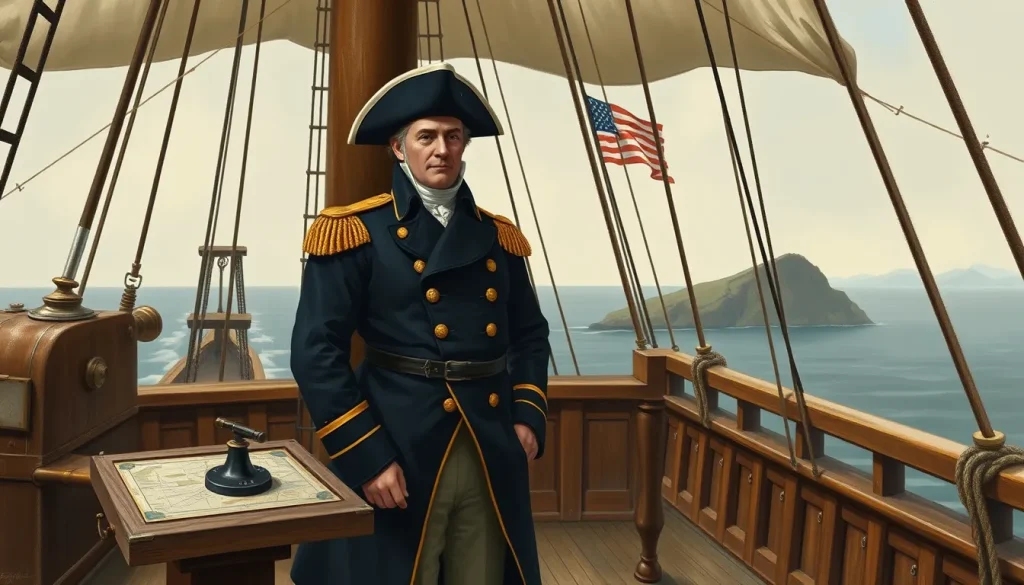
Commodore David Porter (1 February 1780 – 3 March 1843) was a United States Navy officer best known for commanding the frigate USS Essex during the War of 1812. His post-war career — service on the Board of Navy Commissioners, command of the West India Squadron against Caribbean piracy, a court-martial arising from the Fajardo affair in Puerto Rico, leadership of Mexico’s navy, and more than a decade as United States chargé d’affaires at Constantinople — shows how War of 1812 officers shaped the peacetime service and early American diplomacy. This article concerns the elder David Porter; his son, Admiral David Dixon Porter (1813–1891), appears here chiefly as part of the family’s naval legacy.
Historical Context
The navy Porter returned to in 1814 was small, costly, and newly celebrated. Frigate victories and commerce raiding had won public admiration, and in 1816 Congress authorized a gradual increase of the fleet, including ships of the line. Administratively, the service was placed after February 1815 under a Board of Navy Commissioners rather than a single senior captain, and officers of Porter’s rank spent years managing yards, budgets, and construction instead of cruising.
The strategic environment changed quickly. The collapse of Spanish authority in Latin America during the independence wars of roughly 1810–1825 produced a surge of piracy and irregular privateering in the Caribbean, threatening the merchant trade on which the United States depended, and Congress passed successive anti-piracy statutes in the early 1820s. Cuba and Puerto Rico remained Spanish, however, and American naval officers operating nearby had no settled framework for disputes over jurisdiction, arrests, or the treatment of sailors ashore — a gap that produced repeated friction.
Mexico, independent from Spain after 1821, needed naval forces for its continuing struggle against Spanish attempts at reconquest, and it recruited experienced officers from abroad. In the eastern Mediterranean, meanwhile, the United States had a growing carrying trade but no resident diplomatic representation at Constantinople until the early 1830s; the Ottoman capital was the pivot of American negotiations over commerce and navigation in the Levant. These three settings — the Caribbean, the Gulf of Mexico, and the Ottoman capital — framed the second half of Porter’s life.
What Happened
Porter came home from the Pacific in 1814. Paroled after the loss of the Essex at Valparaíso on 28 March 1814, he returned to the United States in the converted prize Essex Junior, reaching New York in July 1814. Congress subsequently voted him its thanks and a gold medal, and his Pacific cruise — the first by a United States warship in those waters — became one of the war’s best-known naval stories.
From 1815 to 1823 Porter served as one of the three members of the Board of Navy Commissioners, alongside John Rodgers and Isaac Hull. The board handled the service’s administration: ship construction and repair, ordnance, navy yards, and the distribution of a peacetime fleet that Congress funded only grudgingly.
In 1823 he was given command of the West India Squadron, a flotilla of small schooners and barges — the so-called “Mosquito Fleet” — operating from the naval station at Key West against pirates and slave traders in the Caribbean and the Gulf. The squadron’s shallow-draft vessels pursued raiders into coastal waters, but disease proved more deadly than combat: yellow fever killed large numbers of officers and men, and Porter himself fell ill. The campaign disrupted piracy, although it did not eliminate it.
In November 1824, at Fajardo on the Spanish island of Puerto Rico, a landing party under Lieutenant Charles Platt became involved in a fatal altercation ashore and Platt was arrested by the local authorities. Porter sailed to Fajardo, landed a force of sailors and marines, and demanded an apology, threatening to burn the town if it were refused. The Spanish governor complied, but Porter’s action exceeded his instructions and embarrassed his government. He was court-martialled in 1825, found guilty, and suspended from duty for six months. Regarding the verdict as an unjust rebuke to an officer who had acted to uphold the flag, he resigned his commission in 1826.
He then accepted an offer to command the navy of Mexico, serving from 1826 to 1829 as its senior officer, in effect its general of marine. He took his sons with him; one, Thomas, died of yellow fever in Mexico at the age of ten. A nephew, David Henry Porter, commanding the brig Guerrero, was killed in action against a Spanish frigate, an engagement described in later family and naval accounts as a desperate fight against heavy odds. Porter returned to the United States in 1829.
In 1831 he was appointed United States chargé d’affaires at Constantinople, a post he held until his death. His work there combined commercial negotiation under the Ottoman–American commercial convention of 1830 with the protection of American seamen and shipping in the Mediterranean and the Levant. He died at Pera, near Constantinople, on 3 March 1843; his remains were later brought back to the United States and reinterred at Woodlands Cemetery in Philadelphia.
Why It Matters
Porter’s post-war career matters in three connected ways. First, it illustrates how the early republic used naval power as an instrument of commerce protection and informal diplomacy: the West India Squadron and the Constantinople legation were both responses to the same problem of protecting American trade in regions where the United States possessed few formal rights or obligations.
Second, the Fajardo affair and the court-martial that followed exposed a structural tension between an officer’s discretionary use of force and civilian control of foreign policy. Contemporaries divided over whether Porter had defended the honour of the flag or provoked a needless confrontation with a power that was not at war with the United States. Historians generally cite the episode as evidence of both the aggressiveness that made War of 1812 officers effective and the diplomatic risks of that aggressiveness.
Third, Porter’s family made his name a synonym for naval service. He adopted James Glasgow Farragut, who took the name David Glasgow Farragut and became the first officer to hold the rank of admiral in the United States Navy; his son David Dixon Porter became the second. Historians differ in emphasis: David F. Long’s biography, whose title Nothing Too Daring signals its subject’s impulsiveness, treats Porter as a gifted but difficult officer whose career was repeatedly limited by his own temper, while George C. Daughan’s study of the Essex cruise stresses the originality and reach of his Pacific campaign. The Marquesas episode — Porter’s 1813 claim of Nuku Hiva for the United States, never ratified and later disavowed — continues to be debated as an early expression of American ambitions in the Pacific.
Early Life
David Porter was born in Boston on 1 February 1780, the son of a merchant captain who had served in the Continental navy. He went to sea with his father and entered the United States Navy as a midshipman in the late 1790s, serving in the Quasi-War with France aboard the frigate Constellation under Thomas Truxtun. After the capture of the French frigate Insurgente in 1799, Porter was among the young officers sent away in the prize. In the First Barbary War he served in the frigate Philadelphia, was taken prisoner when she grounded at Tripoli in October 1803, and remained a captive until 1805.
Role Before the War
After the Barbary captivity Porter held a series of sea and shore assignments, and by 1811 he commanded the frigate Essex, rated at 32 guns but carrying more as the war progressed. When the United States declared war on Britain in June 1812, the Essex was at New York, ready for sea.
Role During the War
On 13 August 1812 the Essex took HMS Alert, the first British warship captured in the war. Porter then cruised against British trade, and in October 1812 sailed south. In 1813 the Essex became the first United States warship to round Cape Horn into the Pacific, where Porter conducted a destructive campaign against British whaling vessels in the Galápagos and off the South American coast, arming captured ships and using them as auxiliaries. In October 1813 he anchored at Nuku Hiva in the Marquesas Islands, supported one faction in a local conflict, built a shore position named Fort Madison, and claimed the islands for the United States — an annexation never ratified and later disavowed by his government.
Trapped in the neutral harbour of Valparaíso, Chile, the Essex was attacked on 28 March 1814 by HMS Phoebe and HMS Cherub under Captain James Hillyar. Disabled and burning, with heavy casualties reported on both sides, Porter struck his colors. He was exchanged and returned home.
Major Actions
The actions most often cited in assessments of Porter’s post-war record are his membership on the Board of Navy Commissioners (1815–1823), which placed him among the small group of captains who ran the service; his command of the West India Squadron (1823–1824), the navy’s principal peacetime operational commitment of the decade; the Fajardo landing and the resulting court-martial (1824–1825); his command of the Mexican navy (1826–1829); and his long diplomatic mission at Constantinople (1831–1843), in which he combined consular protection with commercial negotiation.
Contemporary Accounts
Contemporary evidence about Porter is abundant but uneven. Porter published his own Journal of a Cruise Made to the Pacific Ocean in 1815, expanded in 1822, a detailed narrative that defends his conduct at the Marquesas and at Valparaíso and was plainly intended to shape his reputation; Captain Hillyar’s official dispatch reported the loss of the Essex from the British side. American newspapers of 1824–1826 carried extensive coverage of the Fajardo affair, the court-martial, and Porter’s resignation, and compilations such as Niles’ Weekly Register reprinted official documents and letters relating to them. Recollections written later by his son David Dixon Porter and by officers who knew the family are useful but partisan. The most common limitation is that almost all of these accounts were written by participants with reputations to defend.
Later Life
Porter’s final twelve years were spent at Constantinople, where he represented American commercial and maritime interests at the Ottoman court, corresponded with the State Department on shipping disputes and the treatment of American citizens, and dealt with the consular and quarantine problems of the Levant trade. He wrote and revised historical and autobiographical material during these years, including a memoir of his own father’s generation of naval officers prepared for publication by his son. He died at Pera on 3 March 1843 and was buried in Constantinople; his remains were subsequently returned to the United States and reinterred at Woodlands Cemetery, Philadelphia.
Historical Legacy
Several United States Navy ships have borne the name Porter, and the frigate Essex whose fame he established has been commemorated in later ship names as well. His greater legacy, however, is dynastic and professional. The family produced a generation of officers — his sons, his nephews, and his adopted son Farragut — and the naval tradition he began was still being celebrated in the early twentieth century, when a memorial window at the United States Naval Academy was dedicated to David Dixon Porter and eulogists presented the family’s record as a model of naval service.
Interpretation of Porter himself remains divided. He is credited with extending United States naval reach into the Pacific, with sustaining the navy’s administrative machinery during a period of retrenchment, and with a decisive role in the Caribbean anti-piracy campaign. He is criticized for the annexation attempt in the Marquesas, for the recklessness of the Fajardo landing, and for a temperament that turned professional grievances into public quarrels. The loss of the Essex has been debated since 1814: some contemporaries and later writers faulted his decision to enter a neutral port where a superior British force could blockade him, while others praised his cruise as the most ambitious American naval operation of the war.
Primary Sources
- David Porter, Journal of a Cruise Made to the Pacific Ocean (Philadelphia, 1815; expanded edition, 1822). Porter’s own narrative of the Essex cruise, including the Marquesas and the action at Valparaíso. It is the fullest first-hand American account, but it is also a self-defence written to answer critics and to advance its author’s reputation, and its judgments should be checked against other evidence.
- Proceedings of the 1825 court-martial of Captain David Porter. The record sets out the charges arising from the Fajardo landing along with testimony and Porter’s defence. It is indispensable for the affair but presents the case through the narrow framework of naval law rather than the wider diplomatic context.
- Captain James Hillyar’s official dispatch reporting the capture of the Essex, 1814. The British commander’s report states the Royal Navy’s version of the engagement and its casualties, and is a necessary counterweight to Porter’s account, though it too was written to justify the actions of its author.
- American newspaper and periodical coverage, 1814–1826. Reports and reprinted documents on Porter’s return, his honours, the Fajardo affair, the court-martial, and his resignation survive in the political press of the period and in compilations such as Niles’ Weekly Register. Such items preserve contemporary opinion but are frequently reprints of partisan sources.
- United States diplomatic correspondence from Constantinople, 1831–1843. Porter’s dispatches as chargé d’affaires are preserved in State Department records at the National Archives and document his commercial and consular work at the Porte. They record official business rather than personal reflection.
Further Reading
- Long, David F. Nothing Too Daring: A Biography of Commodore David Porter, 1780–1843. Annapolis: Naval Institute Press, 1970.
- Daughan, George C. The Shining Sea: David Porter and the Epic Voyage of the U.S.S. Essex during the War of 1812. New York: Basic Books, 2013.
- Porter, David Dixon. Memoir of Commodore David Porter, of the United States Navy. Albany, NY: J. Munsell, 1875.
- Alden, Carroll Storrs, and Ralph Earle. Makers of Naval Tradition. Boston: Ginn & Company, 1942. Available online at penelope.uchicago.edu.
- Colvocoresses, G. P. “Admiral Porter.” United States Naval Institute Proceedings 34/1/125 (January 1908).
- Naval History and Heritage Command, Dictionary of American Naval Fighting Ships, entries for USS Essex and USS Porter. Washington, DC.
- Library of Congress, “The Civil War in America” exhibition biographies and the Library’s manuscript and print holdings relating to the Porter family.
References
- Alden, Carroll Storrs, and Ralph Earle. Makers of Naval Tradition. Boston: Ginn & Company, 1942. Chapter IX, “David Dixon Porter.” https://penelope.uchicago.edu/Thayer/E/Gazetteer/Places/America/United_States/_Topics/history/_Texts/CSAMNT/9*.html
- “David Dixon Porter.” Wikipedia. https://en.wikipedia.org/wiki/David_Dixon_Porter
- “David Dixon Porter.” The Dreadnought Project. https://dreadnoughtproject.org/tfs/index.php/David_Dixon_Porter
- Library of Congress. “David Dixon Porter.” The Civil War in America exhibition biographies. https://www.loc.gov/exhibits/civil-war-in-america/biographies/david-dixon-porter.html
- Colvocoresses, G. P. “Admiral Porter.” United States Naval Institute Proceedings 34/1/125 (January 1908). https://www.usni.org/magazines/proceedings/1908/january/admiral-porter
- Long, David F. Nothing Too Daring: A Biography of Commodore David Porter, 1780–1843. Annapolis: Naval Institute Press, 1970.
- Daughan, George C. The Shining Sea: David Porter and the Epic Voyage of the U.S.S. Essex during the War of 1812. New York: Basic Books, 2013.
- Porter, David. Journal of a Cruise Made to the Pacific Ocean. Philadelphia, 1815; expanded edition, 1822.
- Porter, David Dixon. Memoir of Commodore David Porter, of the United States Navy. Albany, NY: J. Munsell, 1875.
- Naval History and Heritage Command. Dictionary of American Naval Fighting Ships, entries for USS Essex and USS Porter. Washington, DC.
FAQ
What did David Porter do after the War of 1812?
He served on the Board of Navy Commissioners from 1815 to 1823, commanded the West India Squadron against Caribbean piracy in 1823–1824, was court-martialled over the Fajardo affair and resigned in 1826, commanded the navy of Mexico from 1826 to 1829, and then served as United States chargé d'affaires at Constantinople from 1831 until his death in 1843.
Why was David Porter court-martialled in 1825?
After a landing party under Lieutenant Charles Platt was involved in a fatal altercation at Fajardo, Puerto Rico, and Platt was arrested in November 1824, Porter landed forces and threatened to burn the town unless the Spanish authorities apologized. The apology was given, but Porter had exceeded his instructions; the court found him guilty and suspended him from duty, and he resigned his commission in 1826.
How did David Porter's family shape his naval legacy?
Porter adopted James Glasgow Farragut, who became David Glasgow Farragut and the first admiral in the United States Navy, and his son David Dixon Porter became the second. Several other sons and nephews also served as officers, so the Porter name became closely associated with the nineteenth-century navy; a memorial window to David Dixon Porter was later dedicated at the United States Naval Academy.


Leave a Reply