
Short Answer
The Battle of Lake Champlain, often called the Battle of Plattsburgh Bay, was a naval engagement fought on 11 September 1814 at Plattsburgh Bay, New York, during the War of 1812. It pitted a United States squadron under Master Commandant Thomas Macdonough against a British squadron under Captain George Downie. This article focuses on the casualties of the naval action, distinguishing them from the larger land-and-naval Battle of Plattsburgh of 6–11 September 1814. The losses are historically significant because they measure the intensity of the fighting, shaped the immediate British retreat, and are frequently cited in debates over the battle’s decisiveness.
Historical Context
By 1814, British forces in Canada had shifted to the offensive after the defeat of Napoleon in Europe released veteran troops for North America. Lieutenant General Sir George Prevost, governor-in-chief of Canada, planned a campaign down Lake Champlain toward Plattsburgh, New York. Control of the lake was essential: it was the supply route for any army moving along the western shore, and without naval superiority Prevost could not sustain an advance. The British built a new frigate, HMS Confiance, at Isle aux Noix on the Richelieu River to challenge the American squadron. The Americans, under Macdonough, had assembled a squadron at Vergennes, Vermont, and anchored it in Plattsburgh Bay. Meanwhile, American and British diplomats were negotiating at Ghent, and military events in North America were expected to influence the terms of peace. Casualty figures from this campaign therefore had political as well as military meaning.
What Happened
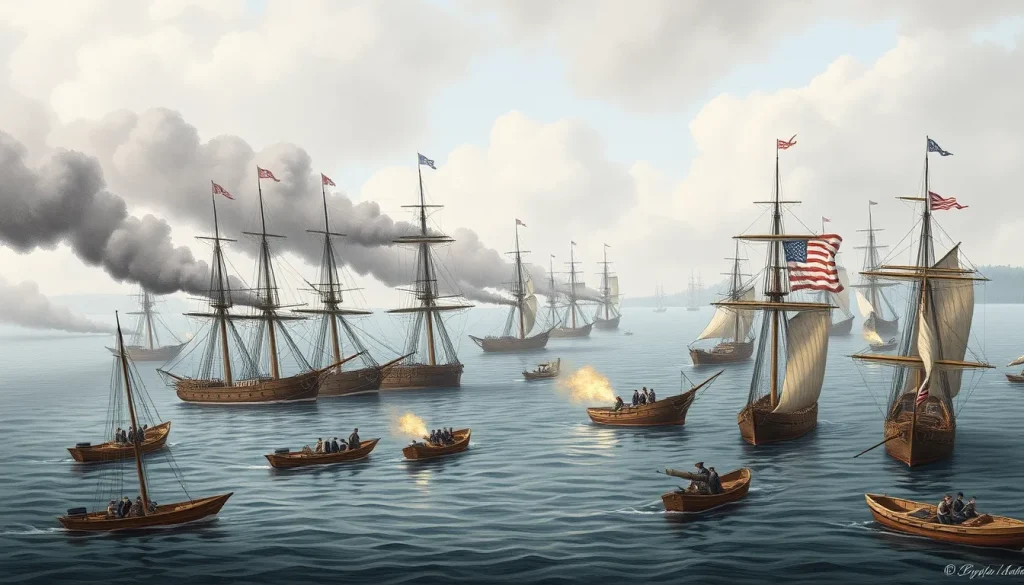
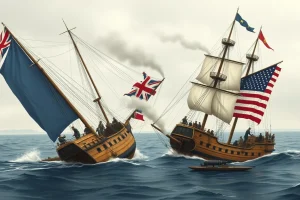
On 6 September 1814, American gunboats skirmished with British forces near Plattsburgh, and a small number of men were killed or wounded before the main battle. The British army under Prevost occupied positions north of the Saranac River, while Macomb’s American regulars and militia held Plattsburgh. Downie’s squadron came south on 8 September but needed time to complete fitting out. On the morning of 11 September, Downie sailed into Plattsburgh Bay to attack Macdonough’s anchored line. The American vessels were moored in a roughly north-south line, with the Saratoga, Eagle, Ticonderoga, Preble, and ten gunboats. The British force included the Confiance, Linnet, Chubb, Finch, and twelve gunboats.
The battle began around 8 a.m. and lasted about two and a half hours. Confiance engaged Saratoga at close range, while Linnet fought Eagle and the British gunboats attacked the American smaller vessels. Downie was killed early in the action. When Eagle cut her cable to find a better position, Saratoga was exposed to additional fire. Macdonough used a stern anchor and spring cables to wind his ship and bring a fresh broadside to bear. Confiance and Linnet eventually surrendered; Chubb was captured, Finch ran aground and was taken, and most British gunboats fled or were sunk. Pring, who succeeded Downie, wrote that the British squadron had fought a severe and destructive action. The wounded and prisoners were gathered from the shattered ships, and Macdonough reported the capture of one frigate, one brig, and two sloops.
Why It Matters
The casualties of the naval battle directly affected the campaign. Although American losses were smaller than British, the killed and wounded on both sides represented a large share of the crews engaged. The British loss of officers and skilled seamen, together with the capture of the squadron, made it impossible for Prevost to continue his advance. Prevost withdrew to Canada, and the American victory at Plattsburgh, alongside the defense of Baltimore the following day, weakened British leverage at the Ghent negotiations. For later historians, the casualty returns are also a test of how the battle is remembered. Some accounts give figures for the naval action alone, while others fold in the land fighting of 6–11 September, producing much larger totals. The difference matters because it changes how the decisiveness and cost of the battle are described.
Definition
In military usage, casualties include killed in action, died of wounds, wounded, captured, and missing. For the Battle of Lake Champlain, the most useful distinction is between the naval engagement of 11 September 1814 and the wider Battle of Plattsburgh, which also included land operations. This article uses the naval battle as its primary scope. Where sources give combined figures, that is stated explicitly. The term casualty does not always include desertion, though some modern summaries of the Plattsburgh campaign list British deserters separately.
Background
Casualty returns from the War of 1812 are uneven. Naval commanders wrote official despatches, but these often emphasized the outcome and the capture of enemy vessels rather than complete lists of the dead and wounded. Ships’ muster books, surgeons’ reports, and prisoner-of-war records provide additional evidence, but many are incomplete or scattered among American, British, and Canadian archives. In the case of Lake Champlain, Macdonough’s despatches to the Secretary of the Navy described the action and the capture of the British squadron. Pring’s letter to Commodore Sir James Yeo gave a British account from aboard the captured Saratoga. These documents are essential, but each was written soon after the battle and served the author’s professional reputation.
How It Worked
The high casualties were produced by close-range artillery fire. Both squadrons fought at anchor or at very short range, using long guns, carronades, and gunboats. Confiance, a new and heavily armed frigate, suffered from the concentrated fire of Saratoga and other American vessels. Saratoga was also badly damaged and had many guns disabled. The British and American gunboats exposed small crews to cannon and small-arms fire. Downie’s death early in the action deprived the British squadron of its commander, and the loss of rigging and anchors prevented coordinated manoeuvre. Surrender did not end the cost: wounded men needed care, prisoners had to be guarded, and damaged ships required repairs. The casualty totals therefore reflect not only the dead and wounded during the fighting but also the large number of British sailors and marines taken prisoner when the squadron surrendered.
Competing Viewpoints
Casualty figures for the Battle of Lake Champlain vary according to scope. For the naval action alone, a commonly cited set of figures is approximately 52 Americans killed and 58 wounded, against about 84 British killed, 110 wounded, and 317 captured. These numbers imply roughly 110 American casualties and over 500 British killed, wounded, and captured. Some sources give slightly different totals or divide the losses among ships and gunboats differently. For the broader Battle of Plattsburgh, modern summaries often list American losses of about 104 killed and 116 wounded, and British losses of about 168 killed, 220 wounded, 317 captured, and 234 deserted. Those larger figures include land fighting and should not be treated as naval battle casualties alone.
Historians also disagree about the significance of the loss ratio. American accounts have traditionally stressed Macdonough’s tactical skill and the decisive result. British accounts, including Yeo’s criticism of Prevost, argued that the squadron was hurried into action before Confiance was fully ready and that attacking the American position in Plattsburgh Bay gave the enemy an advantage. Pring’s report praised Downie and described a hard fight but did not excuse the defeat. These competing perspectives do not change the general scale of the casualties, but they explain why the same numbers have been used to support different interpretations of responsibility and generalship.
Role in the War of 1812
The casualties at Lake Champlain were part of the wider cost of the 1814 British offensive in the northern United States. The naval battle destroyed or captured the British squadron on the lake, killed Downie, and removed the naval support Prevost needed to continue. American killed and wounded, though fewer, included experienced sailors who were difficult to replace on the inland lakes. The battle also shaped public morale. Newspapers in the United States reported the victory and the capture of British vessels, while British officials had to explain the loss of a squadron and the failure of the campaign. At Ghent, the American success helped deny Britain a claim to territory based on wartime occupation.
Consequences and Historical Interpretation
After the battle, the American squadron controlled Lake Champlain. British wounded and prisoners were distributed among American vessels and shore facilities, and the captured ships were taken into American service or laid up. The campaign ended with Prevost’s retreat to Lower Canada. In the longer term, the battle became a central event in American memory of the War of 1812, especially in New York and Vermont. Historians continue to debate whether the British defeat was inevitable or resulted from poor coordination between Prevost and Downie. Casualty evidence is used carefully in that debate because the surviving returns are not complete and because naval, land, and combined totals are often mixed. The safest conclusion is that the naval battle cost the United States roughly one hundred killed and wounded and cost Britain several hundred killed, wounded, and captured, with the exact breakdown varying by source.
Primary Sources
Several contemporary documents are central to any study of the casualties. Thomas Macdonough’s letters to Secretary of the Navy William Jones, dated 11 and 13 September 1814, describe the action and the capture of the British squadron. They are official American reports and are valuable for the sequence of events, but they were written before final casualty returns were complete and emphasize victory. Daniel Pring’s letter to Commodore Sir James Yeo, dated 12 September 1814 from Plattsburgh Bay, gives a British account of the loss of the squadron and the death of Captain Downie. It is a professional report by a captured officer and reflects British disappointment and the pressure to explain the defeat. Sir James Yeo’s letter to John Wilson Croker of 24 September 1814 criticizes Prevost for hurrying the squadron into action; it is important for British command disputes but is not a neutral casualty return. Alexander Macomb’s report on the land defense of Plattsburgh provides context for the larger battle and its separate army losses. Contemporary newspapers such as Niles’ Weekly Register printed extracts and returns, but they often reflected national pride and should be checked against official documents.
Further Reading
- John H. Schroeder, The Battle of Lake Champlain: A Brilliant and Extraordinary Victory (2015).
- David G. Fitz-Enz, The Final Invasion: Plattsburgh, the War of 1812’s Most Decisive Battle (2001).
- Donald R. Hickey, The War of 1812: A Forgotten Conflict, revised edition (2012).
- J. C. A. Stagg, The War of 1812: Conflict for a Continent (2012).
- William S. Dudley, ed., The Naval War of 1812: A Documentary History, especially volumes covering 1814.
- Theodore Roosevelt, The Naval War of 1812 (1882), for an early operational narrative.
- Naval Documents of the War of 1812, U.S. Naval History and Heritage Command, for official correspondence and returns.
References
- W. Jones to Charles Tait, 3 October 1814, enclosing Thomas Macdonough’s despatches, in American State Papers: Naval Affairs, vol. 1, available via ibiblio at https://www.ibiblio.org/pha/USN/1814/18141006Champlain.html.
- Daniel Pring to Sir James Yeo, 12 September 1814, Plattsburgh Bay, reproduced in naval history collections, available via 3decks at http://3decks.pbworks.com/w/page/913068/Battle%20of%20Lake%20Champlain.
- James Lucas Yeo to John Wilson Croker, 24 September 1814, in The War on Lake Champlain, available at https://mlloyd.org/gen/macomb/text/lake.htm.
- J. Fenimore Cooper, The Battle of Lake Champlain (1814), in Great Epochs in American History, available at https://usgennet.org/usa/topic/preservation/epochs/vol5/pg79.htm.
- Wikipedia contributors, Battle of Plattsburgh, Wikipedia, for a summary of competing casualty totals; used cautiously as a tertiary source. https://en.wikipedia.org/wiki/Battle_of_Plattsburgh.
- John H. Schroeder, The Battle of Lake Champlain: A Brilliant and Extraordinary Victory (Norman: University of Oklahoma Press, 2015).
- David G. Fitz-Enz, The Final Invasion: Plattsburgh, the War of 1812’s Most Decisive Battle (New York: Cooper Square Press, 2001).
- Donald R. Hickey, The War of 1812: A Forgotten Conflict, revised ed. (Urbana: University of Illinois Press, 2012).
FAQ
How many casualties were there at the Battle of Lake Champlain?
For the naval action alone, commonly cited figures are about 52 Americans killed and 58 wounded, and about 84 British killed, 110 wounded, and 317 captured. Broader Battle of Plattsburgh totals are higher because they include land fighting.
Was the Battle of Lake Champlain the same as the Battle of Plattsburgh?
The names are often used interchangeably, but the naval Battle of Lake Champlain took place on 11 September 1814 in Plattsburgh Bay, while the Battle of Plattsburgh also includes land operations from 6 to 11 September. Casualty figures differ depending on which scope is used.
Who was killed at the Battle of Lake Champlain?
British Captain George Downie was killed early in the action. Many sailors and marines on both sides were killed or wounded, and large numbers of British personnel were captured when the squadron surrendered. Complete individual casualty lists are incomplete.

Leave a Reply