
Short Answer
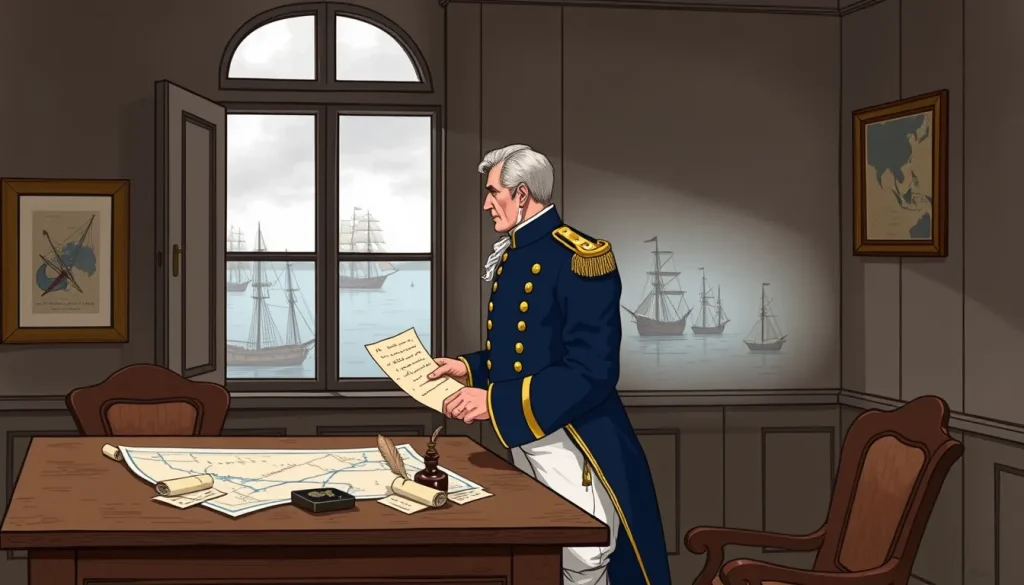
Admiral Sir John Borlase Warren’s peace mission was Britain’s attempt in 1812 to open a diplomatic channel with the United States and arrange a cessation of hostilities after the War of 1812 had begun. Appointed in August 1812 to command the Royal Navy’s unified Halifax, Leeward Islands, and Jamaica stations, Warren also received authority to negotiate with the American government. From Halifax, Nova Scotia, he corresponded with U.S. Secretary of State James Monroe in September and October 1812. The exchange failed because Britain would not suspend impressment, and the war continued until the Treaty of Ghent in 1814.
Historical Context
The United States declared war on Great Britain on June 18, 1812, after years of maritime and commercial conflict. American grievances included the impressment of seamen from American vessels, the Orders in Council that restricted neutral trade, and British support for Indigenous resistance to U.S. expansion in the Old Northwest. Britain was then locked in the Napoleonic Wars and regarded the American war as an unwelcome distraction. The British ministry, weakened by the assassination of Prime Minister Spencer Perceval in May 1812, had already moved to repeal the Orders in Council on June 23, 1812, hoping to remove one American grievance before news of the declaration arrived. The repeal did not address impressment, which the Royal Navy considered essential to manning its fleet.
Diplomatic contact had not completely broken off. Jonathan Russell, the American chargé d’affaires in London, remained in Britain after the declaration. On June 26, 1812, Secretary of State James Monroe instructed Russell that hostilities could cease if Britain repealed the Orders in Council, replaced them with no illegal blockades, discontinued impressment from American vessels, and restored seamen already impressed. Russell presented these terms to Foreign Secretary Lord Castlereagh on August 24, 1812. Castlereagh declined them on August 29, noting that the Orders in Council had already been repealed and that his instructions did not permit concessions on impressment. In this context, the British government turned to Admiral Warren as a possible channel for a limited armistice.
What Happened
On August 3, 1812, the Admiralty appointed Warren, then an admiral of the blue, to command the Halifax, Leeward Islands, and Jamaica stations. The unification of these commands gave him broad authority over British naval operations in the western Atlantic and Caribbean. His instructions also invested him with power to negotiate a cessation of hostilities with the United States. Warren arrived at Halifax in September 1812. His initial task was to communicate with Monroe and see whether the American government would agree to suspend hostilities.

Warren’s approach was not a full peace conference. It was an attempt to arrange an armistice or cessation of hostilities, probably on the basis of the British repeal of the Orders in Council. Monroe’s response, consistent with the instructions already sent to Russell, maintained that the United States would not suspend hostilities unless Britain also discontinued impressment and restored impressed American seamen. Warren’s authority did not extend to such a concession. The correspondence therefore ended without an agreement. Meanwhile, a separate armistice arranged in August 1812 between Sir George Prevost, the British commander in North America, and General Henry Dearborn of the United States was rejected by President James Madison for the same reason: it did not address impressment.
After the failure of his diplomatic overture, Warren turned to military strategy. He advocated a defensive naval war off the North American coast, protecting British trade while maintaining limited blockades of American waters from Halifax and Bermuda. He also recommended reinforcing the Canadian lakes and sent officers such as Robert Heriot Barclay, Daniel Pring, and Robert Finnis to that theater. On October 13, 1812, the British government ordered general reprisals against the United States, but the order included a proviso preserving Warren’s earlier authority to arrange a cessation of hostilities. No such arrangement was reached.
Why It Matters
The failure of Warren’s peace mission meant that the War of 1812 would not end in its first year. It also clarified the diplomatic deadlock: Britain was willing to repeal the Orders in Council, but not to suspend impressment; the United States regarded impressment as a fundamental violation of sovereignty and would not accept a partial settlement. The mission thus exposed the limits of British conciliation and the depth of American commitment to maritime rights. In the shorter term, Warren’s diplomatic failure allowed him to concentrate on naval strategy, including blockades and raids that would shape the war along the Atlantic coast in 1813 and 1814.
Historians have debated how serious the British offer was and how much room Warren had to negotiate. Some emphasize that Britain genuinely wanted to avoid war with the United States while fighting Napoleon, and that the repeal of the Orders in Council was a real concession. Others stress that Britain’s refusal to touch impressment made the offer unacceptable to Madison. Warren himself has often been judged harshly by naval historians, including Alfred Thayer Mahan, for lacking spectacular success. Later assessments, such as the Dictionary of Canadian Biography entry by Frederick C. Drake, argue that Warren’s defensive strategy and logistical support helped relieve pressure on British North America and were more effective than his critics allowed. His peace mission is best understood not as a personal failure alone but as a reflection of incompatible national priorities.
Definition
Admiral Warren’s peace mission was a limited diplomatic initiative, not a formal peace negotiation. It consisted of the authority granted to Warren by the British government in August 1812 to propose and arrange a cessation of hostilities with the United States. Its scope was an armistice—a suspension of fighting—rather than a treaty settling all issues. The mission operated through correspondence between Warren at Halifax and Secretary of State James Monroe in Washington, with the British government retaining control over the major concessions.
Background
The mission grew out of the diplomatic crisis that followed the American declaration of war. Britain had already repealed the Orders in Council on June 23, 1812, but the news could not reach Washington before war was declared. The British government hoped that repeal might persuade Madison to stop hostilities. However, Monroe’s instructions to Jonathan Russell made clear that repeal alone was insufficient. The United States also demanded an end to impressment and the return of impressed seamen. Because Castlereagh had refused those terms in London, the British ministry gave Warren authority to try a parallel approach through his naval command.
How It Worked
Warren’s dual role as naval commander-in-chief and diplomatic agent was unusual but practical. As commander of the Halifax station and the unified western Atlantic commands, he controlled the ships and officers who would enforce any armistice at sea. He could communicate with American officials through flags of truce and naval channels. But his diplomatic authority was bounded. He could propose a suspension of hostilities; he could not abandon impressment or rewrite British maritime policy. The slow speed of transatlantic communications also meant that London’s decisions and Washington’s responses were often overtaken by events. The exchange therefore depended on instructions that were already outdated or too narrow to produce a settlement.
Competing Viewpoints
From the British perspective, the repeal of the Orders in Council removed the most recent and most legally contestable American grievance. Impressment was viewed as a traditional right necessary to man the fleet, and no ministry could easily surrender it without guarantees. Castlereagh told Russell that such concessions would cost the ministry its place and would not be accepted by the British public. From the American perspective, the Orders in Council were only one of several grievances. Impressment involved the sovereignty of the United States and the safety of its seamen. Madison and Monroe insisted that a suspension of hostilities must include an end to impressment, not merely its discussion. Historians who see a missed opportunity emphasize British willingness to repeal the Orders in Council and the genuine desire for peace. Historians who see structural inevitability emphasize that neither side could compromise on its core maritime position in 1812.
Role in the War of 1812
Warren’s mission was Britain’s most direct early attempt to end the war through diplomacy. It failed within months of the declaration. Afterward, the conflict widened. The British navy blockaded American ports, raided the Chesapeake and Delaware coasts, and supported operations in Canada. The United States attempted invasions of Canada and fought naval duels on the Atlantic and lakes. Diplomatic efforts shifted to Russian mediation in 1813 and then to direct negotiations at Ghent in 1814. Warren’s authority to arrange a cessation remained technically alive into October 1812, but it produced no armistice.
Consequences and Historical Interpretation
The immediate consequence was continued war. The longer consequence was that the United States and Britain would not settle their maritime disputes until the Treaty of Ghent, and even that treaty did not mention impressment. The war ended in a return to the status quo ante bellum on most issues, with impressment fading as a practical problem after the defeat of Napoleon. Warren’s mission is therefore remembered as a failed opening rather than a decisive event. Its historical importance lies in what it reveals: Britain’s desire to avoid a costly American war, the American insistence on impressment as a non-negotiable right, and the difficulty of negotiating across the Atlantic in an age of slow communication. Later historians have used the episode to argue both that British peace feelers were sincere and that the war’s causes were too fundamental to be resolved by an armistice in 1812.
Primary Sources
The most important contemporary documents are the diplomatic correspondence of 1812. James Monroe’s letter to Jonathan Russell of June 26, 1812, stated the American conditions for a cessation of hostilities. Russell’s letter to Lord Castlereagh of August 24, 1812, presented those conditions in London. Castlereagh’s reply of August 29, 1812, declined them and explained British objections. The British government’s order of October 13, 1812, for general reprisals included a proviso preserving Warren’s authority to arrange a cessation of hostilities. Warren’s own communications with Monroe in September and October 1812 are the central documents of the peace mission itself. These are preserved in British Admiralty and Foreign Office records and in American diplomatic series such as American State Papers: Foreign Relations.
These sources are official and purpose-written. They reveal stated positions but not private doubts or oral conversations. Castlereagh’s and Monroe’s letters were intended to justify policy and to place responsibility on the other side. Warren’s correspondence reflects his limited instructions and his naval perspective. No verbatim transcript of all the Warren-Monroe letters is reproduced here because the exact wording must be checked against archival or published editions. Readers should consult the National Archives (UK), Library and Archives Canada, the National Archives and Records Administration (US), and published documentary editions for authoritative texts.
Further Reading
- Alfred Thayer Mahan, Sea Power in Its Relations to the War of 1812, 2 vols. (London: Sampson Low, Marston, 1905).
- Henry Adams, History of the United States of America during the Second Administration of James Madison (New York: Charles Scribner’s Sons, 1890).
- Donald R. Hickey, The War of 1812: A Forgotten Conflict, bicentennial ed. (Urbana: University of Illinois Press, 2012).
- J. C. A. Stagg, Mr. Madison’s War: Politics, Diplomacy, and Warfare in the Early American Republic, 1783–1830 (Princeton: Princeton University Press, 1983).
- Bradford Perkins, Prologue to War: England and the United States, 1805–1812 (Berkeley: University of California Press, 1961).
- Frederick C. Drake, "Warren, Sir John Borlase," Dictionary of Canadian Biography, vol. 6 (University of Toronto/Université Laval, 1987).
- William S. Dudley, ed., The Naval War of 1812: A Documentary History, 4 vols. (Washington, DC: Naval Historical Center, 1985–2019).
References
- David Thompson, History of the Late War between Great Britain and the United States, Chapter XIX. warof1812-bicentennial.info/books/historyofthelatewar/hlw-chapter19.php.
- Alfred Thayer Mahan, Sea Power in Its Relations to the War of 1812, vol. 1. Project Gutenberg. https://mirror.csclub.uwaterloo.ca/gutenberg/2/5/9/1/25911/25911-h/25911-h.htm.
- Alfred Thayer Mahan, Sea Power in Its Relations to the War of 1812, vol. 2. Project Gutenberg. https://www.gutenberg.org/files/25912/25912-h/25912-h.htm.
- Henry Adams, History of the United States of America, vol. VII. Project Gutenberg. https://www.gutenberg.org/files/72846/72846-h/72846-h.htm.
- Frederick C. Drake, "Warren, Sir John Borlase," Dictionary of Canadian Biography. https://www.biographi.ca/en/bio/warren_john_borlase_6E.html.
FAQ
What was Admiral Warren's peace mission?
It was Britain's attempt in 1812 to use Admiral Sir John Borlase Warren, commander of the Halifax station, to negotiate a cessation of hostilities with the United States. Warren corresponded with Secretary of State James Monroe, but no armistice was reached.
Why did Warren's negotiation fail?
The United States insisted that any suspension of hostilities include an end to impressment and the restoration of impressed seamen. Warren's instructions did not permit him to concede those points, and the British government refused to suspend impressment.
Did Warren's mission have any effect on the war?
It did not end the fighting. After the diplomatic exchange failed, Warren focused on naval strategy, including blockades and coastal raids, while the war continued until the Treaty of Ghent in 1814.
Leave a Reply