
Short Answer
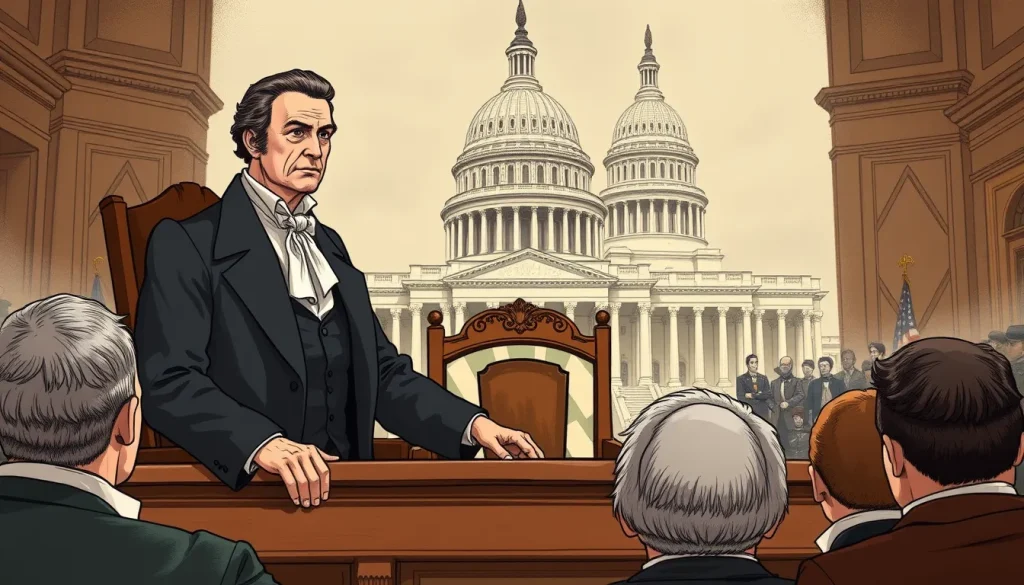
Henry Clay of Kentucky, a prominent figure in the early American republic, served as Speaker of the House of Representatives from November 1811 until January 1814. His tenure coincided with the War of 1812, during which he became the leading voice for the War Hawks—a faction of young Republican congressmen advocating war with Great Britain. Clay used his position to shape the nation’s decision to declare war and to guide military and financial measures through Congress, effectively transforming the speakership from a procedural role into a powerful political office.
Historical Context
After the Revolutionary War, the United States faced continued challenges to its sovereignty. The Royal Navy enforced impressment, the seizure of American sailors for British service, and Britain imposed trade restrictions that disrupted U.S. commerce. Additionally, British authorities in Canada supported Indigenous resistance to American westward expansion, particularly in the Northwest Territory. These grievances intensified in the early 1800s as the Napoleonic Wars raged in Europe. Presidents Thomas Jefferson and James Madison pursued policies such as the Embargo Act of 1807 and the Non-Intercourse Act of 1809 to pressure Britain and France, but these measures proved economically damaging without extracting concessions. By 1810–1811, a new cohort of congressmen, predominantly from the South and West, began to argue that only war could defend American honor and interests. Henry Clay, who had already served two brief appointments to the U.S. Senate, emerged as the leader of this faction upon his election to the House of Representatives in 1810.
What Happened
Henry Clay was elected Speaker on the first day of the Twelfth Congress, November 4, 1811, despite being a freshman representative. He immediately exercised his authority by appointing War Hawks to key committees, including John C. Calhoun of South Carolina as chairman of the Foreign Relations Committee. Under Clay’s guidance, Congress passed a series of resolutions that led to President Madison’s request for a declaration of war. On June 18, 1812, Congress declared war against Great Britain. Clay continued to manage the wartime legislative agenda, calling for increases in the army and navy. When support for the war waned after early American defeats, Clay gave a passionate two-day speech on January 8 and 9, 1813, defending the war and urging passage of a bill to expand the regular army by 50,000 men; the bill passed on January 11. In 1814, Clay resigned from Congress to accept appointment as one of the U.S. commissioners to negotiate a peace treaty. He played a significant role in the negotiations that produced the Treaty of Ghent, signed December 24, 1814.
Why It Matters
Henry Clay’s speakership during the War of 1812 established a precedent for the Speaker as a chief legislative leader. His use of committee appointments, floor speeches, and parliamentary maneuvering to advance a policy agenda was unprecedented. The war itself, though controversial, ended in a negotiated peace that many Americans viewed as a second victory over Britain. Clay’s leadership helped sustain the war effort and influenced the political realignment that followed, including the decline of the Federalist Party, which had criticized the war. Historians have debated the extent to which Clay’s actions were driven by personal ambition or public policy goals, but his role as a strategic coalition-builder is widely recognized. The conflict also set the stage for Clay’s later career as the “Great Compromiser” in national politics.
Early Life
Henry Clay was born near Hanover Court House, Virginia, on April 12, 1777, in the district known as “the Slashes.” He received a modest education and, after reading law with the prominent jurist George Wythe, was admitted to the bar in 1797. Clay moved to Lexington, Kentucky, that year, where he built a successful legal practice and became involved in politics. He served in the Kentucky House of Representatives in 1803 and later in the state senate, and he developed a reputation as an eloquent orator and a proponent of internal improvements.
Role Before the War
Clay served two brief appointments to the U.S. Senate: from 1806 to 1807, when he filled a vacancy, and again from 1810 to 1811. In the Senate, he emerged as a critic of British policies and advocated for vigorous measures against British interference. He also championed the economic development of the West and became known for his support of federal internal improvements. These experiences shaped his conviction that the United States must assert its rights on the international stage.
Role During the War
As Speaker of the House during the Twelfth and Thirteenth Congresses, Clay orchestrated the war movement. He appointed like-minded congressmen to important committees, ensuring that the House would advance war measures. He gave several significant speeches, most notably on January 8 and 9, 1813, when he temporarily stepped down from the Speaker’s chair to debate the bill to increase the army. Clay argued that impressment of American sailors was an assault on national honor and that the war was necessary to secure American rights. His advocacy helped pass the army expansion bill and maintained political support for the conflict. He also oversaw legislation to raise revenue through taxes and loans, and supported congressional oversight of military operations.
Major Actions
- Elected Speaker on November 4, 1811, despite being a first-term House member.
- Appointed War Hawks to key committees, including the Foreign Relations Committee.
- Delivered a two-day speech in January 1813 advocating for expanded military forces.
- Guided the declaration of war through Congress in June 1812.
- Resigned from Congress in January 1814 to join the U.S. peace negotiation delegation.
- Pressed for preservation of American fishing rights and navigation on the Mississippi during the Ghent negotiations.
Contemporary Accounts
Newspapers and political opponents often criticized Clay’s leadership as too aggressive, while supporters praised his oratory and strategic skill. Federalist congressmen, including Daniel Webster in 1813, countered Clay’s arguments and questioned the war’s legality and morality. Clay’s own letters and speeches, such as his January 8, 1813, address, remain primary sources that reveal his convictions. In that speech, he declared: “A nation ought but seldom to go to war. When it does, it should be for clear and essential rights alone… who is prepared to say that American seamen shall be surrendered, the victims to the British principle of impressment?” These accounts illustrate the intense political divisions of the era.
Later Life
After the war, Clay returned to the House in 1815 and was reelected Speaker, serving until 1825, with a brief gap. He later served as Secretary of State under John Quincy Adams, then in the U.S. Senate. Clay became famous as the “Great Compromiser” for his role in the Missouri Compromise of 1820, the Compromise Tariff of 1833, and the Compromise of 1850. He ran for president three times (1824, 1832, 1844) without success. He died in Washington, D.C., on June 29, 1852.
Historical Legacy
Henry Clay’s tenure as Speaker of the House during the War of 1812 is a cornerstone of his legacy. He transformed the speakership into a position of immense political power, setting a precedent for strong party leadership. Historians such as Randall Strahan and his colleagues have argued that Clay used his position to advance both his own policy goals and his political ambitions, establishing a “strategic majority” model of leadership. The War of 1812 itself is often called “the Second War of Independence,” and Clay’s advocacy helped define that interpretation. His later career as a compromiser further solidified his place in American political history.
Primary Sources
The most direct primary sources for Clay’s role as Speaker during the War of 1812 include his speeches in Congress, published in the Annals of Congress. The most famous is his speech delivered on January 8 and 9, 1813, which was widely printed in newspapers. Another set of sources is Clay’s correspondence, including letters to President Madison and fellow war hawks, collected in The Papers of Henry Clay, edited by James F. Hopkins and Mary W. Hargreaves. These documents show his legislative strategy and personal commitment to the war. Additionally, the journals of the House of Representatives record roll-call votes and committee assignments that illustrate Clay’s leadership. All of these sources need to be read critically, as they reflect the political passions of the time; Clay’s speeches were designed to persuade, and his letters often sought to influence colleagues.
Further Reading
- Heidler, David S., and Jeanne T. Heidler. Henry Clay: The Essential American. New York: Random House, 2010.
- Hickey, Donald R. The War of 1812: A Forgotten Conflict. Urbana: University of Illinois Press, 1989.
- Strahan, Randall, Vincent G. Moscardelli, Moshe Haspel, and Richard S. Wike. “The Clay Speakership Revisited.” Polity 32, no. 4 (2000): 543–568.
- White, Leonard D. The Jeffersonians: A Study in Administrative History, 1801–1829. New York: Macmillan, 1951.
References
- “CLAY, Henry.” U.S. House of Representatives: History, Art & Archives. https://history.house.gov/People/Detail/11051.
- “Analysis: Speech in Congress on the War of 1812.” EBSCO Research Starters. https://www.ebsco.com/research-starters/military-history-and-science/analysis-speech-congress-war-1812.
- “Henry Clay – People – Department History – Office of the Historian.” U.S. Department of State. https://history.state.gov/departmenthistory/people/clay-henry.
- Strahan, Randall, Vincent G. Moscardelli, Moshe Haspel, and Richard S. Wike. “The Clay Speakership Revisited.” Polity 32, no. 4 (2000): 543–568.
- Menon, Varun K. “The War That Congress Waged.” Penn History Review 23 (Spring 2016). https://repository.upenn.edu/server/api/core/bitstreams/5ceeddd0-0974-4fa2-8d25-3279618126ed/content.
FAQ
How did Henry Clay become Speaker of the House in 1811?
Clay was elected Speaker on November 4, 1811, the first day of the Twelfth Congress, despite being a freshman representative. His reputation as a leader of the War Hawks and his political skills won him the support of the Republican majority.
What was Henry Clay's most important action during the War of 1812?
Clay served as the principal legislative architect of the war effort, using his position as Speaker to appoint War Hawks to key committees, secure the declaration of war, and rally support for army and navy expansions.
Did Henry Clay fight in the War of 1812?
No, Clay did not serve in the military. He remained in Congress as Speaker, and later resigned to help negotiate the Treaty of Ghent.
Leave a Reply