
Short Answer
During the War of 1812 (1812-1815), newspapers were the primary medium by which civilians followed major battles and campaigns. This article examines how American, British, and Upper Canadian papers covered decisive engagements such as Lake Erie, the Thames, York, and New Orleans, and why that coverage mattered. It treats printed reports as both evidence and propaganda, shaped by politics and by the slow communication of the era.
Historical Context
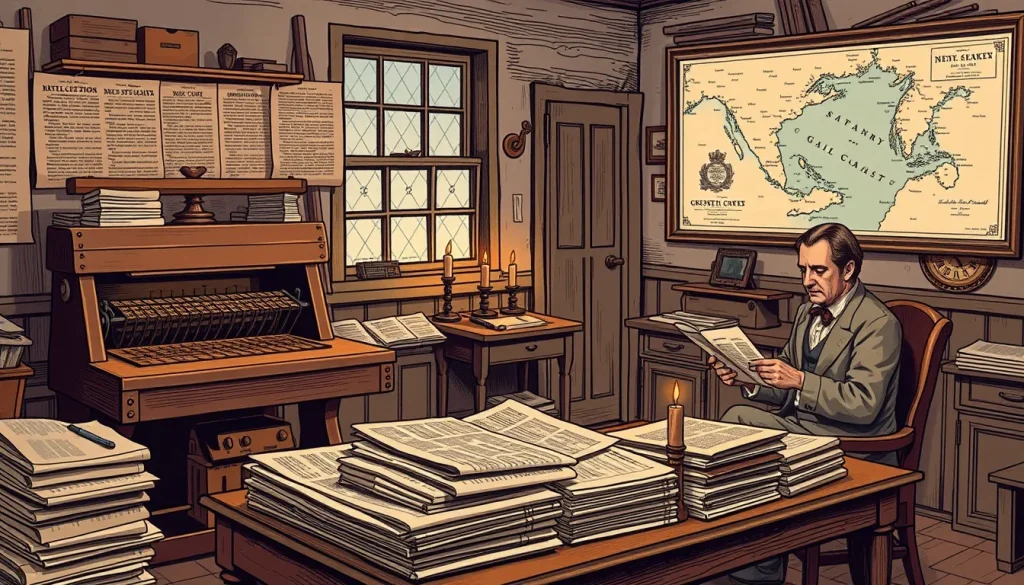
By 1812, the American press was divided between Federalist and Republican (Jeffersonian) papers. Federalist editors, especially in New England, largely opposed ‘Mr. Madison’s War,’ while Republican papers argued that the conflict was necessary to protect American rights and republican government. In Britain and Upper Canada, newspapers were fewer in number and often tied to government or military authorities; Upper Canada had about a dozen papers, while more than 370 appeared in the United States. There were no war correspondents. Editors depended on official dispatches, letters from officers and soldiers, and copies of papers that arrived by horse, boat, or stage. News could take days or months to reach a reader.
What Happened
News of a battle usually followed a set route. Unofficial rumor would reach a port town; then a commander’s dispatch was carried to a capital; once published in a major paper, it was reprinted by editors across the country. The Battle of York (April 27, 1813) illustrates the process. American forces captured the provincial capital of Upper Canada, and a report datelined Buffalo, May 2, appeared in the Buffalo Gazette on May 4. The Boston Weekly Messenger printed it on May 14. The same Boston paper later carried Major General Henry Dearborn’s after-action report and Commodore Isaac Chauncey’s naval dispatch, both copied from the Washington National Intelligencer. The terms of capitulation also appeared in papers as distant as Charleston and Lexington.
The Battle of Lake Erie (September 10, 1813) produced one of the most widely reprinted reports of the war. Commodore Oliver Hazard Perry wrote a short dispatch to General William Henry Harrison announcing the American victory, and editors from Maine to Georgia used it to celebrate United States naval power. A month later, William Henry Harrison’s defeat of a British and Indigenous force at the Battle of the Thames was reported with similar pride, although details were often vague and sometimes exaggerated.

At sea, defeats could be turned into heroic stories. After the USS Essex was captured by the British at Valparaiso, Chile, on March 28, 1814, Captain David Porter’s letter to the secretary of the navy was reprinted in at least 65 American newspapers. Editors emphasized Porter’s courage and the damage the Essex had done to British whalers, rather than the loss of the ship.
The Battle of New Orleans (January 8, 1815) became the war’s most celebrated newspaper story. Although the Treaty of Ghent had been signed on December 24, 1814, news of it had not reached the Gulf coast. Andrew Jackson’s defeat of a British force was therefore reported as a decisive American triumph. As historian Marco Sioli has observed, newspapers helped turn Jackson into a national hero and linked the victory to a vision of westward expansion and the extension of slavery.
Why It Matters
Newspaper coverage shaped how people understood victory, defeat, and the purpose of the war. Federalist papers used early reversals to condemn the administration, while Republican papers magnified successes, contributing to a sense of national vindication. In Upper Canada, British-leaning papers emphasized imperial victories and local loyalty. Later historians use these papers to reconstruct public opinion and even troop movements, but they must account for political bias, long delays, and the widespread practice of reprinting unverified reports. Donald R. Avery has argued that the war marked a turning point in American journalism, shifting news content from foreign to domestic affairs.
Definition
‘Newspaper coverage of the War of 1812’s decisive battles’ includes the reports, editorials, reprinted letters, and official dispatches that contemporary periodicals published about major military and naval engagements. It was not neutral journalism; it was shaped by politics, technology, and the need to win readers.
Background
Early nineteenth-century newspapers were small editorial operations, often printed on a single sheet. Most editors were connected to a political party or accepted party subsidies. They depended on subscriptions and advertising. News gathering was done by exchanging papers with other editors, waiting for official reports, or reading letters sent home by participants. There were no paid reporters in the modern sense, and no press passes.
How It Worked
After a battle, the senior commander wrote an official dispatch to a government official, usually the secretary of war or navy. The dispatch might be carried by a messenger or a naval vessel. Once it reached a capital, it was often given to a friendly newspaper, such as the National Intelligencer in Washington. Other editors, receiving that paper by exchange, would reprint the story, sometimes shortening it to fit their columns. Because there was no copyright law, copying was common. Delays could be considerable. News of the Battle of York reached Buffalo in two days and Boston in twelve, but reports of the Essex battle at Valparaiso took more than three months to appear in American papers.
Competing Viewpoints
Federalist and Republican newspapers offered opposing narratives. In Baltimore, where the state government was Federalist and antiwar, many citizens supported Madison; local papers reflected that clash. In New England, the Boston Gazette was widely seen as the chief antiwar editorial voice, and cartoonist William Charles lampooned its editor as telling sailors not to fight. Republican papers returned the attack, ridiculing Federalists after the Hartford Convention. In Upper Canada, the small press was generally loyal to the Crown and gave less space to dissent. The British press initially dismissed American naval victories, but later printed official reports and sometimes criticized British commanders.
Role in the War of 1812
Newspapers helped create ‘war fever’ before and during the conflict. Many Republican sheets called for action against impressment and trade restrictions. They also made heroes of naval officers and generals, such as David Porter and Andrew Jackson. Federalist papers provided a continuing critique, blaming the administration for defeats and warning of economic danger. Thus the press both sustained enthusiasm for the war and gave voice to opposition, serving as an essential medium through which the war was experienced at home.
Consequences and Historical Interpretation
The war-era press left a lasting legacy. Its coverage made the Battle of New Orleans a national myth and helped elect Andrew Jackson to the presidency. According to Donald R. Avery, the shift toward domestic war news during this period marked a fundamental change in American newspapers. Modern historians, however, treat these accounts with caution. Newspaper stories were often late, partisan, and sometimes invented or embellished. They are best used in combination with official reports, private journals, British sources, and Canadian archives. Study of the press itself reveals how public opinion was formed, challenged, and manipulated in the early republic.
Primary Sources
The most direct evidence of newspaper coverage comes from surviving issues of contemporary papers. For the Battle of York, the Boston Weekly Messenger for May 14 and May 21, 1813, contains American reports, Dearborn’s dispatch, and part of Chauncey’s letter. The Buffalo Gazette of May 4, 1813, provides an earlier version of the news. For naval battles, Captain Porter’s letters to the secretary of the navy were reprinted across the United States after the Valparaiso fight. The Maryland State Archives has compiled a packet of articles from Maryland papers, and digital databases such as Readex’s Early American Newspapers make hundreds of titles searchable. Each source must be examined for its political leanings, its delay, and its reliance on official reports.
Further Reading
- Maryland State Archives. ‘How Maryland Newspapers Reported the War of 1812.’ Documents for the Classroom. https://msa.maryland.gov/msa/speccol/sc5500/sc5572/000001/000000/000191/images/glorious_news_msa.pdf
- Childress, Boyd. ‘Reporting the War of 1812: U.S. Newspaper Coverage of Naval Captain David Porter.’ Readex. https://www.readex.com/readex-report/issues/volume-11-issue-2/reporting-war-1812-us-newspaper-coverage-naval-captain-david
- Sioli, Marco M. ‘War Fever: The American Press and the War of 1812.’ Paper presented at 1812 in the Americas, Brest, 2012. https://air.unimi.it/handle/2434/178945
- Juliusson, David. ‘Spreading the News in 1813.’ Friends of Fort York. https://www.fortyorkfoundation.ca/newsletter/spreading-the-news-in-1813/
- Wikisource. ‘History of American Journalism, Chapter 10: Party Press Period, 1812-1832.’ https://en.wikisource.org/wiki/History_of_American_Journalism/Chapter_10
References
- Maryland State Archives. ‘How Maryland newspapers reported the War of 1812.’ Accessed 2025. https://msa.maryland.gov/msa/speccol/sc5500/sc5572/000001/000000/000191/images/glorious_news_msa.pdf
- Childress, Boyd. ‘Reporting the War of 1812: U.S. Newspaper Coverage of Naval Captain David Porter.’ Readex. https://www.readex.com/readex-report/issues/volume-11-issue-2/reporting-war-1812-us-newspaper-coverage-naval-captain-david
- Sioli, Marco M. ‘War Fever: The American Press and the War of 1812.’ 2012. https://air.unimi.it/handle/2434/178945
- Juliusson, David. ‘Spreading the News in 1813.’ Friends of Fort York, 2007. https://www.fortyorkfoundation.ca/newsletter/spreading-the-news-in-1813/
- Wikisource. ‘History of American Journalism, Chapter 10: Party Press Period, 1812-1832.’ https://en.wikisource.org/wiki/History_of_American_Journalism/Chapter_10
FAQ
How long did it take for news of a battle to appear in newspapers?
It varied with distance and weather. For the Battle of York, news reached Buffalo in two days and Boston in twelve. For the USS Essex defeat at Valparaiso, Chile, reports took more than three months to reach American readers.
Why did different newspapers give different accounts of the same battle?
Partisan allegiance was a major factor. Federalist papers often belittled American success, while Republican papers exaggerated it. Editors also relied on official reports, which could be incomplete or self-serving.
Did newspapers have reporters at the battles?
No. Editors depended on official dispatches, letters from officers and soldiers, and copied articles from other papers. There were no professional war correspondents during the War of 1812.



Leave a Reply