
Short Answer
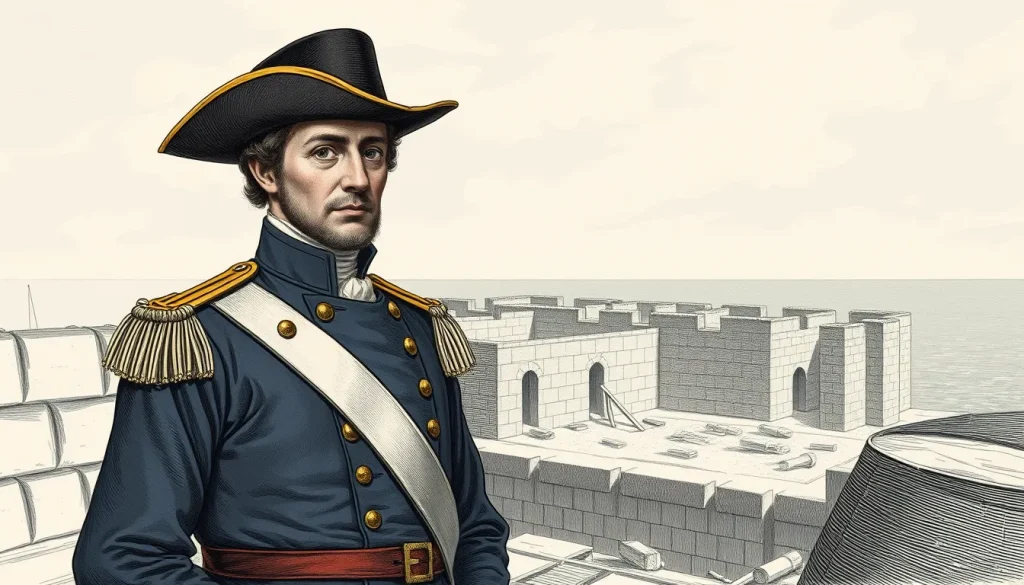
Joseph Gilbert Totten (August 23, 1788 – April 22, 1864) was an American military engineer who served as Chief of Engineers of the U.S. Army for more than twenty-five years. He is best known for designing and overseeing the construction of the “Third System” of American coastal fortifications, a network of masonry forts built to protect major harbors and naval yards. Totten’s career spanned the War of 1812, the Mexican–American War, and the Civil War, and his engineering innovations, including the patented Totten Shutter, had a lasting impact on military architecture.
Historical Context
After the American Revolution, the young United States faced a persistent threat from European naval powers, especially Great Britain. The existing fortifications—many built during the colonial era or the Revolution—were often outdated and poorly maintained. The War of 1812 exposed severe weaknesses in American coastal and frontier defenses. The British blockade of the American coast, raids along the Chesapeake, and the burning of Washington in 1814 demonstrated the urgent need for a systematic national defense program. In response, Congress authorized the construction of new fortifications, and the Corps of Engineers took on the task of designing and building them. In the immediate post-war years, President James Monroe and Secretary of War John C. Calhoun enlisted French military engineer Simon Bernard, a former Napoleonic officer, to help create a board that would standardize a national system of coastal defenses. Joseph Totten, already an experienced engineer, became a key figure on this board and eventually the leading designer of what became known as the Third System.
What Happened
Joseph Totten’s career developed in stages. He graduated from West Point in 1805 and spent his early service constructing fortifications in New York Harbor, including Castle Williams and Fort Clinton. During the War of 1812, he served as chief engineer on the Niagara frontier and later at Lake Champlain. At the Battle of Plattsburgh in September 1814, Totten directed the construction of defensive works and was brevetted (a temporary promotion) to lieutenant colonel and later to colonel for his “meritorious and distinguished services.” After the war, Totten was appointed to the Board of Engineers in 1816, alongside Simon Bernard and others. The board conducted a comprehensive review of harbor defenses and produced a report in 1821 that laid out a long-term plan for fortifying the Atlantic and Gulf coasts.
From 1825 to 1838, Totten supervised the construction of Fort Adams in Newport, Rhode Island, one of the largest and most complex forts in the nation. His experience there informed his design principles for the Third System, characterized by thick masonry walls, multiple tiers of gun casemates, and sophisticated protective features. In 1838, he was promoted to Chief of Engineers, a position he held until his death. Under his leadership, the Corps built dozens of forts, including Fort Monroe in Virginia, Fort Pulaski in Georgia, and Fort Jefferson in the Florida Keys. Totten also conducted experiments on cement, mortars, and iron armor, leading to his development of the Totten Shutter—an iron door that protected gun embrasures while allowing gunners to fire and then reseal the opening rapidly.
Why It Matters
Totten’s work had immediate and long-term effects. During his lifetime, his forts provided the primary coastal defense for the United States, deterring attack and protecting key harbors. In the Civil War, many of these forts became strategic prizes; Fort Sumter, for example, was a Third System fort. Totten’s contributions to military engineering were recognized by his appointment to the Smithsonian Institution’s Board of Regents and his role in founding the National Academy of Sciences. Historians credit Totten with making the Corps of Engineers a professional, scientific body and with advancing the use of iron in fortifications. His designs influenced American coastal defense until the development of rifled artillery rendered masonry forts obsolete after the Civil War.
Early Life
Joseph Gilbert Totten was born in New Haven, Connecticut, the son of Peter Totten and Grace Mansfield. His mother died when he was three years old, and his father, who served as U.S. Consul at Santa Cruz, left him in the care of his uncle, Jared Mansfield, a mathematician and later professor at West Point. Totten attended West Point, graduating in 1805 (the tenth graduate) and received a commission as a second lieutenant in the Corps of Engineers. He briefly resigned in 1806 to assist his uncle with the survey of Ohio and the Northwest Territory, but was reappointed in 1808 and resumed construction work in New York Harbor.
Role Before the War
Before the War of 1812, Totten’s assignments were focused on coastal fortifications. He worked on Fort Williams (later known as Castle Williams) and other defenses of New York. These projects gave him hands-on experience in military masonry, gunnery platforms, and the logistical management of large construction sites, skills that would prove vital later.
Role During the War
During the War of 1812, Totten was appointed chief engineer for the Niagara frontier under General Stephen Van Rensselaer, and later served along Lake Champlain. At the Battle of Plattsburgh (September 11, 1814), he was instrumental in constructing and improving the American defensive lines. His performance earned him two brevets: to lieutenant colonel and colonel. Totten was also involved in planning raids into Canada, though the war ended before any permanent conquests were made.
Major Actions
After the war, Totten’s major contributions were as a designer and supervisor of the Third System fortifications. His most notable projects include Fort Adams, where he spent thirteen years adapting French engineering principles to American conditions; Fort Jefferson in the Dry Tortugas, the largest masonry fort in the United States; and the standardization of defensive plans for dozens of harbors. His 1851 report, “Report of General J.G. Totten, Chief Engineer, on the Subject of National Defense,” provided a comprehensive assessment of the nation’s fortifications and remains a key document in military engineering history.
Contemporary Accounts
Contemporary observers praised Totten’s professionalism and intellect. John G. Barnard, his friend and colleague, wrote a detailed biographical memoir read before the National Academy of Sciences in 1866, calling him “one who has finished his course, and has filled a life, protracted beyond the usual term, with scientific labors of no ordinary variety and magnitude.” The War Department’s official obituary described him as “among the last of the heroes of our ‘Second War of Independence.’” Those who worked under him, including Pierre G.T. Beauregard and George Washington Cullum, later acknowledged his mentorship.
Later Life
Totten remained Chief of Engineers from 1838 until his death. He served in the Mexican–American War as chief engineer for General Winfield Scott, directing the siege of Vera Cruz. He was brevetted brigadier general for that service. In his later years, he served on the Light-House Board (from 1852) and as a regent of the Smithsonian Institution. He co-founded the National Academy of Sciences. Totten died in Washington, D.C., on April 22, 1864, during the Civil War.
Historical Legacy
Totten’s legacy is visible in the many forts that bear his name, including Fort Totten in North Dakota, New York, and the Dry Tortugas. His engineering innovations, particularly the Totten Shutter, marked the first systematic use of iron armor in American harbor defenses. Historians of military architecture note that his designs remained the standard for American coastal forts until rifled cannons proved the vulnerability of masonry. Totten is remembered as a founder of American professional military engineering.
Primary Sources
The most significant contemporary source is John G. Barnard’s “Biographical Memoir of Joseph Gilbert Totten,” published in the National Academy of Sciences’ Biographical Memoirs (1866). It provides a detailed account of Totten’s life and career. Totten’s own reports, especially his 1851 “Report on the Subject of National Defense,” articulate his defensive philosophy and summarize the state of American fortifications. The records of the U.S. Army Corps of Engineers and the Light-House Board contain administrative and technical documents. For the Totten Shutter specifically, National Park Service resources at Fort Jefferson offer detailed descriptions of the device and its operation.
Further Reading
- Barnard, J.G. “Biographical Memoir of Joseph Gilbert Totten.” National Academy of Sciences, 1866.
- Fredrich, Augustine J. “Joseph Totten, Fort Adams, and America’s Third System of Coastal Fortifications.” Proceedings of the 2010 ASCE Conference.
- National Park Service. “Joseph G. Totten and the Totten Shutters.” Dry Tortugas National Park brochure, 2014.
- Graham, John T. “The United States Light-House Board – 1860 Second in a Series: Joseph Gilbert Totten.” The Keeper’s Log (Winter 2010).
References
- Barnard, J.G. “Biographical Memoir of Joseph Gilbert Totten.” National Academy of Sciences Biographical Memoirs (1866). Available at http://biographicalmemoirs.org/pdfs/totten-j-g-1.pdf.
- Fredrich, Augustine J. “Joseph Totten, Fort Adams, and America’s Third System of Coastal Fortifications.” Proceedings of the 2010 ASCE Conference. doi:10.1061/41114(371)25.
- National Park Service. “Joseph G. Totten and the Totten Shutters.” Dry Tortugas National Park brochure, 2014. https://npshistory.com/publications/drto/brochures/totten-shutters-2014.pdf.
- Graham, John T. “The United States Light-House Board – 1860 Second in a Series: Joseph Gilbert Totten.” The Keeper’s Log (Winter 2010). https://archives.uslhs.org/sites/default/files/documents/Keepers%20Log%20Joseph%20G.%20Totten.pdf.
FAQ
What was Joseph Totten's role in the War of 1812?
Totten served as chief engineer on the Niagara frontier and later at Lake Champlain. He was credited with helping build defensive works at Plattsburgh and earned brevets for his service.
What is the Third System of U.S. coastal fortifications?
It was a network of masonry forts designed after the War of 1812 to defend American harbors. Joseph Totten was its principal designer, implementing standardized plans for many coastal cities.
Why are Totten Shutters important?
Totten Shutters were the first use of iron armor in American harbor defenses. They protected gunners from enemy fire while allowing guns to be fired through a quickly opening iron door.

Leave a Reply