
Short Answer
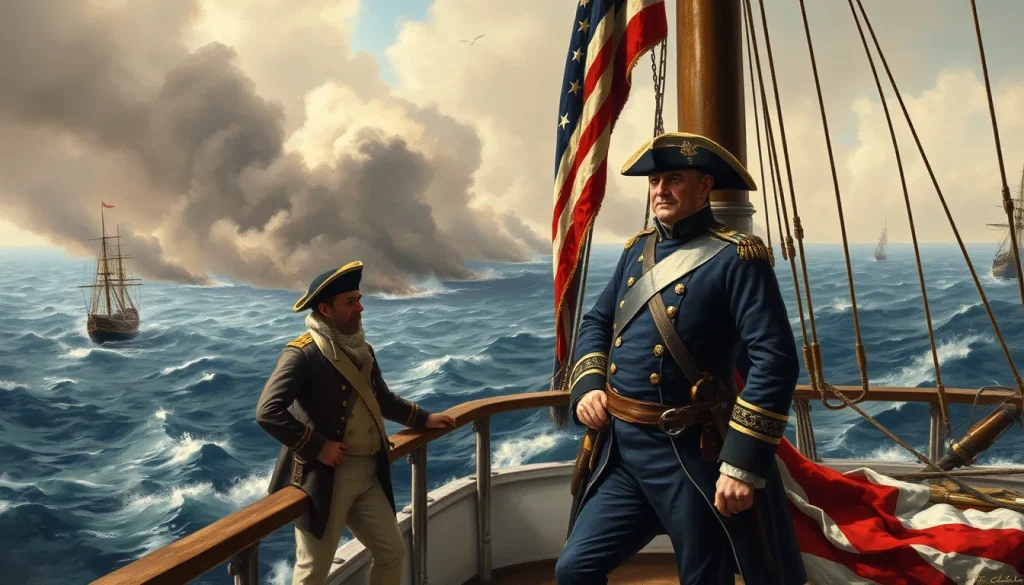
David Porter (March 17, 1780 – March 3, 1843) was a United States Navy officer prominent during the War of 1812. He commanded the frigate USS Essex on a remarkable Pacific commerce-raiding cruise and fought the Battle of Valparaiso in 1814, after which he surrendered to a superior British force.
Historical Context
The War of 1812 (1812–1815) pitted the United States against Great Britain, primarily over maritime trade restrictions, impressment, and Indian policy. On the naval front, the British Royal Navy had overwhelming superiority, while the U.S. Navy possessed only a handful of frigates. Early American victories such as those of the USS Constitution and United States raised morale, but the British implemented a tight blockade. In this environment, American commanders resorted to commerce raiding, preying on British merchant shipping. The Pacific Ocean was a valuable theater because of the British whaling industry, which provided essential oil and other products. A successful raider there could disrupt British commerce and even extend the war.
What Happened
After war was declared in June 1812, Porter, already in command of the USS Essex, sailed from the Delaware capes on July 2, 1812. He headed south, capturing several British merchantmen. In January 1813, he rounded Cape Horn and entered the Pacific, the first U.S. warship to operate there. Over the next year, Essex captured numerous British whaling ships, several of which were armed and added to his squadron. Porter also established a temporary base at Nuku Hiva in the Marquesas, where he took on supplies and refitted.
In February 1814, Porter entered Valparaiso, Chile, intending to resupply. He was soon blockaded by the British frigate HMS Phoebe and sloop HMS Cherub, commanded by Captain James Hillyar, who had superior long guns. After a month of waiting, Porter attempted to break out on March 28, 1814, but a sudden squall knocked away his main topmast, and he was forced to fight under severe disadvantage. The British stood off and pounded Essex with long-range fire; Porter fought bravely but, after heavy casualties and with his ship badly damaged, surrendered. The Essex lost about 58 killed and 65 wounded; British losses were about 5 killed and 10 wounded. Porter and his crew were paroled and eventually returned to the United States.
Why It Matters
The immediate effect of the Essex disaster was a blow to American naval prestige, but Porter’s Pacific campaign had longer-term significance. It demonstrated the reach of American naval power and the vulnerability of British commerce, and it foreshadowed future U.S. aspirations in the Pacific. Historians have debated its strategic value: some argue it was a brilliant diversion that hurt British economic interests, while others contend it had little impact on the war’s outcome. Porter’s own report and memoirs shaped popular memory, and his actions inspired later naval officers. His son, David Dixon Porter, became a leading Union admiral in the Civil War, and the family’s martial tradition continued.
Early Life
David Porter was born in Boston, Massachusetts, on March 17, 1780, to a seafaring family. His father, also named David Porter, served in the Continental Navy during the American Revolution. Young Porter went to sea at an early age and entered the U.S. Navy as a midshipman in 1798, during the quasi-war with France. He rose through the ranks, serving in the West Indies and later in the Barbary Wars, where he was taken prisoner after the loss of the USS Philadelphia in Tripoli. After release, he continued his career and by 1811 had been appointed commander of the frigate Essex.
Role Before the War
Before the War of 1812, Porter had gained experience in naval combat and diplomacy. In the First Barbary War, he was a junior officer on the Philadelphia, which ran aground and was captured; he survived imprisonment in Tripoli. He later commanded the bomb vessel USS Vesuvius and participated in the Battle of Derne. He also served on the Essex earlier and took over command in 1811, when the vessel was re-commissioned. His prewar record earned him a reputation for audacity and seamanship.
Role During the War
Porter’s war service was dominated by the Essex’s cruise. He first operated along the American coast and in the Atlantic, capturing several prizes. Then came the daring Pacific expedition. He faced challenges of logistics and isolation, but he successfully used captured ships and supplies to sustain his squadron. His role was that of a commerce raider, and he inflicted significant damage on British whaling interests. He also made a notable, if symbolic, claim of American sovereignty over the island of Nuku Hiva, which he renamed Madison Island.
Major Actions
The major actions were the capture of numerous whalers and the Battle of Valparaiso. Among the prizes were the British whaling ships that he converted to auxiliary vessels, including the Atlantic, which became the Essex Junior. At Nuku Hiva, he conducted repairs and even established a small American settlement, though it was short-lived. The final major action was his engagement with the Phoebe and Cherub on March 28, 1814, where he chose combat over surrender, fighting for over two hours until his ship was a wreck.
Contemporary Accounts
Porter himself published an account, Journal of a Cruise Made to the Pacific Ocean (1815), which detailed his adventures and justified his conduct. British officials, including Captain Hillyar, offered their own reports, which generally acknowledged Porter’s bravery but emphasized British discipline and gunnery. American newspapers celebrated Porter’s earlier successes, while the defeat was also reported. The journal remains a primary source for the campaign, though it must be read critically, as Porter wrote to defend his reputation.
Later Life
After returning to the United States in 1815, Porter served on the Board of Navy Commissioners. In the 1820s, he commanded the West India Squadron suppressing piracy, but he was court-martialed in 1824 for his aggressive actions in Puerto Rico. Resigning from the U.S. Navy in 1826, he then served as commodore in the Mexican navy before being appointed Minister Resident to the Ottoman Empire by President Andrew Jackson in 1831. He held that post until 1840, and he died in New York City on March 3, 1843.
Historical Legacy
Historians rank Porter among the most skilled American officers of the early republic, yet his legacy is complex. His Pacific cruise demonstrated bold leadership and strategic imagination, but it also ended in a defeat that some critics saw as inevitable. He influenced the development of the U.S. Navy’s professional ethos, and his journal became a standard text for midshipmen. He is remembered as a pioneer of American naval power in the Pacific, and the ship he commanded, USS Essex, has been honored by multiple later vessels bearing that name.
Primary Sources
The most important primary source is Porter’s own Journal of a Cruise Made to the Pacific Ocean, published in 1815, which offers his narrative of the Essex’s voyage. British official reports, particularly Captain Hillyar’s dispatch to the Admiralty, provide the opposing view. Also, American newspapers from the period report both successes and the defeat. These documents must be read with awareness of their authors’ interests and perspectives.
Further Reading
- Hickey, Donald R. The War of 1812: A Forgotten Conflict. Urbana: University of Illinois Press, 1989.
- Cooper, James Fenimore. The History of the Navy of the United States of America. Philadelphia: Lea & Blanchard, 1839.
- Long, David. “Porter, David.” In American National Biography. New York: Oxford University Press, 2000.
References
- Porter, David. Journal of a Cruise Made to the Pacific Ocean. Philadelphia: C. Maxwell, 1815.
- Hillyar, James. Dispatch to the Admiralty, 1814.
- Cooper, James Fenimore. The History of the Navy of the United States of America. Philadelphia: Lea & Blanchard, 1839.
- Hickey, Donald R. The War of 1812: A Forgotten Conflict. Urbana: University of Illinois Press, 1989.
FAQ
What was David Porter's most notable achievement?
He conducted a daring raiding campaign against British whaling ships in the Pacific during 1813–1814, becoming the first U.S. naval officer to operate there.
How did the Battle of Valparaiso end?
The USS Essex was severely damaged by superior British long-range gunfire, and Porter surrendered after heavy casualties.
What did David Porter do after the War of 1812?
He served on the Board of Navy Commissioners, commanded the West India Squadron, briefly joined the Mexican navy, and later became U.S. Minister to the Ottoman Empire.
Why is David Porter historically significant?
He demonstrated the reach of American naval power and expanded U.S. presence in the Pacific, influencing future naval strategy and inspiring later officers.
Leave a Reply