
Short Answer
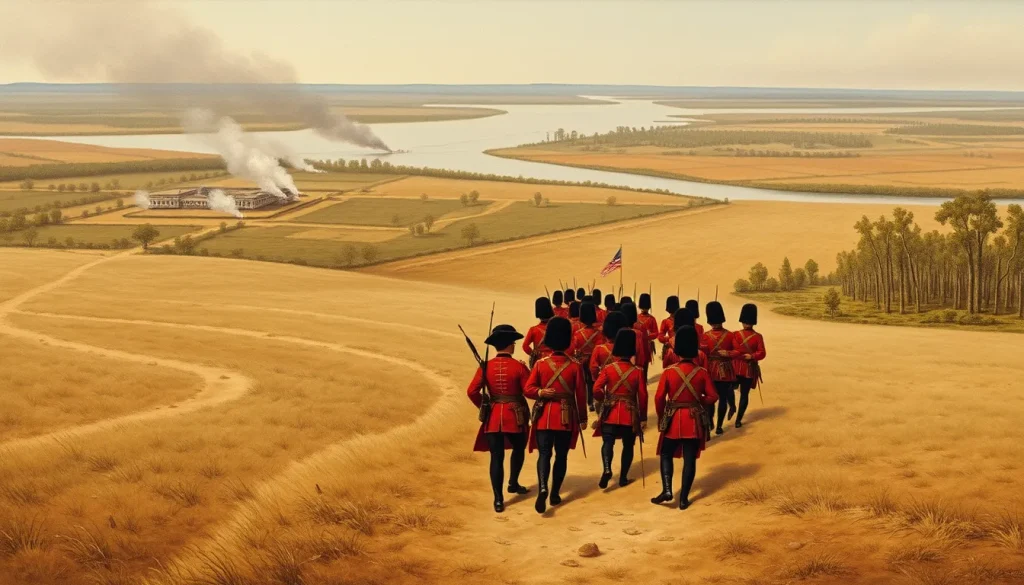
The British forces at the Battle of New Orleans comprised a veteran expeditionary army that invaded Louisiana in late 1814 during the final campaign of the War of 1812. Commanded by Major General Sir Edward Pakenham, the force included seasoned infantry battalions from the Peninsular War and West Indian regiments. Its defeat on January 8, 1815, against Major General Andrew Jackson’s combined American force marked the last major engagement of the conflict and shattered British plans to control the Mississippi River.
Historical Context
Following Napoleon’s abdication in April 1814, Britain could redirect its veteran armies and naval forces to the North American theater. The British strategic aim was to gain territorial concessions by striking at the American heartland. Vice-Admiral Sir Alexander Cochrane proposed an attack on New Orleans, the gateway to the Mississippi River and a key economic hub. The British government and its negotiators at Ghent saw control of New Orleans as a bargaining chip to force the United States to accept British terms. In late 1814, a naval expedition under Cochrane landed a military force east of New Orleans, intending to advance overland from the south.
What Happened
After initial landings below New Orleans on December 23, 1814, American forces under Andrew Jackson launched a surprise night attack, but the British secured their position. Major General Edward Pakenham arrived on Christmas Day to assume command. The British advanced to the Chalmette Plantation, where Jackson had built a strong defensive line along the Rodriguez Canal. After an artillery duel on New Year’s Day proved indecisive, Pakenham ordered a frontal assault on January 8, 1815. The attack against the main American line was repelled with heavy casualties; Pakenham himself was killed. A secondary attack on the west bank succeeded briefly but was aborted. The British withdrew to the fleet on January 18, ending the campaign in failure.
Why It Matters
The defeat of the British force at New Orleans was strategically and symbolically significant. It preserved American control over Louisiana and the Mississippi River, denied Britain a major negotiating asset, and arrived shortly before the Treaty of Ghent was signed on December 24, 1814. In the United States, the victory elevated Jackson and fostered a sense of national unity. For Britain, it was a humiliating end to a war that had already achieved its primary maritime objectives. The battle also influenced American military and political identity for decades, with Jackson’s reputation propelling him to the presidency.
Prelude
In June 1814, Admiral Cochrane proposed the Louisiana expedition to the Admiralty. The plan aimed to capture Mobile and then advance overland, but after Jackson’s defense of Mobile, Cochrane shifted strategy. The fleet rendezvoused in Jamaica with a large troop convoy. The British army, initially under Major General John Keane, landed on the Louisiana coast and navigated through Lake Borgne to approach New Orleans from the south. A flotilla of American gunboats was destroyed on December 14, opening the lake. By December 23, the first troops had landed at Villere Plantation, east of the city.
Forces and Commanders
The British expeditionary force consisted of about 8,000 to 10,000 men at peak strength. The order of battle as of December 25, 1814, showed an effective strength of 5,933 out of 6,660 on strength. The force was organized into two infantry brigades plus an advance brigade and attached artillery and engineers.
- Commander-in-Chief: Major General Sir Edward Pakenham (from December 25, 1814) — killed January 8, 1815.
- Second in Command: Major General Samuel Gibbs — mortally wounded.
- 1st Brigade: commanded by Major General John Keane (wounded). Units included 1/93rd Highlanders, 1st West India Regiment, 5th West India Regiment.
- 2nd Brigade: commanded by Major General Samuel Gibbs, later Colonel Arthur Brooke. Units included 1/4th Foot, 1/44th Foot, 1/21st Foot, and a detachment from 1/62nd Foot.
- Advance Brigade: commanded by Colonel William Thornton. Included 1/85th Light Infantry and other units.
- Artillery: under Lieutenant Colonel Alexander Dickson, with about 30 guns.
- Engineers: under Lieutenant Colonel John Fox Burgoyne.
The army was veteran, many units having served under Wellington in Spain, and was supported by a powerful naval squadron under Admiral Cochrane.
Battlefield and Map Context
The battlefield lay on the east bank of the Mississippi River, about six miles south of New Orleans. The American defensive line, known as Line Jackson, extended from the river to a cypress swamp, about three-quarter mile. The ground was mostly open plantation fields, offering little cover. The British had to cross open ground to reach the American parapet, which was protected by a canal (the Rodriguez Canal). The terrain favored the defender, and the British were funneled into narrow approaches.
Battle Chronology
December 23, 1814: British landed at Villere Plantation. Jackson launched a night attack, which was repelled but alerted the Americans.
December 25: Pakenham arrived and assumed command. The British moved up and established camp.
December 27: British advanced to Chalmette Plantation and began a reconnaissance.
January 1, 1815: British artillery duel with American guns; the British were forced to withdraw their guns.
January 8: Pakenham launched a pre-dawn assault. The main column attacked the American center and right, while Thornton crossed the river with a small force. The main attack was decimated by artillery and rifle fire; Pakenham and Gibbs were killed, and the attack broke. Thornton gained the west bank but was ordered to retreat after the main failure. British suffered over 2,000 casualties in twenty minutes.
January 18: Lambert, now in command, withdrew the army to the fleet.
Casualties and Losses
British casualties on January 8 were devastating. According to the order of battle details, the units suffered roughly: 2,000 killed, wounded, or missing. The 21st Foot alone reported 70 killed, 155 wounded, and 236 missing. The 1/93rd had 63 killed and 101 wounded. Total British losses for the entire campaign, including previous engagements, were substantial. Pakenham was killed, as were three generals. The army’s effective strength fell to about 6,334 by January 25, indicating severe attrition.
Result
The British attack failed completely. The main assault was repulsed with enormous loss, and the surviving troops were withdrawn. The British retained control of the battlefield temporarily but evacuated on January 18. The result was an American defensive victory and a decisive end to British invasion efforts in the Gulf Coast.
Strategic Consequences
The defeat ended British plans to seize New Orleans and control the Mississippi. It also weakened the British negotiating position, though the Treaty of Ghent had already been signed before the battle became known. The American victory boosted national morale and Andrew Jackson’s military reputation, which he later leveraged into the presidency. Politically, the battle came to be seen as a symbol of American independence and resilience. For the British, it marked the end of the War of 1812 with a final defeat, albeit one that did not affect broader imperial interests.
Primary Accounts
Several British participants left accounts of the campaign. The most famous is A Narrative of the Campaigns of the British Army at Washington and New Orleans by George Robert Gleig, a lieutenant in the 85th Foot, who provided a vivid but often biased account. Official despatches from Pakenham, Keane, and Lambert survive in the British National Archives. The American side documented the battle in letters and reports, but the British perspectives are crucial for understanding the decision-making and the assault.
Battlefield Today
The Chalmette Battlefield is now part of the Jean Lafitte National Historical Park and Preserve in Louisiana. The site preserves the American defensive line, including the Rodriguez Canal and the Chalmette National Cemetery. Visitors can walk the field and see monuments, including a memorial to the British soldiers who died.
Primary Sources
Key primary sources for understanding the British forces include:
- The despatches of Major General Pakenham and his successors (National Archives, Kew, WO 1/141).
- A Narrative of the Campaigns of the British Army at Washington and New Orleans (London, 1821) by George Robert Gleig.
- The muster rolls and monthly returns of the British Army units (available at The National Archives, Kew).
- Letters from Admiral Alexander Cochrane to the Admiralty, detailing the naval support.
These sources offer the British perspective, but many are self-serving or written after the event. Their figures on casualties and strength are generally reliable, but motives and assessments of the American forces must be evaluated critically.
Further Reading
- Dale, Matthew B. The Staff Ride Handbook for The Battles of New Orleans, 23 December 1814 – 8 January 1815. Fort Leavenworth: Combat Studies Institute Press, 2015.
- Remini, Robert V. The Battle of New Orleans. New York: Viking, 1999.
- Smith, Zachary F. The Battle of New Orleans. Louisville: John P. Morton & Company, 1904.
- Gleig, George Robert. A Narrative of the Campaigns of the British Army at Washington and New Orleans. London: John Murray, 1821.
References
- “Battle of New Orleans order of battle: British.” Wikipedia. Accessed February 2025. link
- “Battle of New Orleans: The Last Battle of the War of 1812.” American Battlefield Trust. Accessed February 2025. link
- Smith, Zachary F. The Battle of New Orleans. Project Gutenberg eBook #25699. link
- Dale, Matthew B. The Staff Ride Handbook for The Battles of New Orleans. Combat Studies Institute Press, 2015. link
FAQ
How many British troops fought at the Battle of New Orleans?
British strength on January 8, 1815, is estimated at roughly 8,000 men, though the effective strength on December 25, 1814, was about 5,933. The army included veteran infantry battalions from the Peninsular War, West India Regiments, and artillery.
Who commanded the British forces at New Orleans?
Major General Sir Edward Pakenham took command on Christmas Day 1814 and was killed during the assault on January 8. His subordinates included Major General Samuel Gibbs (mortally wounded) and Major General John Keane (wounded). After Pakenham's death, Major General John Lambert assumed command and ordered the withdrawal.
Why did the British lose the Battle of New Orleans?
The British attack faced a well-prepared American defensive line with strong artillery and rifle fire across open ground. The frontal assault lacked adequate artillery support and coordination, and the Americans were able to deliver devastating fire, leading to heavy casualties and the breakdown of the attack.
Leave a Reply