Short Answer
The phrase “Remember the Raisin” refers to the American battle cry that arose after the Battles of Frenchtown, also known as the Battles of the River Raisin, fought in January 1813 in present-day Monroe, Michigan. The cry memorialized the killing of American prisoners by Potawatomi warriors on January 23, 1813, following the second engagement. It became a potent symbol of American resolve during the War of 1812, especially in the Old Northwest, and was later shouted by Kentucky troops at the Battle of the Thames.
Historical Context
The War of 1812 began in June 1812 with the United States declaring war on Great Britain for impressment, trade restrictions, and support of Indigenous resistance. The U.S. strategy included invading Upper Canada from several points. The Old Northwest—present-day Ohio, Indiana, Michigan, and Illinois—was a critical theater because of its connections to the Great Lakes and its Indigenous populations.
In August 1812, Brig. Gen. William Hull surrendered Fort Detroit to British Maj. Gen. Isaac Brock, a severe American setback. President James Madison appointed William Henry Harrison as commander in the Northwest with orders to recapture Detroit. Harrison organized a force of Kentucky volunteers and regular troops, advancing slowly due to supply shortages and winter weather.
By early January 1813, Harrison’s army was still assembling at the Maumee Rapids, but a subordinate, Brig. Gen. James Winchester, received appeals from American settlers at Frenchtown (now Monroe) who feared a British occupation. Against Harrison’s orders, Winchester dispatched a force toward Frenchtown, setting the stage for the battles.
What Happened
On January 18, 1813, approximately 667 Kentucky militia under Lt. Col. William Lewis attacked Frenchtown, which was held by a joint force of British regulars, Canadian militia, and Potawatomi warriors. The Americans drove out the defenders and occupied the village. Winchester soon arrived with reinforcements, bringing the American force to about 1,000 men.
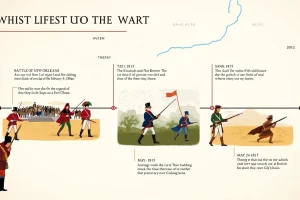
Unaware of the buildup, British Col. Henry Procter organized a counterattack. On the morning of January 22, Procter’s force—numbering about 525 British regulars and Canadian militia plus over 800 Indigenous warriors led by Chief Roundhead—fell upon the American camp. The Americans were surprised and quickly overwhelmed. The Kentucky militia fought desperately but eventually surrendered after Winchester was captured. Approximately 100 Americans were killed during the battle, and about 500 were taken prisoner.
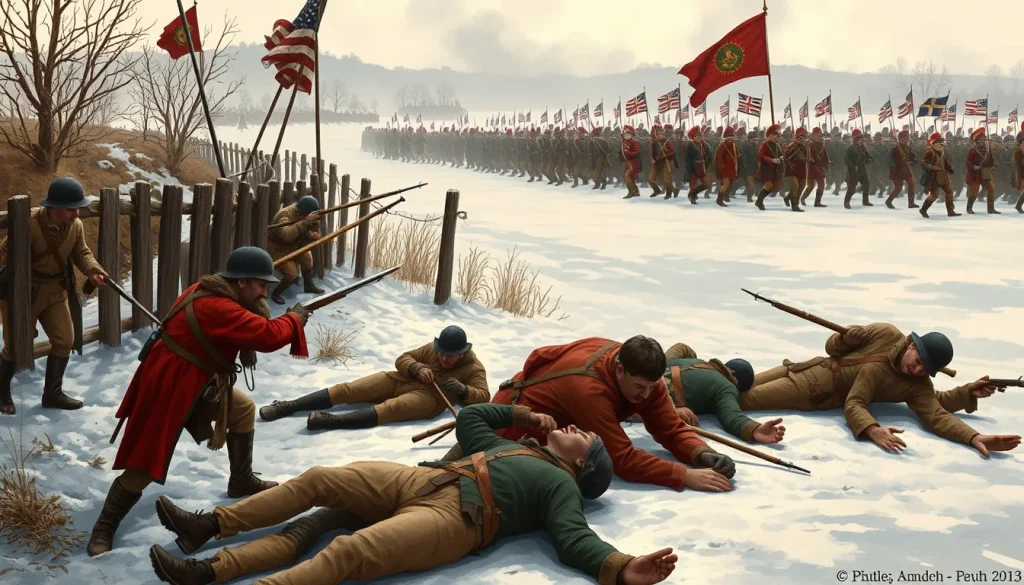
Procter evacuated most prisoners to Fort Malden (Amherstburg) but left roughly 60 severely wounded Americans in Frenchtown, trusting a surrender agreement that they would be protected. However, the next day, January 23, Potawatomi warriors returned and killed many of the wounded prisoners, setting fire to buildings used as hospitals. This act became known as the “Massacre of the River Raisin.”
Only about 30 Americans escaped the entire engagement, either through stealth or flight. The British and their allies suffered relatively few casualties, but the killing of prisoners generated outrage throughout the United States.
Why It Matters
The Battles of Frenchtown and the subsequent massacre had immediate military and psychological consequences. The American defeat delayed Harrison’s campaign for weeks, exposing the Ohio frontier to British and Indigenous raids. More importantly, the massacre became a rallying point for American morale and vengeance.
The phrase “Remember the Raisin” entered the American political and military lexicon as a call to avenge the dead. It was used in recruiting efforts and was famously shouted by Kentucky troops at the Battle of the Thames on October 5, 1813, where a U.S. force under Harrison defeated Procter’s army and killed Tecumseh. Historians argue that the cry helped sustain American commitment after a series of defeats in 1812 and early 1813.
Long after the war, the River Raisin massacre remained a powerful memory, particularly in Kentucky, where dozens of families lost relatives. The site was later designated as River Raisin National Battlefield Park, and annual commemorations continue to honor those who died.
Definition
“Remember the Raisin” is a historical rallying cry originating from the War of 1812. It urged Americans, especially Kentucky soldiers, to remember the killings of wounded prisoners at the Battle of the River Raisin in January 1813. The phrase served both as a call to vengeance and as a means of honorific remembrance.
Background
The cry emerged from a specific incident: after the second Battle of Frenchtown on January 22, 1813, British forces retreated with able-bodied prisoners, but left wounded soldiers behind under a promise of safety. When the British withdrew, Potawatomi warriors returned and killed many of these wounded men. Reports of the killings spread rapidly through the United States, igniting anger and a desire for retribution.
How It Worked
As a battle cry, “Remember the Raisin” functioned as a psychological weapon. It reminded soldiers of the alleged atrocities committed by British-allied Indigenous forces, thereby inflaming their resolve to fight. It also served to unify disparate American units under a common grievance. The cry was particularly effective among Kentucky volunteers, many of whom had lost friends or relatives in the battle.
Competing Viewpoints
Historians and contemporaries have debated the responsibility for the massacre. British commander Henry Procter was criticized both by American prisoners and by some British officers for failing to protect the wounded. Procter claimed that he could not control his Indigenous allies. Indigenous leaders, on the other hand, maintained that their actions were retaliation for American attacks on their communities and for the deaths of their warriors. Some later American accounts exaggerated the number of victims and the brutality of the killings, while others downplayed them for political reasons. Modern scholarship acknowledges the massacre but interprets it within the larger context of frontier warfare, where both sides committed atrocities.
Role in the War of 1812
The cry “Remember the Raisin” contributed directly to the American war effort. It motivated volunteers, especially from Kentucky, and helped sustain public support for an unpopular conflict. It also influenced strategic decisions: the desire to avenge Frenchtown pushed Harrison to pursue an aggressive campaign, culminating in the Battle of the Thames. There, American victory and the death of Tecumseh effectively ended British-Indigenous cooperation in the Northwest, paving the way for the eventual peace.
Consequences and Historical Interpretation
The immediate consequence of the River Raisin massacre was the hardening of American attitudes toward the British and their Indigenous allies. The phrase “Remember the Raisin” transformed a local defeat into a national symbol. In the longer term, it contributed to the American perception that the War of 1812 was a struggle for survival against British barbarism, which in turn influenced treaty negotiations and the later celebration of the war as a “second war of independence.” Historians now view the cry as an example of how wartime atrocities can be used to mobilize public opinion, while also acknowledging the complex realities of frontier conflict where no side held the moral high ground.
Primary Sources
Key primary sources include the official after-action reports from Generals Winchester and Procter, as well as letters from participants and survivors. A contemporary engraving titled “Massacre of the American Prisoners, at French-town, on the River Raisin” (1813) depicts the event and is housed in the William L. Clements Library. Additionally, Kentucky county histories and pension records document the veterans and their testimonials. These sources vary in bias; American accounts emphasize atrocities, while British accounts justify the actions of Indigenous allies. Researchers should consult the collections at River Raisin National Battlefield Park, the U.S. National Archives, and the Library of Congress.
Further Reading
- Gilbert R. Deibert, The River Raisin: A History of the Battle and Massacre (Monroe County Historical Society, 1977).
- Pierre Berton, The Invasion of Canada, 1812–1813 (McClelland & Stewart, 1980).
- National Park Service, River Raisin National Battlefield Park (official site and visitor guide).
- Richard C. Knopf, Compilation of the Letters and Papers of William Henry Harrison (Indiana Historical Bureau, 1935).
- James R. M. Harden, History of the Battles of Frenchtown (Raisin Valley Historical Society, 2013).
References
- “Remember the Raisin.” American Battlefield Trust. Accessed April 2026. https://www.battlefields.org/learn/articles/remember-raisin
- “Michigan: River Raisin National Battlefield Park.” National Park Service. Accessed April 2026. https://www.nps.gov/articles/riverraisin.htm
- “Frequently Asked Questions – River Raisin National Battlefield Park.” National Park Service. Accessed April 2026. https://www.nps.gov/rira/faqs.htm
- “Remember the Raisin!” ExploreKYHistory. Accessed April 2026. https://explorekyhistory.ky.gov/items/show/77
- River Raisin National Battlefield Park brochure (2013), https://www.npshistory.com/publications/rira/brochures/2013.pdf
FAQ
What does 'Remember the Raisin' mean?
It is a rallying cry that commemorates the killing of wounded American prisoners after the Battle of Frenchtown in 1813. It urged Americans to avenge the deaths.
Why was the River Raisin battle important?
It was a major American defeat and the subsequent massacre of prisoners inflamed public opinion and influenced the outcome of the Northwest campaign.
Who killed the American prisoners?
Potawatomi warriors allied with the British, acting after the British commander left the wounded unguarded.


Leave a Reply