
Short Answer
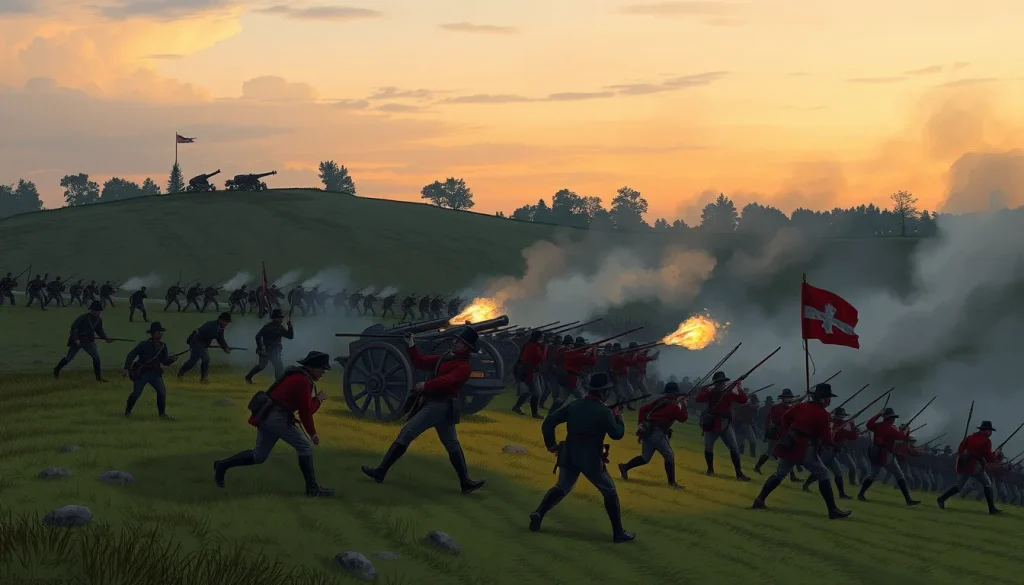
The Battle of Lundy’s Lane, also known as the Battle of Niagara or the Battle of Bridgewater, was fought on the evening and night of 25 July 1814 during the War of 1812, near present-day Niagara Falls, Ontario. One of the bloodiest engagements of the conflict, it pitted an invading American army under Major General Jacob Brown against a British, Canadian, and Indigenous force commanded by Lieutenant General Gordon Drummond. The battle halted the final American invasion of Upper Canada and forced the American army to withdraw to Fort Erie, effectively ending the Niagara campaign of 1814.
Historical Context
The Niagara campaign of 1814 was the third American attempt to invade Upper Canada. On 3 July an American force of regulars commanded by Major General Jacob Brown crossed the Niagara River at its source on Lake Erie and quickly captured Fort Erie. Two days later, at the Battle of Chippawa, a brigade of United States regulars under Brigadier General Winfield Scott defeated a British force under Major General Phineas Riall in an open-field engagement—the first time in the war that American regulars had matched British regulars in linear tactics. The British fell back to Fort George near the mouth of the Niagara River. Brown advanced to Queenston but lacked the troops and heavy artillery needed to attack Fort George. British naval control of Lake Ontario allowed reinforcements to move from York to Fort George, while American naval forces under Commodore Isaac Chauncey remained at Sackets Harbor awaiting new ships. For most of July, Brown’s army occupied Queenston, harassed by Canadian militia and Indigenous warriors. On 24 July Brown withdrew south to Chippawa Creek to secure his supplies and prepare for a future advance toward Burlington. As soon as the Americans retired, Riall advanced his light troops to Lundy’s Lane, a ridge about four miles north of the Chippawa, to maintain contact with the American main force.
What Happened
Early on 25 July, Drummond arrived at Fort George and took personal command on the Niagara peninsula. He ordered a column under Lieutenant Colonel John Tucker to advance along the east bank of the Niagara River from Fort Niagara, hoping to force Brown to evacuate the west bank. Instead, Brown ordered his army north. Riall, seeing the Americans in motion, initially ordered a withdrawal to Fort George, but Drummond—who had force-marched reinforcements to Lundy’s Lane—countermanded the order. British troops were still reoccupying their positions on the ridge when Scott’s brigade emerged from the forest at about 6:00 pm. The British artillery, massed in a cemetery at the highest point of the ridge, opened fire, and Scott’s brigade of roughly 1,000 regulars was severely mauled. Scott ordered a flanking movement against the British left; his troops pushed back two battalions, and the wounded Riall was captured when his stretcher bearers became separated from the British lines. By about 9:00 pm Scott’s brigade had been reduced to roughly 600 effectives.
Brown arrived on the field with the main American body and committed Ripley’s and Porter’s brigades. He ordered Colonel James Miller of the 21st United States Infantry to capture the British artillery, and Miller famously replied, “I’ll try, Sir.” Miller’s charge captured the guns after close-range volleys and a bayonet assault. Drummond, wounded twice but remaining on the field, launched three counterattacks through the night. The fighting continued in almost complete darkness, much of it at bayonet point, and all three counterattacks were repelled with heavy casualties on both sides, though the Americans were unable to remove the captured guns. By midnight both armies had lost most of their senior commanders wounded—Brown and Scott on the American side, Drummond and Riall on the British. Exhausted, short of ammunition and water, Brown ordered a retreat to Chippawa, which the equally exhausted British did not contest.
Why It Matters
Lundy’s Lane is generally classified by historians as a strategic British and Canadian victory. Although the American troops fought effectively and at times held parts of the field, they withdrew the following morning and abandoned the campaign, ending the last American invasion of Upper Canada. The American army retired to Fort Erie, where it was besieged by Drummond before crossing back into the United States in November 1814. The battle demonstrated that American regular infantry, after Scott’s intensive drilling at Buffalo, could fight on equal terms with British regulars—a lesson that influenced post-war American professional military development and the early curriculum at West Point. Historians such as Donald Hickey and Jon Latimer have emphasized the ferocity of the engagement, with Latimer comparing its intensity to the bloodiest battles of the Peninsula War.
Prelude
Following the American capture of Fort Erie on 3 July and the victory at Chippawa on 5 July, Brown advanced his army north to Queenston. The British withdrew to Fort George, where they were reinforced by units moved across Lake Ontario. Brown lacked heavy guns and manpower to storm Fort George, and the British naval squadron controlled the lake. His decision on 24 July to fall back to Chippawa was intended to consolidate his force and secure his supply line before striking toward Burlington. Riall, ordered to keep contact with the withdrawing Americans, advanced to Lundy’s Lane with light infantry, militia, and artillery. Drummond’s arrival on the morning of 25 July and his decision to reinforce rather than withdraw set the stage for the meeting engagement.
Forces and Commanders
United States: Commanded by Major General Jacob Brown, with Brigadier General Winfield Scott commanding the 1st Brigade and Brigadier General Eleazar W. Ripley commanding the 2nd Brigade. Colonel James Miller commanded the 21st Infantry. Porter’s brigade of New York militia also participated. American strength was approximately 2,500–2,800 troops, primarily regular infantry with some artillery and militia.
United Kingdom and Canada: Commanded by Lieutenant General Gordon Drummond, with Major General Phineas Riall as second in command. Units included elements of the 89th, 41st, 8th, and 103rd Regiments of Foot, the Royal Scots, the 104th Regiment, Canadian fencibles and militia, and Indigenous allies under John Norton. British strength was approximately 3,000–3,500 men. Colonel Hercules Scott commanded a separate column that arrived late in the battle. British artillery included two 24-pounder guns, two 6-pounder guns, one 5.5-inch howitzer, and a Congreve rocket detachment.
Battlefield and Map Context
Lundy’s Lane was a spur road running from the main Portage Road alongside the Niagara River, approximately one mile inland from Niagara Falls. The road ran along the summit of a rise about 25–30 feet above the surrounding terrain, commanding good views in all directions. The ground on either side was a mix of open farmland and forest, with thick woods along the Portage Road where Scott’s troops emerged. The British placed their artillery in a cemetery at the highest point of the ridge—the site that later became Drummond Hill Cemetery. The position anchored one flank near the river and provided defensive fields of fire across the open ground to the south.
Battle Chronology
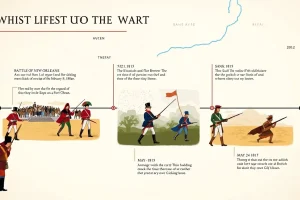
- Morning, 25 July 1814: Drummond arrives at Fort George; orders Tucker’s column along the east bank and reinforcements to Lundy’s Lane.
- Early afternoon: Brown orders his army north from Chippawa; Riall orders a withdrawal, but Drummond countermands and orders the ridge reoccupied.
- About 5:30–6:00 pm: American approach detected; Scott’s brigade emerges from the forest and takes artillery fire.
- About 6:00–7:00 pm: Scott’s flank attack rolls back the British left; Riall is captured.
- About 7:00–8:00 pm: Brown arrives with the main American force; repeated attacks against the British hilltop positions.
- About 8:00–9:00 pm: Miller’s 21st Infantry captures the British artillery after a bayonet charge.
- About 9:00–10:00 pm: Drummond’s first counterattack; repelled. Scott’s brigade reduced to about 600 effectives.
- About 10:00–11:00 pm: Drummond’s second counterattack; repelled. Scott is badly wounded.
- About 11:00 pm–midnight: Drummond’s third counterattack; a bayonet duel in near darkness; repelled.
- About midnight: Brown orders a withdrawal; the exhausted British do not pursue.
- Morning, 26 July: American forces retreat to Chippawa, then to Fort Erie.
Casualties and Losses
American losses were approximately 173 killed, 571 wounded, and 117 missing, though some contemporary returns cite slightly different figures (e.g., 171 killed, 572 wounded, and 110 missing). British and Canadian losses were approximately 84 killed, 559 wounded, and 235 missing or captured. Combined casualties totaled nearly 1,740 out of fewer than 6,000 engaged, a casualty rate of roughly 29 percent—among the highest of any engagement of the Napoleonic era. Both armies lost several senior officers, and Major General Riall was captured.
Result
The battle is generally considered tactically inconclusive: both sides held portions of the field at various points, the Americans captured the British guns but later abandoned them, and both armies withdrew voluntarily. Strategically, however, the battle was a British and Canadian victory because the American invasion of Upper Canada was halted. The American army withdrew to Chippawa and then to Fort Erie, where it was besieged before eventually evacuating the fort and retiring across the Niagara River in November.
Strategic Consequences
Lundy’s Lane ended the last American invasion of Upper Canada. Brown’s army, too badly mauled to resume offensive operations, was besieged at Fort Erie by Drummond’s forces from August to September 1814. The American garrison survived two British assault attempts and sortied effectively before evacuating the fort in early November. On the British side, heavy casualties strained limited colonial resources, but the defense of the Niagara frontier was secured. The battle also cemented the reputations of Winfield Scott and James Miller and contributed to the postwar professionalization of the United States Army.
Primary Accounts
The principal primary sources for the battle are the official reports of Major General Jacob Brown, Lieutenant General Gordon Drummond, and Brigadier General Winfield Scott. Brown’s report to the United States Secretary of War contains the first written version of Miller’s famous “I’ll try, Sir” response and the American casualty return. Drummond’s dispatches to the British government reported the British casualty figures and made the case for a British victory. Scott later reflected on the battle in his memoirs (published 1864). Contemporary newspaper accounts on both sides of the border also reported the action, and several 19th-century regimental histories preserved veteran testimony from participants on both sides.
Battlefield Today
The battlefield at Lundy’s Lane now lies within the city of Niagara Falls, Ontario, within a residential area. The highest point of the ridge, where the British artillery and cemetery stood, is preserved as Drummond Hill Cemetery, which contains the remains of many soldiers killed in the battle. The Lundy’s Lane Battlefield was designated a National Historic Site of Canada in 1937. A monument in the cemetery commemorates the engagement, and the nearby Lundy’s Lane Museum (in the former Lundy’s Lane Schoolhouse) offers interpretation of the battle and the wider Niagara campaign.
Primary Sources
Major General Jacob Brown’s official report, addressed to the Secretary of War and dated after the battle, provides the American command perspective, including casualty returns and the famous exchange with James Miller. Lieutenant General Gordon Drummond’s dispatch to the British government, likewise produced shortly after the engagement, offers the British command perspective and includes their casualty figures. Winfield Scott’s post-war memoirs (published 1864) include his recollections of the action, written with hindsight. Each source is shaped by its author’s position and wartime context: Brown and Drummond each sought to justify their decisions and claim advantage, while Scott wrote decades later with the perspective of a long career.
Further Reading
- The Incredible War of 1812, J. Mackay Hitsman (revised edition)
- 1812: War with America, Jon Latimer
- The War of 1812: A Forgotten Conflict, Donald R. Hickey
- Flames Across the Border: 1813–1814, Pierre Berton
- American Battlefield Trust, “Lundy’s Lane Battle Facts and Summary” (battlefields.org)
- The Canadian Encyclopedia, “Battle of Lundy’s Lane” (thecanadianencyclopedia.ca)
References
- American Battlefield Trust, “Lundy’s Lane Battle Facts and Summary.” https://www.battlefields.org/learn/war-1812/battles/lundys-lane.
- War of 1812 Historical Reference Site, “Battle of Lundy’s Lane.” https://thewarof1812.org/battles/battle-of-lundys-lane/.
- History of War, “Battle of Lundy’s Lane, 25 July 1814.” https://www.historyofwar.org/articles/battles_lundys_lane.html.
- Wikipedia, “Battle of Lundy’s Lane.” https://en.wikipedia.org/wiki/Battle_of_Lundy’s_Lane.
- The Canadian Encyclopedia, “Battle of Lundy’s Lane.” https://thecanadianencyclopedia.ca/index.php/en/article/battle-of-lundys-lane.
FAQ
Who won the Battle of Lundy's Lane?
The battle is tactically disputed, but strategically it was a British and Canadian victory. The American invasion of Upper Canada was halted, and the U.S. army withdrew to Fort Erie and eventually crossed back into the United States.
What was the 'I'll try, Sir' quote at Lundy's Lane?
When General Brown asked Colonel James Miller if he could capture the British artillery on the hill, Miller replied, 'I'll try, Sir.' His charge succeeded, and the phrase became the regimental motto of the 21st United States Infantry.
How many casualties were there at Lundy's Lane?
Combined casualties were approximately 1,740 out of fewer than 6,000 engaged—roughly 29 percent. American losses were about 173 killed, 571 wounded, and 117 missing; British and Canadian losses were about 84 killed, 559 wounded, and 235 missing or captured.
Why is it called Lundy's Lane?
The battle took place at the intersection of Lundy's Lane with the Portage Road, about a mile inland from Niagara Falls. The lane was named for a local landowner whose farm gave the road its name.
Leave a Reply