
Short Answer
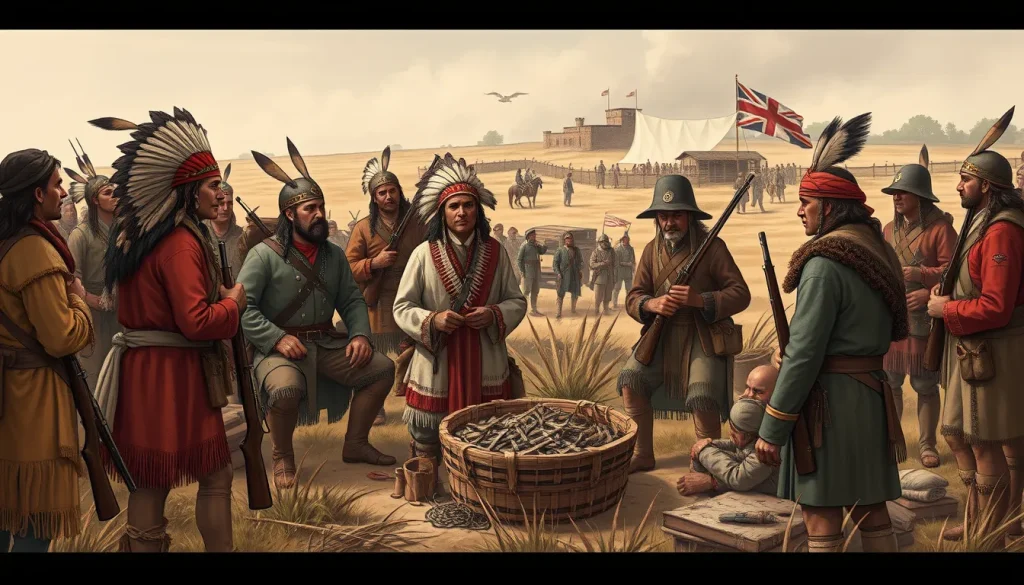
The Northwest Indian War (also called the Little Turtle’s War or the Ohio War) was an armed conflict for control of the Old Northwest—the region north of the Ohio River and south of the Great Lakes—fought chiefly between the United States and the Northwestern Confederacy, a coalition of Indigenous nations including the Miami, Shawnee, Lenape, Wyandot, Ottawa, Ojibwe, and Potawatomi. The fighting lasted from the mid-1780s until the Treaty of Greenville in 1795, with major U.S. campaigns in 1790, 1791, and 1794. Though it ended seventeen years before the War of 1812, it directly shaped the later war in the Northwest: it established U.S. military power in the region, intensified Indigenous dispossession, and left unresolved British-Indigenous alliances and border grievances that would resurface after 1812.
Historical Context
The roots of the conflict lay in the imperial rivalries and settlement pressures that followed the Seven Years’ War. In the 1763 Treaty of Paris, France ceded its North American mainland claims to Britain, including the Ohio and Illinois countries. Britain’s Royal Proclamation of 1763 attempted to reserve territory west of the Appalachian Mountains for Indigenous nations, but colonial expansion and British imperial reorganization soon eroded that boundary. The Quebec Act of 1774 placed the Ohio Valley under the province of Quebec, alarming American colonists with land claims there and contributing to the Revolutionary crisis.
During the American Revolutionary War, many Indigenous nations in the Great Lakes and Ohio Valley allied with Britain or pursued their own strategies to protect sovereignty and hunting grounds. The 1783 Treaty of Paris ended the war and ceded British territory south of the Great Lakes to the new United States, but Indigenous nations were not parties to the treaty and did not accept that Britain could transfer their lands. Britain retained several strategic posts south of the Great Lakes—including Detroit, Niagara, Michilimackinac, and Oswegatchie—and continued fur trade and diplomatic activity through the British Indian Department. These posts violated the treaty’s spirit, but Britain argued they were retained until American debts to Loyalists were settled.
In the United States, the Confederation Congress sought to organize the new western territory. The Land Ordinance of 1785 and the Northwest Ordinance of 1787 created procedures for surveying, selling, and governing lands north of the Ohio River. These laws assumed U.S. sovereignty and encouraged settlement, but they collided with the claims and lifeways of the Miami, Shawnee, Lenape, Wyandot, Ottawa, Ojibwe, Potawatomi, and other nations. In 1785, a Western Confederacy—often called the Northwestern Confederacy—began to take shape through councils and agreements to resist American expansion. British officials at Detroit and other posts provided arms, ammunition, and diplomacy, hoping to maintain influence and a buffer against U.S. expansion. After George Washington became president in 1789, his administration treated the region as essential to national security and economic growth. The stage was set for a war that would become a direct precursor to the War of 1812 in the Old Northwest.
What Happened
Violence escalated in the mid-1780s as American settlers moved north of the Ohio River and Indigenous war parties attacked isolated settlements and military detachments. U.S. authorities attempted treaty negotiations at Fort Stanwix (1784), Fort McIntosh (1785), Fort Finney (1786), and Fort Harmar (1789), but these agreements were disputed by many Indigenous nations because they were made with only some groups and did not recognize the Confederacy’s collective position. In 1790, President Washington authorized Brigadier General Josiah Harmar to lead a punitive campaign into the Miami heartland. Harmar’s force of regulars and militia marched toward Kekionga, the Miami capital near modern Fort Wayne, Indiana. In October 1790, after burning some villages, Harmar’s detachments were ambushed and defeated in several engagements; the campaign failed to break Indigenous resistance and damaged U.S. prestige.
In 1791, Governor Arthur St. Clair led a larger expedition into the Ohio Country. On November 4, 1791, near present-day Fort Recovery, Ohio, his force was surprised and routed by a large confederacy force led by Miami war chief Little Turtle, Shawnee leader Blue Jacket, and Lenape leader Buckongahelas. St. Clair’s Defeat—often called the Battle of the Wabash—was the worst defeat ever suffered by the U.S. Army at the hands of Indigenous forces. Hundreds of soldiers and camp followers were killed, and the U.S. military was nearly destroyed.
Congress responded by authorizing a new army, the Legion of the United States, and Washington appointed Major General Anthony Wayne to command it. Wayne trained the Legion rigorously at Legionville, Pennsylvania, and then moved it west, building a chain of forts—including Fort Recovery, Fort Adams, Fort Defiance, and Fort Wayne—to secure supply lines and pressure the Confederacy. In August 1794, Wayne’s Legion defeated the Confederacy at the Battle of Fallen Timbers, near the Maumee River in modern northwestern Ohio. The British garrison at nearby Fort Miamis refused to aid the retreating Indigenous warriors, revealing the limits of British support. Wayne then advanced to Kekionga and established Fort Wayne.
In 1795, the defeated Confederacy and other Indigenous nations signed the Treaty of Greenville, ceding large portions of present-day Ohio and parts of Indiana, Illinois, and Michigan to the United States. The treaty established a boundary line and reserved certain lands for Indigenous nations, but it was not universally accepted. The Jay Treaty of 1794 between the United States and Britain led to British evacuation of the Great Lakes posts by 1796, though British influence and trade continued. The Northwest Indian War thus ended with U.S. control of the Old Northwest, but it did not resolve the underlying tensions. In the following decade, Indigenous leaders including Tecumseh and Tenskwatawa built a new confederacy, and when the War of 1812 began, many Indigenous nations allied with Britain in an effort to halt American expansion. The Northwest Indian War had set the pattern for that later conflict.
Why It Matters
The Northwest Indian War confirmed U.S. sovereignty over the Old Northwest and opened the region to rapid American settlement. It led to the admission of Ohio as a state in 1803 and paved the way for Indiana, Illinois, Michigan, and Wisconsin. It also established the U.S. Army as a permanent national institution and created a cadre of officers who would serve in the War of 1812. For Indigenous nations, the war brought devastating losses, land cessions, and the weakening of the Northwestern Confederacy, though resistance continued. The Treaty of Greenville became a foundational document in U.S.-Indigenous relations, and its disputed land cessions fueled later conflicts.
Historians interpret the war in several ways. Some emphasize it as a U.S. war of conquest driven by settler expansion and national security. Others focus on Indigenous agency, showing that the Confederacy was a sophisticated diplomatic and military coalition defending sovereignty. Still others stress British manipulation and the role of British agents at Detroit, who encouraged Indigenous resistance while avoiding direct war with the United States. These interpretations are not mutually exclusive, but they reflect different emphases on American, Indigenous, and British perspectives. The war is also remembered as a precursor to the War of 1812 in the Northwest, where the unresolved issues of British support, Indigenous land rights, and border security erupted again.
Prelude
The immediate prelude to the war included failed treaty negotiations and escalating raids. U.S. officials believed that treaties at Fort Stanwix, Fort McIntosh, Fort Finney, and Fort Harmar had secured land cessions, but many Indigenous leaders rejected them as fraudulent or incomplete. The Northwestern Confederacy insisted that any land cession required unanimous consent of the allied nations. British officials at Detroit, including Lieutenant Governor John Graves Simcoe after 1791, maintained a diplomatic and supply relationship with the Confederacy. American settlers continued to cross the Ohio River, and violence on the frontier increased. Washington’s administration decided that only military force could enforce U.S. claims.
Forces and Commanders
On the U.S. side, President George Washington and Secretary of War Henry Knox directed strategy. Brigadier General Josiah Harmar led the 1790 campaign; Governor Arthur St. Clair led the 1791 expedition; and Major General Anthony Wayne commanded the Legion of the United States from 1792 to 1795. Brigadier General James Wilkinson was a subordinate and later a controversial figure. U.S. forces included regular infantry, artillery, dragoons, and state militia, often poorly trained and supplied in the early campaigns.
The Northwestern Confederacy included Miami, Shawnee, Lenape (Delaware), Wyandot, Ottawa, Ojibwe, Potawatomi, Mingo, and some Iroquois warriors. Key leaders included Miami war chief Little Turtle, Shawnee leader Blue Jacket, Lenape leader Buckongahelas, Ottawa leader Egushawa, and Iroquois diplomat Joseph Brant. British support came from the British Indian Department, notably agents Alexander McKee, Matthew Elliott, and Simon Girty, who distributed arms and supplies from Detroit and Fort Miamis. British regulars and militia generally did not fight openly, but their presence and logistical aid were crucial.
Battlefield and Map Context
The war unfolded across the Ohio Country, the Maumee and Wabash river valleys, and the southern shore of Lake Erie. Key locations included Kekionga (modern Fort Wayne, Indiana), the site of St. Clair’s Defeat (modern Fort Recovery, Ohio), Fallen Timbers (near modern Maumee, Ohio, southwest of Toledo), Fort Miamis (modern Maumee, Ohio), Fort Washington (Cincinnati, Ohio), and Detroit (Michigan). The region’s dense forests, rivers, and limited roads made logistics difficult and favored Indigenous tactics. The map of the conflict overlaps with the later War of 1812 campaigns in the Northwest, including Detroit, the Maumee, and the Thames River.
Battle Chronology
- 1785–1789: Northwestern Confederacy forms; raids and skirmishes increase; U.S. treaty councils fail to resolve sovereignty disputes.
- October 1790: Harmar campaign; U.S. forces defeated near Kekionga.
- November 4, 1791: St. Clair’s Defeat near modern Fort Recovery, Ohio.
- 1792–1793: Anthony Wayne organizes and trains the Legion of the United States; advances into Ohio Country.
- 1794: Wayne builds forts and moves toward the Maumee; British Fort Miamis remains a point of tension.
- August 20, 1794: Battle of Fallen Timbers; Wayne defeats the Confederacy.
- August 3, 1795: Treaty of Greenville cedes extensive lands to the United States.
- 1796: British evacuate Detroit and other Great Lakes posts under the Jay Treaty.
Casualties and Losses
Casualty figures for the Northwest Indian War are incomplete and sometimes disputed. Harmar’s campaign in 1790 cost the United States roughly 75 to 200 killed and missing, depending on the account. St. Clair’s Defeat in 1791 was catastrophic: contemporary U.S. reports counted about 632 soldiers killed and 264 wounded, with additional camp followers killed. Some modern tabulations estimate total U.S. deaths across the war at around 1,221, with 458 wounded, though these figures vary by source. Indigenous losses are far less documented. The Confederacy suffered casualties in individual battles, and the war’s overall toll included displacement, starvation, and disease. At Fallen Timbers, U.S. losses were relatively light—roughly 30 to 40 killed and about 100 wounded—while Indigenous losses were perhaps 30 to 40 killed, though estimates differ. The absence of reliable records for Indigenous casualties reflects both the nature of the fighting and the unequal documentary record.
Result
The war ended in a U.S. military victory. The Treaty of Greenville forced the Northwestern Confederacy and other signatory nations to cede about two-thirds of modern Ohio and portions of Indiana, Illinois, and Michigan. The United States gained effective control of the Old Northwest, and the British evacuated their posts by 1796. However, the treaty did not end Indigenous resistance or land disputes. Many nations and leaders rejected the cessions, and the United States continued to pressure Indigenous lands in the decades that followed.
Strategic Consequences
Strategically, the war secured the U.S. western border and accelerated settlement, but it also created the conditions for the War of 1812 in the Northwest. The British decision to aid the Confederacy while avoiding open war left a legacy of suspicion. The Treaty of Greenville and subsequent land cessions fueled Indigenous unity movements, including the one led by Tecumseh and Tenskwatawa. The 1811 Battle of Tippecanoe further inflamed the region. When the United States declared war on Britain in 1812, the Old Northwest became a major theater. British forces and Indigenous allies captured Detroit and fought at Fort Meigs, Fort Stephenson, and the Thames, where Tecumseh was killed in 1813. The Northwest Indian War thus served as both a precedent and a prelude: it demonstrated the power of Indigenous coalitions, the importance of British support, and the determination of the United States to control the region.
Primary Accounts
Primary accounts of the Northwest Indian War come mainly from American military officers, government officials, and British agents. Arthur St. Clair published a narrative defending his conduct, and Ebenezer Denny’s military journal provides a detailed eyewitness perspective on St. Clair’s campaign. Anthony Wayne’s correspondence and orders document the Legion’s organization and campaign. The Treaty of Greenville proceedings and the treaty text itself are essential for understanding the diplomatic settlement. British Indian Department records, including letters from Alexander McKee and Matthew Elliott, illuminate British policy and supply networks. Indigenous voices are more difficult to recover; Little Turtle, Blue Jacket, and other leaders spoke through interpreters, and their perspectives survive in treaty councils, later interviews, and oral traditions. All these sources are shaped by the interests of their authors and must be read critically.
Battlefield Today
Several sites preserve the memory of the Northwest Indian War. Fort Recovery State Museum and Monument in Ohio marks the site of St. Clair’s Defeat and the later fort built by Wayne. Fallen Timbers Battlefield and Monument in Maumee, Ohio, commemorates the 1794 battle. Fort Miamis National Historic Site preserves earthworks associated with the British fort. The city of Fort Wayne, Indiana, occupies the former Miami capital of Kekionga. Greenville, Ohio, preserves the site of the Treaty of Greenville. These places are interpreted today with attention to both U.S. and Indigenous histories, though public memory has often emphasized American military victory over Indigenous dispossession.
Primary Sources
The most important contemporary documents include:
- Treaty of Greenville (August 3, 1795): The treaty text records land cessions, boundaries, and annuity payments. It is available in Charles J. Kappler’s Indian Affairs: Laws and Treaties and in the American State Papers: Indian Affairs.
- Arthur St. Clair, A Narrative of the Manner in Which the Campaign Against the Indians … Was Conducted (1812): St. Clair’s self-defense offers insight into the 1791 campaign but is highly partisan.
- Ebenezer Denny, Military Journal of Major Ebenezer Denny (1859): Denny served in the St. Clair campaign and provided a day-by-day account. His journal is valuable but limited to his own observations.
- Anthony Wayne correspondence and orders: Wayne’s letters to Henry Knox and others detail the Legion’s training, supply, and operations. They are found in various edited collections and archives.
- British Indian Department records: Letters and reports from Detroit and Fort Miamis, held in Library and Archives Canada and other repositories, document British arms and diplomacy. They reflect British imperial interests.
- American State Papers: Indian Affairs: This published collection contains treaties, reports, and correspondence from U.S. officials.
These sources must be used with caution. American military accounts often minimize U.S. failures or exaggerate Indigenous atrocities. British records emphasize British influence while denying direct responsibility for Indigenous warfare. Indigenous perspectives are underrepresented and often filtered through interpreters and colonial record-keepers.
Further Reading
- Sword, Wiley. President Washington’s Indian War: The Struggle for the Old Northwest, 1790–1795. University of Oklahoma Press, 1985.
- Gaff, Alan D. Bayonets in the Wilderness: Anthony Wayne’s Legion in the Old Northwest. University of Oklahoma Press, 2004.
- Hogeland, William. Autumn of the Black Snake: The Creation of the U.S. Army and the Invasion That Opened the West. Farrar, Straus and Giroux, 2017.
- Dowd, Gregory Evans. A Spirited Resistance: The North American Indian Struggle for Unity, 1745–1815. Johns Hopkins University Press, 1992.
- White, Richard. The Middle Ground: Indians, Empires, and Republics in the Great Lakes Region, 1650–1815. Cambridge University Press, 1991.
- Calloway, Colin G. The American Revolution in Indian Country: Crisis and Diversity in Native American Communities. Cambridge University Press, 1995.
- Skaggs, David Curtis, and Larry L. Nelson, eds. The Sixty Years’ War for the Great Lakes, 1754–1814. Michigan State University Press, 2001.
- Ohio History Connection, Fort Recovery State Museum, and Fallen Timbers Battlefield resources.
References
- Sword, Wiley. President Washington’s Indian War: The Struggle for the Old Northwest, 1790–1795. University of Oklahoma Press, 1985. ISBN 9780806124889.
- “Northwest Indian War.” Wikipedia. https://en.wikipedia.org/wiki/Northwest_Indian_War.
- Kappler, Charles J., ed. Indian Affairs: Laws and Treaties, Vol. 2. Washington: Government Printing Office, 1904.
- St. Clair, Arthur. A Narrative of the Manner in Which the Campaign Against the Indians, in the Year One Thousand Seven Hundred and Ninety-One, Was Conducted. Philadelphia: Jane Aitken, 1812.
- Denny, Ebenezer. Military Journal of Major Ebenezer Denny. Philadelphia: J. B. Lippincott, 1859.
- American State Papers: Indian Affairs. 2 vols. Washington: Gales and Seaton, 1832–1834.
- Gaff, Alan D. Bayonets in the Wilderness: Anthony Wayne’s Legion in the Old Northwest. University of Oklahoma Press, 2004.
- Dowd, Gregory Evans. A Spirited Resistance: The North American Indian Struggle for Unity, 1745–1815. Johns Hopkins University Press, 1992.
- White, Richard. The Middle Ground: Indians, Empires, and Republics in the Great Lakes Region, 1650–1815. Cambridge University Press, 1991.
FAQ
What caused the Northwest Indian War?
The war grew out of the 1783 Treaty of Paris, which ceded the Old Northwest to the United States without Indigenous consent, and U.S. settlement north of the Ohio River. The Northwestern Confederacy resisted these incursions, while Britain retained Great Lakes posts and supplied Indigenous allies.
How did the Northwest Indian War lead to the War of 1812?
It left unresolved tensions over British support for Indigenous nations, U.S. expansion, and control of the Great Lakes border. These grievances contributed to Indigenous unity movements under Tecumseh and to the Northwest campaigns of the War of 1812.
What was the Treaty of Greenville?
Signed in 1795, it ended the Northwest Indian War. The United States gained large cessions in modern Ohio and parts of neighboring states, while Indigenous signatories received annuity payments and reserved lands. Many Indigenous nations disputed the treaty's legitimacy.
Leave a Reply