
Short Answer
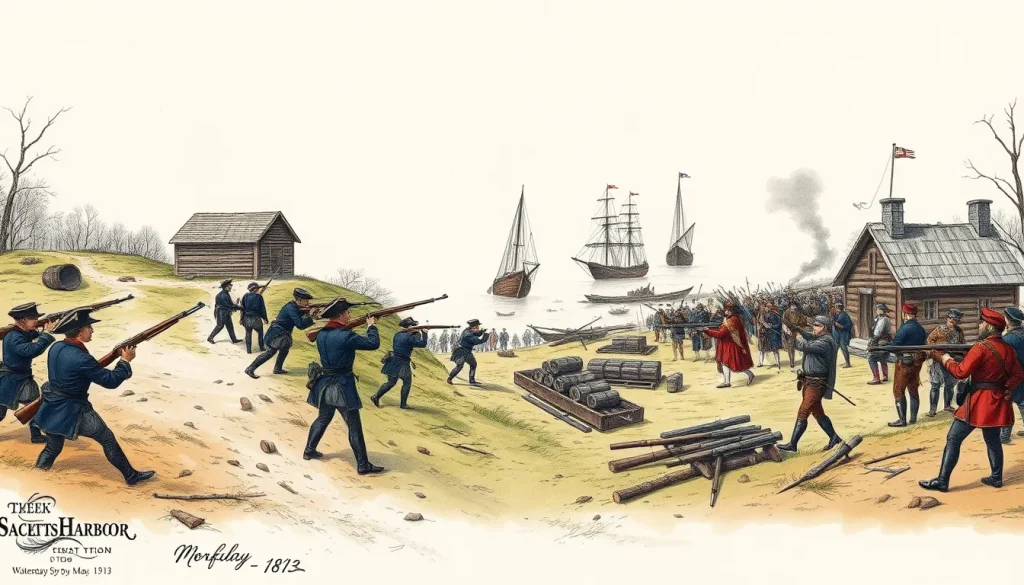
The Battle of Sackets Harbor (29 May 1813) was a British and Canadian amphibious raid on the United States Navy’s principal shipyard on Lake Ontario, at Sackets Harbor, New York. British regulars, Canadian militia, and Indigenous warriors under Sir George Prevost, Governor General of Canada, landed on Horse Island and advanced on the town but were checked by American regulars and New York militia under Brigadier General Jacob Brown. The Americans held the field, yet fires set in the alarm at the navy yard destroyed stores and damaged the unfinished sloop-of-war General Pike, so the raid partly accomplished its purpose. This article covers the 1813 engagement, sometimes called the Second Battle of Sackets Harbor; the smaller naval action of 19 July 1812 at the same anchorage is a separate event, and contemporary documents usually spell the place name “Sackett’s Harbour.”
Historical Context
Lake Ontario was the central artery of the war in the northeast. Troops, artillery, and provisions moved by water between Kingston, York (modern Toronto), the Niagara frontier, and the American posts at Sackets Harbor, Oswego, and the Niagara River. Because neither side could force a decisive fleet action, both governments invested heavily in shipbuilding, and the harbors where the ships were built became strategic objectives rather than mere depots.
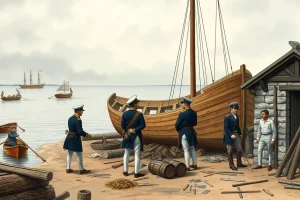
Sackets Harbor stands on Black River Bay in Jefferson County, New York, roughly thirty miles south of Kingston across the lake. It offered a sheltered anchorage, abundant timber, and access to the St. Lawrence valley. After war was declared in June 1812 it became the headquarters of Commodore Isaac Chauncey’s Lake Ontario squadron, the site of a navy yard run by the shipwright Henry Eckford, and a supply depot for the U.S. Army’s northern operations. Its exposure had already been shown on 19 July 1812, when a British squadron was driven off by the brig Oneida and shore batteries in the first engagement at the harbor.
By the spring of 1813 the yard was building a sloop-of-war rated for 26 guns, named General Pike after Brigadier General Zebulon Pike, killed at York in April. A completed General Pike threatened to give Chauncey command of the lake, a fact well understood at Kingston. In late May 1813 Chauncey’s squadron carried Major General Henry Dearborn’s troops to the successful amphibious attack on Fort George, and for several days the harbor was left with its fortifications, its stores, its shipyard, and an unfinished warship, but almost no fleet.
What Happened
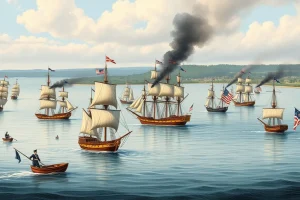
Sir George Prevost, Governor General of Canada, struck at the exposed base. A squadron under Commodore Sir James Lucas Yeo left Kingston on 27 May 1813 carrying roughly 800 to 900 British regulars, Canadian militia, and a small party of Indigenous warriors. On 28 May the flotilla intercepted a body of about 150 American reinforcements marching toward Sackets Harbor, taking most of them prisoner; Prevost also gathered reports that the garrison had been reduced. Early on 29 May his troops landed on Horse Island, about a mile from the village.
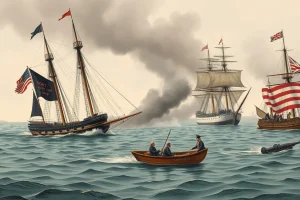
The landing force pushed the militia outposts back across the causeway and advanced toward the American works around Navy Point. Contrary winds kept most of Yeo’s squadron, and its heavy guns, off the shoreline, leaving the assaulting infantry without naval fire support. American regulars held the earthworks, and Brown rallied the militia; as the Americans extended their line and threatened to outflank him, Prevost ordered a withdrawal to the boats. Before the British re-embarked, personnel at the navy yard, fearing capture, set fire to the naval storehouse and to the General Pike. The fires aboard the ship were extinguished, but the storehouse and a large quantity of cordage, canvas, and provisions were lost.
Why It Matters
The immediate outcome was an American tactical victory that was also a partial British success. Sackets Harbor remained in American hands and the shipyard was not destroyed; General Pike was saved, completed, and launched within weeks, serving as Chauncey’s flagship. At the same time, the destruction of naval stores slowed American operations on Lake Ontario during the 1813 campaign. Contemporary American accounts tended to emphasize the repulse, while contemporary British accounts emphasized the damage done to the yard.
The raid also shaped reputations. Prevost’s decision to withdraw short of the shipyard drew criticism from some British officers, though later historians, notably Tanya Grodzinski, argue that he faced entrenched works, had lost effective naval support, and risked being cut off with his boats. Jacob Brown’s conduct strengthened his standing, and he received a brigadier general’s commission in the regular army in July 1813. More broadly, the engagement illustrates the Lake Ontario stalemate: each side destroyed the other’s supplies and shipwright capacity rather than winning a decisive fleet action, and construction escalated until both squadrons included ships as large as any then afloat.
Prelude
Intelligence drove the raid. Reports reaching Kingston indicated that Chauncey’s squadron had gone east and that the Sackets Harbor garrison was thin. Prevost assembled the expedition quickly from the Kingston garrison and sailed on 27 May. The interception of the American reinforcement column on 28 May removed some 150 men who might otherwise have strengthened the defenses, and prisoners confirmed that the works were lightly manned. Weather on the morning of 29 May was overcast with light and contrary winds, a condition that ultimately prevented the British squadron from closing to bombard the American position.
Forces and Commanders
The British and Canadian force numbered roughly 870 to 900 troops, commanded personally by Sir George Prevost, with Commodore Sir James Lucas Yeo commanding the naval squadron. The landing party was drawn from the Kingston garrison and is reported to have included detachments of British regulars such as companies of the 100th and 104th Regiments, the Glengarry Light Infantry, Canadian militia, and a small contingent of Indigenous warriors. Sailors and marines from the squadron supported the landing.
The American force, numbering about 1,400 to 1,500, was commanded by Brigadier General Jacob Brown of the New York militia, the senior officer present, with Colonel Electus Backus commanding the regular infantry. Roughly two-thirds of the defenders were militia, including volunteers from Albany, with the remainder U.S. regulars. Also present were naval personnel, shipwrights, and yard workers associated with the shipyard directed by Henry Eckford. Commodore Isaac Chauncey, the squadron commander, was absent with the fleet.
Battlefield and Map Context
Horse Island lies about a mile west of the village across a shallow bay, and in 1813 a causeway linked it to the mainland, making it the natural landing route for an attacking force. The village occupies a peninsula on the south shore of Black River Bay, with the navy yard on Navy Point at the waterfront. American defenses included earthwork batteries and blockhouses covering the western approaches; the principal work on the bluff above the harbor is commonly identified as Fort Tompkins. The geography mattered greatly: an attacker landing at Horse Island had to cross open ground and a narrow causeway under fire, while the defender could fall back on prepared positions close to the yard.
Battle Chronology
Before dawn on 29 May, British and Canadian troops began landing on Horse Island and formed for the advance. American militia outposts, including Albany volunteers, skirmished with the leading troops but could not prevent the crossing, and they withdrew across the causeway to the mainland. The British and Canadian infantry followed and pushed toward the village.
Near the American works the advance slowed. Without the supporting fire of the squadron, the attackers could not suppress the entrenched regulars, and Brown used the interval to reform the militia and extend the American line. Fearing that his line of retreat to the boats might be cut, Prevost ordered the force back to Horse Island and re-embarkation. During the withdrawal, workers and militia at the navy yard, apparently believing the town would fall, set fire to the naval storehouse and to the General Pike; the ship was saved by firefighters, but the stores were largely destroyed.
Casualties and Losses
Casualty returns are incomplete and differ between accounts. American reports usually give roughly twenty to twenty-five killed and about sixty to eighty-five wounded, with most losses among the militia and regular infantry engaged west of the village. British and Canadian returns are commonly summarized as approximately forty to fifty killed and a similar number wounded, with a smaller number taken prisoner, though some popular summaries give higher totals for both sides. Several published figures combine killed, wounded, and captured, which helps explain the discrepancies. No reliable count of Indigenous casualties appears in the surviving returns.
Result
The engagement ended as an American tactical victory: the landing was repelled, the shipyard was not destroyed, and the General Pike was saved and completed. It was also a partial British success, since the raid destroyed a large quantity of naval stores and temporarily disrupted American logistics on the lake. No significant change in the naval balance on Lake Ontario followed immediately.
Strategic Consequences
Sackets Harbor continued to function as the principal American naval base on Lake Ontario, and the naval arms race with Kingston accelerated through 1813 and 1814. General Pike joined Chauncey’s squadron and briefly contributed to American superiority, but that advantage proved short-lived. The raid also added to the growing criticism of Prevost within the British command, even as modern scholars point to the practical constraints he faced. On the American side, the battle reinforced the value of militia in defensive fighting and advanced Brown’s career. Neither side gained lasting control of the lake, and the pattern of raids, shipbuilding, and indecisive squadron maneuvers continued.
Primary Accounts
The most commonly cited contemporary accounts are official reports and correspondence rather than published narratives. These include Jacob Brown’s report to his superior, Major General Henry Dearborn; Commodore Isaac Chauncey’s letters to Secretary of the Navy William Jones concerning the shipyard and the damage to stores; and Prevost’s and Yeo’s dispatches describing the landing, the withdrawal, and the destruction at the yard. American and Canadian newspapers of June 1813, including the Kingston and Montreal papers and the American weekly register press, carried summaries and extracts. These accounts are often self-serving: commanders wrote to justify their decisions, and newspaper versions were frequently based on secondhand testimony.
Battlefield Today
Sackets Harbor Battlefield State Historic Site preserves the navy yard, part of the battleground, and Horse Island, where the 1813 landing began. The site includes restored 1850s navy yard buildings, the Commandant’s House, exhibits, and a trail, and it presents costumed interpretation and guided tours. A granite monument marking the centennial of the battle was dedicated in 1913, with Franklin D. Roosevelt delivering remarks. In 2013, American, Canadian, and British military personnel and civilians dedicated a monument to the Crown forces who died in the attack, a commemoration recognized by Queen Elizabeth II. The American Battlefield Protection Program has identified the Sackets Harbor battleground as a Priority I principal site requiring preservation.
Primary Sources
For the 1813 battle, the key contemporary documents are official military and naval reports, notably Jacob Brown’s report to Major General Henry Dearborn and the correspondence of Commodore Isaac Chauncey with the Navy Department, together with Sir George Prevost’s dispatch to the Colonial Secretary in London and Commodore Sir James Lucas Yeo’s naval reports. These documents establish the sequence of the landing, the failure of the naval squadron to close the shore, and the destruction of stores, but each was written by a participant defending his own decisions. Newspaper accounts from Kingston, Montreal, Albany, and New York supply detail not found in official papers, though they are frequently based on rumor, prisoners’ testimony, or letters from unidentified officers. Muster rolls, quartermaster returns, and navy yard accounts provide the best evidence for numbers and losses; they are scattered and incomplete. No verbatim transcript is reproduced here, and readers should consult published documentary editions and the holdings of the Library of Congress, the U.S. National Archives, Library and Archives Canada, and the New York State Archives rather than rely on paraphrase.
Further Reading
- Patrick A. Wilder, The Battle of Sackett’s Harbour, 1813 (Nautical and Aviation Publishing, 1994).
- Robert Malcomson, Lords of the Lake: The Naval War on Lake Ontario, 1812–1814 (Naval Institute Press, 1998).
- Tanya Grodzinski, Defender of Canada: Sir George Prevost and the War of 1812 (University of Oklahoma Press, 2013).
- Donald R. Hickey, The War of 1812: A Forgotten Conflict (University of Illinois Press, 1989; revised editions).
- J. C. A. Stagg, Mr. Madison’s War: Politics, Diplomacy, and Warfare in the Early American Republic, 1783–1830 (Princeton University Press, 1983).
- William S. Dudley, ed., The Naval War of 1812: A Documentary History, 3 vols. (Naval Historical Center, 1985–2002).
- New York State Parks, Sackets Harbor Battlefield State Historic Site (site, museum, and archival collections).
- American Battlefield Trust, battle summary and map for Sackets Harbor.
References
- American Battlefield Trust, “Sackets Harbor,” https://www.battlefields.org/learn/war-1812/battles/sackets-harbor
- New York State Parks, Recreation and Historic Preservation, “Sackets Harbor Battlefield State Historic Site,” https://parks.ny.gov/visit/historic-sites/sackets-harbor-battlefield-state-historic-site
- Patrick A. Wilder, The Battle of Sackett’s Harbour, 1813 (Nautical and Aviation Publishing, 1994).
- Robert Malcomson, Lords of the Lake: The Naval War on Lake Ontario, 1812–1814 (Naval Institute Press, 1998).
- Tanya Grodzinski, Defender of Canada: Sir George Prevost and the War of 1812 (University of Oklahoma Press, 2013).
- Donald R. Hickey, The War of 1812: A Forgotten Conflict (University of Illinois Press, 1989; revised editions).
- William S. Dudley, ed., The Naval War of 1812: A Documentary History, 3 vols. (Naval Historical Center, 1985–2002).
- J. C. A. Stagg, Mr. Madison’s War (Princeton University Press, 1983).
FAQ
Was the Battle of Sackets Harbor an American victory?
Tactically, yes: the British and Canadian landing was repelled, the shipyard survived, and the unfinished sloop-of-war General Pike was saved. It was also a partial British success, because the raid destroyed a large quantity of naval stores and disrupted American logistics on Lake Ontario.
Why did the British attack Sackets Harbor in 1813?
Sackets Harbor was the principal American naval base and shipyard on Lake Ontario. With Commodore Chauncey's squadron away supporting the attack on Fort George, Sir George Prevost hoped to destroy the yard, its stores, and the nearly completed General Pike before the ship could give the United States command of the lake.
What was the First Battle of Sackets Harbor?
The first engagement at the harbor occurred on 19 July 1812, shortly after war was declared, when a British squadron on Lake Ontario was driven off by the American brig Oneida and shore batteries. It is a separate action from the 29 May 1813 raid.
Leave a Reply