
Short Answer
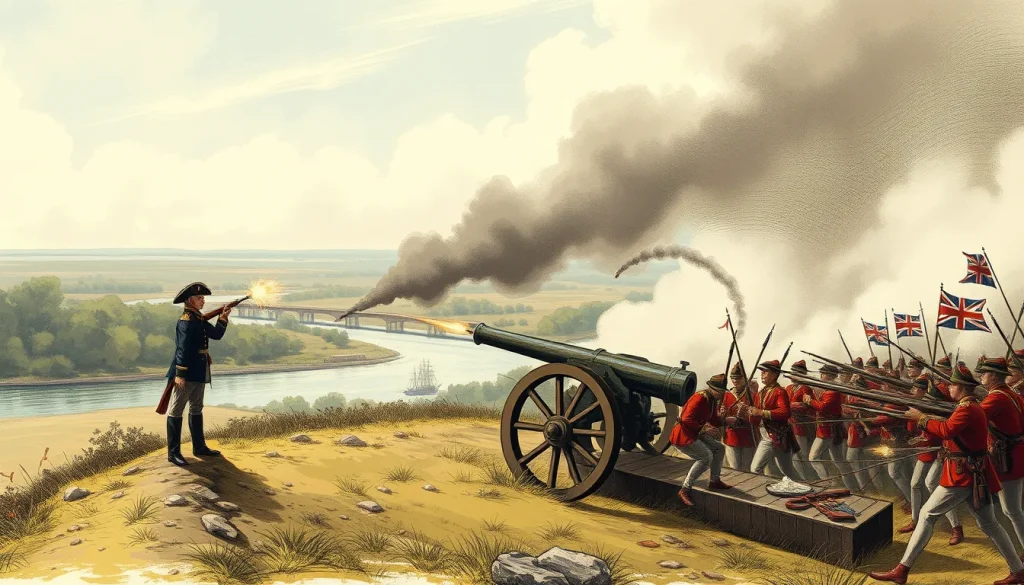
Commodore Joshua Barney’s Last Stand at Bladensburg refers to the defense made by Barney and his Chesapeake Flotilla and Marines during the Battle of Bladensburg, Maryland, on August 24, 1814. As part of the British Chesapeake campaign, a British army and naval force under Major General Robert Ross and Rear Admiral George Cockburn routed American forces under Brigadier General William H. Winder, opening the road to Washington, D.C. Barney’s flotillamen and Marines briefly checked the British advance on a hillside position before Barney was wounded and captured. The action is remembered as a rare moment of disciplined resistance in an otherwise chaotic American defeat and as the final military stand of Barney’s career.
Historical Context
The War of 1812 grew out of maritime disputes between the United States and Great Britain, including impressment of American sailors, trade restrictions, and British support for Indigenous resistance in the Great Lakes region. By 1813, British Rear Admiral George Cockburn was raiding communities along the Chesapeake Bay, burning towns and seizing supplies. The United States had few regular naval forces in the bay, and local militia often proved inadequate against British regulars and sailors.
Joshua Barney, a Revolutionary War naval hero, proposed a shallow-draft flotilla of barges or row-galleys that could operate in the Chesapeake’s shoals and annoy the British. Secretary of the Navy William Jones accepted the plan, and Barney was appointed to command the U.S. Chesapeake Flotilla. In June 1814 the flotilla fought at St. Leonard’s Creek, but by August British forces had driven it up the Patuxent River. Trapped at Pig Point, Barney ordered his vessels burned on August 22, 1814, to prevent their capture. He then marched his flotillamen and Marines overland toward Washington, D.C., where American authorities were scrambling to defend the capital.
What Happened
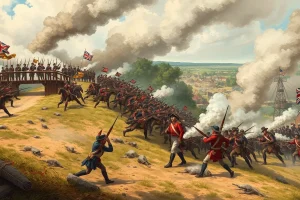
Barney’s force, numbering several hundred flotillamen and Marines with a small artillery train, reached Bladensburg, Maryland, on the road to Washington. On August 24, 1814, British troops under Major General Robert Ross attacked the American defensive lines on the west bank of the Eastern Branch, now the Anacostia River. The first American line at the Bladensburg bridge collapsed under British rocket fire and a bayonet charge. A second line also gave way, and the battle became a rout.
Barney’s command, posted on a hill behind the collapsing lines, held its ground and fired into the advancing British column. The British 85th Light Infantry and other units attacked Barney’s position directly. Barney was wounded in the thigh and captured; his men, after inflicting casualties, were forced to retreat or surrender. The British occupied Bladensburg and later marched into Washington, where they burned the Capitol, the White House, and other public buildings on August 24-25, 1814.
Why It Matters
The Battle of Bladensburg was a decisive American defeat that exposed the weakness of the capital’s defenses and led directly to the burning of Washington. Barney’s last stand did not save the city, but it delayed the British advance and provided a rare example of disciplined resistance during an otherwise panicked retreat. The action restored Barney’s public reputation and became part of the memory of the War of 1812 as a moment of naval courage against overwhelming odds.
Historians continue to debate responsibility for the defeat. Some emphasize Brigadier General William H. Winder’s inexperienced militia, confusing command arrangements, and the interference of Secretary of State James Monroe. Others stress the professionalism of British regulars, the psychological effect of Congreve rockets, and the poor positioning of American forces. Barney’s flotillamen are generally credited with making one of the few effective stands of the day, though their exact impact on British casualties remains a matter of interpretation.
Prelude
After the British drove the Chesapeake Flotilla up the Patuxent River, Barney destroyed his vessels at Pig Point on August 22, 1814, and marched his men toward Washington. President James Madison and his advisers expected a British attack on the capital, but they were uncertain whether the target would be Washington or Baltimore. Winder, commanding the 10th Military District, concentrated militia and regulars at Bladensburg, a crossing point on the road from the Patuxent to Washington. Barney’s flotillamen and Marines were ordered to join the defense, arriving with artillery but without naval vessels.
Forces and Commanders
The American force at Bladensburg was led by Brigadier General William H. Winder and included Maryland, Virginia, and District of Columbia militia, a small number of U.S. regulars, U.S. Marines, and Barney’s Chesapeake Flotillamen. President Madison, Secretary of State James Monroe, and other officials were present but did not exercise unified command. Barney commanded his flotillamen and Marines on the American left or center-left, with about 400 to 500 men and five cannon.
The British force was commanded by Major General Robert Ross, with naval support from Rear Admiral George Cockburn. It included British infantry regiments such as the 4th, 44th, and 85th Foot, Royal Marines, and sailors, supported by Congreve rockets. Colonel William Thornton led the 85th Light Infantry in the assault on Barney’s position. British numbers are usually estimated at about 4,000 to 4,500, while American forces numbered roughly 6,000 to 6,500, though many were inexperienced militia.
Battlefield and Map Context
The battle took place at Bladensburg, Prince George’s County, Maryland, on the Eastern Branch of the Potomac River, now called the Anacostia River. The town stood northeast of Washington, D.C., where the Bladensburg road crossed the river toward the capital. American forces deployed on the west bank, with the bridge as a focal point. Barney’s hill, sometimes called Barney’s position, lay behind the forward American lines and overlooked the road and river crossing.
Today the battlefield lies largely within Bladensburg and Colmar Manor, Maryland, near U.S. Route 1 and the Bladensburg Waterfront Park. Urban development has obscured much of the original terrain, but markers, monuments, and the Star-Spangled Banner National Historic Trail interpret the action for visitors.
Battle Chronology
- August 22, 1814: Barney burns the Chesapeake Flotilla at Pig Point to prevent its capture.
- August 23: Barney’s flotillamen and Marines march toward Washington and are directed to Bladensburg.
- August 24, morning: British forces under Ross and Cockburn advance on Bladensburg.
- August 24, afternoon: American first line at the bridge collapses under rocket fire and British bayonet attack; the second line also gives way.
- August 24, later afternoon: Barney’s flotillamen and Marines hold their hill, fire on the British, and are attacked by the 85th Foot. Barney is wounded and captured.
- August 24 evening: British occupy Bladensburg and advance toward Washington.
- August 24-25: British forces burn the Capitol, the White House, and other public buildings in Washington.
Casualties and Losses
Commonly cited figures for the Battle of Bladensburg are about 64 British killed and 185 wounded, and about 26 American killed, 51 wounded, and 100 captured. These numbers vary somewhat among accounts, and precise unit-level casualties for Barney’s command are less certain. Barney himself was wounded in the thigh and taken prisoner. His flotillamen and Marines suffered casualties while covering the retreat of other American units.
Result
The battle was a British tactical victory and an American rout. The defeat opened the road to Washington, D.C., which British forces entered and burned that night and the following day. Barney’s last stand failed to stop the British advance, but it delayed them long enough to allow some American forces and officials to escape and became the most celebrated episode of an otherwise disastrous day for the United States.
Strategic Consequences
The burning of Washington was a severe blow to American morale and a symbol of national humiliation. It also galvanized American resistance, contributing to the successful defense of Baltimore in September 1814 and the broader surge of patriotism that followed. The British raid did not achieve a lasting occupation or force an American surrender, and British forces soon withdrew.
For Barney, the battle restored a reputation that had been damaged by earlier controversies over rank, foreign service, and the slave trade. He survived his wound, was exchanged, and lived until 1818, but Bladensburg remained his final military engagement. Later historians have treated his stand as an example of the effectiveness of trained sailors and Marines compared with unprepared militia, while cautioning that the American defeat had many causes beyond the collapse of the militia.
Primary Accounts
Barney’s own letters and reports provide the most detailed American account of the flotilla and the battle. His July 4, 1813, letter to Secretary of the Navy William Jones proposed the row-galley flotilla and explained its tactical purpose. His official report after Bladensburg describes the flotillamen’s resistance and his own wounding and capture. These accounts are valuable but naturally present Barney’s actions in a favorable light.
British officer George Robert Gleig, who served in the campaign, later published a narrative of the Washington campaign that describes the British advance and the American defense. It offers a British perspective but was written years later and reflects the biases of a participant. American newspapers such as Niles’ Weekly Register carried contemporary reports, while Mary Barney’s 1832 memoir of her father collected letters and reminiscences that shaped his heroic reputation. Each source must be read with attention to its purpose, audience, and distance from the events.
Battlefield Today
The Bladensburg battlefield is not a single preserved park. Much of the ground is urbanized, but the Bladensburg Waterfront Park, the Star-Spangled Banner National Historic Trail, and local historical markers identify key locations. The Battle of Bladensburg Monument and nearby interpretive signs commemorate the American defense and Barney’s stand. Visitors can follow the route from Bladensburg toward Washington and trace the broader Chesapeake campaign through sites in Maryland and the District of Columbia.
Primary Sources
- Joshua Barney to William Jones, July 4, 1813: Barney’s proposal for a Chesapeake flotilla of shallow-draft barges. It explains his tactical thinking but is a self-interested appeal for command.
- Joshua Barney’s official report to the Secretary of the Navy, August 1814: An American account of the Battle of Bladensburg and the flotilla’s role. It is a participant’s report and emphasizes Barney’s own command.
- George Robert Gleig, A Narrative of the Campaigns of the British Army at Washington and New Orleans (1821): A British officer’s memoir of the campaign. It provides a British view but was written years later and is shaped by memory and national perspective.
- Niles’ Weekly Register, 1814: A contemporary American newspaper that printed reports and correspondence about the battle. It reflects American editorial bias and early, sometimes incomplete information.
- Mary Barney, Biographical Memoir of the Late Commodore Joshua Barney (1832): A family memoir containing letters and recollections. It is essential for Barney’s reputation but is highly sympathetic.
Further Reading
- Hickey, Donald R. The War of 1812: A Forgotten Conflict. Rev. ed. Urbana: University of Illinois Press, 2012.
- Lord, Walter. The Dawn’s Early Light. New York: W. W. Norton, 1972.
- Pitch, Anthony S. The Burning of Washington: The British Invasion of 1814. Annapolis: Naval Institute Press, 1998.
- Eshelman, Ralph E., Scott S. Sheads, and Donald R. Hickey. The War of 1812 in the Chesapeake: A Reference Guide to Historic Sites. Baltimore: Johns Hopkins University Press, 2010.
- Crawford, Michael J., ed. The Naval War of 1812: A Documentary History. Vol. 3. Washington, DC: Naval Historical Center, 2002.
- Barney, Mary. Biographical Memoir of the Late Commodore Joshua Barney. Boston: Gray and Bowen, 1832.
- Gleig, George Robert. A Narrative of the Campaigns of the British Army at Washington and New Orleans. London: John Murray, 1821.
- National Park Service. Joshua Barney. Star-Spangled Banner National Historic Trail. https://www.nps.gov/stsp/learn/historyculture/joshua-barney.htm.
- Eden, Steven. Commodore Barney at the Bladensburg Races. Naval History 24, no. 5 (October 2010). https://www.usni.org/magazines/naval-history-magazine/2010/october/commodore-barney-bladensburg-races.
References
- National Park Service. ‘Joshua Barney.’ Star-Spangled Banner National Historic Trail. https://www.nps.gov/stsp/learn/historyculture/joshua-barney.htm.
- Eden, Steven. ‘Commodore Barney at the Bladensburg Races.’ Naval History 24, no. 5 (October 2010). https://www.usni.org/magazines/naval-history-magazine/2010/october/commodore-barney-bladensburg-races.
- Hickey, Donald R. The War of 1812: A Forgotten Conflict. Rev. ed. Urbana: University of Illinois Press, 2012.
- Lord, Walter. The Dawn’s Early Light. New York: W. W. Norton, 1972.
- Pitch, Anthony S. The Burning of Washington: The British Invasion of 1814. Annapolis: Naval Institute Press, 1998.
- Eshelman, Ralph E., Scott S. Sheads, and Donald R. Hickey. The War of 1812 in the Chesapeake: A Reference Guide to Historic Sites. Baltimore: Johns Hopkins University Press, 2010.
- Crawford, Michael J., ed. The Naval War of 1812: A Documentary History. Vol. 3. Washington, DC: Naval Historical Center, 2002.
- Barney, Mary. Biographical Memoir of the Late Commodore Joshua Barney. Boston: Gray and Bowen, 1832.
- Gleig, George Robert. A Narrative of the Campaigns of the British Army at Washington and New Orleans. London: John Murray, 1821.
FAQ
What was Commodore Joshua Barney's last stand at Bladensburg?
It was the defense made by Barney and his Chesapeake Flotilla and Marines on a hillside at the Battle of Bladensburg on August 24, 1814. They briefly checked the British advance before Barney was wounded and captured.
Why did Barney's flotillamen fight at Bladensburg?
After the British drove the Chesapeake Flotilla up the Patuxent River, Barney burned his vessels at Pig Point on August 22, 1814, and marched his men overland to join the defense of Washington. They were ordered to Bladensburg with artillery.
What happened to Barney after the battle?
Barney was wounded in the thigh and captured by the British. He was later exchanged, and although he survived, Bladensburg remained his final military engagement. He died in 1818.


Leave a Reply