
Short Answer
In 1811, Shawnee leader Tecumseh traveled south to the Creek Nation, where he addressed a major council at Tuckabatchee and met with other southeastern Indigenous nations. He sought to extend his pan-Indigenous confederacy against United States expansion and to draw the Creeks into a wider war with Britain. The visit helped inspire the Red Stick faction that fought the Creek War of 1813–1814, a conflict that became the southern theater of the War of 1812. Historians generally treat Tecumseh’s visit as an important catalyst rather than the sole cause of the Creek War.
Historical Context
After the American Revolution, the United States pressed westward and southward into Indigenous homelands. In the Southeast, Georgia and the Mississippi Territory expanded rapidly. The Creek Confederacy, a loose alliance of towns and peoples, was divided into Upper Creek towns along the Coosa and Tallapoosa Rivers, in present-day Alabama, and Lower Creek towns in the Flint and Chattahoochee valleys, in present-day Georgia and Alabama. Lower Creeks had more sustained contact with British, Spanish, and American traders; many adopted livestock raising, cotton cultivation, and other market practices. Upper Creeks, more distant from American settlement, were more likely to resist assimilation.
Treaties such as the 1790 Treaty of New York and the 1805 cession of lands east of the Ocmulgee River reduced Creek territory. Benjamin Hawkins, the U.S. Indian agent, promoted a "civilization program" that encouraged agriculture, domestic arts, and a centralized National Council. Hawkins’s program created new inequalities. Mixed-heritage Creek elites often benefited, while many Upper Creeks resented the loss of traditional town autonomy and hunting lands. These tensions were already severe before Tecumseh arrived.
The wider War of 1812 grew out of U.S.-British conflicts over impressment, trade, and frontier influence. In the Northwest, Tecumseh and his brother Tenskwatawa, the Shawnee Prophet, built a confederacy at Prophetstown in present-day Indiana. They rejected land cessions and called for Indigenous unity. In 1811, Governor William Henry Harrison marched against Prophetstown. Tecumseh was absent on his southern journey when U.S. forces fought the Battle of Tippecanoe on November 7, 1811. His confederacy survived, and he continued to seek allies among southeastern nations.
What Happened
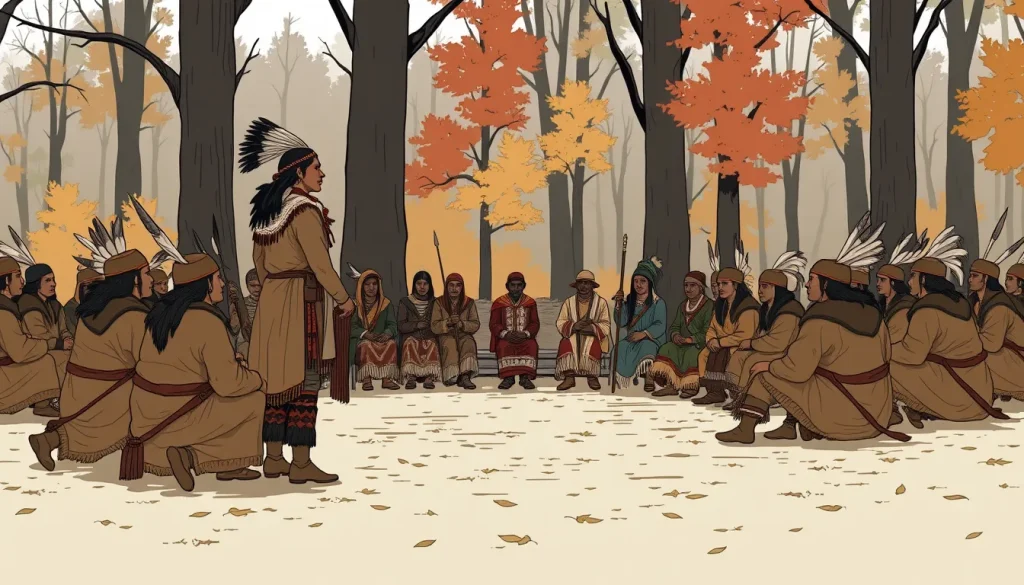
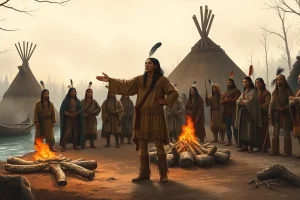
Tecumseh left Prophetstown in 1811 and traveled through the Choctaw, Chickasaw, Cherokee, and Creek nations. He reached Creek country in the autumn of 1811. His most famous appearance was at Tuckabatchee, a major Upper Creek town on the Tallapoosa River in present-day Alabama. According to later accounts, he addressed a large council that included Big Warrior, a leading Creek headman, and other town leaders. He spoke for several days, urging the Creeks to join a pan-Indigenous alliance, reject American land cessions, turn away from American trade and farming practices, and resist U.S. expansion. He also suggested that Britain would support Indigenous resistance.
The response was mixed. Many older headmen and Lower Creek leaders were skeptical or hostile. They had economic and political ties to the United States and feared a disastrous war. Some younger Upper Creek warriors, however, were receptive. Tecumseh’s message reinforced existing grievances over land loss and American pressure. He also visited Choctaw and Chickasaw councils, where he had less success.
While Tecumseh was in the South, U.S. forces defeated Tenskwatawa’s followers at Tippecanoe. News of the battle reached the Creeks and intensified debate. Tecumseh returned north in early 1812. He did not lead Creek forces in the war that followed. Instead, the Red Stick movement emerged from local Creek leaders and prophets, including Peter McQueen, William Weatherford, Menawa, and Josiah Francis. The term "Red Stick" referred to red-painted war clubs and to the militants’ councils, not to a movement directed by Tecumseh.
The Creek War began in 1813. In July, Red Stick warriors attacked U.S. forces at the Battle of Burnt Corn. On August 30, 1813, they destroyed Fort Mims in present-day Alabama, killing hundreds of settlers, militia, and allied Creeks. The United States responded with campaigns led by Andrew Jackson of Tennessee, John Floyd of Georgia, and Ferdinand Claiborne of the Mississippi Territory. The war ended with Jackson’s victory at the Battle of Horseshoe Bend on March 27, 1814. The Treaty of Fort Jackson, signed on August 9, 1814, forced the Creeks to cede about 23 million acres to the United States.
Why It Matters
Tecumseh’s visit mattered because it helped connect the Creek struggle to a broader Indigenous resistance movement. It gave Red Stick leaders a vocabulary of pan-Indigenous unity, anti-American resistance, and British alliance. It also raised expectations of outside support. Yet the Creek War had local causes that predated Tecumseh: American expansion, land cessions, Hawkins’s policies, economic change, and divisions between Upper and Lower Creeks. Historians therefore disagree about how much the visit caused the war. Some describe it as a decisive catalyst; others see it as one important influence among many.
The consequences were enormous. The Creek War became a southern theater of the War of 1812. British and Spanish officials in Florida and the Gulf Coast supplied arms and encouragement to the Red Sticks, hoping to distract the United States. The U.S. victory broke Creek power in the Southeast, opened Alabama and Georgia to white settlement, and helped make Andrew Jackson a national hero. It also set the stage for the Gulf campaigns that culminated in the Battle of New Orleans in 1815. In the longer term, the land cessions and later federal removal policies led to the forced migration of many Creeks to Indian Territory in the 1830s.
Historical memory has often simplified the story. Tecumseh is remembered as a pan-Indigenous visionary, while the Creek War is sometimes treated as a footnote to the War of 1812. In fact, Creek people made their own choices. Red Stick leaders drew on Muskogee religious traditions, town politics, and local grievances. Tecumseh’s visit was influential, but it did not erase Creek agency or create the conflict from nothing.
Definition
In this context, "Tecumseh’s 1811 visit" refers to his diplomatic and ideological mission to the southeastern Indigenous nations, especially the Creeks, beginning in 1811 and continuing into early 1812. It was not a single event but a series of councils, speeches, and meetings intended to build a military and political alliance against the United States.
Background
The visit grew out of the pan-Indigenous movement led by Tecumseh and Tenskwatawa. That movement opposed American land cessions, urged a return to traditional practices, and sought British support. The Creeks had their own history of resistance and revival. Upper Creek towns had resisted American encroachment for decades, and Creek prophets had already called for spiritual renewal. Tecumseh’s journey linked these local currents to a larger intertribal effort.
How It Worked
Tecumseh worked through councils and personal diplomacy. He appealed to shared grievances: loss of hunting grounds, unfair treaties, debt, and American cultural pressure. He emphasized Indigenous unity and the need to act before the United States grew stronger. He also presented Britain as a potential ally. Among the Creeks, his message resonated most with Upper Creek warriors and younger leaders who felt the costs of American expansion most directly. Local prophets and war leaders then adapted his message to Creek needs. The Red Stick movement was thus not a puppet of Tecumseh but a Creek response that used pan-Indigenous ideas.
Competing Viewpoints
Historians debate the extent of Tecumseh’s influence. One interpretation stresses his visit as a turning point that ignited Red Stick militancy and helped push the Creeks toward war. Another interpretation emphasizes that Creek tensions were already explosive and that the war would likely have occurred without him. Evidence for strong influence includes the timing of the visit, the spread of pan-Indigenous rhetoric, and Red Stick efforts to seek British aid. Evidence for caution includes the absence of a verbatim transcript of Tecumseh’s Tuckabatchee speech, the mixed Creek response, and the fact that Red Stick leaders had their own agendas. The famous story that Tecumseh predicted the New Madrid earthquakes of 1811–1812 is not supported by contemporary documents and appears to be a later legend.
Role in the War of 1812
The Creek War became the southern front of the War of 1812. While Tecumseh fought and died in the Northwest, Red Stick envoys sought help from British and Spanish officials at Pensacola and elsewhere. British agents later supplied arms and recruits to Creeks and other Indigenous peoples in the Gulf region. U.S. forces under Andrew Jackson used the Creek War to secure the Gulf Coast, then defended New Orleans against a British invasion. In this way, Tecumseh’s visit contributed indirectly to the strategic landscape of the wider war, even though he never commanded Creek armies.
Consequences and Historical Interpretation
The immediate consequence was U.S. victory in the Creek War and the Treaty of Fort Jackson. The longer consequences included massive land loss, the weakening of Creek independence, and the eventual forced removal of many Creeks. For historians, the visit illustrates both the power and the limits of pan-Indigenous diplomacy. Tecumseh inspired resistance across nations, but local leaders, local grievances, and U.S. expansion shaped how that resistance actually unfolded. The most accurate interpretation is that his 1811 visit was a significant catalyst, not a sole cause, of the Creek War.
Primary Sources
No verbatim transcript of Tecumseh’s Tuckabatchee speech is known to survive. The speech is reconstructed from later Creek and American accounts, which vary and may be embellished. Researchers should therefore distinguish contemporary documents from retrospective memory.
- Benjamin Hawkins correspondence. Hawkins, the U.S. Indian agent, wrote official letters and reports about Creek councils, Tecumseh’s visit, and growing Red Stick militancy. These are essential but reflect a U.S. official’s perspective and often treat Indigenous resistance as a threat.
- Andrew Jackson papers and U.S. military reports. Letters, orders, and after-action reports from the Creek campaigns describe the fighting, alliances, and land cessions. They are valuable for military details but were written by U.S. commanders and are not neutral about Creek factions.
- Creek oral traditions and later narratives. Nineteenth-century Creek writers and storytellers, including George Stiggins’s historical narrative, preserved Creek perspectives on factionalism and the war. These are later sources, shaped by removal and memory, not contemporary diaries.
- British and Spanish colonial records. Correspondence from Pensacola, Florida, and the Gulf Coast documents arms, supplies, and diplomatic contacts with Red Stick leaders. They show the international dimension of the conflict but say little about Tecumseh’s 1811 speeches.
- Newspapers. Publications such as Niles’ Weekly Register carried reports on Tecumseh, Tippecanoe, and the Creek War. They are useful for public perception but often repeated rumors and secondhand information.
Further Reading
- Richard D. Blackmon, The Creek War, 1813–1814 (U.S. Army Center of Military History, 2014).
- Will C. Holmes, "American Expansionism and the Creek War of 1813–1814," Vulcan Historical Review 3 (1999).
- John Sugden, Tecumseh: A Life (Henry Holt, 1997).
- Gregory Evans Dowd, A Spirited Resistance: The North American Indian Struggle for Unity, 1745–1815 (Johns Hopkins University Press, 1992).
- Claudio Saunt, A New Order of Things: Property, Power, and the Transformation of the Creek Indians, 1733–1816 (Cambridge University Press, 1999).
- Joel W. Martin, Sacred Revolt: The Muskogees’ Struggle for a New World (Beacon Press, 1991).
- Frank L. Owsley Jr., Struggle for the Gulf Borderlands: The Creek War and the Battle of New Orleans, 1812–1815 (University of Alabama Press, 1981).
- Kathryn E. Holland Braund, Deerskins and Duffels: Creek Indian Trade with Anglo-America, 1685–1815 (University of Nebraska Press, 1993).
References
- Richard D. Blackmon, The Creek War, 1813–1814, U.S. Army Campaigns of the War of 1812 (Washington, DC: Center of Military History, 2014), https://www.govinfo.gov/content/pkg/GOVPUB-D114-PURL-gpo53888/pdf/GOVPUB-D114-PURL-gpo53888.pdf.
- Will C. Holmes, "American Expansionism and the Creek War of 1813–1814," Vulcan Historical Review 3 (1999), https://digitalcommons.library.uab.edu/cgi/viewcontent.cgi?article=1460&context=vulcan.
- John Sugden, Tecumseh: A Life (New York: Henry Holt, 1997).
- Gregory Evans Dowd, A Spirited Resistance: The North American Indian Struggle for Unity, 1745–1815 (Baltimore: Johns Hopkins University Press, 1992).
- Claudio Saunt, A New Order of Things: Property, Power, and the Transformation of the Creek Indians, 1733–1816 (Cambridge: Cambridge University Press, 1999).
- Joel W. Martin, Sacred Revolt: The Muskogees’ Struggle for a New World (Boston: Beacon Press, 1991).
- Frank L. Owsley Jr., Struggle for the Gulf Borderlands: The Creek War and the Battle of New Orleans, 1812–1815 (Tuscaloosa: University of Alabama Press, 1981).
- Kathryn E. Holland Braund, Deerskins and Duffels: Creek Indian Trade with Anglo-America, 1685–1815 (Lincoln: University of Nebraska Press, 1993).
FAQ
Did Tecumseh start the Creek War?
No. The Creek War grew from American expansion, land cessions, and internal Creek divisions. Tecumseh's 1811 visit helped inspire the Red Stick faction, but he did not command Creek forces or solely cause the war.
What did Tecumseh say at Tuckabatchee?
No verbatim transcript survives. Later accounts say he urged Creek leaders to join a pan-Indigenous alliance, reject U.S. land cessions, and resist American expansion. These accounts vary and should be treated cautiously.
How did the Creek War end?
It ended with Andrew Jackson's victory at the Battle of Horseshoe Bend in March 1814 and the Treaty of Fort Jackson in August 1814, which forced the Creeks to cede large lands.
Leave a Reply