Short Answer
Free men of color — a legal and social category that in the early nineteenth century covered free-born and manumitted Black men in the United States, British North America, and the Gulf and Caribbean borderlands — entered the War of 1812 with restricted rights and with the widely shared expectation that loyal service would improve their standing. After the fighting ended in 1815, most free Black men in the United States found their civil status unchanged or narrowed, while several thousand people of African descent who had reached British lines were evacuated as free people to Bermuda, Nova Scotia, New Brunswick, Trinidad, and Sierra Leone. The outcome cannot be separated from Article I of the Treaty of Ghent, which forbade carrying away “slaves or other private property” and produced a British-American claims dispute that was not finally closed until 1828.
Historical Context
Approximately 186,000 free Black people lived in the United States at the time of the 1810 federal census, the great majority in the South and in the port cities of the Northeast. Freedom did not mean equality. Free Black people faced limits on voting, testimony, property holding, movement, and residence that varied by state; several northern states had begun gradual emancipation but continued to restrict the civil and political rights of free Black residents. In the South, free people of color were subject to registration laws, special taxes, and the constant suspicion of white neighbors and officials. Louisiana, with its French and Spanish legal inheritance, was an exception: free men of color there had served in militia units before the war and were organized again in 1814–1815.
Military policy reflected this ambiguity. The regular United States Army did not enlist Black soldiers in 1812 or 1813, and most states barred Black men from the militia, though the United States Navy, the revenue service, and privateering crews employed Black sailors, free and enslaved. Historian Gene Allen Smith estimates that roughly 1,000 African American sailors were among the Americans imprisoned at Dartmoor in England during the war. In Upper Canada, a small corps of free and formerly enslaved Black men — the Coloured Corps, commanded by Captain Robert Runchey — was raised in 1812 and served at Queenston Heights and on the Niagara frontier.
British policy was shaped by manpower needs, by the abolition of the British slave trade in 1807, and by a long-standing practice of offering protection to people who reached British lines. On 2 April 1814 Vice Admiral Alexander Cochrane issued a proclamation inviting persons “disposed to emigrate” from the United States to come aboard His Majesty’s ships or to military posts on the coast, where they would have the choice of entering the sea or land forces or of being sent as free settlers to British possessions in North America or the West Indies. The offer was aimed primarily at enslaved people, but it also drew free men of color, and it placed the status of everyone who accepted it at the center of the postwar settlement. Most of the British colonies to which these refugees were sent were themselves slave societies; emancipation across the British Empire came only in 1833, with effect in 1834.
What Happened
During the war free men of color served in many capacities. In the Chesapeake, free Black watermen, pilots, and guides worked for both sides. Along the Gulf Coast, free men of color in Louisiana were organized into two battalions under Major Jean Baptiste Plauché and fought at the Battle of New Orleans on 8 January 1815; the free Black drummer Jordan Noble was among those present. Andrew Jackson’s proclamation to the free men of color of Louisiana on 21 September 1814 promised pay, bounty, and land on the same terms as white volunteers. In British service, the Colonial Marines — a corps that included many who had been enslaved in the Chesapeake and along the southern coast — served alongside regular redcoats, and Smith estimates that some 600 Chesapeake Bay men joined it. As many as 4,000 to 5,000 enslaved people fled to British protection from the Chesapeake alone.
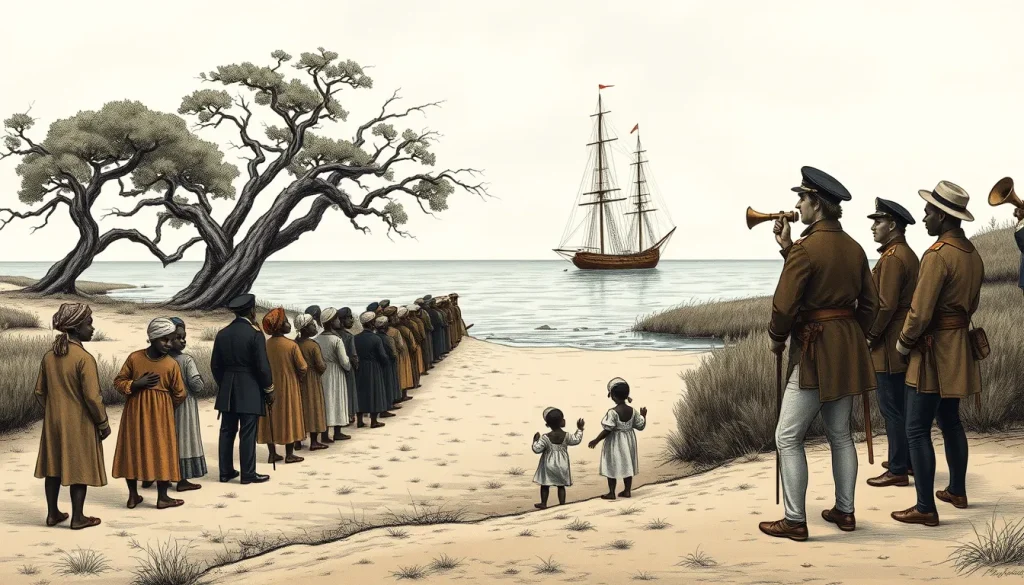
After the Treaty of Ghent was signed on 24 December 1814, British forces continued to evacuate people who had come under their protection. On 5 March 1815, the warship HMS Regulus left Cumberland Island off the Georgia coast with nearly 500 men, women, and children aboard, including the Colonial Marines Robert Colburn and David Gales. The following day, the American commissioners Thomas M. Newell and Thomas Spalding arrived at Dungeness on Cumberland Island with a newspaper printing of the treaty and demanded the return of the refugees. Rear Admiral George Cockburn refused. Under British supervision, Americans were permitted to appeal to people aboard the Regulus; the effort produced the recording of thirteen individuals whom the Americans regarded as eligible for return. The Regulus reached Bermuda on 29 April 1815, where Peter Sewell was reunited with his wife and children, who had sailed separately from Tangier Island.
The refugees dispersed widely. Hundreds remained in Bermuda, where the British settled many on a segregated naval establishment at Ireland Island. Others were carried to Nova Scotia and New Brunswick, where their arrival is recorded in the Halifax List, a register comparable in purpose to the Book of Negroes compiled after the American Revolution; they struggled economically and some later removed to Trinidad in 1821. Several hundred Colonial Marines and their families were settled in Trinidad in 1816 in what became known as the Company Villages, and their descendants are called Merikins. Smaller numbers went to Sierra Leone. Colburn and Gales settled in Trinidad; Colburn died there on 9 February 1857, while the date of Gales’s death is unknown. The United States pursued the return of escapees through diplomatic notes and claims, eventually submitting the question to arbitration and to a claims commission that awarded compensation to American enslavers rather than restoring the people involved; the dispute was finally closed in 1828.
Why It Matters
For free men of color in the United States, the war’s immediate result was disappointment. Bounty lands and pensions promised to Black volunteers were inconsistently honored, Black militia companies were generally disbanded or marginalized, and many states tightened rather than relaxed their restrictions on free Black life. The American Colonization Society, founded in 1816, channeled white anxieties about free Black people into schemes for removal to Africa, and Paul Cuffe’s 1815 voyage carrying Black American emigrants to Sierra Leone showed that some free Black people pursued emigration on their own terms. Northern states narrowed Black voting rights in these years, and southern states strengthened registration and movement laws.
For the refugees who reached British territory, the outcome was genuinely mixed: they gained legal freedom, land in Trinidad and Nova Scotia, and the ability to keep families together, but they faced segregated housing, poor provisions, and life in colonies where slavery remained legal. The compensation eventually paid under the Treaty of Ghent went to American slaveholders, not to the people who had freed themselves. Historians accordingly read the aftermath as a case of “equality deferred” — the phrase used by Gene Allen Smith — while also recognizing that the wartime escapes and the Black service record became precedents that later generations cited in the struggle for citizenship.
Definition: “Free Men of Color” as a Legal Category
In the early nineteenth century, free men of color were Black men who were not legally enslaved: the free-born, the manumitted, the descendants of free Black or mixed-race families, and, in Louisiana and Spanish Florida, men classified under French and Spanish categories of libre or mulâtre. The category was defined as much by what it excluded as by what it conferred. Free status provided no guarantee of the vote, of jury service, of equal pay, or of secure property; it could be lost through re-enslavement laws, kidnapping, or being sold as a runaway. Free men of color were also distinguished from enslaved people in militia and public-works arrangements, which is why the question of what happened to them after 1815 is different from the question of what happened to enslaved people who escaped to the British during the war.
Background: Free Black Communities at the End of the War
By 1815 free Black communities in Baltimore, Philadelphia, New York, and New Orleans had built churches, mutual-aid societies, and schools; Richard Allen’s African Methodist Episcopal Church was organized in 1816, the same year as the colonization society. These institutions became the organizational base for postwar Black political and community life. In British North America, free Black people were far fewer, and slavery remained legal in Upper and Lower Canada and in the Maritimes until the 1830s. The demographic weight of the postwar question therefore lay in the United States, where free Black population growth continued — from about 186,000 in 1810 to roughly 320,000 by 1830 — even as legal restrictions multiplied.
How It Worked: Evacuation, Registers, and Claims
Three mechanisms determined the fate of the people involved. First, evacuation: British naval and military commanders transported refugees from Chesapeake posts, Cumberland Island, and other coastal stations to Bermuda, Halifax, Trinidad, and Sierra Leone. Second, registration: colonial authorities compiled lists such as the Halifax List to record arrivals, allocate provisions and land, and control movement; these registers are now among the principal surviving sources for the refugees’ identities. Third, claims: the United States government assembled evidence of people carried away, demanded restitution under Article I of the Treaty of Ghent, and ultimately accepted monetary compensation through arbitration and a claims commission. Nothing in the process gave the people themselves standing. The practical result was that individuals who reached British soil stayed free, while the legal and financial argument was conducted entirely between the two governments.
Competing Viewpoints: What the Treaty of Ghent Required
Article I of the Treaty of Ghent required both parties to restore captured territory and prohibited “carrying away any of the artillery or other public property originally captured” or “any slaves or other private property.” American officials read this as requiring the return of nearly everyone who had left with the British, or at least compensation for them. British officials read it narrowly: a person could not be involuntarily returned unless still resident at the place from which they had escaped — a condition that evacuation had already made impossible. Historians have generally treated the British position as legally opportunistic and the American position as practically unenforceable, though some scholars emphasize that the British also acted from a genuine reluctance to re-enslave people who had come under their protection. The disagreement was serious enough to require arbitration and a claims commission, and the final settlement of 1828 compensated American slaveholders while leaving the refugees free. Historians also disagree about the wider balance sheet: Smith and Alan Taylor stress the hardening of racial law and the failure of the promise of equality, while other scholars emphasize that several thousand people secured durable freedom and land in the British Empire.
Role in the War of 1812: Service, Flight, and Loyalty
Free men of color contributed to the war effort on both sides, and their choices shaped the postwar negotiations. In American service, Black sailors were common in the Navy and on privateers, and roughly 1,000 African American sailors were held at Dartmoor; in Louisiana, free men of color formed two battalions that fought at New Orleans in January 1815. In British service, free and formerly enslaved men served in the Colonial Marines, guided and piloted British forces in the Chesapeake, and worked aboard the ships that carried refugees to Bermuda and Trinidad. In Upper Canada, the Coloured Corps served on the Niagara frontier, and its veterans, including Richard Pierpoint, received land grants after the war; Pierpoint later petitioned for passage to Sierra Leone. On the Gulf Coast, free Black and mixed-race communities in Spanish Florida, which some had joined for protection, came under sustained American attack after 1815, and the fort on the Apalachicola held by Black and Indigenous fighters was destroyed in 1816.
Consequences and Historical Interpretation
The longer-term consequences were asymmetric. In the United States, the war’s aftermath accelerated the tightening of racial law: the American Colonization Society (1816), the Denmark Vesey conspiracy and South Carolina’s Negro Seamen Act (1822), the Missouri Compromise (1820), northern disfranchisement statutes, and the hardening of “free negro” codes all belong to this period. In the British Empire, the refugees remained free, but their material conditions in Bermuda, Nova Scotia, and Trinidad were poor, and emancipation throughout the empire did not arrive until 1833–1834. Later historians have moved the subject from the margins to the center of the war’s history. Alan Taylor’s The Internal Enemy argues that slavery and the fear of insurrection shaped Virginia’s conduct of the war, while Gene Allen Smith’s The Slaves’ Gamble and the work of Harvey Amani Whitfield on the Black refugees frame the war as a moment when African Americans forced both empires to confront the meaning of freedom. Public memory of the war long ignored these people; only in the late twentieth and twenty-first centuries did their service, escapes, and settlements become a standard part of the story told at sites such as Fort McHenry, Chalmette, and the Niagara frontier.
Primary Sources
Several contemporary sources anchor this subject. Vice Admiral Alexander Cochrane’s proclamation of 2 April 1814, printed as a broadside and reprinted in American newspapers, states the British offer of protection and the choice of enlistment or settlement; it is a recruitment document and must be read as such. Andrew Jackson’s proclamation to the free men of color of Louisiana, dated 21 September 1814 and published in the Louisiana press, promises equal pay and bounty lands; it reflects political necessity rather than an established policy, and the promises were largely unfulfilled. The Treaty of Ghent, signed 24 December 1814, is the governing legal text, and Article I is the clause at issue. The March 1815 correspondence among Thomas M. Newell, Thomas Spalding, and Rear Admiral George Cockburn documents the Cumberland Island confrontation from the American side and is printed in American State Papers: Foreign Relations. The Halifax List, held by the Nova Scotia Archives, records the arrival of Black refugees and is a colonial administrative document rather than a personal account, so it under-records family relationships and origins. Colonial Marine muster records in the British Admiralty series at The National Archives (United Kingdom) supply names and service details but were compiled for military purposes. All of these sources privilege officials and literate record-keepers; the refugees’ own voices survive mostly in later petitions, land records, and church and family records rather than in wartime testimony.
Further Reading
- Gene Allen Smith, The Slaves’ Gamble: Choosing Sides in the War of 1812 (New York: Palgrave Macmillan, 2013).
- Alan Taylor, The Internal Enemy: Slavery and War in Virginia, 1772–1832 (New York: W. W. Norton, 2013).
- Harvey Amani Whitfield, Blacks on the Border: The Black Refugees in British North America, 1815–1860 (Burlington: University of Vermont Press, 2006).
- Ira Berlin, Slaves Without Masters: The Free Negro in the Antebellum South (New York: Pantheon, 1974).
- Jeffrey Bolster, Black Jacks: African American Seamen in the Age of Sail (Cambridge, MA: Harvard University Press, 1997).
- John McNish Weiss, The Merikins: Free Colored Settlers in Trinidad (London: McNish & Weiss, 1995).
- National Park Service, “Fighting for Freedom: African Americans and the War of 1812” article series.
- Nova Scotia Archives, Black Refugees and Halifax List records, digitized collections.
- Parks Canada and Library and Archives Canada resources on the Coloured Corps and the Niagara frontier.
References
- William Kelly, “Black Freedom Seeking During the War of 1812: From the Chesapeake, Cumberland Island, and Beyond, Part 2,” U.S. National Park Service. https://www.nps.gov/articles/000/black-freedom-seeking-during-the-war-of-1812-from-the-chesapeake-cumberland-island-and-beyond.htm
- Gene Allen Smith, “Wedged Between Slavery and Freedom: African American Equality Deferred,” U.S. National Park Service. http://nps.gov/articles/wedged-between-slavery-and-freedom.htm
- Gene Allen Smith, The Slaves’ Gamble: Choosing Sides in the War of 1812 (New York: Palgrave Macmillan, 2013).
- Alan Taylor, The Internal Enemy: Slavery and War in Virginia, 1772–1832 (New York: W. W. Norton, 2013).
- Harvey Amani Whitfield, Blacks on the Border: The Black Refugees in British North America, 1815–1860 (Burlington: University of Vermont Press, 2006).
- John McNish Weiss, The Merikins: Free Colored Settlers in Trinidad (London: McNish & Weiss, 1995).
- Jeffrey Bolster, Black Jacks: African American Seamen in the Age of Sail (Cambridge, MA: Harvard University Press, 1997).
- Ira Berlin, Slaves Without Masters: The Free Negro in the Antebellum South (New York: Pantheon, 1974).
- Treaty of Peace and Amity between His Britannic Majesty and the United States of America (Treaty of Ghent), 24 December 1814, Article I.
- American State Papers: Foreign Relations, vol. 4 (correspondence of March 1815 concerning Cumberland Island).
- Nova Scotia Archives, Halifax List and Black Refugees records.
- Library and Archives Canada and Parks Canada materials on the Coloured Corps, Upper Canada, 1812–1815.
FAQ
Did free men of color gain rights after the War of 1812?
In the United States, generally not. Bounty lands and pensions for Black volunteers were inconsistently honored, Black militia companies were marginalized, and many states tightened restrictions through registration laws, northern disfranchisement statutes, and colonization schemes such as the American Colonization Society of 1816. In British territory, refugees gained legal freedom but lived in colonies where slavery remained legal until 1833–1834 and often faced segregation and poverty.
What did the Treaty of Ghent say about enslaved and free Black people?
Article I required the restoration of captured territory and prohibited carrying away "any slaves or other private property." The United States argued this covered nearly everyone who had left with the British; Britain argued a person could be returned only if still resident at the place of escape, which evacuation had made impossible. The dispute was eventually submitted to arbitration and a claims commission and was closed in 1828.
Where did Black refugees from the War of 1812 go?
They were evacuated mainly to Bermuda, Nova Scotia, and New Brunswick, with several hundred Colonial Marines and their families settled in Trinidad in 1816 and smaller numbers sent to Sierra Leone. Some Nova Scotia refugees later removed to Trinidad in 1821.
How many people escaped to the British during the War of 1812?
American claims and British registers document about 3,608 people whom the United States sought to recover, a figure historians treat as a minimum. Gene Allen Smith estimates that as many as 4,000 to 5,000 enslaved people fled to British protection from the Chesapeake alone.
Leave a Reply