
Short Answer
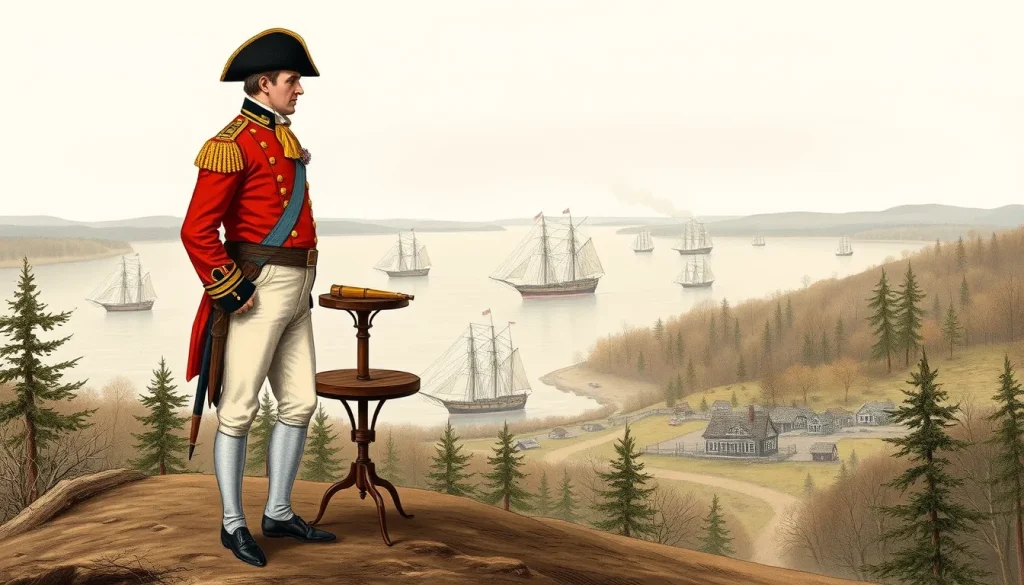
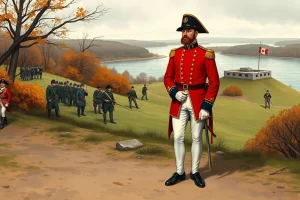
Sir George Prevost (19 May 1767 – 5 January 1816) was a British Army officer and colonial administrator who served as governor-in-chief of British North America and commander-in-chief of British forces in North America from 1811 to 1815. During the War of 1812 he was responsible for the defence of the Canadas, and in September 1814 he personally directed the last major British offensive of the war, the combined land and naval attack on Plattsburgh, New York. When the British squadron on Lake Champlain was destroyed on 11 September 1814, he halted the land assault and withdrew to Lower Canada, a decision that earned him the lasting label of the general who failed at Plattsburgh. This article concerns Prevost himself, his command, and the 1814 campaign; the wider naval war on the lakes is treated only where it bears directly on his decisions.
Historical Context
For Britain, the war with the United States that began in June 1812 was a secondary theatre of a global conflict. The bulk of the British Army was committed to the Peninsular War in Spain and Portugal and to the defence of the British Isles against Napoleonic France. British North America therefore had to be defended with limited regulars, fencibles, and locally raised militia. Prevost, who took up his dual civil and military command in October 1811, understood that reinforcements could not be relied upon and that Quebec, the only permanent fortress in the Canadas, was the decisive point to hold.
The colonies he governed were internally divided. Lower Canada (present-day Quebec) had a French-speaking Canadien majority, a Roman Catholic Church with considerable influence, and an appointed executive council dominated by English-speaking merchants. Prevost’s predecessor, Sir James Henry Craig, had quarrelled with Canadien politicians and with the assembly, leaving relations strained on the eve of war. Prevost’s conciliatory approach—cultivating the church and the assembly’s leading figures—helped secure a new militia act and funds for defence in early 1812.
Geographically, the most direct invasion route between the United States and Montreal ran through the Lake Champlain corridor of northern New York and Vermont. Plattsburgh, on the west shore of the lake, was both an American military post on the Saranac River and the base of the United States squadron on Lake Champlain. Control of the lake mattered because it governed the movement of troops and supplies along that corridor; Prevost also hoped an occupation would create a buffer for Lower Canada.
The strategic picture changed in 1814. With Napoleon’s abdication in April, Britain could send Peninsular War veterans to North America, and Prevost received orders to seize one or more major American bases. Both sides also raced to build fleets on the lakes, so that any land campaign depended heavily on which squadron controlled the water.
What Happened
Prevost’s tenure fell into two phases. From 1812 to early 1814, London instructed him to act defensively and to take the offensive only to repel invasion. He reinforced Upper Canada but discouraged attacks, which brought him into conflict with Major-General Sir Isaac Brock, who nevertheless captured Detroit in August 1812 after Captain Charles Roberts had taken Fort Michilimackinac. In August 1812 Prevost agreed to an armistice with the American commander, Major-General Henry Dearborn, in the hope that hostilities might end; it was repudiated by President James Madison and lasted less than a month. In May 1813 Prevost personally accompanied a joint army and naval raid on the American base at Sackets Harbor, New York, which achieved only partial success and was widely criticized. In 1814 he accepted an American proposal for a ceasefire, which the British government forbade.
With the arrival of veteran troops in 1814, Prevost prepared a thrust down the Lake Champlain corridor. His force crossed the border on 1 September 1814 and advanced on Plattsburgh with roughly 11,000 effectives, organized largely into a division under Major-General Francis de Rottenburg and including brigades commanded by Major-General Manley Power, Major-General Thomas Brisbane, and Major-General Frederick Philipse Robinson. Facing them were about 4,000 American regulars under Brigadier-General Alexander Macomb, supported by New York and Vermont militia.
The British advance was checked at the Saranac River. Prevost, lacking detailed intelligence on crossing points and on the American works beyond the river, halted Robinson’s brigade rather than pressing an attack, and waited for the naval squadron under Captain George Downie to engage the American flotilla commanded by Master Commandant Thomas Macdonough in Plattsburgh Bay. Downie’s ships attacked on 11 September 1814 and were decisively beaten; Downie was killed and most of his squadron was captured. Watching the naval defeat, Prevost cancelled the land assault and withdrew his army to Lower Canada, despite the objections of his brigade commanders, who believed the position could still be carried.
Prevost was recalled to Britain in 1815 to answer for his conduct, and he requested a court martial to clear his name. Before it could convene, he died in London on 5 January 1816.
Why It Matters
The immediate consequence was the collapse of the last major British offensive of the war in the north. The British lost their naval presence on Lake Champlain, and the American victory at Plattsburgh, coming alongside the defence of Baltimore, strengthened the United States’ negotiating position as the Treaty of Ghent was concluded in December 1814. Prevost’s decision was defended at the time as prudent, since a defeated army on the far side of a hostile lake corridor risked being cut off, but it was attacked by officers who had served under Wellington and who believed a decisive victory had been thrown away.
In the longer term, Prevost’s record became a subject of competing traditions. Critics, including several of his own generals, emphasized his caution, his difficult relations with subordinates, and the failure at Plattsburgh. Others, including the Duke of Wellington, accepted the logic of a defensive strategy given the forces available while faulting Prevost’s handling of the senior officers sent to him. Modern assessments, including those of the Canadian Encyclopedia, often describe him as the “Defender of Canada,” crediting his conciliation of the Canadiens and his pre-war militia measures with helping Canada resist American invasion. The disagreement turns largely on whether Prevost should be judged as a battlefield commander or as an administrator managing scarce resources within London’s strategic direction.
Early Life
George Prevost was born on 19 May 1767 in New Barbadoes Township, New Jersey (now Hackensack), the son of Augustin Prevost, a French-speaking Protestant from Geneva who had served in the British Army during the Seven Years’ War and the American War of Independence. Educated in England and in North America, George was commissioned as an ensign in the 60th Regiment of Foot in 1779 at about eleven years of age, the regiment in which his father held senior rank. He transferred to the 47th Foot in 1782 and to the 25th Foot as a captain in 1784, returning to the 60th as a major in 1790. Contemporary comment and later biographers note that family wealth—his maternal grandfather was a banker in Amsterdam—allowed him to purchase promotions in an era when that practice was normal.
Role Before the War
Prevost served in the West Indies during the French Revolutionary and Napoleonic Wars. He was wounded twice at St. Vincent in January 1796, became a colonel in 1798 and a brigadier-general the same year, and served as lieutenant-governor of St. Lucia from 1798 to 1802, where his fluency in French helped him work with the French planter elite. He was governor of Dominica from 1802 and was promoted major-general in 1805, the year he was created a baronet. In 1808 he became lieutenant-governor of Nova Scotia, and in 1809 he took part in the successful British capture of Martinique, commanding a substantial force of infantry and marines. As lieutenant-governor of Nova Scotia he also established “free ports” in Nova Scotia and New Brunswick that encouraged New England merchants to evade President Thomas Jefferson’s embargo on trade with Britain, and he worked to improve colonial defences. Administrative ability and conciliatory governance, rather than battlefield reputation, were the qualities that recommended him for the Canadian command in 1811.
Role During the War
As governor-in-chief and commander-in-chief from October 1811, Prevost combined civil government with military command—an arrangement that made him responsible both for militia legislation and for the movement of regular troops. He secured a militia act and defence funds from the Lower Canada assembly and won the confidence of the Catholic Church, which helped produce widespread willingness to serve at the outbreak of war. His forces at the start of hostilities numbered roughly 5,600 regulars and fencibles, of which only about 1,200 were stationed in Upper Canada, so he husbanded them for the defence of the colony. He also believed that aggressive attacks would unite Americans behind the war policy of their government, a judgement reinforced by his knowledge of political opposition in New England.
Major Actions
Prevost’s most consequential military decisions were the armistice of August 1812 with Dearborn, the raid on Sackets Harbor on 29 May 1813 conducted jointly with Commodore Sir James Lucas Yeo, and the Plattsburgh campaign of September 1814. The Sackets Harbor operation failed to destroy the American naval base and storehouses, and it damaged Prevost’s standing among senior officers. In 1814 he moved against Plattsburgh with a force substantially larger than the defenders and urged Downie into an immediate attack before the American squadron could be reinforced. When the squadron was lost, Prevost chose retreat over an assault already prepared by his brigadiers, a decision that defined his reputation.
Contemporary Accounts
Contemporary opinion was sharply split. Prevost’s own despatches defended the withdrawal as necessary to preserve an army it would have been dangerous to hazard. Power, Brisbane, and Robinson, all Peninsular War veterans, protested the cancellation of the attack and argued that the American works could have been stormed; Power also complained of the absence of reconnaissance and intelligence. In Britain, Wellington’s correspondence expressed support for Prevost’s defensive strategy while attributing much of his difficulty to quarrels with the senior generals sent to him—an assessment that has been paraphrased, not quoted, here. Critics among the English-speaking elite of Lower Canada, whose influence Prevost’s conciliatory policies had reduced, also attacked his administration.
Later Life
Prevost was recalled to London in 1815 and left Canada for the last time that year. Humiliated by the circumstances of his removal and by accusations over Plattsburgh, he sought a court martial to clear his name. He had been in poor health for some time and died on 5 January 1816 in London before proceedings could begin. He was buried at the Church of St Mary the Virgin, East Barnet, near London.
Historical Legacy
Prevost’s legacy rests on two contrasting records. As an administrator, he is credited with stabilizing Lower Canada’s internal politics at the moment of war, mobilizing militia support, and stretching limited resources to defend the colony. As a field commander, he is remembered chiefly for Plattsburgh, where a numerically superior army withdrew after a naval defeat. Historians differ on how much weight to give each. A durable line of interpretation, reflected in Canadian reference works, treats him as the “Defender of Canada”; other accounts, including the U.S. National Park Service’s biography, emphasize his limited battlefield experience and the disastrous outcome of 1814. Both readings draw on the same documentary record, and no verdict has been universally accepted.
Primary Sources
The central documents for assessing Prevost are his official despatches to the Secretary of State for War and the Colonies, Earl Bathurst, which set out his account of the Plattsburgh campaign and were partly published in the London Gazette and in later documentary collections; the Colonial Office correspondence held at The National Archives, Kew, contains the related orders, intelligence reports, and complaints from subordinate officers. Correspondence between Prevost and Captain George Downie before the naval action is important for the question of whether Prevost pressed the squadron into a premature attack. The reports of the American commanders Alexander Macomb and Thomas Macdonough, submitted to the War Department and Navy Department respectively, provide the opposing perspective and are frequently reprinted in documentary editions of the period. The protests of Prevost’s brigade commanders at Plattsburgh survive in their own letters and later testimony prepared in connection with the court martial that never convened. All of these sources are partisan in the sense that they were written by participants defending their own conduct; no verified verbatim transcript of the key letters is reproduced here, and readers should consult published documentary editions and the archival originals rather than relying on paraphrases.
Further Reading
- Turner, Wesley B. British Generals in the War of 1812: High Command in the Canadas. McGill-Queen’s University Press, 1999.
- Hitsman, J. Mackay. The Incredible War of 1812: A Military History, updated by Donald E. Graves. Robin Brass Studio, 1999.
- Fitz-Enz, David G. The Final Invasion: Plattsburgh, the War of 1812’s Most Decisive Battle. Cooper Square Press, 2001.
- Malcomson, Robert. Lords of the Lake: The Naval War on Lake Ontario, 1812–1814. Naval Institute Press, 1998.
- Berton, Pierre. Flames Across the Border: The Canadian Invasion, 1813–1814. McClelland & Stewart, 1981.
- The Canadian Encyclopedia, entries on Sir George Prevost and the Battle of Plattsburgh.
- U.S. National Park Service, biography of Sir George Prévost.
- American Battlefield Trust, biography of George Prévost.
- Library and Archives Canada, Ottawa, and The National Archives, Kew (Colonial Office correspondence and Governor General’s records).
- Musée du Château Ramezay, Montreal, which holds a portrait of Prevost by Jean-Baptiste Roy-Audy.
References
- Marsh, James H., and Wes Turner. “Sir George Prevost.” The Canadian Encyclopedia. https://thecanadianencyclopedia.ca/en/article/sir-george-prevost
- Ridler, Jason. “Battle of Plattsburgh.” The Canadian Encyclopedia. https://www.thecanadianencyclopedia.ca/en/article/battle-of-plattsburgh
- U.S. National Park Service. “Sir George Prévost.” https://www.nps.gov/people/george-prevost.htm
- American Battlefield Trust. “George Prévost.” https://www.battlefields.org/learn/biographies/george-pr%C3%A9vost
- Wikipedia. “George Prevost.” https://en.wikipedia.org/wiki/George_Prevost
- Turner, Wesley B. British Generals in the War of 1812: High Command in the Canadas. McGill-Queen’s University Press, 1999.
- Hitsman, J. Mackay. The Incredible War of 1812: A Military History, updated by Donald E. Graves. Robin Brass Studio, 1999.
FAQ
Why is Sir George Prevost associated with failure at Plattsburgh?
He commanded the September 1814 invasion of northern New York, during which the British naval squadron under Captain George Downie was destroyed on Lake Champlain on 11 September. Prevost then cancelled a prepared land assault and withdrew to Lower Canada, despite objections from his brigade commanders. The withdrawal, rather than the campaign's initial planning, became the centre of criticism.
Did Prevost die before his court martial?
Yes. He was recalled to Britain in 1815 to answer for the campaign and requested a court martial to clear his name. He had been in poor health and died in London on 5 January 1816 before proceedings convened, so he was never tried.
Why do some historians call Prevost the 'Defender of Canada'?
He governed Lower Canada with limited troops, conciliated Canadien political and religious leaders, secured militia legislation and defence funding before the war, and followed a defensive strategy that kept the colony's principal strongholds intact. Historians who emphasize these administrative achievements use the phrase, though assessments of his battlefield command remain divided.
Leave a Reply