
Short Answer
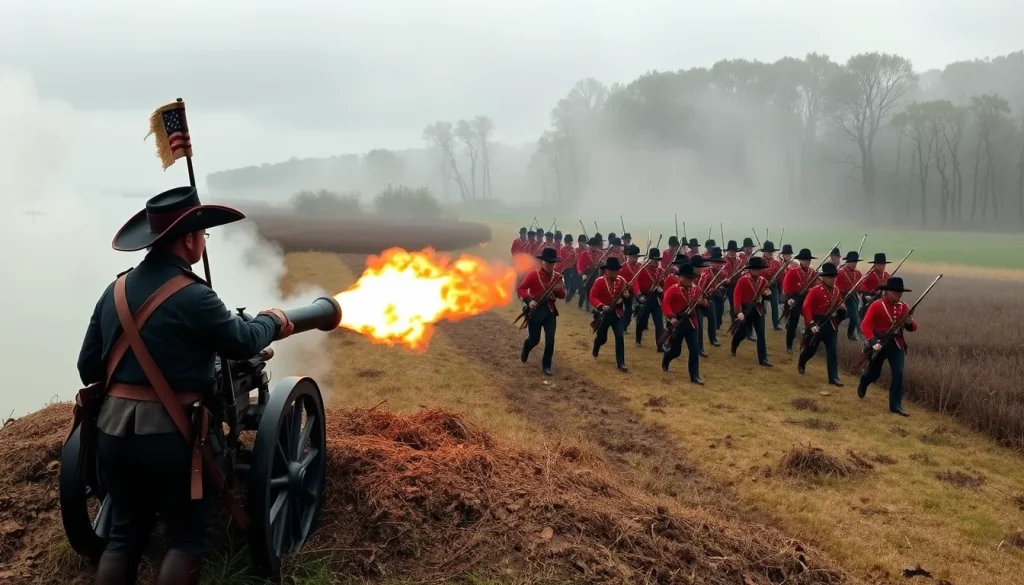
The Battle of New Orleans, fought on January 8, 1815, was the final major military engagement of the War of 1812. The battle took place approximately five miles southeast of New Orleans, Louisiana, near the Chalmette Plantation, where American forces under Major General Andrew Jackson defeated a larger British army commanded by Major General Sir Edward Pakenham. Although the Treaty of Ghent had been signed on December 24, 1814, formal ratification occurred only in February 1815, so the battle was fought after the war had technically ended in Europe but before it took effect in North America.
Historical Context
Following Napoleon’s defeat in the spring of 1814, Great Britain could redirect seasoned troops and naval forces to the North American theater, aiming to strike at the United States. New Orleans was a prime objective: it controlled the mouth of the Mississippi River, served as the outlet for one-third of American agricultural produce, and was a gateway to the Louisiana Purchase territories. The British Admiralty, particularly Vice Admiral Sir Alexander Cochrane, saw the capture of New Orleans as a way to weaken the American cause, possibly to overturn the Louisiana Purchase and to gain leverage in the ongoing peace negotiations at Ghent, Belgium.
Peace talks had produced the Treaty of Ghent on December 24, 1814, but news did not reach the Gulf Coast before the campaign unfolded. British orders to Major General Pakenham, issued in October 1814, instructed him to continue operations even if he heard of a peace treaty, fearing that the United States might not ratify an agreement. Meanwhile, Americans believed that the British intended to hold New Orleans and the surrounding territory permanently, a fear that influenced the intensity of the defense.
What Happened
The British launched the Gulf Campaign in September 1814, beginning with an attack on Fort Bowyer near Mobile. In December, a British fleet under Vice Admiral Cochrane entered Lake Borgne, east of New Orleans. On December 14, a British flotilla captured an American gunboat squadron, giving them access to the lakes. British troops under General John Keane landed and advanced to the Villere Plantation on the Mississippi River, about nine miles below New Orleans, on December 23. In response, Andrew Jackson, who had arrived in New Orleans on December 1, launched a surprise night attack. Though the attack did not dislodge the British, it bought time for Jackson to withdraw to a defensible line along the Rodriguez Canal, a dry millrace south of the city.
Jackson’s defensive line, soon called “Line Jackson,” ran from the Mississippi River eastward to an impassable cypress swamp, stretching about three-quarters of a mile. Using slave labor and local materials, the Americans constructed a parapet and positioned artillery. British forces under Pakenham, who arrived on December 25, probed the position, leading to the artillery duel of January 1 and a skirmish on December 28. After failing to break the line, Pakenham ordered a full frontal assault on the morning of January 8, 1815.
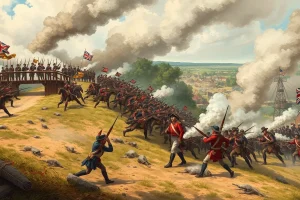
The British attack consisted of two columns against the main American line, with a smaller force crossing the river to engage American guns on the west bank. Around 6:20 a.m., the British advanced across open fields into a concentrated fire of artillery and musket fire. The attackers were repelled within roughly thirty minutes. Pakenham was mortally wounded, as was his second-in-command, Major General Samuel Gibbs. The British suffered about two thousand casualties, including dead, wounded, and missing, while American losses were minimal. The surviving British force under Major General John Lambert withdrew from the battlefield and re-embarked at Lake Borgne by January 27.
Why It Matters
The Battle of New Orleans had no bearing on the territorial outcome of the War of 1812 because the Treaty of Ghent, signed two weeks earlier, re-established the status quo ante bellum. Nevertheless, the overwhelming American victory had profound psychological and political effects. It ended the war on a high note for the United States, helping to erase the memory of earlier British victories and burned Washington, DC. The battle elevated Andrew Jackson to national fame, propelling him to the presidency in 1828. It also confirmed American control over the lower Mississippi and the Louisiana Purchase, securing the pathway for westward expansion. In British historical memory, the battle represented a costly tactical failure against a fortified opponent, and it reinforced the difficulty of fighting in North American terrain. The date of January 8 was celebrated as a national holiday for decades, though that remembrance faded in the twentieth century.
Prelude
The campaign began with British successes at the Battle of Lake Borgne on December 14, 1814, when a force of 980 sailors and Royal Marines under Captain Nicholas Lockyer captured the American gunboat flotilla under Lieutenant Thomas ap Catesby Jones. That victory opened the water route toward the Mississippi. The British army, gathered at Jamaica and then at Ship Island, proceeded to land on the east shore of Lake Borgne and march overland through bayous, reaching the Villere Plantation on December 23. Jackson’s night attack that evening, while not a decisive victory, checked the British advance and allowed him to fall back to the Chalmette line.
Forces and Commanders
The American force of about 5,700 men was a composite of U.S. Army regulars, Tennessee and Kentucky militia, Louisiana state militia, free African Americans, Choctaw warriors, and privateers under Jean Lafitte. Commanders included Andrew Jackson, Major General of the U.S. Army; Daniel Patterson of the U.S. Navy; and Choctaw leader Pushmataha. The British force, numbering about 8,000, comprised hardened regulars—many veterans of the Peninsular War—under Major General Sir Edward Pakenham, with Gibbs, Keane, and Lambert as subordinate commanders. The British also had naval support under Vice Admiral Cochrane.
Battlefield and Map Context
The battlefield was located on the Chalmette Plantation, on the east bank of the Mississippi River, about five miles downstream from New Orleans. The American line stretched from the levee across a field to a dense swamp, with the Rodriguez Canal as a dry ditch in front. The terrain was largely open and flat, offering no cover to an attacking force. The west bank of the Mississippi, held by a smaller American contingent under Brigadier General David Morgan, was a secondary objective. The position is now preserved as the Chalmette Battlefield unit of Jean Lafitte National Historical Park and Preserve.
Battle Chronology
The main assault began at dawn on January 8, 1815, with a British diversionary attack on the west bank that succeeded in capturing an American battery. On the main line, two columns, one along the river and one along the swamp, advanced toward the American fortifications. They came under a devastating artillery barrage and rifle fire from behind the earthworks. The column on the left, led by Colonel Robert Rennie, briefly captured an American redoubt but were driven back. The main column, led by Pakenham himself, was routed before reaching the line. Pakenham and Gibbs were both killed. Within half an hour, the attack was over. The British withdrew their remaining forces, and after a period of hesitation, Lambert ordered a retreat. The last engagements took place with the British rearguard on January 18, after which the entire British force withdrew to Lake Borgne and re-embarked.
Casualties and Losses
American losses were remarkably low: 13 killed, 39 wounded, and 19 missing or captured, totaling 71. British casualties were catastrophic: 291 killed, 1,262 wounded, and 484 missing or captured, totaling 2,037. Among the dead were Major Generals Pakenham and Gibbs. These figures are derived from official returns and are cited in most historical accounts, though some popular narratives vary slightly. The disproportion underscores the effectiveness of the American defensive position and the costliness of the frontal assault.
Result
The Battle of New Orleans was a decisive American victory. The British failed to capture the city, suffered enormous losses, and withdrew to their fleet. The battle had no effect on the peace treaty, but it secured the American claim to Louisiana and the Mississippi Valley. The British force subsequently attacked and captured Fort Bowyer in Mobile Bay in February 1815, but that success had no strategic consequence once news of the treaty arrived.
Strategic Consequences
The primary strategic consequence was that the British abandoned their plans to take New Orleans and the Louisiana Territory. The battle confirmed that the Treaty of Ghent’s status quo ante bellum would be honored, meaning the United States retained the Louisiana Purchase and all other territorial possessions. The victory bolstered American diplomatic standing in the ratification process and gave the nation a final, heroic narrative of the war. For the British, the defeat was a reminder of the operational risks of extended campaigns in North America, and it contributed to a post-war attitude of avoiding further military conflict with the United States.
Primary Accounts
Several first-hand accounts of the battle survive. Jean Hyacinthe de Laclotte, a Louisiana militia officer, produced sketches and a painting based on his observations during the fighting. American officers such as Andrew Jackson wrote official after-action reports. British accounts include letters from officers and the proceedings of later courts-martial. Many of these accounts are preserved in the National Archives and in published documentary collections. The most significant limitation is that they reflect the perspectives of participants and often exaggerate enemy numbers or minimize one’s own errors.
Battlefield Today
The Chalmette Battlefield is a unit of Jean Lafitte National Historical Park and Preserve in Chalmette, Louisiana. Visitors can see reconstructed earthworks, a monument commemorating the battle, and the Chalmette National Cemetery. The site preserves the terrain that gave Jackson his defensive advantage. Interpretive programs explain the battle, its participants, and its legacy.
Primary Sources
The most important contemporary documents include Andrew Jackson’s official report of January 9, 1815, which described the battle and listed casualties; Vice Admiral Cochrane’s dispatches; and the public letters of Sir Edward Pakenham and his successors. The Treaty of Ghent itself is the treaty document that officially ended the war. The diary of Private Isaac Cooke of the 93rd Highland Regiment, if available, provides a British soldier’s perspective. These sources are housed in the U.S. National Archives, the British National Archives, and various collections. Researchers must be aware of the biases of military reporting and the incomplete records of enlisted soldiers.
Further Reading
- The Battle of New Orleans by Robert V. Remini (1999)
- American Battlefield Trust: “Battle of New Orleans: The Last Battle of the War of 1812”
- U.S. Army Center of Military History: “The Battle of New Orleans” (2014)
- Jackson’s Way: Andrew Jackson and the People of the Western Waters by John Buchanan (2001)
- Chalmette Battlefield, Jean Lafitte National Historical Park and Preserve, official National Park Service resources
References
- “Battle of New Orleans,” Wikipedia, accessed [date], https://en.wikipedia.org/wiki/Battle_of_New_Orleans.
- U.S. Army Center of Military History, “The Battle of New Orleans, January 8, 1815,” https://history.army.mil/news/2014/140108a_newOrleans.html.
- American Battlefield Trust, “Battle of New Orleans: The Last Battle of the War of 1812,” https://www.battlefields.org/learn/articles/battle-new-orleans-last-battle-war-1812.
- HISTORY.com Editors, “Battle of New Orleans,” History, November 9, 2009, May 28, 2025 update, https://www.history.com/articles/battle-of-new-orleans.
- HISTORY.com Editors, “The Battle of New Orleans,” History, February 9, 2010, May 28, 2025 update, https://www.history.com/this-day-in-history/january-8/the-battle-of-new-orleans.
FAQ
Why was the Battle of New Orleans fought after the Treaty of Ghent was signed?
The Treaty of Ghent was signed on December 24, 1814, but news did not reach the Gulf Coast in time to stop the campaign. The treaty was not ratified by the United States until February 16, 1815, so the battle occurred before the war legally ended for Americans.
How did Andrew Jackson assemble an army so quickly to defend New Orleans?
Jackson, who arrived in New Orleans on December 1, 1814, declared martial law and called up local militia, regular army units, free African Americans, Choctaw warriors, and even privateers under Jean Lafitte. He used local slaves to build defensive fortifications.
What was the significance of the Battle of New Orleans for the United States?
The overwhelming victory boosted American national pride, secured control over the Mississippi River and the Louisiana Purchase, and made Andrew Jackson a national hero, eventually leading to his presidency. It also discouraged future British military ventures in the region.


Leave a Reply