
Short Answer
During the War of 1812 (1812–1815), the women of Baltimore played indispensable but often under-recorded roles in supporting the American war effort, sustaining households, and directly responding to military threats. From sewing the enormous Star-Spangled Banner that flew over Fort McHenry to nursing wounded soldiers after the Battle of North Point, Baltimore women contributed in a city that was a major economic and privateering hub. Their actions, set against a backdrop of British naval attacks and the Chesapeake campaign of 1814, illustrate both the limitations and possibilities of women’s agency in wartime.
Historical Context
By 1812, Baltimore was the third-largest city in the United States, with a population of about 47,000, including a large immigrant community from Ireland, Germany, and French refugees. Its deep-water harbor on the Patapsco River made it a center for trade, shipbuilding, and above all privateering, which inflicted heavy damage on British shipping. This activity earned Baltimore the British epithet “a nest of pirates” and made it a primary target for British retaliation. The war, declared in June 1812, exacerbated political tensions between Federalists and Democratic-Republicans, as seen in the violent Baltimore riots targeting the anti-war Federal Republican newspaper. Women lived within a society that gave them limited legal and political rights, yet they were expected to maintain homes, raise children, and support the war effort in various practical ways. Their recorded experiences mostly come from elite and middle-class letters and diaries; the voices of enslaved women, free Black women, and working-class women are rare but can be partially reconstructed from indirect sources.
What Happened
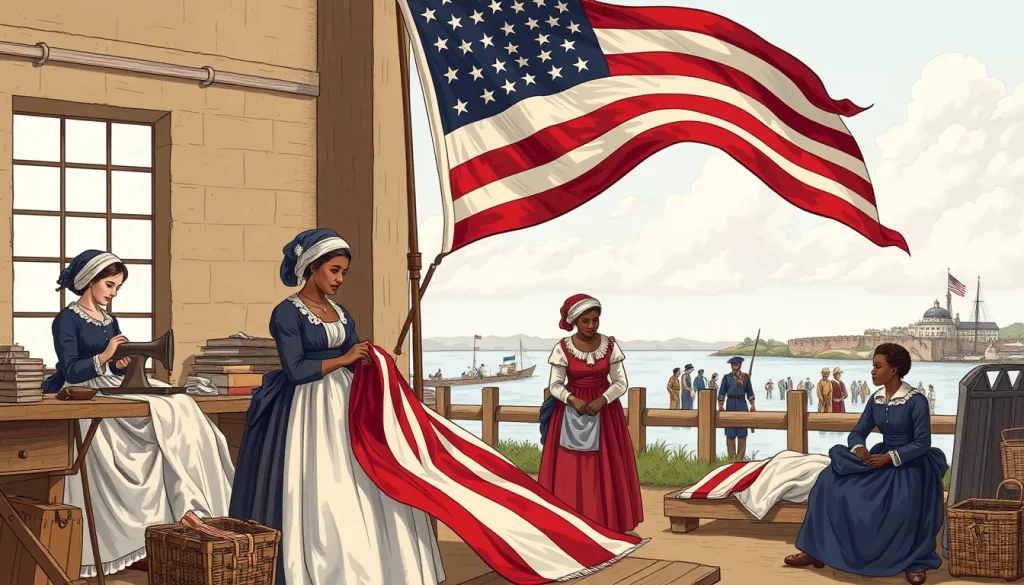
After a British naval blockade of the Chesapeake began in 1813, Baltimore’s civilian population, including women, faced heightened danger. Women managed households and businesses while men served in the militia or sailed on privateers. Some encountered the enemy directly: Hetty Boulden, an enslaved woman, reportedly helped save Elkton from being burned in April 1813 by warning local defenders. The British raided along the Chesapeake, capturing enslaved individuals and offering freedom to those who joined their cause; Lucy Hall and her family escaped to the British and resettled in Nova Scotia. In 1814, the British attack on Baltimore brought the war to the city’s doorstep. At Fort McHenry, Mary Pickersgill and her team—including her daughter, nieces, and two enslaved African American women—sewed a 30×42-foot garrison flag, commissioned by Major George Armistead, which became the inspiration for Francis Scott Key’s “The Star-Spangled Banner.” During the Battle of Baltimore on September 13–14, women like Elizabeth Warner Sands, a 25-year-old mother, assisted U.S. Army surgeon James H. McCulloch at the field hospital near the Old Methodist Meeting House, caring for wounded soldiers, including her own brothers and nephew. First Lady Dolley Madison, though not in Baltimore, fled Washington on August 24, 1814, and famously saved George Washington’s portrait; her enslaved maid Sukey helped pack valuables. In Baltimore, other women such as Kitty Knight, according to local legend, persuaded British officers to spare two private homes. After the war, women like Pickersgill continued to run businesses and engage in philanthropy, leaving a legacy that historians increasingly recognize.
Why It Matters
The contributions of Baltimore’s women during the War of 1812 were essential to the city’s defense and to the larger war effort, though they were largely unrecognized at the time. Their actions demonstrated that women could perform vital public roles—as flag makers, nurses, and even informal defenders—within a society that limited their political rights. These women also challenged contemporary gender expectations, participating in the patriotic narrative while negotiating the realities of slavery and racial inequality. For historians, the War of 1812 offers a window into the daily lives of women in the early republic, revealing both their resilience and the erasure of many from the historical record. The story of the Star-Spangled Banner, in particular, has become a symbol of national identity, but it also underscores the often-uncredited labor of women and enslaved individuals. The long-term significance lies in how these contributions complicate our understanding of the home front and set precedents for women’s civic involvement in wartime.
Definition
“Women of Baltimore during the War of 1812” encompasses the diverse experiences of female residents—white and Black, free and enslaved—in a major American port city during the conflict. Their roles ranged from traditional domestic duties to active participation in war-related production, healthcare, and defense, shaped by class, race, and marital status.
Background
In the early republic, women’s legal status was largely defined by coverture, which limited married women’s property and contract rights. Single women and widows had more autonomy, as did some free Black women, though all faced social restrictions. Baltimore’s thriving economy offered women opportunities for paid work, particularly in textiles and domestic service. The war disrupted existing patterns, as men left for military service and privateering, and as British blockades cut off trade.
How It Worked
Women contributed to the war effort in several practical ways. Many took on expanded household management, including producing clothing and supplies for soldiers. Others engaged in war-related entrepreneurship: Mary Pickersgill’s flag-making business flourished, and she and her team sewed the garrison flag for Fort McHenry. Women also served as nurses, as seen with Elizabeth Warner Sands, who tended to wounded at North Point. Some, like Dolley Madison, used their social positions to preserve national symbols. Enslaved women faced a different calculus, with some seeking freedom through the British or remaining with their enslavers. Free Black women, such as Grace Wisher, an indentured servant, may have contributed alongside Pickersgill.
Competing Viewpoints
Historians interpret women’s motives and impact in different ways. Traditional narratives emphasize patriotic duty and domestic sacrifice, while newer scholarship highlights the diversity of women’s experiences, especially those of enslaved and free Black women who had complex loyalties. Some argue that the war reinforced patriarchal structures, while others see it as a rare moment when women’s work was visibly valued. The scarcity of primary sources from ordinary women means that many claims rest on circumstantial evidence, leading to ongoing debate about the extent of women’s influence.
Role in the War of 1812
Baltimore’s women directly supported the military effort. They sewed flags and uniforms, nursed soldiers, and maintained homes that sustained the civilian population. Their management of businesses and households allowed men to serve. In the 1814 attack, women like Elizabeth Warner Sands risked their lives to care for the wounded, and legends like Kitty Knight’s show women negotiating directly with British officers. Enslaved women’s decisions to escape or remain also shaped the war’s social dynamics.
Consequences and Historical Interpretation
The immediate consequence was that Baltimore survived the British attack, and women’s contributions were acknowledged piecemeal, such as Elizabeth Warner Sands’s honorary membership in the Old Defenders’ Association in 1889. Over time, the image of Mary Pickersgill’s flag became a national icon, but the roles of other women faded from memory. Subsequent historians have recovered stories of enslaved women like Lucy Hall and free women of color, illustrating a more complete picture of the home front. The war’s legacy for women included a reassertion of separate spheres, but also small gains in economic independence and philanthropy, as seen in Pickersgill’s later career. Today, the Star-Spangled Banner Flag House and the National Park Service’s Star-Spangled Banner National Historic Trail interpret these stories to the public.
Primary Sources
Dolley Madison’s letter to Lucy Todd (August 24, 1814) provides a firsthand account of the flight from Washington and the rescue of Washington’s portrait. It reflects the urgency and personal courage of a prominent woman during an invasion.
Margaret Bayard Smith’s journal (published posthumously as A Winter in Washington) offers a literate woman’s observations of the war’s impact on Washington and Baltimore, including the fears and responses of women and children.
Newspaper accounts, such as the announcement of Elizabeth Warner Sands’s death in 1890, later celebrated her nursing role, but contemporary newspapers from 1814 rarely mentioned women’s contributions.
The records of the Old Defenders’ Association and other veterans’ organizations contain later recollections. The letter from Major George Armistead commissioning the garrison flag (1813) is indirect evidence of women’s work.
Limitations: These sources were created by or about elite women; enslaved and working-class women are largely absent, and their roles must be inferred from legal documents, tax lists, and the few existing oral traditions.
Further Reading
- Donald R. Hickey, The War of 1812: A Forgotten Conflict (University of Illinois Press, 1989).
- Anthony Ruggiero, “Women’s Roles in the War of 1812,” National Women’s History Museum, lesson plan resource.
- Maryland Women’s Heritage Center, “Mary Young Pickersgill” biographical profile.
- National Park Service, “Women in the Chesapeake Region during the War of 1812,” Star-Spangled Banner National Historic Trail.
- American Battlefield Trust, “Baltimore during the War of 1812” (2020).
References
- National Park Service, “Women in the Chesapeake Region during the War of 1812,” accessed 2025, https://www.nps.gov/stsp/learn/historyculture/women-in-chesapeake-during-the-war-of-1812.htm.
- National Women’s History Museum, “Women’s Roles in the War of 1812,” by Anthony Ruggiero, accessed 2025, https://www.womenshistory.org/resources/lesson-plan/women-in-the-war-of-1812.
- National Park Service, “Elizabeth Warner Sands,” accessed 2025, https://www.nps.gov/stsp/learn/historyculture/elizabeth-warner-sands.htm.
- American Battlefield Trust, “Baltimore during the War of 1812,” accessed 2025, https://www.battlefields.org/learn/articles/baltimore-during-war-1812.
- Maryland State Archives, “Biographies – Mary Young Pickersgill,” accessed 2025, https://msa.maryland.gov/msa/educ/exhibits/womenshallfame/html/pickersgill.html.
FAQ
What roles did women in Baltimore play during the War of 1812?
Women managed households, ran businesses, sewed flags and uniforms, served as nurses, and sometimes confronted British troops directly. Notable examples include Mary Pickersgill, who sewed the Star-Spangled Banner, and Elizabeth Warner Sands, who cared for wounded soldiers.
Did enslaved women in Baltimore have different experiences during the war?
Yes. Enslaved women like Hetty Boulden and Lucy Hall faced the risk of being taken by the British or chose to escape to freedom. Some, like Grace Wisher, were indentured servants who may have worked alongside free women in flag-making. Their voices are rarely recorded, but they were part of the home front.
How have historians evaluated women's contributions to the War of 1812?
Historians have shifted from a focus on elite women like Dolley Madison to a broader view that includes working-class, enslaved, and free Black women. They emphasize that women's labor was essential to sustaining the war effort, and they interpret these roles as both reinforcing and challenging gender norms of the time.

Leave a Reply