
Short Answer
Oliver Hazard Perry’s victory at the Battle of Lake Erie on September 10, 1813, was a decisive American naval success in the War of 1812. Commanding a small squadron built from green timber at Presque Isle, Perry defeated a British force under Robert Heriot Barclay, gaining control of the lake and forcing the British evacuation of Detroit. This engagement established Perry as a national hero and secured American dominance in the Northwest frontier for the rest of the war.
Historical Context
At the outset of the War of 1812, British forces based at Amherstburg (Fort Malden) and Detroit threatened American settlements in Ohio and the Northwest Territory. Lake Erie served as the vital logistical artery: British posts and Indigenous allies depended on supplies shipped across the lake from the east. After American setbacks in 1812, including the surrender of Detroit, the United States sought to challenge British naval supremacy on the Great Lakes. A naval arms race developed in early 1813 as both sides rushed to construct squadrons. The Americans built ships at Presque Isle (Erie, Pennsylvania) under the direction of shipbuilder Noah Brown, while the British constructed vessels at Amherstburg. By the summer of 1813, Master Commandant Oliver Hazard Perry had assembled a nine-vessel squadron, but he faced a severe shortage of trained sailors and had to supplement his crews with militia and infantry volunteers from William Henry Harrison’s army.
What Happened
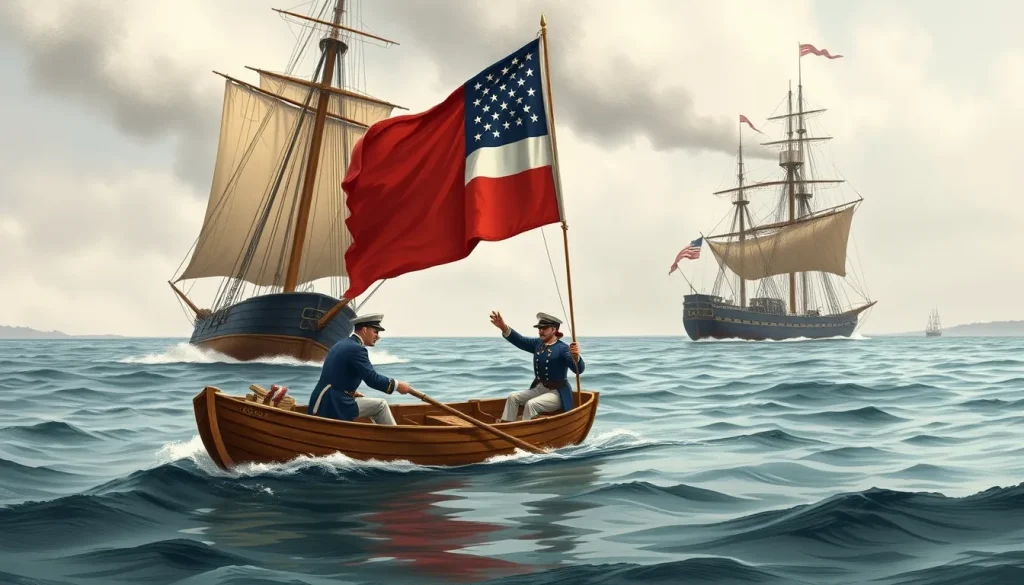
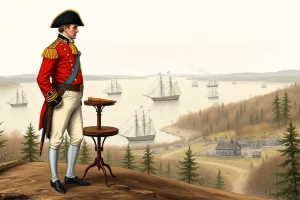
On the morning of September 10, 1813, Perry’s fleet, anchored off Put-in-Bay, spotted six British vessels to the northwest. After a wind shift favored the Americans, Perry maneuvered his squadron to engage. The British, armed largely with long-range guns, held an advantage at distance; the Americans, though fewer in number of ships, carried carronades that were devastating at close range. Both squadrons formed a line of battle. Perry’s flagship, the brig Lawrence, bore the brunt of British fire early on, suffering heavy casualties and losing most of its guns. After nearly two hours, with the Lawrence crippled, Perry transferred his flag to the untouched brig Niagara by rowing across open water under enemy fire. He then broke through the British line, firing both broadsides, while the British flagship Detroit and Queen Charlotte collided and became entangled. Within minutes, the British surrendered. Perry’s terse report to General Harrison became famous: “We have met the enemy and they are ours.”
Why It Matters
The American victory on Lake Erie had immediate and lasting consequences. It severed the British supply line to Amherstburg and Detroit, forcing Major-General Henry Procter to evacuate Detroit and retreat up the Thames River. Harrison’s army pursued and defeated the British and their Indigenous allies at the Battle of the Thames on October 5, 1813, where Tecumseh was killed. Control of Lake Erie remained in American hands for the remainder of the war, preventing any renewed British offensive into Ohio or Pennsylvania. For later historians, the battle is significant as one of the few American naval victories against the Royal Navy in the war, though it was fought against a hastily assembled squadron rather than the full might of the British fleet. Perry’s personal courage, highlighted by his mid-battle transfer, became a central element of American naval mythology.
Early Life
Oliver Hazard Perry was born on August 23, 1785, in South Kingstown, Rhode Island, the eldest son of Christopher Raymond Perry, a captain in the American navy, and Sarah Alexander Perry. At thirteen he obtained a midshipman’s warrant in the U.S. Navy and served in the Quasi-War with France and the Tripolitan War against the Barbary pirates. He saw no major combat during those conflicts, but gained experience aboard frigates such as the Constitution and Essex. In 1809 he received command of the schooner Revenge, which he lost to a reef off Watch Hill, Rhode Island, in 1811; a court-martial exonerated him.
Role Before the War
After the loss of the Revenge, Perry married Elizabeth Champlin Mason in May 1811. With war threatening in 1812, he sought a sea command but was initially assigned to the gunboat flotilla at Newport. Promoted to master commandant in October 1812, he repeatedly petitioned for a more active role. In February 1813, through his friend Isaac Chauncey, Perry received orders to report to Lake Erie, where he would be responsible for building and commanding a fleet to challenge British control.
Role During the War
Perry arrived at Presque Isle in March 1813 and oversaw the construction and fitting out of a squadron that eventually included the brigs Lawrence and Niagara, the brig Caledonia, five schooners, and a sloop. He also dealt with logistical shortages, recruiting landsmen and soldiers to fill crews. In August, his squadron moved to Put-in-Bay, threatening British supply lines. When Barclay’s squadron appeared on September 10, Perry sortied and fought the decisive battle, winning control of the lake.
Major Actions
The Battle of Lake Erie was Perry’s principal action. He deployed his fleet in line, but the Lawrence became heavily engaged and was nearly destroyed. Perry’s transfer to the Niagara and subsequent breakthrough of the British line resulted in the surrender of the entire British squadron of six vessels. He then sent his famous dispatch to General William Henry Harrison. Afterward, Perry assisted in the Battle of the Thames, serving as a volunteer aide to Harrison.
Contemporary Accounts
Perry’s own report to Harrison, dated September 10, 1813, is the most direct account of the battle. A letter from Perry to Secretary of the Navy William Jones also described the action. The battle flag bearing the words “Don’t Give Up the Ship” was created from the dying words of Captain James Lawrence, Perry’s friend, and became a symbol of the victory. Contemporary newspaper accounts celebrated Perry’s triumph and his personal bravery.
Later Life
After the war, Perry was promoted to captain. He briefly commanded the frigate Java and saw limited service in the Chesapeake during the British raids of 1814. Postwar, he helped settle boundary disputes and in 1819 led a diplomatic mission to Venezuela, where he contracted yellow fever. He died on August 23, 1819, his thirty-fourth birthday, and was buried in Trinidad, though his remains were later reinterred in Rhode Island.
Historical Legacy
Perry’s victory at Lake Erie secured his reputation as one of the leading American naval officers of the War of 1812. The battle’s strategic importance—control of the lake and the subsequent retreat from Detroit—made it a turning point in the western theater. Perry’s “Don’t Give Up the Ship” flag and his terse dispatch entered American cultural memory. Monuments, including Perry’s Victory and International Peace Memorial on South Bass Island, commemorate the engagement. Historians continue to debate the quality of Perry’s tactics, but his personal courage and the result of the battle are undisputed.
Primary Sources
Primary sources for Perry’s role at Lake Erie include his dispatch to Major General William Henry Harrison, dated September 10, 1813, which reads in part: “We have met the enemy and they are ours.” Perry also wrote to Secretary of the Navy William Jones, describing the battle and its results. The battle flag, preserved at the United States Naval Academy, is a physical artifact of the event. Samuel Hambleton, a purser on the Lawrence, kept a diary that provides a detailed firsthand account of the battle and Perry’s leadership. These sources are all housed in American archives; the flag is at the Naval Academy Museum.
Further Reading
- Hickey, Donald R. The War of 1812: A Forgotten Conflict. University of Illinois Press, 1989.
- Malcomson, Robert. Lords of the Lake: The Naval War on Lake Ontario, 1812-1814. Naval Institute Press, 2002.
- Skaggs, David Curtis, and Larry L. Nelson, eds. The Sixty Years’ War for the Great Lakes, 1754-1814. Michigan State University Press, 2001.
- White, Richard. The Middle Ground: Indians, Empires, and Republics in the Great Lakes Region, 1650-1815. Cambridge University Press, 1991.
References
- National Park Service, “The Battle of Lake Erie,” Perry’s Victory & International Peace Memorial, accessed [date], https://www.nps.gov/pevi/learn/historyculture/battle_erie_detail.htm.
- American Battlefield Trust, “Lake Erie Battle Facts and Summary,” American Battlefield Trust, accessed [date], https://www.battlefields.org/learn/war-1812/battles/battle-lake-erie.
- Klein, Christopher, “What Was the Battle of Lake Erie?” History.com, September 10, 2013, https://www.history.com/articles/the-battle-of-lake-erie-200-years-ago.
- National Park Service, “Oliver Hazard Perry,” Perry’s Victory & International Peace Memorial, accessed [date], https://www.nps.gov/pevi/learn/historyculture/perry.htm.
- The War of 1812 Resource, “Battle of Lake Erie,” The War of 1812, accessed [date], https://thewarof1812.org/battles/battle-of-lake-erie/.
FAQ
What was Perry's famous message after the Battle of Lake Erie?
Perry sent a dispatch to Major General William Henry Harrison that read, 'We have met the enemy and they are ours.' The full message listed the captured British ships.
Why was the Battle of Lake Erie strategically important?
The American victory severed British supply lines to Detroit and Amherstburg, forcing the British to evacuate Detroit and leading directly to the Battle of the Thames.
What was Perry's role in the battle?
Perry commanded the American squadron, led the attack, transferred his flag from the disabled Lawrence to the Niagara, and broke the British line, forcing the surrender of the British fleet.
Leave a Reply