
Short Answer
The Battle of Mackinac Island (4 August 1814, with preliminary operations from late July) was an unsuccessful American attempt to recapture Fort Mackinac during the War of 1812. A United States force of roughly 700 regulars, volunteers, and sailors under Lieutenant Colonel George Croghan, carried and supported by a naval squadron under Commodore Arthur Sinclair, landed on the northwest shore of Mackinac Island in Michigan Territory but was halted by Indigenous warriors and British regulars and forced to re-embark. The failure left the Straits of Mackinac and the northern fur-trade routes in British hands for the remainder of the war, and it stands as one of the clearest examples of the limits of American power in the upper Great Lakes.
Historical Context
Mackinac Island — pronounced “Mackinaw” — lies in the Straits of Mackinac, the water passage connecting Lake Michigan and Lake Huron. Fort Mackinac, built on a limestone bluff above the harbour at the island’s southern end, controlled shipping through the straits and the fur trade of the surrounding region, which contemporaries often called Michilimackinac. Control of the post also carried political weight: British officials, Great Lakes traders, and the British Indian Department believed that possession of Mackinac shaped the allegiances of Anishinaabe nations — Odawa, Ojibwe, and Potawatomi among them — and other Indigenous peoples of the Old Northwest, many of whom opposed United States settlement and land cessions.
When the United States declared war in June 1812, the nearest British garrison, at St. Joseph Island, acted quickly. In mid-July 1812 a mixed force of British regulars, Canadian voyageurs, and Indigenous warriors under Captain Charles Roberts crossed to Mackinac and compelled the small American garrison to surrender before its commander knew that war had been declared. The news encouraged Indigenous communities that had been neutral or undecided to side with Britain, and it contributed to a series of British and Indigenous successes over the following year.
The strategic situation shifted in 1813. The American naval victory at the Battle of Lake Erie (10 September 1813) restored United States control of Lake Erie and made possible the recapture of Detroit and the defeat of a British and Indigenous force at the Battle of the Thames (5 October 1813). Mackinac itself remained in British hands, but the loss of Detroit severed its supply line from the east, and the garrison under Captain Richard Bullock of the 41st Regiment of Foot went onto half rations during the winter of 1813–1814.

In February 1814 Lieutenant Colonel Robert McDouall of the Glengarry Light Infantry was ordered to reopen communications with Mackinac. He established a new supply route running north from York by way of Lake Simcoe and the Nottawasaga River to Georgian Bay, and in the spring he moved a party of about ninety Royal Newfoundland Fencibles, a small artillery detachment with four field guns, Royal Navy sailors, and carpenters by batteau to the island. McDouall reached Mackinac on 18 May 1814 with provisions for the hungry garrison, and within days he was joined by roughly two hundred Indigenous warriors under the nominal leadership of Lieutenant Robert Dickson of the Indian Department. Anishinaabe communities around the region had strong reasons to prevent an American return, and later accounts credit local figures such as Elizabeth Mitchell with helping to call warriors to the island’s defence.
What Happened
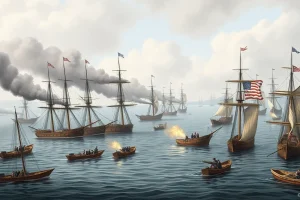
United States authorities decided in 1814 to recover Mackinac, partly to restore American influence over the northern fur trade and partly to strengthen the American position before peace negotiations. A force of about 700 men — detachments of the 17th, 19th, and 24th U.S. Infantry together with a battalion of Ohio militia — assembled at Detroit under Lieutenant Colonel George Croghan. Commodore Arthur Sinclair’s squadron, which included the brigs Niagara and Lawrence and the schooners Caledonia, Scorpion, and Tigress, carried the troops up Lake Huron, sailing on 3 July 1814.
Before reaching Mackinac the expedition struck at British and Canadian fur-trade posts. St. Joseph Island, abandoned by the British in 1812, offered nothing of value; at Sault Ste. Marie the Americans destroyed the North West Company’s depot. These operations, together with the Americans’ visible presence on the lake, removed any chance of surprise. When Sinclair’s ships appeared off Mackinac on 26 July, McDouall had already recalled his outposts and gathered his Indigenous allies.
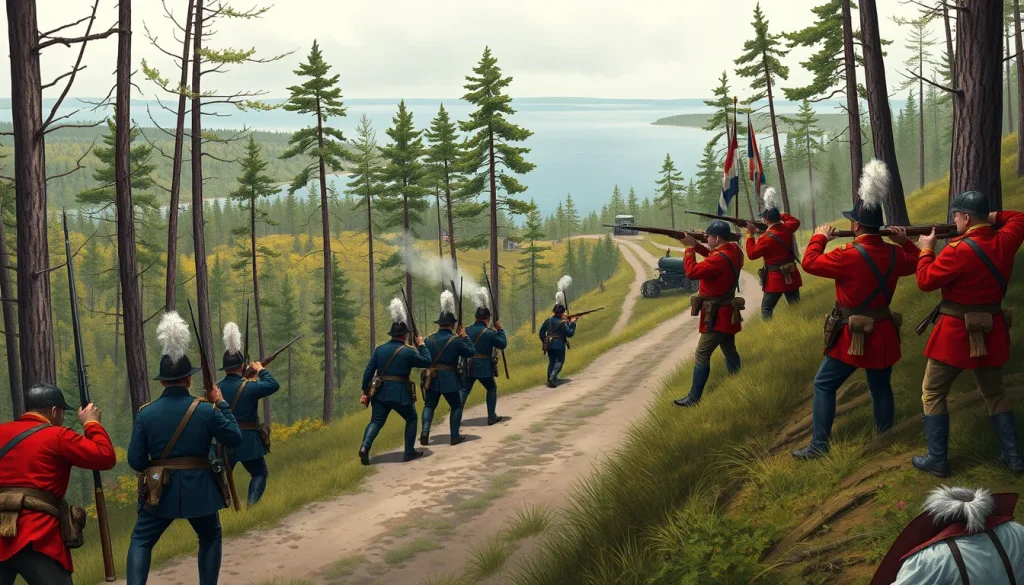
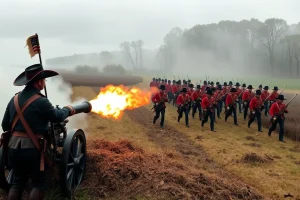
Contrary winds and heavy weather kept the troops aboard ship for more than a week. On 4 August the Americans finally landed on the island’s northwest shore — the site now called British Landing — about two miles from the fort, and Croghan advanced inland along the road through dense forest. Indigenous warriors posted in the woods opened fire on the column near the clearing known as Dousman’s farm. Major Andrew Holmes was killed leading a party forward, and although the Americans brought up their field pieces, the dispersed marksmen offered poor targets. British regulars and a field gun moved out from the direction of the fort in support, and Croghan, his men extended and under fire from cover, ordered a withdrawal. The Americans returned to the beach, re-embarked after dark, and sailed for Detroit.
Why It Matters
The battle settled the question of who would hold the Straits of Mackinac for the remainder of the war. British and Indigenous forces retained the island, the fur trade continued to flow through British and Canadian channels, and the alliance on which Britain depended in the northwest remained intact. The Americans made no second attempt.
The engagement also illustrates a pattern common to the War of 1812 in the Great Lakes region: American numbers and naval strength could not easily overcome prepared defences, difficult terrain, and Indigenous warfare conducted from cover by warriors with strong local knowledge and clear political stakes. Historians generally treat the campaign as a failure of American planning and reconnaissance as much as a British triumph, noting that the attacks on outlying posts advertised the expedition’s purpose well in advance.
For the Indigenous nations of the region, the outcome was a short-term success with a longer, less favourable aftermath. The Treaty of Ghent (24 December 1814) restored captured territory but said nothing binding about Indigenous land or sovereignty, and the British withdrawal from Mackinac in 1815 left the communities that had fought alongside them facing an expanding United States on their own. That gap between military success and diplomatic outcome is a central theme in modern scholarship on the war in the Northwest.
Prelude
American planning for 1814 combined strategic ambition with limited resources. Croghan’s command was assembled at Detroit in June and early July, and Sinclair’s squadron was assigned to carry and support it. The expedition’s first objective was Mackinac, but the Americans also hoped to disrupt British supply routes on Lake Huron and Georgian Bay. Their early raids on St. Joseph Island and Sault Ste. Marie had the unintended effect of warning McDouall, who used the delay caused by contrary winds to strengthen the defences, position artillery, and place his Indigenous allies along the most likely American approach.
Forces and Commanders
United States: Lieutenant Colonel George Croghan of the 17th U.S. Infantry commanded the land force; Commodore Arthur Sinclair commanded the naval squadron; Major Andrew Holmes was the senior officer killed. The land force consisted of detachments of the 17th, 19th, and 24th U.S. Infantry with a battalion of Ohio militia, numbering roughly 700 in total, supported by a few field guns and by naval gunnery.
Britain and its Indigenous allies: Lieutenant Colonel Robert McDouall of the Glengarry Light Infantry was commandant at Mackinac; Captain Richard Bullock of the 41st Regiment of Foot had held the post before him; Lieutenant Robert Dickson of the British Indian Department exercised loose authority over the Indigenous contingent. The garrison included men of the Royal Newfoundland Fencibles and the locally raised Michigan Fencibles, a small artillery detachment with field guns, and local militia. Indigenous strength is usually estimated at around 300 warriors, drawn from Anishinaabe and neighbouring nations. Precise numbers on both sides are uncertain, and British returns seldom recorded Indigenous participants by name.
Battlefield and Map Context
Mackinac Island is roughly three miles across at its widest point. Fort Mackinac stands on a bluff about 150 feet above the harbour at the island’s southeastern end, overlooking the straits. The American landing took place on the opposite, northwestern shore — now called British Landing — about two miles from the fort by the road that crosses the island. That road ran through heavy timber and passed a clearing associated with the trader Michael Dousman, and it was there, roughly midway between the landing and the fort, that the American column was ambushed. The battle site is recorded at approximately 45°51′11″N 84°37′03″W; the later historic marker on British Landing Road stands near 45°52′25″N 84°38′03″W.
Battle Chronology
Detailed timing in the surviving sources is approximate, and American and British accounts differ on particulars.
- 26 July 1814: Sinclair’s squadron arrives off Mackinac; contrary winds and weather prevent an immediate landing, giving McDouall additional time to prepare.
- Late July to early August: Ships and fort exchange fire at intervals; American troops remain aboard ship, cramped and short of fresh water.
- 4 August, morning and midday: Boats put Croghan’s force ashore at the northwest landing site.
- Early afternoon: The column advances along the forest road toward the fort in extended formation, with artillery and flankers.
- Contact: Indigenous warriors open fire from cover near Dousman’s farm. American flanking parties are driven in, and Major Holmes is killed while leading a party forward.
- Afternoon: American field pieces come into action but cannot effectively engage dispersed marksmen. British regulars and a field gun advance from the direction of the fort.
- Late afternoon: Croghan, his line strung out and taking casualties, orders a withdrawal.
- Night of 4–5 August: The Americans carry their wounded back to the beach and re-embark; the squadron sails away.
Casualties and Losses
American losses are usually given as about 13 killed and 55 wounded, including Major Holmes. British official returns record one man killed and one wounded, and some modern summaries list no British casualties at all; Indigenous losses are not reliably documented and may be understated in British records. All figures should be treated as estimates, since returns from the period are incomplete and the two sides counted their losses differently.
Result
The battle was a British and Indigenous victory. The American attempt to take Fort Mackinac failed, the landing force withdrew, and no further American expedition against the island was mounted before the war ended.
Strategic Consequences
Mackinac remained in British hands until 1815, keeping the Straits of Mackinac and the northern fur-trade routes under British and Canadian control for the rest of the war. Naval operations on Lake Huron continued after the battle: in August 1814 a detachment from Sinclair’s squadron destroyed the British schooner Nancy at the Nottawasaga River, but her crew later captured the American schooners Tigress and Scorpion in the St. Marys River, restoring a rough British naval ascendancy on the lake that lasted into 1815. Under the Treaty of Ghent, signed on 24 December 1814, captured posts were to be restored; the British evacuated Fort Mackinac in 1815 and the United States resumed possession. In the longer term the island’s fur trade declined, and Mackinac’s significance shifted toward military memory and, later, tourism.
Primary Accounts
The surviving written record is heavily weighted toward American and British official correspondence. Croghan and Sinclair both reported on the operation to their superiors, and McDouall’s despatches to his commanders describe the British and Indigenous defence. Contemporary newspapers in the United States printed officers’ reports and brief notices of the defeat, often with limited detail. Indigenous perspectives on the battle and on the wider alliance are largely absent from the official documents; they survive mainly in oral tradition and in the records of later generations, and they are correspondingly difficult for historians to verify in the same terms as the written reports. Memoirs and reminiscences by participants, some published decades afterwards, add colour but must be used cautiously.
Battlefield Today
The site of the ambush is marked as the Battlefield of 1814 Informational Site on British Landing Road, designated a Michigan State Historic Site on 19 March 1958. Fort Mackinac is preserved and interpreted as a museum by Mackinac State Historic Parks, and much of the island belongs to Mackinac Island State Park. The island is reached by ferry and is closed to private automobiles. Interpretive markers at the battlefield and the fort address the 1812 capture, the 1814 battle, and the role of Indigenous nations in the region’s conflict.
Primary Sources
- Lt. Col. George Croghan’s official report on the expedition, written after the force returned to Detroit in August 1814 and submitted to the War Department, and reproduced in published documentary collections such as the American State Papers: Military Affairs and state historical society volumes. It supplies the American account of the landing, the ambush, and the withdrawal. It is the report of a defeated commander and necessarily presents his decisions in the most favourable light.
- Commodore Arthur Sinclair’s reports on naval operations on Lake Huron in 1814, covering the transport of the army, the bombardment, and later attacks on British posts. They are useful for naval chronology but say relatively little about the land fighting.
- Lt. Col. Robert McDouall’s despatches and related British correspondence from Mackinac, printed in William Wood’s Select British Documents of the Canadian War of 1812 (Champlain Society, 1920–1928). These give the British and Indian Department view of the defence and of Indigenous participation. They reflect the priorities and assumptions of British officials and typically record Indigenous warriors only collectively.
- Newspaper reports from the United States in the late summer and autumn of 1814, which reprinted officers’ letters and official notices. They are derivative in character, often abbreviated or embellished, and should be checked against the reports they quote.
No verified verbatim transcript of the principal documents is reproduced here. Readers should consult the printed editions named above or the holding archives for exact wording.
Further Reading
- William Wood, ed., Select British Documents of the Canadian War of 1812, 4 vols. (Champlain Society, 1920–1928) — the standard printed collection of British and Canadian correspondence.
- Brian Leigh Dunnigan, The British Army at Mackinac, 1812–1815 (Mackinac Island State Park Commission, 1980) — a focused study of the garrison and its operations.
- George F. G. Stanley, The War of 1812: Land Operations (Macmillan, 1983) — places the Mackinac campaign in the wider military narrative.
- J. C. A. Stagg, The War of 1812: Conflict for a Continent (Cambridge University Press, 2012) — a modern synthesis with attention to strategy in the Northwest.
- Donald R. Hickey, The War of 1812: A Forgotten Conflict (University of Illinois Press, revised edition, 2012).
- Alan Taylor, The Civil War of 1812 (Knopf, 2010) — addresses Indigenous and settler perspectives in the Great Lakes borderlands.
- Mackinac State Historic Parks and the American Battlefield Trust — site interpretation and summary resources.
References
- “Battle of Mackinac Island (1814),” Wikipedia, https://en.wikipedia.org/wiki/Battle_of_Mackinac_Island_(1814).
- “Mackinac Island Battle Facts and Summary,” American Battlefield Trust, https://www.battlefields.org/learn/war-1812/battles/mackinac-island.
- William Wood, ed., Select British Documents of the Canadian War of 1812, 4 vols. (Toronto: Champlain Society, 1920–1928).
- Brian Leigh Dunnigan, The British Army at Mackinac, 1812–1815 (Mackinac Island: Mackinac Island State Park Commission, 1980).
- J. C. A. Stagg, The War of 1812: Conflict for a Continent (Cambridge: Cambridge University Press, 2012).
FAQ
Who won the Battle of Mackinac Island in 1814?
British and Indigenous forces won. The American landing force under Lieutenant Colonel George Croghan was ambushed near Dousman's farm, failed to reach Fort Mackinac, and re-embarked during the night of 4–5 August 1814.
Why did the American attempt to retake Fort Mackinac fail?
The expedition lost the element of surprise through earlier attacks on British and Canadian posts on Lake Huron, and contrary winds delayed the landing for more than a week, allowing Lieutenant Colonel Robert McDouall to prepare defences and position Indigenous warriors. When the Americans landed on 4 August, their column was ambushed in dense forest where their field artillery could not be used effectively.
What happened to Mackinac Island after the battle?
The British retained Fort Mackinac until 1815. The Treaty of Ghent, signed on 24 December 1814, provided for the restoration of captured territory, and the British evacuated the post in 1815, after which the United States resumed possession.
Leave a Reply