
Short Answer
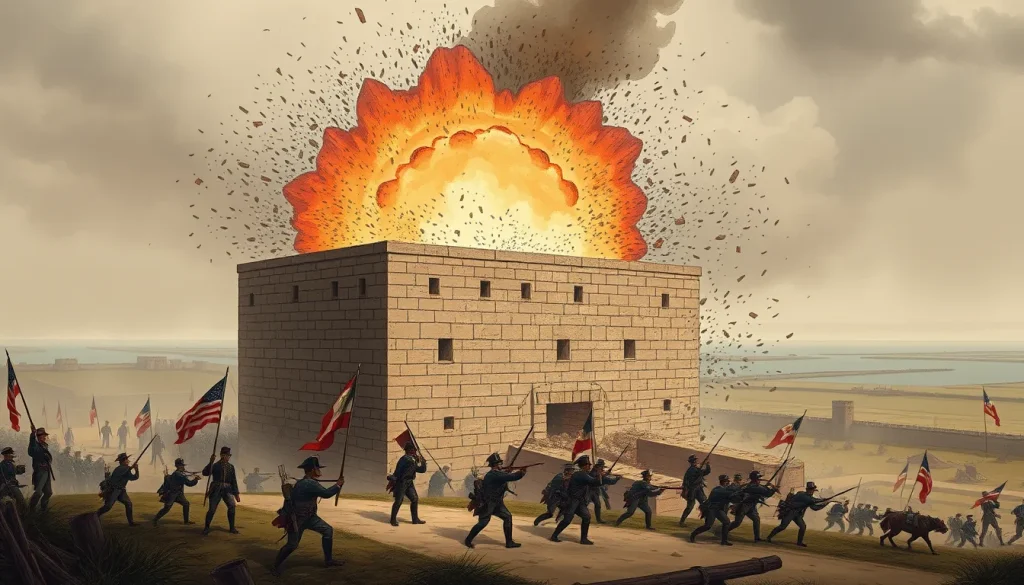
The explosion at Fort York on 27 April 1813 occurred during the Battle of York, when a large British magazine near the garrison at York, Upper Canada—modern Toronto—detonated as American forces advanced. The blast killed or wounded more than 250 Americans, mortally wounded Brigadier General Zebulon Pike, and shaped the American capture of the provincial capital. The central historical question is whether the explosion was an accident or a deliberate act; the evidence indicates that British commander Roger Hale Sheaffe ordered the magazine destroyed to keep its stores from capture, while the catastrophic casualties it inflicted on the American column were probably an unintended consequence rather than a pre-planned trap.
Historical Context
By early 1813, the War of 1812 had settled into a contest for the Great Lakes and the Canadian border. York was the capital of Upper Canada and a supply point for British forces on Lake Ontario, though its defences were modest compared with Kingston or Niagara. The town’s garrison included British regulars, Canadian militia, and a small naval establishment. American strategy that spring called for Commodore Isaac Chauncey’s squadron on Lake Ontario to support Major General Henry Dearborn’s army in attacks on York and then the Niagara peninsula. Control of York would disrupt Upper Canadian government, seize military stores, and perhaps draw British attention away from other fronts.
Fort York stood west of the town, near the mouth of Garrison Creek and Lake Ontario. Its defenses included earthworks, batteries, barracks, and a principal powder magazine. The magazine was central to the garrison’s ability to resist: it held black powder, fixed ammunition, shot, shell, and small-arms cartridges. British and Canadian authorities had improved the works after the declaration of war in June 1812, but construction records for the new magazine are fragmentary. This lack of documentary detail has helped keep alive competing explanations of what happened when it exploded.
What Happened
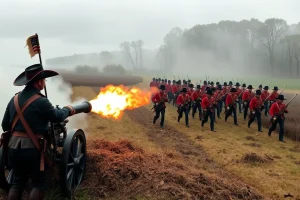
On 27 April 1813, American troops landed west of Fort York and advanced toward the garrison. The British commander, Major General Roger Hale Sheaffe, faced a much larger American force and chose to withdraw rather than risk encirclement. Before retreating, he ordered the grand magazine destroyed so that its extensive stores would not fall into American hands. The exact method and timing of the demolition remain uncertain. What is clear is that around 1 p.m., as an American column approached the area, the magazine detonated with enormous force.

The explosion threw stone, timber, clay, shot, shell, and iron fragments across the advancing Americans. Major Abraham Eustis, an American artillery officer, described the air as darkened with stones, rafters, and clay. Brigadier General Zebulon Pike was struck by a large stone and mortally wounded; he died soon afterward. Contemporary American accounts counted roughly 38 killed and 224 wounded by the blast, though casualty figures vary among reports and later histories. The blast was felt many kilometres away and temporarily stunned both sides. After the explosion, American forces completed their occupation of York, while Sheaffe’s command retreated. In the days that followed, American troops burned several public buildings, an act that intensified Upper Canadian resentment.
Why It Matters
The explosion turned an American victory into a costly and traumatic one. Pike’s death removed a capable American field commander, and the heavy casualties from the magazine blast briefly threatened to unravel the American advance. At the same time, the capture of York gave the United States a symbolic victory, disrupted Upper Canadian government, and yielded military stores—though much was destroyed in the explosion. For Britain and Upper Canada, the loss of York exposed the vulnerability of the provincial capital and contributed to debates over Sheaffe’s leadership and decision to retreat.
Historians have long disagreed about how to characterize the explosion. Some contemporary Americans suspected that the British had mined the ground or deliberately engineered the magazine to shred an attacking column. Later scholarship has found no proof of such a design. Most modern accounts treat the detonation as a deliberate demolition ordered to deny supplies, while the destruction of the American column was either an unintended result or a risk accepted without full knowledge of the magazine’s effects. The episode therefore illustrates a recurring problem in military history: a deliberate action can produce consequences that contemporaries experience as an accident or atrocity.
Definition
The subject is the detonation of the principal British magazine at Fort York during the Battle of York on 27 April 1813. In this context, sabotage is not a precise legal or military term; the explosion was an authorized demolition by the retreating British commander, not a secret act by an enemy agent. Accident is also imprecise. The ignition was probably intentional, but the mass casualties among the American column may not have been the primary purpose.
Background
Fort York’s magazine was a military necessity. Black powder had to be kept dry, secure, and away from accidental sparks, yet readily available for cannon and small arms. A powder magazine had existed at York since the 1790s, and after the War of 1812 began, British authorities built or improved a larger magazine near the garrison. The most detailed surviving description comes from Amasa Trowbridge, an American surgeon who treated wounded after the battle and later sent recollections to the historian Benson Lossing. Trowbridge described a substantial stone and masonry structure with a deeply buried lower magazine and an entrance from the lake side, surmounted by a stone building used for military and naval stores. He reported hundreds of barrels of powder and large quantities of fixed ammunition in the complex. Ordnance reports from March 1813, cited by historian Robert Malcomson, list more than 300 barrels of powder, thousands of round shot, shells, case shot, and tens of thousands of musket cartridges at York.
How It Worked
When Sheaffe ordered the magazine destroyed, the aim was to prevent its capture. British engineers or artillerymen would have needed to place combustible material or a powder trail to ignite the stored powder, then withdraw. The operation was dangerous and dependent on timing. If the demolition was delayed too long, the Americans might seize the magazine; if it was fired too soon, the British might fail to destroy the stores fully. The explosion’s lethal debris field was shaped by the building’s construction. Trowbridge’s description of a stone and masonry structure helps explain why the blast projected heavy fragments outward. American officers interpreted this as evidence of deliberate anti-personnel design, but no surviving plan or order proves that the magazine was built as a mine or that Sheaffe intended to kill the advancing column with it.
Competing Viewpoints
American accounts from 1813 often treated the explosion as a British trap. Major General Henry Dearborn, the American commander, believed the magazine had been arranged to discharge stones toward the attacking columns. Other officers thought the British had exploded a mine beneath the approach. These conclusions were shaped by the shock of the blast and by the heavy American losses. British and Canadian accounts, by contrast, describe the destruction as a necessary military measure to deny stores to the enemy. Modern historians generally side with the latter explanation while acknowledging uncertainty. Robert Malcomson concluded that there was no proof British engineers designed the magazine to destroy an enemy column. Christopher Hume described the explosion’s effect on the battle as accidental in the sense that Sheaffe likely did not anticipate its full human cost. The most defensible interpretation is that the detonation was deliberate, but its catastrophic impact on the American column was unintended or only partly anticipated.
Role in the War of 1812
The Battle of York was part of the American campaign on Lake Ontario in 1813. The explosion did not determine the war’s outcome, but it shaped the battle’s memory and the immediate course of the campaign. The American victory at York demonstrated the reach of Chauncey’s fleet and Dearborn’s army, but it also revealed the difficulties of occupying hostile territory. The burning of public buildings by American forces afterward became a grievance in Upper Canada and was later cited in discussions of retaliation, including the British burning of Washington in 1814. The loss of Pike deprived the American army of an experienced commander, while the destruction of stores at York weakened British logistical capacity on the lake. The explosion thus belongs to the wider pattern of destruction and retaliation that marked the war’s middle years.
Consequences and Historical Interpretation
In the short term, the explosion contributed to an American tactical victory that felt like a disaster. It killed and wounded hundreds, halted the advance temporarily, and made the capture of York more controversial. In the longer term, it fed Canadian memory of American invasion and helped make Fort York a site of commemoration. Historians continue to debate whether the explosion should be called an accident. Most distinguish between the decision to destroy the magazine, which was deliberate, and the consequences of the blast, which were not fully controlled. The absence of construction plans and the reliance on later recollections mean that some details will remain uncertain. What can be said with confidence is that the explosion was not an accidental ignition in the ordinary sense; it was a military demolition that became one of the most deadly episodes of the Battle of York.
Primary Sources
- Amasa Trowbridge Papers, Library of Congress: Trowbridge, an American surgeon, wrote a detailed description of the magazine in the mid-1850s for Benson Lossing. It is valuable for the structure and contents of the magazine, but it was written decades after the event and includes information likely gathered from local people.
- Abraham Eustis account: Eustis, an American artillery officer, provided a vivid contemporary description of the debris—stones, rafters, and clay—falling on the American column. His account is immediate but reflects an American participant’s perspective.
- Samuel Conner account: Conner, an aide to General Dearborn, described cartloads of stone, iron, shell, and shot. It contributes to understanding the physical effects of the blast but is not a neutral engineering report.
- Henry Dearborn’s official correspondence: Dearborn’s opinion that the magazine may have been designed to discharge stones toward American columns shows how American commanders interpreted the event. His view is a claim, not proof of British intent.
- Ordnance reports, March 1813: These reports list powder, shot, shell, and cartridges at York and are cited in modern accounts. They establish the scale of stores but do not describe the demolition decision.
- British command correspondence and later accounts: British reports and retrospectives indicate that Sheaffe ordered the magazine destroyed to prevent its capture. The exact wording and timing of the order are not fully preserved in easily accessible form; researchers should consult Library and Archives Canada and The National Archives (UK).
Further Reading
- Robert Malcomson, Capital in Flames: The American Attack on York, 1813 (McGill-Queen’s University Press, 2008).
- Robert Malcomson, Ka-Boom!!! The Explosion of the Grand Magazine, Friends of Fort York, 2008.
- Christopher Hume, Toronto’s Big Bang, Friends of Fort York, 2016.
- Carl Benn, Historic Fort York, 1793–1993 (Dundurn Press, 1993).
- Benson J. Lossing, Pictorial Field-Book of the War of 1812 (Harper & Brothers, 1868).
- Fort York National Historic Site, Toronto, Ontario.
References
- Malcomson, Robert. Ka-Boom!!! The Explosion of the Grand Magazine. Friends of Fort York, July 15, 2008. https://www.fortyorkfoundation.ca/newsletter/ka-boom-the-explosion-of-the-grand-magazine/
- Hume, Christopher. Toronto’s Big Bang. Friends of Fort York, December 13, 2016. https://friendsoffortyork.ca/newsletter/toronto-s-big-bang/
- Malcomson, Robert. Capital in Flames: The American Attack on York, 1813. Montreal: McGill-Queen’s University Press, 2008.
- Benn, Carl. Historic Fort York, 1793–1993. Toronto: Dundurn Press, 1993.
- Lossing, Benson J. Pictorial Field-Book of the War of 1812. New York: Harper & Brothers, 1868.
- Trowbridge, Amasa. Papers. Library of Congress, Washington, D.C.
FAQ
Was the Fort York explosion an accident?
The detonation itself was a deliberate British demolition ordered to prevent the magazine's capture. The heavy casualties among American troops were probably unintended or not fully anticipated, so historians usually describe the cause as deliberate but the human impact as an unintended consequence.
Did the British deliberately target Americans with the magazine?
There is no proof that the magazine was designed as a mine or anti-personnel device. American officers suspected a trap, but modern historians find no documentary evidence of such a plan. The British purpose was to deny stores to the enemy.
Who ordered the explosion at Fort York?
Major General Roger Hale Sheaffe, the British commander at York, ordered the destruction of the grand magazine as his forces retreated on 27 April 1813.


Leave a Reply