
Short Answer
On the night of 5-6 June 1813, during the Battle of Stoney Creek in Upper Canada, a British night attack overran the camp of two American brigades and captured both of their commanding officers: Brigadier General John Chandler and Brigadier General William H. Winder. Both men were taken prisoner, held in British custody, and eventually exchanged back to the United States, where each returned to duty. Their capture explains much about why roughly 700 British regulars were able to defeat an American force of more than 3,000 men and end the 1813 American advance along the Niagara Peninsula.
Historical Context
By the spring of 1813 the United States was attempting a second campaign to conquer Upper Canada along the Niagara frontier. On 27 May 1813 an American army under Major General Henry Dearborn captured Fort George at the mouth of the Niagara River, forcing the British commander, Brigadier General John Vincent, to abandon the fort and retreat westward with about 1,600 men to Burlington Heights, at the western end of Lake Ontario.
Vincent’s position was precarious. He had disbanded his militia contingents, and he depended on delay, reinforcements, and the British squadron on Lake Ontario under Commodore Sir James Lucas Yeo, which could threaten the American supply line along the Niagara River. The American pursuit was slow. Dearborn was elderly and ill, and the brigades pushed forward first under Winder and then under Chandler advanced cautiously, halting at Forty Mile Creek before moving toward Stoney Creek on 5 June. The strategic question was whether the Americans could reach and destroy the British base at Burlington Heights before Vincent was reinforced.
What Happened
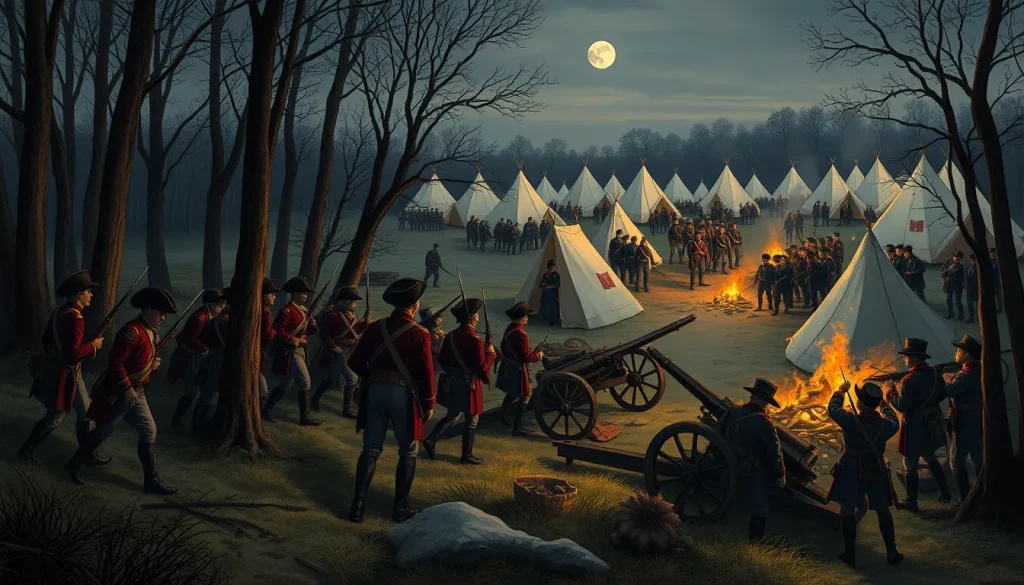
The combined American force, numbering about 3,400 men in one widely used estimate and about 3,500 in another, encamped on the evening of 5 June 1813 at Stoney Creek beside the road. The two generals established headquarters at the nearby Gage farm, and Chandler, as the senior officer, commanded the whole. The Americans were confident, having received intelligence about the British defences from Aaron Stevens, a former member of the British Indian Department.
Vincent sent his deputy assistant adjutant general, Lieutenant Colonel John Harvey, to reconnoitre the American camp. Harvey reported that the American guards were few and careless, that the line of encampment was long and broken, and that the artillery was poorly supported, a position that could be struck rapidly and hard. Vincent agreed to a night attack. A column of roughly 700 men drawn from the 1/8th (King’s) Regiment of Foot and the 49th Regiment of Foot, including about fourteen local Canadian volunteers, marched from Burlington Heights; Vincent accompanied it but placed Harvey in command.
The British advanced in darkness. Local tradition credits Billy Green, a nineteen-year-old resident of Stoney Creek, with supplying the American countersign of the day, obtained from his brother-in-law Isaac Corman, and with guiding the column through the woods toward the American position.
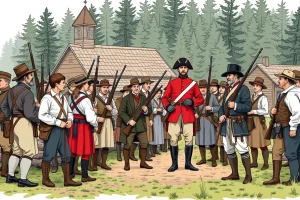
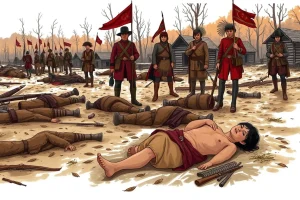
The attack began before dawn on 6 June. American pickets were overwhelmed, and the camp became a confused close-quarters fight in which friend and enemy were difficult to distinguish. Major Charles Plenderleath of the 49th Regiment ordered his men to seize the American field guns before they could be loaded and served. Hearing the fighting at the guns, Chandler ran forward to rally what he believed were his own soldiers and was taken at bayonet point; Winder was captured in similar circumstances. With both brigade commanders gone and the artillery lost, the surviving American officers could not restore order. Colonel James Burn of the 2nd Light Dragoons convened a council of officers and ordered a withdrawal.
Casualty returns differ between accounts and should be treated as approximate. British losses are usually given as about 23 killed and between 134 and 138 wounded, with a small number missing or captured. American losses are reported in one set of returns as roughly 17 killed, 38 wounded, and about 100 captured, while other accounts give about 55 killed or wounded with 100 missing.
The Americans fell back first to Forty Mile Creek, where they found their depot destroyed by Yeo’s squadron, and then to Fort George, harassed on the march by British and Indigenous scouts.
Why It Matters
The immediate consequence of the captures was the collapse of the American advance. A force that greatly outnumbered its attacker lost both of its forward brigade commanders in a single night, at the moment when the British column was itself disorganized and preparing to withdraw. The British retained Burlington Heights and with it their foothold at the head of Lake Ontario, and within two weeks the American position on the peninsula narrowed further after the Battle of Beaver Dams on 24 June 1813.
For the two men, capture was an interruption rather than the end of their careers. As was customary for officers of the period, they were held for exchange rather than long-term imprisonment, and both returned to American service. Winder was exchanged and in 1814 was placed in command of the Tenth Military District, which included Washington; he led the American force defeated at Bladensburg on 24 August 1814, was widely blamed, and was acquitted at court-martial. Chandler, a former member of the United States House of Representatives, later served as a United States Senator from Maine. Historians continue to debate how much the captures caused the British victory: some treat the seizure of the two generals and the guns as the decisive stroke, while others argue that the American force was already poorly posted, poorly supplied, and poorly led.
Definition and Scope
The American generals captured at Stoney Creek were Brigadier General John Chandler (1769-1841) and Brigadier General William Henry Winder (1775-1824). No other American general officer was taken in the engagement. The question therefore has two parts: how the two men came to be captured during the night attack of 5-6 June 1813, and what became of them afterwards. This article treats both, and distinguishes the capture itself, documented in British and American returns and in the reports of subordinate officers, from the details of the generals’ captivity and exchange, which are less fully recorded in the surviving sources.
Background
Winder, a Maryland lawyer with pre-war military experience, was appointed colonel of the 14th United States Infantry in 1812 and promoted to brigadier general in March 1813. Chandler, born in New Hampshire and settled in Maine, had served in Congress and held a militia commission before receiving his brigadier’s appointment in the regular army. Both commanded brigades in the force Dearborn sent up the Niagara Peninsula after the fall of Fort George. Winder’s brigade moved first and halted at Forty Mile Creek; Chandler’s brigade joined it, and because Chandler was senior he assumed command of the combined force, which then advanced to Stoney Creek.
How the Capture Occurred
The captures resulted from darkness, proximity, and the collapse of unit cohesion rather than from any deliberate plan to take prisoners. The British attacked a camp whose regiments were strung out along a road with artillery in the centre. Once the guns were in British hands, any American officer attempting to rally the defence had to approach men whose identity he could not confirm. Chandler’s move toward the artillery brought him within reach of the 49th Regiment’s bayonets, and Winder was taken under much the same circumstances. The loss of both brigadiers, together with the guns, removed the officers best placed to organize a counter-attack while the British column, its objective achieved, was preparing to withdraw.
Competing Viewpoints
Several points remain contested. First is the significance of the captures: most narrative accounts describe the seizure of Chandler and Winder as crippling the American command at the decisive moment, while others emphasize that American dispositions were poor, that only part of the force was engaged, and that the British simply exploited weaknesses that already existed. The post-battle report of the United States Assistant Adjutant-General, for example, claimed that only 1,328 Americans were engaged out of a much larger command. Second is the source of the American countersign: local tradition credits Billy Green, while an account published by Frederick Snider in 1877 attributes it to a ruse by Harvey on a sentry. Snider’s reminiscence is late, second-hand, and demonstrably confused about names, dates, and places; historians generally treat it as unreliable, and some accounts instead hold that Harvey obtained the passwords from a recently paroled prisoner. Third, casualty figures vary between British returns, American returns, and later compilations. Fourth, describing the battle as a turning point is an interpretation rather than a documented fact: the American campaign up the peninsula was already slow, and the decision to withdraw was made by officers on the field rather than by Dearborn.
Role in the War of 1812
The capture of the two generals effectively ended the American offensive in the Niagara Peninsula for 1813. Deprived of their senior commanders, the Americans abandoned their advance on Burlington Heights and withdrew to Fort George, where they remained largely confined for the rest of the campaign season. The engagement also advanced the reputation of Lieutenant Colonel John Harvey, who later served at Crysler’s Farm and Lundy’s Lane. The exchange of Chandler and Winder returned two experienced officers to the United States Army, though neither held a field command of comparable importance again until Winder’s appointment in the Washington region in 1814.
Consequences and Historical Interpretation
The most durable consequence of the battle was strategic: the Americans kept Fort George but could not extend their hold on the peninsula, and the Niagara frontier remained contested rather than conquered. Since the nineteenth century the engagement has been read in two ways, as an example of bold night tactics and local initiative, and as a case study in American command and supply failure; the capture of Chandler and Winder sits at the centre of both readings. In popular Canadian memory the battle is associated with Billy Green, sometimes called the Paul Revere of Canada, and with the Gage farm. The site is preserved as Battlefield House Museum and Park National Historic Site in present-day Hamilton, Ontario.
Primary Sources
The most useful contemporary documents for the capture are British: Lieutenant Colonel John Harvey’s reconnaissance report recommending the night attack, and Brigadier General John Vincent’s after-action report to the British commander-in-chief in Canada, Sir George Prevost. Both describe the raid from the attackers’ perspective and should be read as the accounts of the victorious side. On the American side, the post-battle report of the Assistant Adjutant-General to Dearborn’s headquarters gives the American account of the engagement and of the numbers involved; it was written by officers who had lost the field and who had an interest in explaining the defeat.
Neither Chandler nor Winder left a detailed published narrative of the capture itself, and surviving details come mainly from British reports, the letters and later testimony of subordinate officers, and nineteenth-century reminiscences. Two of those reminiscences are frequently cited but must be used with care: the account attributed to Billy Green, transmitted to his grandson, and the 1877 recollection of Frederick Snider, which conflicts with the documentary record on several points. Ernest Cruikshank’s Documentary History of the Campaign upon the Niagara Frontier gathers many contemporary documents, returns, and newspaper items relating to the campaign. Verified verbatim transcripts of the key reports should be consulted in that collection or in an institutional archive rather than reconstructed from memory.
Further Reading
- Ernest A. Cruikshank, ed., The Documentary History of the Campaign upon the Niagara Frontier, 1812-1814 (Welland, Ontario: Tribune Press, 1896-1908).
- Jason Ridler, Battle of Stoney Creek, The Canadian Encyclopedia.
- J. Mackay Hitsman, The Incredible War of 1812: A Military History (University of Toronto Press, 1965; revised edition 1999).
- Pierre Berton, The Invasion of Canada, 1812-1813 (McClelland & Stewart, 1980).
- Alan Taylor, The Civil War of 1812 (Alfred A. Knopf, 2010).
- George Sheppard, Plunder, Profit, and Paroles: A Social History of the War of 1812 in Upper Canada (McGill-Queen’s University Press, 1994).
- Battlefield House Museum and Park National Historic Site, Hamilton, Ontario.
- Biographical Directory of the United States Congress, entry for John Chandler.
References
- Wikipedia contributors, Battle of Stoney Creek, Wikipedia. https://en.wikipedia.org/wiki/Battle_of_Stoney_Creek
- Jason Ridler, Battle of Stoney Creek, The Canadian Encyclopedia. https://thecanadianencyclopedia.ca/en/article/battle-of-stoney-creek
- Ernest A. Cruikshank, ed., The Documentary History of the Campaign upon the Niagara Frontier, 1812-1814 (Welland, Ontario: Tribune Press, 1896-1908).
- J. Mackay Hitsman, The Incredible War of 1812: A Military History (Toronto: University of Toronto Press, 1965; revised edition 1999).
- Alan Taylor, The Civil War of 1812 (New York: Alfred A. Knopf, 2010).
- Pierre Berton, The Invasion of Canada, 1812-1813 (Toronto: McClelland & Stewart, 1980).
FAQ
Who were the American generals captured at Stoney Creek?
Brigadier General John Chandler and Brigadier General William H. Winder, both of the United States Army. Chandler commanded the combined American force of two brigades; Winder commanded one of those brigades. Both were taken on the night of 5-6 June 1813 when British troops seized the American artillery in their camp.
Did the captured generals escape, or were they exchanged?
They were held in British custody rather than escaping. As was customary for officers of the period, they were held for exchange, and both returned to American service. Winder later commanded the Tenth Military District and led the American force at Bladensburg on 24 August 1814; Chandler subsequently served as a United States Senator from Maine. Surviving sources do not record the exact dates of their exchanges in consistent detail.
Why were two American generals captured so easily?
Their camp was strung out along a road with weak, poorly placed pickets, and the British attacked at night after removing flints to reduce noise. Once British troops of the 49th Regiment seized the American field guns, officers trying to rally the defence approached men they could not identify in the darkness. Chandler and Winder were both taken at bayonet point near the guns.

Leave a Reply