
Short Answer
Lyncoya (c. 1812–1828), also spelled Lincoya or Lincoyer, was a Muscogee (Creek) child orphaned during the Battle of Tallushatchee on November 3, 1813, an engagement of the Creek War that formed part of the wider War of 1812 in the Old Southwest. American forces under John Coffee destroyed the Upper Creek town, and Lyncoya was among the survivors taken into the custody of Andrew Jackson, then a Tennessee militia commander. Raised in Jackson’s Hermitage household, he was educated, apprenticed to a Nashville saddler, and died of tuberculosis in 1828. His brief life is historically significant because it exposes the violence of the Creek War, the practice of taking Indigenous children into white households, and the later political use of Jackson’s adoption of him.
Historical Context
The Creek War of 1813–1814 grew out of longer tensions within the Creek Confederacy, U.S. territorial expansion into the Old Southwest, and the wider conflict between the United States and Britain. The Red Stick faction of the Upper Creeks resisted U.S. influence, land cessions, and the authority of leaders who accommodated American demands. Their opponents, often called friendly Creeks, allied with U.S. forces, as did Cherokee and Choctaw fighters. The War of 1812 intensified these divisions because British agents and Spanish authorities in Florida were suspected of encouraging Indigenous resistance to the United States.
After the Red Stick attack on Fort Mims in August 1813, Tennessee militia and U.S. regulars under Andrew Jackson campaigned against Creek towns in present-day Alabama. The Battle of Tallushatchee, fought by a force led by John Coffee, was one of the early engagements of that campaign. The wider War of 1812 also shaped the region through blockade, trade disruption, and U.S. fears of British intervention along the Gulf Coast. Jackson’s command became a central instrument of U.S. power in the region, and his household at the Hermitage in Tennessee became the destination for several Creek children taken during the fighting.
What Happened
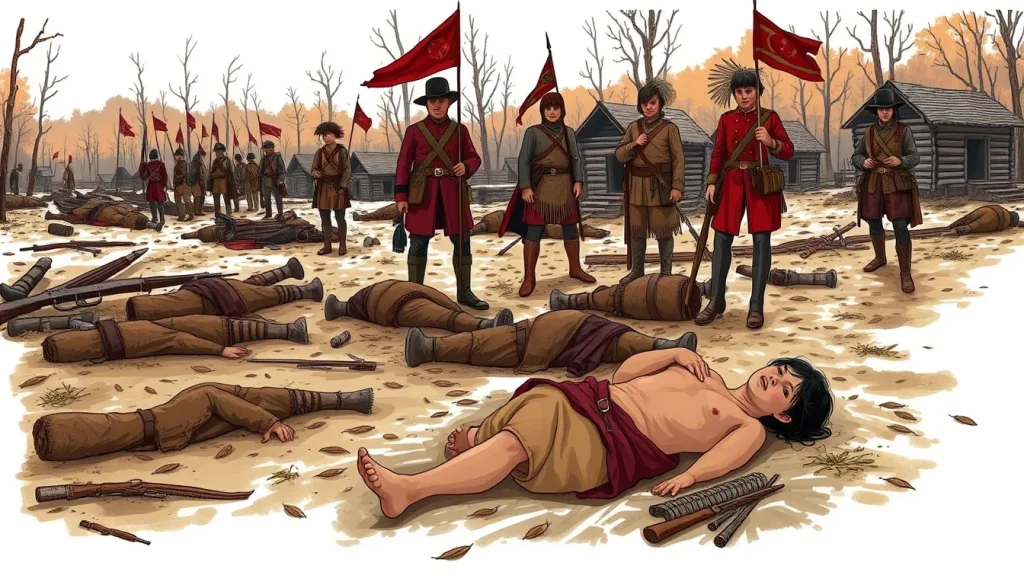
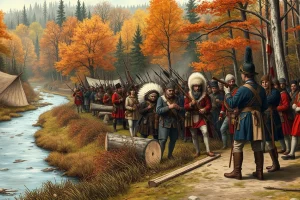
On November 3, 1813, a mounted force of Tennessee militia and allied Indigenous warriors under John Coffee attacked the Upper Creek town of Tallushatchee, also spelled Tullushatchee or Tallasseehatchee, in present-day eastern Alabama. The town was destroyed. Contemporary and later accounts differ in detail, but the U.S. National Park Service states that at least 186 Creek men were killed and more than 80 prisoners were taken, including women and children. Other studies emphasize that women and children were among the dead and that fires set during the assault burned people in their cabins.
After the battle, soldiers found an infant boy, reported to be about ten or twelve months old, alive near the body of his dead mother. The surviving women of the town, many of them wounded, were unable or unwilling to care for him. He was brought to Andrew Jackson, who wrote to his wife Rachel that he felt unusual sympathy for the child and compared the orphan’s situation to his own early loss of family. Jackson sent the boy to the Hermitage, where he was given the name Lyncoya. The name is not securely documented as a Muscogee name; some accounts associate it with a white caretaker, while later popular sources have claimed a Muscogee meaning without firm evidence.
Lyncoya was not the only Creek child sent to the Jackson household. Another child, Theodore, was taken from Littafuchee in October 1813 and died soon after arriving. A third, called Charley, was later presented to Jackson as a companion for his adopted son Andrew Jackson Jr. Lyncoya survived and became a dependent member of the household. The term adopted is commonly used, but his legal status remains unclear. Like other Indigenous children taken as captives or dependents, he may have been intended as a pett, a companion for a white child, though Jackson later referred to his wards in familial terms.
Lyncoya received some education in the Jackson household, and at one point Jackson considered sending him to the United States Military Academy at West Point. That plan did not materialize. He was instead apprenticed to a saddler in Nashville. In 1828 he contracted a respiratory illness and returned to the Hermitage, where he died of tuberculosis on July 1, 1828, at about sixteen years of age. He was buried in an unmarked grave near the Hermitage in Davidson County, Tennessee.
Why It Matters
Lyncoya’s life matters first because it records the human cost of the Creek War. He was orphaned by a U.S. military action, then absorbed into the household of the commander who ordered that campaign. His presence in the Hermitage complicates simple narratives of Andrew Jackson’s attitudes toward Indigenous peoples. Jackson’s sympathy for the child was noted by contemporaries and later biographers, but it existed alongside his prosecution of a brutal war and his later support for Indian removal.
Second, Lyncoya became a political symbol. As early as 1815, and certainly by the 1824 and 1828 presidential campaigns, Jackson’s allies pointed to the rescued Creek child as evidence that Jackson was not a mere killer of Indians. His obituary, published during the bitter 1828 contest between Jackson and John Quincy Adams, served as political messaging as much as remembrance. Nineteenth-century biographies presented Jackson as the hero of Lyncoya’s story, and the theme has reappeared in modern defenses of Jackson’s Indian policy.
Historians generally caution against reading Lyncoya’s adoption as a refutation of Jackson’s Indian removal policies. They distinguish personal charity or paternalism from the structural violence of dispossession. At the same time, Lyncoya was not merely a symbol; he was a child who lost his family, lived in a slaveholding household, received an education, was apprenticed, and died young. His story also belongs to Indigenous history, not only to Jackson’s biography, because it reflects the ways Creek children were separated from their communities during American expansion.
Early Life
Lyncoya was born around 1812 or 1813, probably in the Upper Creek town of Tallasseehatchee in present-day Alabama. His parents were Muscogee Creek people, and modern accounts often place his family within the Upper Creek grouping and possibly the Red Stick political faction. Because the surviving evidence comes almost entirely from American sources, little can be said with certainty about his Creek name, family, or early life before the battle. The name Lyncoya was given to him after he entered Jackson’s orbit, and its origin is disputed.
Role Before the War
Lyncoya had no documented public or military role before the War of 1812. He was an infant during the period when the United States declared war on Britain in June 1812 and when the Creek civil conflict escalated in 1813. His early life is known only through the circumstances of his survival at Tallushatchee; no reliable source describes his life in the town before the attack. This limitation is important because most surviving records were created by the American officers and households that took him in, not by his Creek family or community.
Role During the War
During the War of 1812 and the Creek War, Lyncoya was not a combatant. He was a young child orphaned in a military engagement and then made a dependent of Andrew Jackson’s household. His role was therefore involuntary and domestic rather than military. He was cared for at a distance by Rachel Jackson and others at the Hermitage, and surviving correspondence indicates that Jackson monitored his health and education. The practical work of caring for him was delegated to others, including an enslaved man named Charles according to later accounts. Lyncoya’s wartime experience represents the experience of noncombatant Indigenous children caught between American military campaigns and the households of American officers.
Major Actions
As a child, Lyncoya had no major military or political actions. The documented milestones of his life are survival at Tallushatchee, transportation to Tennessee, education in the Jackson household, a letter to Andrew Jackson dated December 29, 1823, and apprenticeship to a Nashville saddler. His intended appointment to West Point was discussed but never occurred. These events are significant less as individual achievements than as evidence of how he was incorporated into Jackson’s family and later remembered in political culture.
Contemporary Accounts
Contemporary accounts of Lyncoya come mainly from Andrew Jackson’s letters, the recollections of American officers, and newspaper notices. Jackson’s letters to Rachel Jackson in 1813–1814 mention the child and express sympathy for his plight. Richard Keith Call, who served under Jackson, later recalled the officers’ attention to the orphan in terms that emphasized Jackson’s softer feelings. A Nashville newspaper obituary in 1828 described Lyncoya as the son of a chief and used his death in the context of Jackson’s presidential campaign. These sources are valuable but limited: they are written by white Americans, often years after the events, and they tend to make Lyncoya’s story serve Jackson’s reputation rather than preserve Creek perspectives.
Later Life
After the Creek War, Lyncoya grew up at the Hermitage alongside other wards and enslaved people. He received some schooling, and Jackson at one time hoped he might attend West Point. Instead, he was apprenticed to a saddler in Nashville, a trade that would have offered him a modest place in Tennessee society. His health failed in 1828, and he returned to the Hermitage, where he died of tuberculosis on July 1, 1828. He was buried in an unmarked grave near the plantation. His death occurred during the presidential campaign that would make Andrew Jackson president, and his obituary became part of the political contest.
Historical Legacy
Lyncoya’s legacy is divided between family memory, political propaganda, and historical scholarship. For Jackson’s allies, he demonstrated the general’s compassion and provided a defense against accusations of Indian-hating. For later historians, he illustrates the contradictions of Jackson’s career: a man capable of personal tenderness toward an Indigenous child and of waging war against Indigenous nations and supporting their removal. The National Park Service and the Hermitage have included Lyncoya in public history, often emphasizing the uncertainty of his legal status and the absence of a known likeness. Modern scholarship places him within the broader history of Indigenous child captivity, assimilation, and the political uses of biography.
Primary Sources
Several identifiable source types are central to Lyncoya’s history. Andrew Jackson’s letters to Rachel Jackson from 1813–1814, published in The Papers of Andrew Jackson, document the child’s arrival and Jackson’s stated sympathy; they reflect Jackson’s perspective and paternalism. A letter from Lyncoya to Andrew Jackson dated December 29, 1823, is referenced in modern accounts and archival descriptions; no verified transcript is reproduced here, and readers should consult The Papers of Andrew Jackson or the holding repository for the text. The Nashville Republican obituary of 1828 provides a public, politically charged notice of his death and is limited by its campaign context. Richard Keith Call’s reminiscence, recorded later, offers an officer’s memory of the episode but is subject to the distortions of recollection.
Further Reading
- U.S. National Park Service, Lyncoya, https://www.nps.gov/people/lyncoya.htm.
- The Papers of Andrew Jackson, edited by Sam B. Smith, Harriet Chappell Owsley, and subsequent editors, University of Tennessee Press, ongoing.
- Robert V. Remini, Andrew Jackson and the Course of American Empire, 1767–1821, Harper & Row, 1977.
- Gregory A. Waselkov, A Conquering Spirit: Fort Mims and the Redstick War of 1813–1814, University of Alabama Press, 2006.
- Claudio Saunt, A New Order of Things: Property, Power, and the Transformation of the Creek Indians, 1733–1816, Cambridge University Press, 1999.
References
- U.S. National Park Service, Lyncoya, https://www.nps.gov/people/lyncoya.htm.
- Wikipedia, Lyncoya Jackson, https://en.wikipedia.org/wiki/Lyncoya_Jackson.
- The Papers of Andrew Jackson, edited by Sam B. Smith et al., University of Tennessee Press.
- Robert V. Remini, Andrew Jackson and the Course of American Empire, 1767–1821, Harper & Row, 1977.
- Gregory A. Waselkov, A Conquering Spirit: Fort Mims and the Redstick War of 1813–1814, University of Alabama Press, 2006.
FAQ
Who was Lyncoya?
Lyncoya was a Muscogee (Creek) child born around 1812–1813, orphaned at the Battle of Tallushatchee in 1813, and raised in Andrew Jackson's Hermitage household until his death from tuberculosis in 1828.
Was Lyncoya legally adopted by Andrew Jackson?
The term adopted is commonly used, but the legal status of Lyncoya in Jackson's household is unclear. He was a dependent ward and was educated and later apprenticed, but no firm evidence establishes a formal legal adoption.
How did Lyncoya die?
Lyncoya contracted a respiratory illness and died of tuberculosis at the Hermitage on July 1, 1828, at about sixteen years of age. He was buried in an unmarked grave near the plantation.
Why is Lyncoya significant to War of 1812 history?
His life connects the Creek War to the wider War of 1812, shows the experience of an Indigenous child orphaned by U.S. military action, and became a political symbol used to defend Andrew Jackson's reputation during and after his presidency.
Leave a Reply