
Short Answer
The British raids on Frenchtown and Havre de Grace in late April and early May 1813 brought the War of 1812 directly into the homes, businesses, and streets of Maryland’s upper Chesapeake Bay. For civilians, the raids meant sudden dawn attacks, Congreve rockets, naval bombardment, flight with little warning, plunder, burning, capture, and the loss of livelihoods. These events are historically significant because they show how a war often narrated through battles and diplomacy was experienced as terror, displacement, and material ruin by ordinary people, and because they helped harden American resentment against British operations in the Chesapeake.
Historical Context
By 1813, the United States and Britain had been at war for nearly a year. In the Chesapeake Bay, British strategy combined blockade, amphibious raids, and the destruction of American shipping, military stores, and supply networks. Rear Admiral George Cockburn, commanding a British squadron in the bay, pursued a campaign intended to disrupt commerce, tie down militia, and demonstrate that the United States could not protect its own coastline.
The upper Chesapeake was especially important. Frenchtown, near present-day Elkton, Maryland, sat on the Elk River and served as a transshipment point for flour, military supplies, and goods moving toward Baltimore and Philadelphia. Havre de Grace, at the mouth of the Susquehanna River, was a small market town with gun batteries at Concord Point and Potato Hill. Local defense depended on Maryland militia, often poorly equipped, thinly spread, and unprepared for a sudden seaborne assault. Civilians in these communities were therefore exposed to a form of warfare that could arrive from the water at any hour.
What Happened
On 29 April 1813, Cockburn’s forces attacked Frenchtown. A British landing party of about 150 Royal Marines brushed aside a six-gun battery and destroyed large quantities of flour, military supplies, and five small ships. Forays against nearby Elkton were repulsed by Forts Defiance and Hollingsworth, but Frenchtown’s commercial stores were lost. Civilians in and around the town faced the sudden destruction of property, the seizure or burning of goods, and the fear that further attacks would follow. Contemporary American accounts treated the raid as part of a broader pattern of British plunder in the bay.
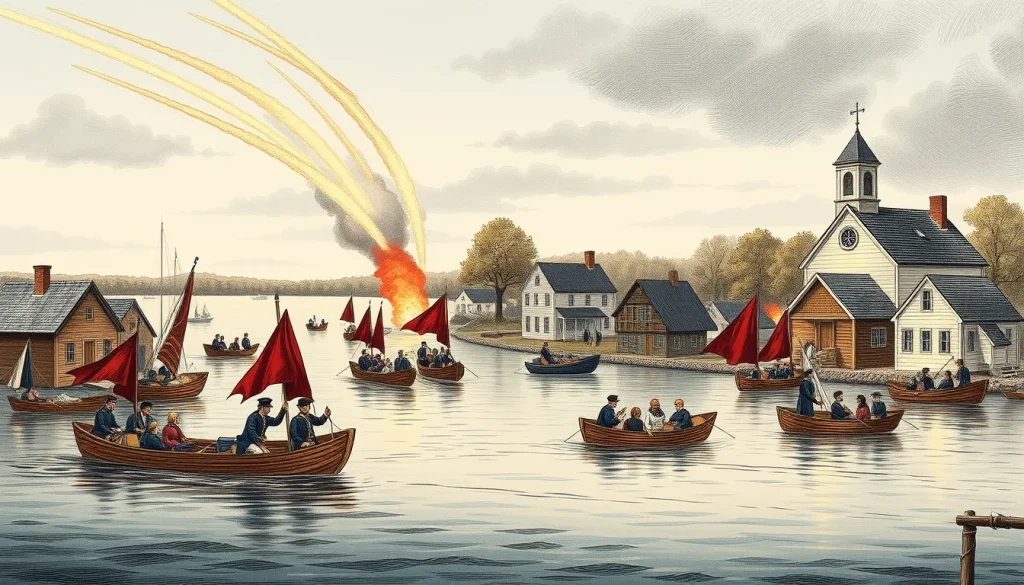
The more detailed civilian testimony comes from Havre de Grace. Cockburn’s fleet anchored off Turkey Point, separated from the town by shoal water. Before dawn on 3 May 1813, he sent a flotilla of sixteen to nineteen boats carrying Royal Marines and sailors under Commander John Lawrence across the shoals. The British used Congreve rockets, which produced terrifying whizzing and popping sounds, to create confusion. An eyewitness quoted in Niles’ Weekly Register described "distressed people, women and children half naked" running from their homes.
Most of the militia had left or fled when the attack began. Fewer than forty defenders remained at the Concord Point battery. Second Lieutenant John O’Neill reportedly manned another battery alone for a time before being wounded or forced back, then continued firing with a musket. He was eventually captured. British troops entered Havre de Grace, plundered houses, and burned a substantial portion of the town. Initial reports claimed that every building except one was destroyed, but later estimates indicated that roughly twenty to forty of about sixty dwellings were lost. The Episcopal church was spared from burning, though it was vandalized.
O’Neill was taken aboard Cockburn’s flagship, HMS Maidstone. According to local tradition and later accounts, his fifteen-year-old daughter Matilda helped secure his release by appealing to British authorities, and local magistrates also petitioned for him. Cockburn removed six cannons from the town and then sent forces to destroy the Principio Foundry, an important ironworks and cannon foundry. On 6 May, British raiders attacked Georgetown and Fredericktown on the Sassafras River, where warehouses, ships, and private homes were again destroyed. Although those raids lie outside the strict scope of Havre de Grace and Frenchtown, they show that the civilian experience of April and May 1813 was part of a sustained campaign.
Why It Matters
For civilians, the immediate effects were displacement, loss of homes and goods, physical danger, and lasting fear. Some families fled into the countryside; others lost everything they could not carry. The raids also produced a powerful memory of victimization. Cockburn became known in American newspapers and popular memory as the "Beast of Havre de Grace," and First Lady Dolley Madison described his attacks on civilians as a "savage stile of warfare." These reactions helped turn previously indifferent or uncertain residents against the British.
In the longer term, the raids formed part of the British Chesapeake campaign that established naval dominance in the bay and contributed to the planning of the 1814 operations against Washington and Baltimore. Historians disagree about how much the destruction was driven by military necessity and how much by a deliberate policy of intimidation. Some emphasize that the British targeted military supplies, ships, and batteries; others point to the burning of private dwellings and the terror caused by rockets as evidence of excessive force against civilians. The civilian experience is therefore central to interpreting the raids, not merely a backdrop to military events.
Definition
In this context, the civilian experience refers to how noncombatants encountered the British raids: the alarms and flight, the loss or destruction of property, the threat of capture, the disruption of households and businesses, and the ways those events were remembered. The discussion focuses on Frenchtown on 29 April 1813 and Havre de Grace on 3 May 1813, while noting that the same campaign touched other Chesapeake communities.
Background
Cockburn’s raids followed his occupation of Spesutie Island and his broader effort to disrupt the upper Chesapeake. Frenchtown was a supply hub; Havre de Grace was a river town with batteries that had fired on British vessels. The civilian population included merchants, craftsmen, farmers, women, children, and enslaved African Americans. Some residents had warning of British movements, but many did not. The militia system was designed for local defense, yet it could not stop a professional amphibious force landing at dawn. British officers viewed resistance as a justification for punitive action, while American authorities saw the destruction of private property as a violation of the laws of war.
How It Worked
From the civilian perspective, the raids followed a frightening pattern. British boats approached before daylight, often rowing across shallow water where larger ships could not go. Congreve rockets and naval gunfire created noise, smoke, and panic. Landing parties of Royal Marines and sailors then overwhelmed local batteries and moved into the town. At Frenchtown, the main destruction fell on commercial warehouses, flour supplies, and ships. At Havre de Grace, the violence moved into residential streets. Witnesses described houses robbed of valuables, items destroyed when they could not be carried away, and families fleeing with little clothing or belongings.
The British sometimes showed selective restraint. At Havre de Grace, the Episcopal church was not burned, though it was damaged. Prisoners such as John O’Neill could be released after appeals. But for civilians, these distinctions offered little comfort. The raids demonstrated that a community could be attacked, plundered, and partially burned within hours, with no reliable means of defense.
Competing Viewpoints
British official accounts, including Cockburn’s report in the London Gazette, presented the raids as legitimate military operations against American batteries, shipping, and military stores. They emphasized resistance by local forces and the destruction of warlike supplies. American newspaper accounts and later reminiscences stressed civilian suffering, describing "plunder without distinction" and "wanton barbarity among civilized people." These accounts were often partisan and sometimes exaggerated the scale of destruction, but they reflected genuine experiences of terror and loss.
Historians continue to weigh these perspectives. Some argue that the raids were strategically rational and aimed primarily at military targets. Others contend that the burning of private homes and the use of rockets against a town crossed a line into intimidation. The exact number of buildings burned at Havre de Grace remains uncertain, with initial claims of near-total destruction later revised downward. This uncertainty illustrates the broader problem of relying on eyewitness reports produced in the midst of war.
Role in the War of 1812
The Frenchtown and Havre de Grace raids were early episodes in Cockburn’s Chesapeake campaign. They disrupted American supply lines, destroyed shipping and military stores, and forced militia units to remain on alert across the bay. They also contributed to a climate of fear that affected civilian morale and American military planning. The intelligence and experience gained during these raids helped the British prepare for larger operations in 1814, including the burning of Washington. For civilians, the raids became a reference point for later British attacks and a symbol of the war’s reach into everyday life.
Consequences and Historical Interpretation
The immediate consequences included ruined businesses, burned homes, displaced families, and a deepened distrust of British intentions. In Havre de Grace, John O’Neill became a local hero; he later received a sword inscribed to the "Gallant O’Neill" and was appointed first keeper of Concord Point Lighthouse. A cannon memorial and other markers preserved his memory. The town’s experience also entered broader American memory through newspaper reports, an 1817 account by Jared Sparks in the North American Review, and a near-contemporary etching by William Charles titled Admiral Cockburn Burning and Plundering Havre de Grace.
Historians interpret the civilian experience in several ways. Some see it as an example of early nineteenth-century warfare that blurred the line between military and civilian targets. Others emphasize the limited and selective nature of the destruction, noting that not every building was burned and that some property was spared. Most agree that the raids had a powerful psychological effect and that the suffering of civilians was real, even where the documentary record is incomplete or partisan. The experience of Frenchtown is less well documented than that of Havre de Grace, which remains a limitation in reconstructing the full civilian story.
Primary Sources
Several contemporary sources illuminate the civilian experience. Niles’ Weekly Register of 15 May 1813 published John O’Neill’s account of his resistance and capture, including his statement that an English officer on horseback and marines took him with two muskets in his hand. The same newspaper on 22 May 1813 carried an eyewitness description of the Havre de Grace raid, including the claim that the enemy robbed every house of everything valuable that could be carried away and destroyed what could not be taken. These accounts are valuable but partisan and were published to stir outrage.
James Jones Wilmer, a resident of Havre de Grace, published Narrative Respecting the Conduct of the British from Their First Landing on Spesutia Island till Their Progress to Havre de Grace in 1813. It offers local detail but is explicitly a citizen’s protest against British conduct. Jared Sparks, later president of Harvard University, was tutoring in the area and wrote an account published in the North American Review in 1817; it is a retrospective source shaped by memory and later perspective. On the British side, Cockburn’s report appeared in the London Gazette on 6 July 1813 and presents the raid as a military success with minimal British losses. William Charles’s etching, now held by the Maryland Historical Society, is a near-contemporary visual source but functions as political satire and propaganda. No verified full transcript of every civilian testimony is available in the provided research context; researchers should consult archival holdings and published documentary editions for exact wording.
Further Reading
- National Park Service, Star-Spangled Banner National Historic Trail, "Attack on Havre de Grace."
- National Park Service, "The first step was plunder without distinction."
- Egon Hatfield, "War of 1812 bicentennial: Chesapeake Campaign," U.S. Army.
- Christopher T. George, Terror on the Chesapeake: The War of 1812 on the Bay (White Mane Books, 2000).
- Donald R. Hickey, The War of 1812: A Forgotten Conflict.
- Robert Malcomson, Historical Dictionary of the War of 1812 (Scarecrow Press, 2006).
References
- National Park Service, "Attack on Havre de Grace," Star-Spangled Banner National Historic Trail, https://www.nps.gov/stsp/learn/historyculture/attack-on-havre-de-grace.htm.
- National Park Service, "The first step was plunder without distinction," https://www.nps.gov/articles/plunder-without-distinction.htm.
- Egon Hatfield, "War of 1812 bicentennial: Chesapeake Campaign," U.S. Army, 20 May 2013, https://www.army.mil/article/103676/war_of_1812_bicentennial_chesapeake_campaign.
- Wikipedia, "Raid on Havre de Grace," https://en.wikipedia.org/wiki/Raid_on_Havre_de_Grace, citing Christopher T. George, Terror on the Chesapeake, and Robert Malcomson, Historical Dictionary of the War of 1812.
- The War of 1812, "Cockburn’s Chesapeake Raids of 1813," https://thewarof1812.org/battles/cockburns-chesapeake-raids-of-1813/.
- Niles’ Weekly Register, 15 May 1813 and 22 May 1813, as quoted in National Park Service materials.
- London Gazette, 6 July 1813, Cockburn’s report on the Havre de Grace raid.
- James Jones Wilmer, Narrative Respecting the Conduct of the British from Their First Landing on Spesutia Island till Their Progress to Havre de Grace (Baltimore: P. Mauro, 1813).
- Jared Sparks, "Conflagration of Havre de Grace," North American Review and Miscellaneous Journal, vol. 5, no. 14 (July 1817), 157-163.
FAQ
What happened to civilians during the British raid on Havre de Grace?
Civilians were awakened by Congreve rockets and naval gunfire at dawn on May 3, 1813. Many fled with little clothing or belongings. British landing parties plundered houses, destroyed goods they could not carry, and burned roughly twenty to forty of about sixty dwellings. Some residents were captured, including John O'Neill, who was later released after appeals.
Was Frenchtown attacked before Havre de Grace?
Yes. British forces under Rear Admiral George Cockburn attacked Frenchtown on April 29, 1813, destroying flour, military supplies, and five small ships. The raid on Havre de Grace followed on May 3, 1813.
How did British officials justify the raids?
Cockburn's official report in the London Gazette presented the raids as legitimate military operations against American batteries, shipping, and military stores. British authorities emphasized resistance by local forces and the destruction of warlike supplies, while American accounts stressed civilian suffering and property destruction.



Leave a Reply