
Short Answer
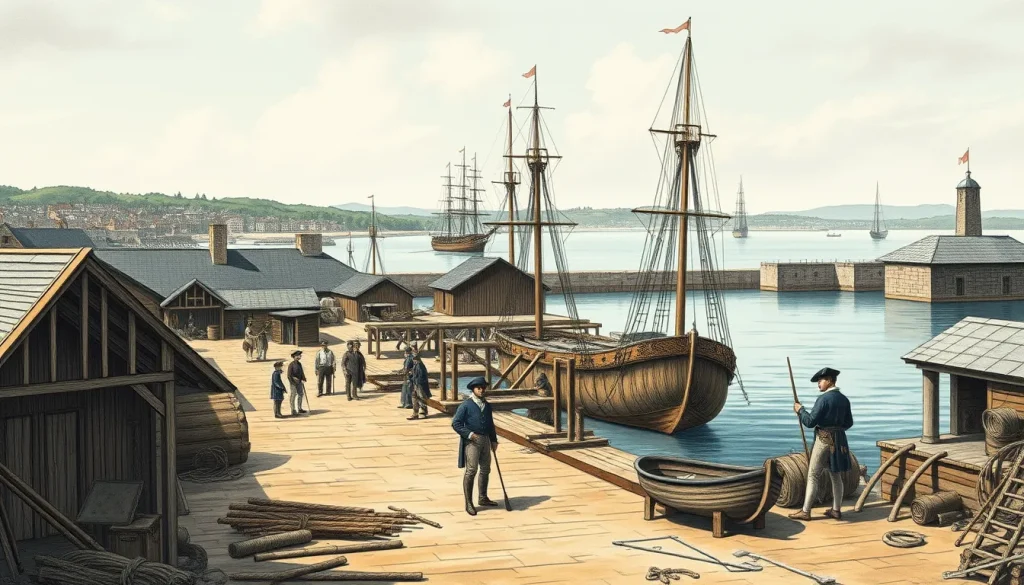
Halifax, Nova Scotia, served as the headquarters of the Royal Navy’s North American Station and as Britain’s principal naval dockyard on the western Atlantic during the War of 1812 (1812–1815). From its careening wharf, mast ponds, victualling yards and prisoner-of-war depot, the Royal Navy refitted, supplied and dispatched the squadron that blockaded the United States, escorted convoys and brought captured prizes into port. Because Britain was still fighting Napoleonic France for most of the war, Halifax was the logistical hinge that allowed a comparatively small North American squadron to remain effective thousands of miles from the home dockyards.
Historical Context
This article examines Halifax as a naval base and station headquarters rather than as a battlefield: no engagement was fought in or around the harbour during the war. The institution at the centre of the story is the Royal Naval Dockyard at Halifax, established in 1759 on the western shore of Halifax Harbour, north of Citadel Hill and outside the main town.
Halifax had been founded in 1749 as a fortified naval town, and its harbour was deep, largely ice-free and comparatively easy to defend. The dockyard was commissioned in 1759 and served as the main British naval base in North America during the Seven Years’ War and the American Revolution. After the Thirteen Colonies were lost, Halifax became the Royal Navy’s best-equipped yard in North America and a collecting point for masts and spars cut across British North America, which were gathered there and shipped to England in heavily escorted convoys.
Geography alone did not guarantee importance. In 1812 the Royal Navy was the largest navy in the world, with roughly 145,000 men and some 978 ships, but the great majority were committed against France in European waters. The North American Squadron, based at Halifax, was treated as a backwater; in 1812 it numbered about 27 vessels, including one ship-of-the-line, eight frigates and seven sloops, and many of its ships were undermanned or in poor condition. A separate squadron was based at Newfoundland. The United States Navy was far smaller, but its officers were professional, its crews experienced, and several of its frigates were newer and more heavily armed than the British vessels they met.
Nova Scotia’s own position was precarious. Its economy depended heavily on imported provisions from New England, and its coastal defences were either absent or, at Halifax itself, in a decrepit state. Few regular soldiers could be mustered, and memories of shore raids by privateers during the American Revolution made many outport residents anxious at the sight of an unfamiliar sail. Sir John Coape Sherbrooke, who became lieutenant-governor of Nova Scotia in 1811, and Vice-Admiral Sir Herbert Sawyer, commanding the North American Station, were left to organise the colony’s defence largely from local resources.
The war itself grew out of five years of deteriorating relations, driven chiefly by British impressment of sailors from American merchant vessels and by the Orders in Council restricting neutral trade with Napoleonic France. The United States declared war on 18 June 1812; news reached Halifax on 27 June aboard HMS Belvidera, a frigate that had escaped a pursuing American squadron. Britain’s own declaration followed later, after hopes of a negotiated settlement persisted into the autumn.
What Happened
Nova Scotian officials initially feared an American attack on Halifax, and reports from Washington suggested that a raid on the port featured in American planning. In practice the United States Navy was too small to mount a direct strike, but American privateers proved a persistent threat to shipping along the Atlantic coast, seizing British and colonial vessels and their cargoes. Halifax responded by commissioning colonial privateers, the best known of which was the Liverpool Packet, and by insisting that merchantmen sail in convoy.
Trade did not stop. New England merchants, hostile to the American embargo measures and eager for profit, continued selling provisions northward, and officials in Nova Scotia issued licences exempting such vessels from seizure. By the end of 1812 Halifax had become a bustling entrepôt exchanging American flour, peas and salted meat for British manufactures and Caribbean rum, sugar and molasses.
The strategic balance shifted during 1813 as Britain, still engaged in Europe but increasingly confident, sent additional ships to Halifax and extended a blockade of the American coast. Begun informally in 1812, the blockade was widened in February 1813 to cover the Delaware and Chesapeake Bays, in March to Savannah, Port Royal, Charleston and New York, and in November to the entire coast south of Narragansett Bay. Roughly twenty ships were on station in 1812; about 135 were committed by the end of the conflict.
The most celebrated event associated with Halifax was the single-ship action of 1 June 1813, when the Halifax-based HMS Shannon, commanded by Captain Philip Broke, challenged the newly refitted USS Chesapeake outside Boston Harbour. The American ship was commanded by Captain James Lawrence, who had only recently taken command. The action was extremely short and extremely bloody, lasting a matter of minutes before Chesapeake was boarded and taken; Lawrence was mortally wounded, and Broke was seriously hurt. Published casualty returns vary between accounts, but both crews suffered heavily in one of the deadliest single-ship actions of the war. On 6 June the Shannon brought her prize into Halifax Harbour, where the arrival was treated as a public event.
Halifax also functioned as a prison depot. American captives were held at Melville Island in the Northwest Arm; contemporary estimates and later museum accounts indicate that more than 8,000 Americans passed through Nova Scotian captivity between 1812 and 1815. Conditions were often cramped and unsanitary, and infectious disease killed a substantial number of prisoners, of whom nearly 200 were buried on nearby Deadman’s Island.
In 1814 the abdication of Napoleon in April freed British resources for North America. The blockade was extended to New England in May, and in September a force mounted from Halifax under Sherbrooke occupied Castine in Maine, holding it until the war ended. Customs revenue collected during that occupation, commonly known in Nova Scotia as the Castine fund, was later applied to public purposes in the colony. News of the Treaty of Ghent, signed in December 1814, reached the region in 1815 and military operations ceased. Halifax itself had never been attacked.
Why It Matters
In the short term, the base allowed Britain to keep an unbroken naval presence off the American coast at a time when reinforcements from Europe were scarce. It supported the blockade that cut American exports and customs revenue dramatically, provided a court and a port for the disposal of prizes, and supplied the machinery for handling prisoners. It also spared Nova Scotia the invasion and raiding that residents had feared.
In the longer term, Halifax’s wartime prominence did not last. In 1818 the station was reorganised so that Halifax became the squadron’s summer base while the Royal Naval Dockyard at Bermuda served for the remainder of the year — a shift that reflected Bermuda’s more central position for operations in the western Atlantic and Caribbean. The Halifax yard continued in Royal Navy hands until 1905 and was sold to Canada in 1907; the site is now part of CFB Halifax and was designated a National Historic Site of Canada in 1923.
Memory of the war in Nova Scotia has centred on the Shannon and Chesapeake, marked by bicentennial ceremonies at Halifax in June 2013, and on the prisoners buried on Deadman’s Island. Melville Island later housed Black Refugees who came to Nova Scotia after the war, giving the site a second and very different historical association.
Historians disagree about how decisive Halifax really was. Some, following the detailed administrative work of Julian Gwyn, treat the yard as indispensable to British operations in the region. Others, such as Rohit T. Aggarwala, emphasise the role of institutional inertia in Admiralty decisions and note that Halifax was the best-equipped British yard in America while nonetheless being the centre of naval activity only intermittently. The disagreement is less about whether Halifax mattered than about whether it was a strategic necessity or a convenient inherited asset.
Definition
In this context, a critical base means a permanent naval establishment with facilities that a squadron could not easily do without: a careening wharf and refitting yard for hull work, mast ponds and mast houses for spars, victualling and ordnance stores, a hospital, administrative offices for the station commander, and — at Halifax — a vice-admiralty court and a prisoner-of-war depot. This differs from a harbour that merely offered anchorage or water. Halifax was also a station headquarters, meaning that it was the seat of the officer commanding the Royal Navy’s North American Squadron and the point from which orders, convoys and dispatches were issued.
Background
The Royal Navy adopted permanent overseas dockyards only reluctantly. For much of the eighteenth century, ships stationed abroad returned to England every few years for major refits. Warm-water service, however, made frequent careening necessary because shipworm attacked hulls, and French and Spanish naval expansion after 1805 kept the fleet concentrated in European waters. Halifax was already an established yard when the War of 1812 began, having been built up during the Seven Years’ War and the American Revolution, and it had acquired a particular importance as a depot for masts and spars after the loss of American timber sources.
How It Worked
Operationally, Halifax performed several linked functions. It repaired and supplied the squadron, allowing ships to remain on station rather than return to Britain. It dispatched cruisers and escorted convoys along the Atlantic seaboard and to the Caribbean. It received prizes, which were adjudicated in the vice-admiralty court and then sold. It collected intelligence and forwarded dispatches between London, the Canadas and the fleet. It processed prisoners, mainly at Melville Island. And it coordinated with the army garrisons whose fortifications — including the Citadel, York Redoubt, Fort Charlotte on Georges Island and batteries at Point Pleasant — were designed in large part to protect the yard itself.
Competing Viewpoints
One interpretation holds that Halifax was the indispensable foundation of British naval power in the western Atlantic: without a dockyard, the blockade could not have been sustained and prizes could not have been processed. A second interpretation stresses that Halifax was one of several British and colonial ports — Newfoundland, Bermuda later, and various colonial harbours — and that the American navy was never strong enough to threaten it, so its importance should not be exaggerated into decisive strategic weight. A third line of argument, prominent in Canadian and Nova Scotian accounts, emphasises the base’s economic and social effects on the colony, including wartime prosperity from licensed trade with New England, while American accounts tend to treat Halifax chiefly as the home port of the blockading squadron and of the Shannon.
Role in the War of 1812
Halifax was the base from which the North American Squadron operated during all three phases of the maritime war: the period of American single-ship successes in 1812, the build-up and widening blockade of 1813, and the domination of the American seaboard in 1814 after reinforcements arrived from Europe. It was also the port that received the Chesapeake as a prize in June 1813, the depot that held thousands of American prisoners, and the staging point for the 1814 expedition that occupied Castine.
Consequences and Historical Interpretation
The base helped Britain avoid defeat at sea in the war’s first year and then to apply sustained commercial pressure on the United States. Its post-war decline was gradual but real: the shift toward Bermuda in 1818 reduced Halifax’s centrality, although the yard remained a Royal Navy establishment for nearly another century. Modern scholarship tends to treat Halifax less as a dramatic actor than as infrastructure — the unglamorous foundation on which blockade, convoy, prize-taking and prisoner management depended. Where historians differ is over how much of Britain’s success should be attributed to that infrastructure and how much to the sheer size of the Royal Navy and the eventual collapse of Napoleon’s empire.
Primary Sources
Several categories of contemporary material bear directly on Halifax’s wartime role. The correspondence of Lieutenant-Governor Sir John Coape Sherbrooke with the colonial secretary, preserved in the Colonial Office series for Nova Scotia (CO 217) at The National Archives in Kew, documents local defence preparations, the licensing of trade and relations with the Mi’kmaq. Admiralty correspondence from the North American Station (ADM 1 series) records the movements, condition and supply of the squadron.
Halifax newspapers, including the Royal Gazette and Nova Scotia Advertiser and the Acadian Recorder (founded in 1813), carried shipping notices, prize reports and accounts of the arrival of the Chesapeake. Captain Philip Broke’s official report of the action of 1 June 1813, written immediately afterwards, was widely reprinted; like all after-action reports it presents the author’s own account of the engagement and should be read alongside American statements. Vice-admiralty court records for Halifax document the legal processing of prizes.
These sources have clear limitations. Official dispatches were written to justify decisions and advance careers; newspapers depended on incomplete reports and local loyalties; prisoner records are fragmentary, and the number of deaths at Melville Island rests on partial returns and later commemoration rather than a single reliable register. Where figures conflict, this article reports the disagreement rather than choosing one number as definitive.
Further Reading
- Julian Gwyn, Ashore and Afloat: The British Navy and the Halifax Naval Yard before 1820 (Ottawa, 2004).
- Julian Gwyn, Frigates and Foremasts: The North American Squadron in Nova Scotia Waters, 1745–1815 (Vancouver, 2003).
- Rohit T. Aggarwala, “One such place in North America: New York, Boston, and Halifax as British Naval Bases, 1743–1783,” The Northern Mariner XXIII, no. 4 (October 2013).
- John R. Grodzinski, “Atlantic Campaign of the War of 1812,” The Canadian Encyclopedia.
- Royal Nova Scotia Historical Society, Virtual Plaque Series: The War of 1812 in Nova Scotia.
- Nova Scotia Museum and Maritime Museum of the Atlantic, resources on Nova Scotia and the War of 1812.
- Dictionary of Canadian Biography, entry for Sir John Coape Sherbrooke.
- Parks Canada, Halifax Citadel National Historic Site and Halifax Dockyard National Historic Site.
References
- Nova Scotia Museum, “How did the military and navy based in Nova Scotia participate in the War of 1812?” https://hmhps.ca/pdf/How-did-the-military-and-navy-based-in-Nova-Scotia-participate-in-the-War-of-1812.pdf
- Royal Nova Scotia Historical Society, “The War of 1812 in Nova Scotia,” Virtual Plaque Series. https://www.rnshs.ca/wp-content/uploads/2013/08/War1812.pdf
- John R. Grodzinski, “Atlantic Campaign of the War of 1812,” The Canadian Encyclopedia. https://thecanadianencyclopedia.ca/en/article/atlantic-campaign-of-the-war-of-1812
- “Royal Naval Dockyard, Halifax,” Wikipedia. https://en.wikipedia.org/wiki/Royal_Naval_Dockyard,_Halifax
- Rohit T. Aggarwala, “One such place in North America: New York, Boston, and Halifax as British Naval Bases, 1743–1783,” The Northern Mariner XXIII, no. 4 (October 2013). https://www.cnrs-scrn.org/northern_mariner/vol23/tnm_23_339-365.pdf
- Julian Gwyn, Ashore and Afloat: The British Navy and the Halifax Naval Yard before 1820 (Ottawa, 2004).
- Julian Gwyn, Frigates and Foremasts: The North American Squadron in Nova Scotia Waters, 1745–1815 (Vancouver, 2003).
- Dictionary of Canadian Biography, “Sherbrooke, Sir John Coape.” http://www.biographi.ca/en/bio.php?id_nbr=3132
FAQ
Why was Halifax so important to the Royal Navy in the War of 1812?
It was the North American Station's headquarters and the only well-equipped British dockyard on the western Atlantic, so it could refit, victual and repair ships, process prizes, escort convoys and hold prisoners without sending vessels back to Britain. That infrastructure sustained the blockade of the United States while most of the Royal Navy remained committed against Napoleonic France.
Was Halifax ever attacked during the War of 1812?
No. American officials reportedly considered a raid on Halifax, and Nova Scotian authorities feared one, but the United States Navy was too small to mount a direct strike. The main threats Nova Scotia faced were from American privateers attacking shipping along the coast.
What happened to Halifax's naval base after the War of 1812?
Its centrality declined. In 1818 the station was reorganised so that Halifax became the squadron's summer base while the Royal Naval Dockyard at Bermuda served the remainder of the year. The Halifax yard remained in Royal Navy hands until 1905 and was sold to Canada in 1907.


Leave a Reply