
Short Answer
During the War of 1812, British soldiers serving in North America carried a standardised set of weapons and personal equipment that defined their battlefield role. This equipment, centred on the India Pattern flintlock musket—commonly known as the Brown Bess—along with a bayonet, cartridge box, and various accoutrements, was a product of British military regulations and experience from the Napoleonic Wars. Understanding this equipment is essential to understanding how British forces fought, their tactical doctrine, and why they fared as they did against American and Canadian forces.
Historical Context
The British Army in North America during the War of 1812 was a veteran force, though the conflict was a secondary front compared to the ongoing Napoleonic Wars in Europe. Britain maintained garrisons in Canada, where regular infantry regiments were stationed alongside provincial units and Canadian militia. Supply lines stretched across the Atlantic, and the army relied on a well-established system of equipment issue that had been refined through years of warfare. However, the vast distances and limited infrastructure in North America sometimes led to shortages and local improvisation. Canadian militia units, in particular, often lacked the standardised equipment of the regulars and were armed with whatever was available, ranging from older muskets to captured arms.
What Happened
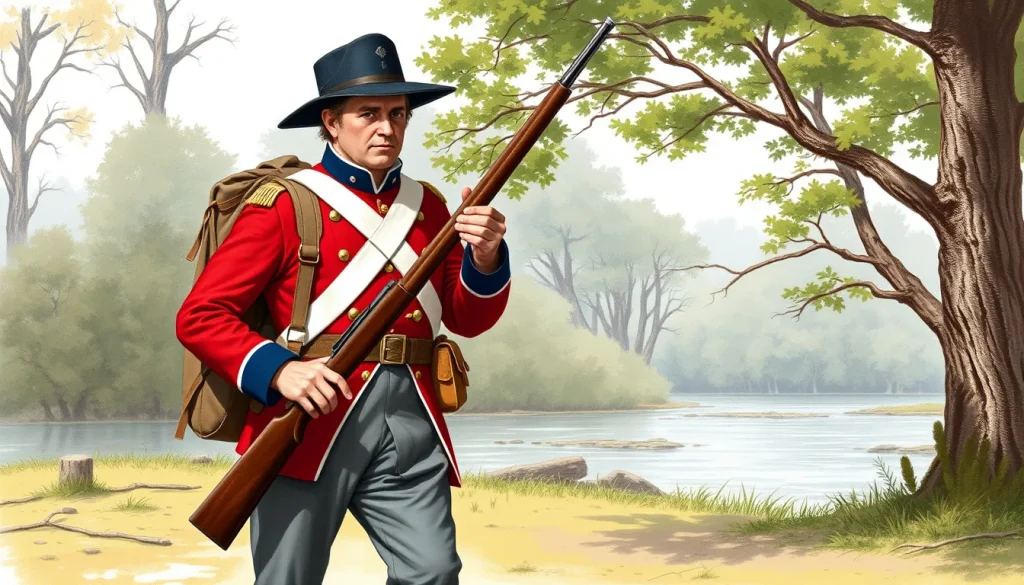
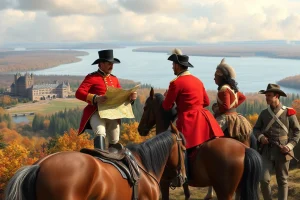
A typical British infantryman of the 41st or 49th Regiment carried the India Pattern musket, a .75-calibre smoothbore flintlock that weighed approximately ten pounds (4.5 kilograms). The musket was capable of firing a round lead ball using a paper cartridge containing 125 grains of powder. Soldiers were issued sixty rounds in a black leather cartridge box worn on a cross belt over the right shoulder. The box also held spare flints and tools for maintaining the musket. A bayonet with a seventeen-inch triangular blade was attached to the muzzle when needed for close combat. In addition to weapons, soldiers carried a knapsack containing a blanket, spare linen shirts, socks, and a mess tin; a haversack for food; a canteen; and a set of personal items such as a razor, soap, and a comb. The standard uniform was a red woolen coat with facings identifying the regiment, grey trousers, and a shako cap. Officers carried swords and often pistols, while light infantry and rifle units were issued the rifled Baker rifle, which was more accurate but slower to load.
Why It Matters
The equipment carried by British soldiers shaped battlefield tactics and outcomes. The smoothbore musket was inaccurate beyond about 75 yards, so British infantry relied on massed volleys fired in disciplined formations followed by bayonet charges. This tactic proved effective in battles such as Queenston Heights and Chippewa, where British regulars stood firm against American attacks. However, the slower-firing American riflemen could outshoot the British in skirmish warfare, leading to British reliance on cavalry and Native allies to counter such threats. The reliability of the Brown Bess and the soldiers’ training contributed to British defensive successes, but supply shortages often meant that not all units were fully equipped, particularly Canadian militia. Later historians have debated whether the musket’s inaccuracy was a limiting factor, but most agree that the soldier’s training and the sheer volume of fire made it a formidable weapon in its era.
Definition
Equipment carried by British soldiers in the War of 1812 comprised the weapon, ammunition, accoutrements, clothing, and personal necessities allocated to a soldier by the British Army. This included the musket, bayonet, cartridge box, knapsack, haversack, canteen, and the various items worn or carried on the body or in a pack.
Background
The British Army of 1812 was the product of long wars with Revolutionary and Napoleonic France. Regiments had been in active service for years, and soldiers were drilled in rapid loading and firing techniques. The standard infantry weapon was the India Pattern musket, a cheaper variant of the Brown Bess that was produced for the East India Company and later adopted widely. British armies in Canada also included rifle units, such as the 95th Rifles, who carried the Baker rifle, a shorter rifled weapon with a similar calibre but greater accuracy. Canadian militia, on the other hand, were part-time soldiers who often supplied their own equipment or were issued what was available from government stores.
How It Worked
The India Pattern musket was a flintlock muzzleloader. To fire, a soldier bit the end off a paper cartridge, poured some powder into the flash pan, rammed the rest down the barrel with the ball, and then fired. Practice allowed up to three rounds per minute. The cartridge box, worn on a belt, held the sixty issued rounds, typically in a tin or wooden insert to keep them dry. Spare flints and a screwdriver were also stored there. The bayonet could be fixed to the musket for close combat, allowing the infantry to repel cavalry and engage in charges. The knapsack, usually made of painted canvas, contained a blanket, spare clothing, and a mess tin. Foraging at night, soldiers also carried a haversack of food and a canteen, usually made of wood or tin. The red coat, though conspicuous, was a source of morale and identity, while gaiters protected the lower legs.
Competing Viewpoints
Historians differ in their assessments of British equipment. Some argue that the Brown Bess was an effective weapon, citing its stopping power and the soldiers’ ability to fire quickly enough to create dense volleys. Others emphasize its inaccuracy and the advantage held by American riflemen at longer ranges. There is also debate about the effectiveness of the British cartridge box, which could be cumbersome, and whether sufficient ammunition was always available. More recently, scholars have pointed out that equipment was only part of the equation; training and morale often proved decisive, as seen in British victories against numerically superior American forces.
Role in the War of 1812
British equipment played a critical role in key engagements. At the Battle of Queenston Heights in October 1812, British regulars and Canadian militia repelled an American invasion of Canada, with the musket-volley and bayonet charge proving decisive. At the Battle of Chippewa in July 1814, American regulars, also armed with muskets, gave the British a close fight, but British discipline eventually carried the field. In the defense of Fort Erie and Lundy’s Lane, British infantry used their firepower and bayonets to hold positions despite heavy casualties. The Baker rifle proved its worth in skirmish actions, allowing riflemen to harass American columns from the woods. Canadian militia, often armed with older muskets or whatever was available, fought alongside the regulars and contributed to victories on the Niagara and Detroit frontiers.
Consequences and Historical Interpretation
The equipment carried by British soldiers influenced the war’s outcome. British reliance on muskets and bayonets meant they could not match American riflemen in long-range skirmishing, but they excelled in open-field battles. The war also exposed weaknesses in British logistics, as some units faced shortages of ammunition and clothing, particularly during the harsh Canadian winters. Later historians have viewed the British soldier’s equipment as representative of Napoleonic-era warfare, emphasizing discipline and mass firepower over individual marksmanship. The conflict accelerated military reforms, such as the eventual adoption of rifle-equipped light infantry, that would shape future British armies.
Primary Sources
Contemporary returns and inspection reports provide detail on British equipment. The Upper Canada Militia returns, such as those from the 1st Glengarry and 1st Stormont regiments, list muskets, bayonets, cartouche boxes, and belts, often noting their condition. These documents are held at Library and Archives Canada and reflect the challenges of equipping provincial forces. British War Office records, including ordnance inventories and clothing lists, offer a more complete picture of regular army equipment. Published memoirs, such as the journals of British officers like John Le Couteur, describe the physical experience of carrying and using the musket. These sources confirm the standard issue items but also reveal variations caused by supply disruptions.
Further Reading
- Chartrand, René. British Forces in North America 1793–1815. Osprey Publishing, 1998.
- Hickey, Donald R. The War of 1812: A Forgotten Conflict. University of Illinois Press, 1989.
- American Battlefield Trust. “Equipment in the War of 1812.” Last modified July 9, 2024. https://www.battlefields.org/learn/articles/equipment-war-1812.
- Newfield, Gareth. “Arms and Accoutrements of the Upper Canada Militia During the War of 1812.” Accessed 2025. https://www.warof1812.ca/ucmilitiaarms.htm.
References
- American Battlefield Trust, “Equipment in the War of 1812,” https://www.battlefields.org/learn/articles/equipment-war-1812.
- Osprey Publishing, “Soldiers of the War of 1812,” https://www.ospreypublishing.com/ca/osprey-blog/2015/soldiers-of-the-war-of-1812/.
- Gareth Newfield, “Arms and Accoutrements of the Upper Canada Militia During the War of 1812,” https://www.warof1812.ca/ucmilitiaarms.htm.
- Canada’s History, “Brown Bess Musket in the War of 1812,” https://ch-stage.reasononeinc.com/explore/military-war/brown-bess-musket-in-the-war-of-1812.
FAQ
What rifle did British soldiers carry in the War of 1812?
Most British regular infantry carried the India Pattern flintlock musket, commonly called the Brown Bess. Rifle units, such as the 95th Rifles, used the Baker rifle, which was more accurate but slower to load.
How much ammunition did a British soldier carry?
A soldier typically carried 60 paper cartridges in a cartridge box, each containing gunpowder and a lead ball. In combat, he could also access regimental ammunition reserves.
Did Canadian militia have the same equipment as British regulars?
No. Canadian militia were often equipped with whatever arms were available, including older muskets or captured weapons, and sometimes lacked full accoutrements. Government issues varied widely by region.
Leave a Reply