
Short Answer
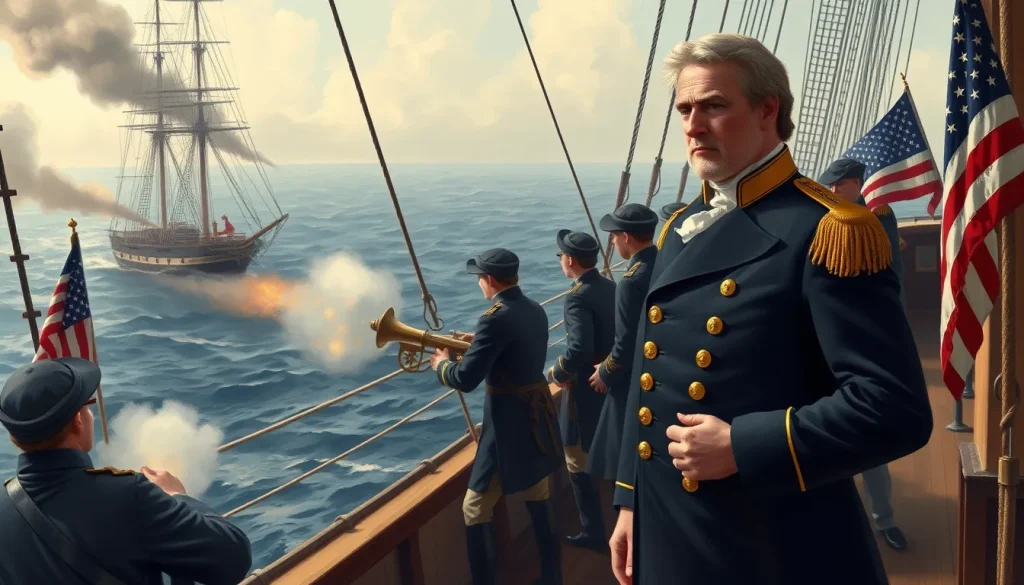
William Bainbridge (May 7, 1774 – July 27, 1833) was a senior officer in the early United States Navy whose career spanned the Quasi-War, the Barbary Wars, and the War of 1812. He is best remembered for commanding the frigate USS Constitution during her victorious engagement with HMS Java in December 1812, a battle that helped secure American naval prestige during the conflict with Britain. Bainbridge’s long service also included command of the Charlestown Navy Yard and membership on the Board of Naval Commissioners.
Historical Context
The United States Navy was formally established in 1794 and expanded in 1798 amid rising tensions with France. During the 1790s and early 1800s, American merchant shipping faced threats from both European powers and North African Barbary states. The United States paid tributes to Algiers, Tunis, and Tripoli, but when the Pasha of Tripoli declared war in 1801, President Jefferson sent naval squadrons to the Mediterranean. The First Barbary War (1801–1805) tested the new navy and produced a cohort of experienced officers. By 1812, the U.S. Navy was still tiny compared to the Royal Navy, but its frigates were heavily built and carried long guns, giving them a tactical advantage in single-ship duels. The War of 1812 began with American invasions of Canada and a naval campaign that produced several celebrated frigate victories. William Bainbridge belonged to that generation of officers who shaped American naval identity during its formative decades.
What Happened
Bainbridge was born in Princeton, New Jersey, the son of a Loyalist physician. He went to sea at age fifteen and earned a master’s berth by 1793. In 1798 he accepted a lieutenant’s commission in the new U.S. Navy. During the Quasi-War with France, he commanded the schooner USS Retaliation and was forced to surrender to two French frigates—the first U.S. Navy vessel to be captured. He subsequently commanded the brig Norfolk and captured several French privateers.
In 1800, commanding USS George Washington, Bainbridge delivered tribute to the Dey of Algiers, who forced him to carry an ambassador to Constantinople under the Algerian flag—a humiliating episode that emphasized the vulnerability of American shipping. In 1803, Bainbridge took command of the frigate USS Philadelphia and while chasing a Tripolitan vessel grounded the ship on an uncharted reef in Tripoli harbor. Unable to refloat her, he surrendered; he and his crew remained prisoners until June 1805. Although a court-martial cleared him of fault, the incident darkened his reputation.
After his release, Bainbridge returned to merchant service, but in 1812, with war against Britain imminent, he rejoined the navy. In September 1812, he succeeded Isaac Hull as commander of USS Constitution. He sailed for the South Atlantic in October. On December 29, 1812, off Brazil, Constitution encountered the British frigate HMS Java. The two ships engaged in a fierce duel. Bainbridge was wounded twice, but Constitution’s heavier guns and superior hull strength prevailed. After two and a half hours, Java was a wreck; the British struck her colors. Because Java was too damaged to salvage, Bainbridge ordered her scuttled. This victory made Bainbridge a national hero and further established the combat reputation of the American frigate navy.
In 1813, Bainbridge returned to Boston and resumed command of the Charlestown Navy Yard, where he oversaw construction of the ship-of-the-line USS Independence. After the war, he served in the Mediterranean during the Second Barbary War (1815), though Stephen Decatur’s squadron had already subdued Algiers by the time Bainbridge arrived. He later served as a naval commissioner and as commandant of the Boston and Philadelphia navy yards. He died in Philadelphia in 1833.
Why It Matters
Bainbridge’s victory over Java was a major propaganda coup for the United States. It occurred at a time when American land forces were struggling, and it proved that the U.S. Navy could defeat Royal Navy frigates in single-ship actions. The battle also helped convince Britain to treat American prisoners of war more cautiously and to avoid underestimating American warships. Bainbridge’s earlier misfortunes—the Retaliation and Philadelphia captures—were offset by his later successes, demonstrating the value of experience and leadership in the young navy. Historians today view Bainbridge as a competent but sometimes unlucky officer whose persistence and seamanship contributed to the establishment of American naval tradition. His administrative work at the Charlestown Navy Yard also laid a foundation for the rapid naval expansion of later decades.
Early Life
William Bainbridge was born in Princeton, New Jersey, the eldest child of Dr. Absalom Bainbridge and Mary Taylor. His father, a Loyalist, served as a surgeon in the British army and left for England in 1783, leaving William to be raised by his maternal grandfather. At age fifteen, Bainbridge began serving on merchant vessels in the Delaware River, where he learned practical seamanship. By 1792 he was serving aboard the merchant ship Cantor. In 1796, while commanding the Hope, he suppressed a mutiny on a nearby ship and was soon promoted to master. This early experience gave him the confidence and navigational skills that distinguished his later naval career.
Role Before the War
Before the War of 1812, Bainbridge gained a mixed reputation. In 1798, he was appointed lieutenant and given command of USS Retaliation; his capture by French frigates in November 1798 was an inauspicious start. Nevertheless, he later commanded USS Norfolk and captured French privateers. In 1800, as commander of USS George Washington, he was forced to sail to Constantinople under the Algerian flag, a humiliation that underscored the need to end the Barbary tribute system. In 1803, his command of USS Philadelphia ended in grounding and capture; he and his crew were imprisoned for nineteen months. A court-martial exonerated him, but the loss haunted his public image. From 1808 to 1812 he served in the merchant marine, but he kept in touch with naval affairs and was ready to return when war loomed.
Role During the War
At the outbreak of the War of 1812, Bainbridge was assigned to the Charlestown Navy Yard in Boston, where he directed critical repairs and improvements. In September 1812, he took command of USS Constitution, succeeding Captain Isaac Hull. Sailing south, he captured the British ship HMS Java on December 29, 1812, in a hard-fought battle off Brazil. Despite being wounded twice, he remained in command, and his ship’s overwhelming firepower sealed the victory. After returning to Boston in February 1813, he again commanded the Charlestown Navy Yard and oversaw construction of the ship-of-the-line Independence. His leadership ensured the yard became an effective repair and construction facility, critical to American naval operations.
Major Actions
Bainbridge’s most significant military action was the capture of HMS Java (December 29, 1812). In that battle, Constitution outgunned the British 38-gun frigate; the Java was reduced to a wreck and scuttled. He also commanded the frigate President during a failed cruise in 1812, but he did not encounter enemy warships. Earlier, his capture of French privateers during the Quasi-War and his participation in the First Barbary War—particularly the grounding of Philadelphia—defined his career. In 1815, he commanded a squadron in the Mediterranean during the Second Barbary War, but the decisive actions had already occurred.
Contemporary Accounts
Bainbridge’s own official report of the Java engagement, addressed to Secretary of the Navy Paul Hamilton, was widely published in American newspapers. He described the battle and the condition of his ship, writing that Constitution was “a perfect wreck” of her opponent. British accounts, including the court-martial of Java’s surviving officers, conceded the American ship’s superior firepower. Midshipman Samuel Leech, who served on Java, later wrote a memoir describing the terror of the fight. These sources provide vivid details of the battle and the contrasting interpretations of the outcome.
Later Life
After the War of 1812, Bainbridge remained in the navy. In 1815, he sailed to the Mediterranean in command of a squadron, though Stephen Decatur had already forced the Dey of Algiers to yield. Bainbridge then served as commandant of the Charlestown Navy Yard (1813–1815, 1818–1820) and later as a member of the Board of Naval Commissioners from 1825 to 1828. He spent his final years as commandant of the Philadelphia Navy Yard. He died on July 27, 1833, in Philadelphia and was buried at Christ Church Burial Ground. His service was honored by the naming of several U.S. Navy ships.
Historical Legacy
Bainbridge is remembered as one of the original commodores of the U.S. Navy. His victory over Java helped boost American morale during a trying year. Historians note that his career exemplified both the risks and rewards of the early navy—his capture of Philadelphia was a costly mistake, but his later success demonstrated resilience. Bainbridge also contributed to the institutional development of the navy through his work at the Charlestown Navy Yard and as a naval commissioner. He is a central figure in any study of the naval side of the War of 1812.
Primary Sources
The most important primary source for Bainbridge’s wartime command is his official report of the Java action to Secretary of the Navy Paul Hamilton (January 3, 1813). This document, preserved in the National Archives, details the engagement and the condition of Constitution. British sources include the court-martial proceedings of Java’s surviving officers (1813), which are in the British National Archives. Also valuable is the memoir of Samuel Leech, Thirty Years from Home (1843), which describes the battle from a British sailor’s perspective. Bainbridge’s extensive correspondence concerning the Charlestown Navy Yard is held in the collections of the National Archives and the Massachusetts Historical Society.
Further Reading
- Ian Toll, Six Frigates: The Epic History of the Founding of the U.S. Navy (New York: W.W. Norton, 2006).
- Christopher McKee, A Gentlemanly and Honorable Profession: The Creation of the U.S. Naval Officer Corps, 1794–1815 (Annapolis: Naval Institute Press, 1991).
- William M. Fowler Jr., Jack Tars and Commodores: The American Navy, 1783–1815 (Boston: Houghton Mifflin, 1984).
- The USS Constitution Museum’s online resources on William Bainbridge (ussconstitutionmuseum.org).
- National Park Service, “William Bainbridge,” Boston National Historical Park.
References
- “William Bainbridge,” Encyclopaedia Britannica, accessed 2026, https://www.britannica.com/biography/William-Bainbridge.
- “William Bainbridge,” National Park Service, Boston National Historical Park, https://www.nps.gov/people/william-bainbridge.htm.
- “William Bainbridge,” USS Constitution Museum, https://ussconstitutionmuseum.org/crew/william-bainbridge-2/.
- “William Bainbridge,” Wikipedia, accessed 2026, https://en.wikipedia.org/wiki/William_Bainbridge.
FAQ
What was William Bainbridge's most famous victory?
Bainbridge captured the British frigate HMS Java on December 29, 1812, while commanding the USS Constitution. The battle took place off the coast of Brazil and ended with the Java being scuttled.
Did William Bainbridge face any major failures during his career?
Yes. In 1803, as commander of USS Philadelphia, he ran the ship aground in Tripoli harbor and was captured with his crew. He spent nineteen months in prison before being released. A court-martial cleared him, but the event clouded his reputation.
What was Bainbridge's role after the War of 1812?
After the war, Bainbridge commanded the Charlestown Navy Yard, served in the Mediterranean during the Second Barbary War, and later served as a member of the Board of Naval Commissioners from 1825 to 1828.
Leave a Reply