Short Answer
Tecumseh’s Confederacy was a politically and spiritually motivated alliance of Indigenous nations in the Old Northwest and the South, organized between 1805 and 1811. Led by the Shawnee chief Tecumseh and his brother Tenskwatawa (the Prophet), the confederacy sought to halt American land cessions and preserve Indigenous sovereignty. This movement directly shaped the outbreak of the War of 1812, as Tecumseh’s decision to ally with Great Britain brought Indigenous warriors into the conflict and influenced American perceptions of a British–Indian conspiracy.
Historical Context
After the American Revolution, the new United States rapidly expanded westward. The 1783 Treaty of Paris gave the United States nominal control of the Ohio River Valley, but the region was still heavily populated by Indigenous nations. Between 1790 and 1794, a pan-Indian confederacy, led by chiefs such as Blue Jacket and Little Turtle, resisted U.S. army advances. That confederacy was decisively defeated at the Battle of Fallen Timbers (1794), and its subsequent Treaty of Greenville (1795) forced many tribes to cede most of present-day Ohio to the United States.
Despite the treaty, American settlers and territorial governors continued to pressure Indigenous lands. Governor William Henry Harrison of the Indiana Territory negotiated a series of treaties between 1803 and 1809 that extracted millions of acres from tribes that were often coerced or manipulated. These land cessions undermined the traditional way of life, leading to poverty, disease, and dependence on American trade. Into this crisis stepped Tenskwatawa, a Shawnee religious leader whose visions inspired a spiritual revival that rejected American goods, alcohol, and the loss of traditional customs. His brother Tecumseh recognized that the movement could unite disparate peoples into a political resistance that would stop further land losses.
What Happened
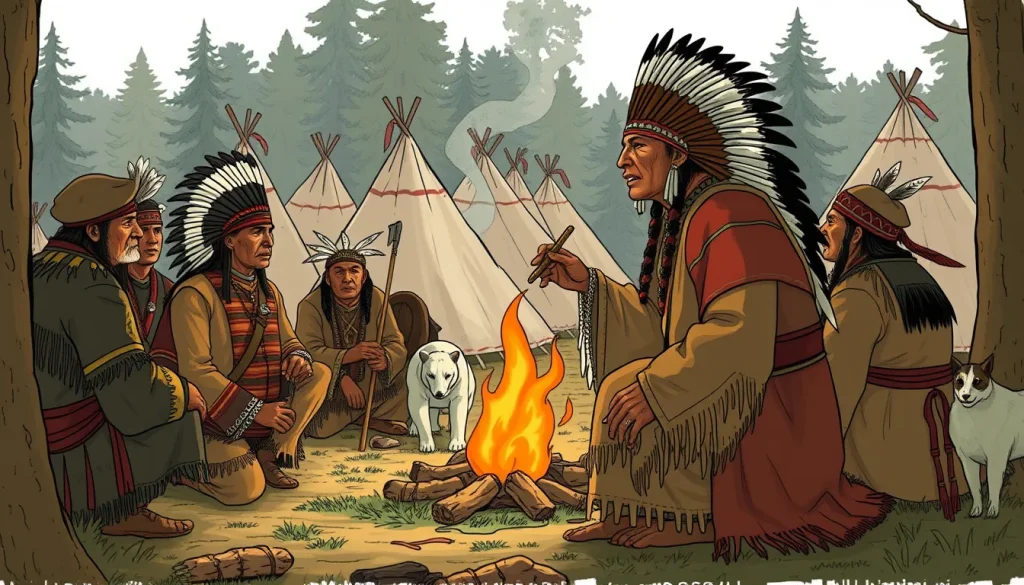
Tenskwatawa began preaching in 1805, gathering followers from many tribes. In 1808, the brothers established a settlement known as Prophetstown at the confluence of the Wabash and Tippecanoe Rivers in present-day Indiana. The location was strategic, offering access to numerous waterways and near the British post at Fort Malden in Upper Canada. The brothers attracted hundreds of warriors and families from the Shawnee, Delaware, Potawatomi, Kickapoo, Winnebago, Ottawa, Chippewa, and other nations.
Tecumseh became the political and military leader of the movement. He traveled extensively from 1809 to 1811, visiting tribes in Ohio, Indiana, Illinois, the Great Lakes region, and even the southern Creeks and Cherokees. His message was that Indigenous land was held in common by all indigenous peoples; no single tribe could sell it without the consent of all. He rejected the legitimacy of treaties signed by individual chiefs. In August 1810, he met with Governor Harrison at Vincennes, delivering a famous speech that refused to recognize American land purchases and threatened resistance to further intrusions.
While Tecumseh was away recruiting among southern tribes in late 1811, Harrison led a military expedition to intimidate or destroy Prophetstown. On November 7, 1811, troops under Harrison attacked an encampment of the Prophet’s followers near the Tippecanoe River. The Battle of Tippecanoe ended inconclusively, but the Americans burned Prophetstown and destroyed the movement’s central base. Tecumseh returned to find his village in ruins, and he decided to ally with the British, who were already supplying Indigenous allies from Canada.
When the War of 1812 began in June 1812, Tecumseh led about 350 warriors to Fort Malden. He played a crucial role in the capture of Fort Detroit in August 1812, where his demonstration of numerical strength contributed to the American surrender. For the next year, Tecumseh and his confederacy fought alongside British forces in the Niagara and Detroit frontiers, until Tecumseh was killed at the Battle of the Thames on October 5, 1813. His death effectively ended the confederacy.
Why It Matters
Tecumseh’s Confederacy was the most formidable pan-Indian movement since Pontiac’s Rebellion. It represented a last major effort to resist U.S. expansion across the Appalachians before the War of 1812. The confederacy’s existence and its ties to the British heightened tensions between the United States and Great Britain, contributing to the American declaration of war. In the war itself, Tecumseh’s warriors were essential to early British victories, but his death and the failure to create a permanent Indigenous state led to widespread land cessions and the eventual removal of Indigenous peoples from the Old Northwest. Historical memory of Tecumseh varies: to Amerian history he is a noble hero, to Canadian history a defender, and to Indigenous communities a symbol of resistance and sovereignty.
Definition
Tecumseh’s Confederacy was a loose military and political alliance of Native American nations, organized by Shawnee chief Tecumseh and his brother Tenskwatawa, aimed at resisting U.S. expansion and preserving Indigenous lands and autonomy. It operated from roughly 1805 until Tecumseh’s death in 1813.
Background
The confederacy emerged from the wreckage of earlier pan-Indian attempts and the spiritual crisis caused by rapid land loss and cultural disruption. The Treaty of Greenville (1795) demonstrated the need for unity, although that earlier confederation had failed due to tribal divisions and superior American military force. Tenskwatawa’s religious revival provided a unifying spiritual dimension, while Tecumseh turned the revival into a secular political movement.
How It Worked
Tecumseh traveled ceaselessly, holding councils and persuading warriors and chiefs to join. He argued that land belonged to all Indian peoples, and thus unilateral land cessions were void. Prophetstown served as a central meeting place and symbol. The confederacy had no formal structure; it relied on personal leadership, oratory, and the spiritual authority of Tenskwatawa. Tecumseh’s military experience and persuasive skills were key to its success. He also sought British support, viewing them as a counterweight to American power.
Competing Viewpoints
American authorities, especially William Henry Harrison, saw the confederacy as a British-instigated plot meant to block legitimate American settlement. Harrison viewed the Prophet as a fraud and Tecumseh as a dupe of British agents. British officials in Canada were initially wary but gradually saw the value of allying with Tecumseh to protect Upper Canada. Among Indigenous peoples there were divisions: some tribes, like the Delaware and Miami, were reluctant or hostile, fearing Tecumseh’s influence or their own local interests. Historians today debate whether Tecumseh was the primary architect or whether his brother’s religious revival was more important. Some see Tecumseh as a visionary pan-Indian nationalist, while others emphasize the movement’s spiritual roots.
Role in the War of 1812
When the war began, Tecumseh allied with Britain, seeing it as the only hope to preserve Indigenous lands. His warriors joined British forces under Major General Isaac Brock and later General Henry Procter. Tecumseh’s role in the surrender of Detroit on August 16, 1812 was critical, as his apparent numerical superiority persuaded American General William Hull to surrender without a fight. Tecumseh continued to lead warriors in numerous skirmishes, including the siege of Fort Meigs in 1813. His relationship with British commanders soured as he sought to protect Indigenous interests amidst British retreats. His death at the Battle of the Thames, during a decisive American victory, marked the collapse of the confederacy and the end of organized armed resistance in the Old Northwest.
Consequences and Historical Interpretation
The confederacy’s failure allowed the United States to assert control over the lower Great Lakes after the war. The 1814 Treaty of Ghent made provisions for the restoration of Indigenous lands, but these were ignored, and the Old Northwest was rapidly opened for settlement. Subsequent removal policies in the 1830s completed the displacement of many nations. Historians have re-assessed Tecumseh’s legacy, portraying him as a sophisticated political and military leader who articulated a vision of Indigenous unity. The confederacy is now seen as a precursor to later resistance movements, and its memory is honored in both Canadian and American traditions.
Primary Sources
Key primary sources include Tecumseh’s speeches recorded at Vincennes in 1810 and 1811, which were reported by Governor Harrison and his interpreter; the letters and reports of British officers like Isaac Brock and Henry Procter; and the journals of American participants in the Battle of Tippecanoe. Tenskwatawa’s teachings are preserved in accounts by contemporary observers such as the Moravian missionary John Heckewelder. These sources are limited by the biases of their authors—American officials often demonized the Prophet, while British officers tended to praise Tecumseh’s martial abilities. Direct Indigenous viewpoints are largely filtered through these official reports, making it difficult to reconstruct the confederacy’s internal deliberations.
Further Reading
- Edmunds, R. David. Tecumseh and the Quest for Indian Leadership. 2nd ed., Pearson, 2006.
- Sugden, John. Tecumseh: A Life. Henry Holt, 1997.
- Coates, Kenneth. The Forgotten Allies: The Oneida and the War of 1812. (Note: for comparative context.)
- Berton, Pierre. The Invasion of Canada, 1812–1813. McClelland & Stewart, 1980.
References
- Marsh, James H., and Tabitha de Bruin. “Tecumseh.” The Canadian Encyclopedia, Historica Canada. https://thecanadianencyclopedia.ca/en/article/tecumseh.
- Barce, Elmore. “Tecumseh’s Confederacy.” Indiana Magazine of History, vol. 14, no. 1, 1918, pp. 68–80. https://scholarworks.iu.edu/journals/index.php/imh/article/download/6021/5763/.
- Dictionary of Canadian Biography, s.v. “TECUMSEH (Tech-kum-thai).” https://www.biographi.ca/en/bio/tecumseh_5F.html.
- Blakemore, Erin. “How Tecumseh fought for Native lands—and became a folk hero.” National Geographic, 4 Nov. 2022. https://www.nationalgeographic.com/history/article/how-tecumseh-fought-for-native-lands-and-became-a-folk-hero.
- The Canadian Encyclopedia profile of Tecumseh (PDF reproduction). https://cmod.ca/wp-content/uploads/2017/03/tecumseh.pdf.
FAQ
What was Tecumseh’s Confederacy?
It was a pan-Indigenous alliance led by Tecumseh and Tenskwatawa to resist American expansion and land cessions, active from about 1805 until Tecumseh’s death in 1813.
Why did Tecumseh ally with the British?
Tecumseh saw Britain as a necessary ally against American expansion. His defeat at Tippecanoe and British offers of support convinced him that alliance with Britain was the best chance to preserve Indigenous lands.
What happened to the confederacy after Tecumseh’s death?
The confederacy collapsed after Tecumseh was killed at the Battle of the Thames on October 5, 1813. The British withdrew support, and the United States gained control of the Old Northwest, leading to further land cessions and removal.
Leave a Reply