
Short Answer
The British blockade of the American coast during the War of 1812 was a progressive Royal Navy campaign to close the United States’ major ports and cripple its maritime commerce. Beginning informally in 1812 and expanding through 1814, it eventually covered much of the Atlantic seaboard from Chesapeake Bay to New England, as well as parts of the Gulf Coast. For American coastal cities, the blockade meant idled wharves, disrupted foreign and coastal trade, falling customs revenue, higher prices, and greater exposure to British raids. It became one of the war’s most consequential strategic pressures, even though its severity varied by region and remains a subject of historical debate.
Historical Context
The War of 1812 grew out of unresolved Anglo-American disputes over neutral trade, impressment of sailors, and British maritime policies during the Napoleonic Wars. The United States declared war on Britain in June 1812, but it did so with a small navy and a federal government heavily dependent on customs duties collected at Atlantic ports. The Atlantic seaboard was the country’s most densely populated and commercially developed region; its merchants, farmers, and bankers supplied much of the tax revenue and credit that the Madison administration needed to finance the war. British strategy, by contrast, rested on the Royal Navy’s global supremacy. Although Britain was still preoccupied with France, its North American squadron was based at Halifax, with additional support from Bermuda, and could be reinforced as European commitments allowed. From the outset, British planners saw blockade as a form of economic warfare that could pressure the United States without requiring a large invasion. American regional politics also shaped the blockade: New England was initially exempted because many of its Federalist merchants opposed the war and continued trading with British North America, while the British hoped to deepen political divisions within the United States.
What Happened
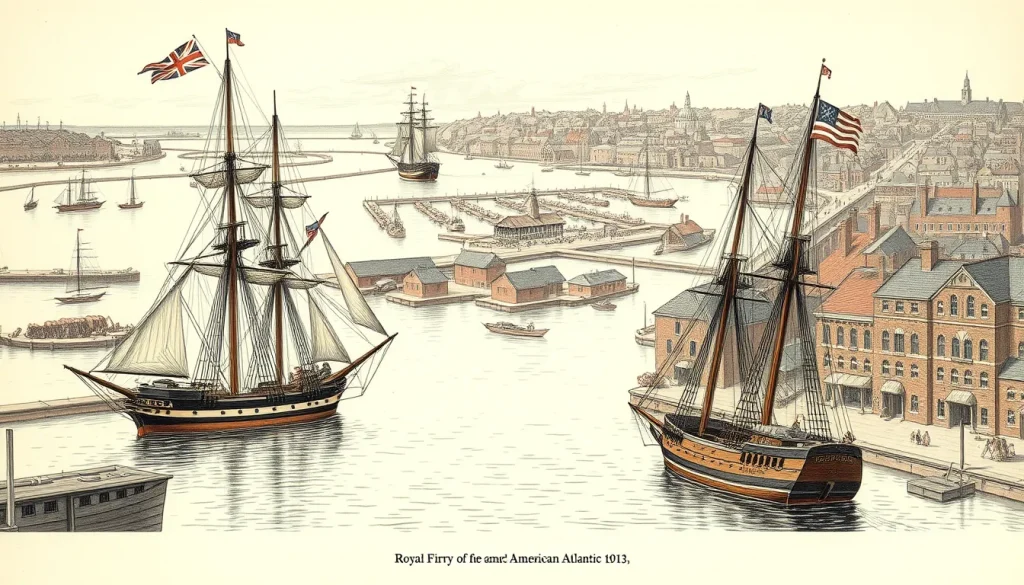
The blockade expanded in stages. In late 1812, the British established an informal blockade of South Carolina and Georgia, and in December Admiral Sir John Borlase Warren declared Chesapeake and Delaware Bays under blockade. About twenty Royal Navy ships were on station that year. In February and March 1813, the blockade was extended to the Delaware and Chesapeake approaches and then to Savannah, Port Royal, Charleston, and New York. By mid-November 1813, it covered the entire coast south of Narragansett Bay. In 1814, Vice Admiral Alexander Cochrane replaced Warren, and after Napoleon’s abdication in Europe freed British resources, New England was finally included in May 1814. By the end of the conflict, roughly 135 British warships were engaged in the blockade. The effects on coastal cities were severe. New York, Philadelphia, Baltimore, Norfolk, Charleston, Savannah, and Boston saw foreign shipping decline, wharves stand idle, and waterfront employment shrink. Coastal shipping, which moved goods between American ports, was also disrupted, forcing merchants to rely on slower and more expensive overland routes or on smuggling. Commonly cited figures show American exports falling from about $61 million in 1811 to about $7 million in 1814, while customs revenue fell by roughly half or more. Another measure puts total exports and imports at $114 million in 1811 and $20 million in 1814, with customs receipts dropping from $13 million to $6 million. The blockade also exposed port communities to British raids, especially in Chesapeake Bay, where campaigns in 1813 and 1814 included the occupation of Washington in August 1814 and an unsuccessful attack on Baltimore that September. In the Gulf Coast, British operations continued into 1815. In the Chesapeake, the British offer of freedom to enslaved people who reached their lines led thousands to escape, a social consequence that fell heavily on coastal and tidewater communities.
Why It Matters
The blockade mattered immediately because it attacked the financial foundation of the American war effort. Customs duties were the federal government’s main source of income, and when trade collapsed, the Treasury struggled to pay for soldiers, militia, ships, and supplies. Secretary of the Treasury Albert Gallatin and later Alexander Dallas faced repeated shortfalls, and the government relied increasingly on loans and paper money. The economic distress deepened regional divisions, especially in New England, where opposition to the war contributed to the Hartford Convention in 1814–1815. In the longer term, the blockade demonstrated the vulnerability of a maritime trading republic to British sea power. It encouraged postwar interest in domestic manufacturing, internal improvements, and economic independence, even as it also reinforced British naval supremacy. Historical memory has often celebrated American frigate victories and privateers while overlooking the blockade, but many later historians have argued that the blockade was the Royal Navy’s most important contribution to the war. Henry Adams wrote that "No ordinary operations of war" could affect the United States so severely as this "inexorable blockade." Naval historians such as Alfred Thayer Mahan, and later Brian Arthur and Andrew Lambert, have treated blockade and economic warfare as central. Other scholars stress that American privateers continued to damage British commerce, that smuggling and regional exemptions limited the blockade’s reach, and that the war ended with no territorial change at Ghent. The debate is less about whether the blockade hurt than about how decisively it shaped the outcome.
Definition
The British blockade was a naval operation designed to prevent ships from entering or leaving specified American ports. It was not a single battle or a permanent wall at sea, but a series of Admiralty orders, proclamations, and cruising stations enforced by Royal Navy warships. Under contemporary maritime law, a blockade was supposed to be effective enough to warn neutral shipping away; in practice, enforcement varied by geography, weather, and the number of ships available. The blockade aimed at both military and economic targets: it sought to confine the U.S. Navy, interrupt enemy commerce, and cut off the customs revenue that financed the American war effort.
Background
Before the war, the United States had become one of the world’s leading neutral carriers, and its Atlantic ports depended on trade with Britain, Europe, the Caribbean, and other American ports. Customs houses in cities such as New York, Boston, Philadelphia, Baltimore, and Charleston generated most federal revenue. Britain, meanwhile, had spent two decades using blockade and convoy as instruments of economic warfare against France. When war began, the Royal Navy had few ships in North American waters, but it possessed the world’s largest fleet and could expand its presence. The initial British decision to spare New England was both strategic and political: it allowed British forces and provinces to obtain American grain and livestock while encouraging Federalist opposition to the war. That exemption became harder to justify as the conflict continued and as neutrals used New England ports to sustain trade.
How It Worked
Royal Navy squadrons operated from Halifax and Bermuda, dispatching frigates, sloops, brigs, and smaller vessels to blockade stations off major ports and waterways. Blockading ships intercepted merchantmen, seized cargoes as prize, and discouraged neutral vessels from sailing. The system was never airtight. Fast privateers and blockade runners sometimes slipped through, and smuggling flourished along coastlines and across the Canadian border. But the cumulative effect on coastal cities was heavy. Merchants could not predict when ships would sail or arrive, insurance rates rose, and many vessels remained in port. The blockade also made it difficult for the U.S. Navy to sortie in force, leaving American coastal defense largely to gunboats, forts, and local militia. British raids and landing parties further disrupted port communities, especially in the Chesapeake and Gulf regions.
Competing Viewpoints
Historians disagree about how decisive the blockade was. Brian Arthur and Andrew Lambert argue that Britain’s blockades and convoy system were the war’s central naval strategy and that they crippled the American economy, confined the U.S. Navy, and gave Britain the strategic upper hand. Donald R. Hickey’s review of Arthur’s work notes that the blockade has often been neglected because it lacks the drama of single-ship duels, yet it was the preeminent use of British naval power. Other historians emphasize American resilience: privateers captured hundreds of British merchant vessels, coastal communities adapted through smuggling and overland trade, and the New England exemption limited the blockade’s early impact. Some scholars also question whether the blockade alone forced the peace, since the Treaty of Ghent restored the status quo and British land operations achieved mixed results. The fairest conclusion is that the blockade was a severe and expanding economic pressure, but its effects were uneven and interacted with military, political, and diplomatic developments.
Role in the War of 1812
The blockade shaped the war in several ways. It confined much of the U.S. Navy to port after 1813, preventing American squadrons from challenging British control of the Atlantic. It undermined federal finances, making it harder to recruit, supply, and pay for armies and militia. It supported British amphibious raids along the Chesapeake and Gulf coasts, including the Washington campaign of 1814. It also intensified sectional tensions, as New England’s initial exemption and continued cross-border trade angered Americans in the Mid-Atlantic and South. At the same time, the blockade did not achieve territorial conquest or force an American surrender. Its main role was to apply steady economic and military pressure that made the war increasingly costly for the United States.
Consequences and Historical Interpretation
In the short run, the blockade devastated American overseas and coastal commerce, reduced customs revenue, threw sailors and dockworkers out of work, raised prices for imported goods, and encouraged smuggling and domestic manufacturing. It contributed to the financial crisis that plagued the Madison administration and to the political discontent that culminated in the Hartford Convention. In the Chesapeake, it also created opportunities for enslaved people to escape to British lines. In the long run, the blockade reinforced awareness of American dependence on foreign trade and British sea power. After the war, trade revived, but many Americans drew lessons about the need for domestic industry and internal improvements. Historians continue to debate whether the blockade was the war’s decisive naval instrument or one pressure among many. Its importance is now widely acknowledged, even if its exact weight in the peace settlement remains contested.
Primary Sources
Several categories of contemporary sources document the blockade. British Admiralty orders and blockade proclamations issued by Admiral Sir John Borlase Warren and Vice Admiral Alexander Cochrane define the official scope and timing of the blockade; they are held in British archival collections and show policy from the Royal Navy’s perspective. American Treasury reports by Albert Gallatin and Alexander Dallas, along with customs-house records, provide evidence of falling revenue and trade. Port newspapers such as Niles’ Weekly Register and local gazettes reprint shipping notices, price currents, and reports of unemployment or scarcity, though they reflect editorial viewpoints and incomplete information. Merchant petitions, state governors’ correspondence, and congressional records show how coastal communities experienced the blockade and appealed for relief. British naval logs, officers’ letters, and memoirs describe cruising, prize-taking, and the boredom of blockade duty, but they usually say less about the economic effects ashore. No verbatim transcript is reproduced here; researchers should consult the relevant archives and published documentary editions for exact wording.
Further Reading
- Brian Arthur, How Britain Won the War of 1812: The Royal Navy’s Blockades of the United States, 1812–1815 (Boydell Press, 2011).
- Donald R. Hickey, The War of 1812: A Forgotten Conflict (University of Illinois Press, revised edition).
- Andrew Lambert, The Challenge: Britain Against America in the Naval War of 1812 (Faber and Faber, 2012).
- Alfred Thayer Mahan, Sea Power in Its Relations to the War of 1812 (1905).
- Faye M. Kert, Prize and Prejudice: Privateering and Naval Prize in Atlantic Canada in the War of 1812 (International Maritime Economic History Association, 1997).
- William S. Dudley, ed., The Naval War of 1812: A Documentary History (Naval Historical Center, multiple volumes).
- John R. Grodzinski, "Atlantic Campaign of the War of 1812," The Canadian Encyclopedia.
References
- Donald R. Hickey, review of Brian Arthur, How Britain Won the War of 1812, Napoleon Series. https://www.napoleon-series.org/military-info/Warof1812/2012/Issue19/BritBlockade.pdf
- Faye Margaret Kert, "‘True, Publick and Notorious’: The Privateering War of 1812," London Journal of Canadian Studies. https://doi.org/10.14324/111.444.ljcs.2013v28.005
- Brian Arthur, preface to How Britain Won the War of 1812, Boydell and Brewer. https://doi.org/10.1515/9781782040019-007
- "The British Blockade of the American Coast," The War of 1812. https://thewarof1812.org/battles/the-british-blockade-of-the-american-coast/
- John R. Grodzinski, "Atlantic Campaign of the War of 1812," The Canadian Encyclopedia. https://thecanadianencyclopedia.ca/en/article/atlantic-campaign-of-the-war-of-1812
FAQ
When did the British blockade begin?
It began informally in 1812, with orders for Chesapeake and Delaware Bays in late 1812 and wider expansion in 1813. New England was not fully included until May 1814.
How did the blockade affect American coastal cities?
It reduced shipping, closed markets, collapsed customs revenue, caused unemployment and shortages, and exposed ports to raids. Some cities relied on smuggling, overland trade, and privateering.
Was the blockade the decisive factor in the War of 1812?
Many naval and economic historians argue it was the Royal Navy’s most important contribution, but others stress American privateering, regional exemptions, and the war’s limited territorial outcome.
Leave a Reply